Two boys had met to bid “goodbye,” One was my friend, the other 1; He was going home—going home to die.
I know for long he talked to me, But I think I only heard the sea— It moaned and moaned incessantly,
I dared not look at him—I saw The wind play with a wisp of straw: ‘Twas early Spring and cold and raw.
But when the station came in sight Through parted clouds the sun shone bright. Flooding the world with warmth and light.
A moment later in the train I glanced at, with a stab of pain, The face I never saw again.
The train went out: dark grew the sky And all at once tempestuously A storm of hail swept far and night.
But darkness could not blot or kill That sunlit face—it never will: By night and day I see it still.
Edwin Emmanuel Bradford’s The Parting first appeared in The Romance of Youth and Other Poems in 1910, with later editions appearing around 1920. It is tempting to read it as a wartime farewell between two young men, particularly because of its language of death and separation.
But the date matters.
This is 1910.
The First World War is still four years away.
So who, exactly, are these two boys?
Bradford gives us almost nothing. Just the meeting. The silence. The cold. The train. And that extraordinary final image of the boy’s face surviving everything — even darkness.
The poem belongs to the strange, fascinating world of early twentieth-century Uranian literature: writing that openly explored romantic and homoerotic relationships between men and adolescent boys.
Bradford himself lived an extraordinary double life. He was an Anglican vicar, respectable enough to be reviewed seriously and, remarkably, often favourably. At the same time, he was publishing poetry about male beauty, youth and desire.
That tension is part of what makes The Parting so haunting.
The Bather in the Blue Grotto at Capri is a homoerotic poem by the English clergyman and Uranian poet Edwin Emmanuel Bradford, first published in The New Chivalry and Other Poems in 1918.
The poem takes us into the famous Blue Grotto, where Bradford watches a young bather preparing to dive. What follows is an unabashed celebration of male youth and physical beauty. The body is described almost like a painting: the curly brown hair, the dark eyes, the sun-browned skin, the small details that become, in Bradford’s gaze, something close to an ideal.
Prepared to dive, he flings aside his vest, And waits the signal. Brown’s his curly hair, Deep brown his eyes, and now we see it bare, Though face and hands are browner than the rest, Save two brown nipples on the boyish breast, His sun-burnt body’s nut brown everywhere.
Bradford himself is an intriguing figure. Born in 1860, he was an English clergyman, theologian, poet and novelist who wrote extensively about male beauty, desire and romantic attachment between men and boys. He belonged to the Uranian tradition—a largely underground literary culture in which male-male love could be expressed through poetry and fiction at a time when homosexuality was both socially condemned and, in Britain, criminalised.
And yet Bradford’s work was not entirely hidden away. Between 1908 and 1930, Kegan Paul published twelve volumes of his writing. His poetry also received attention from the mainstream press, sometimes with surprisingly favourable reviews.
There is something rather extraordinary about finding this openly homoerotic vision of a young male body in a respectable English poetry collection of 1918. Bradford looks at the bather in the blue light of Capri and simply allows himself to admire him.
A century later, the poem feels both of its time and strangely direct: an old-fashioned language wrapped around a very uncomplicated act of looking.
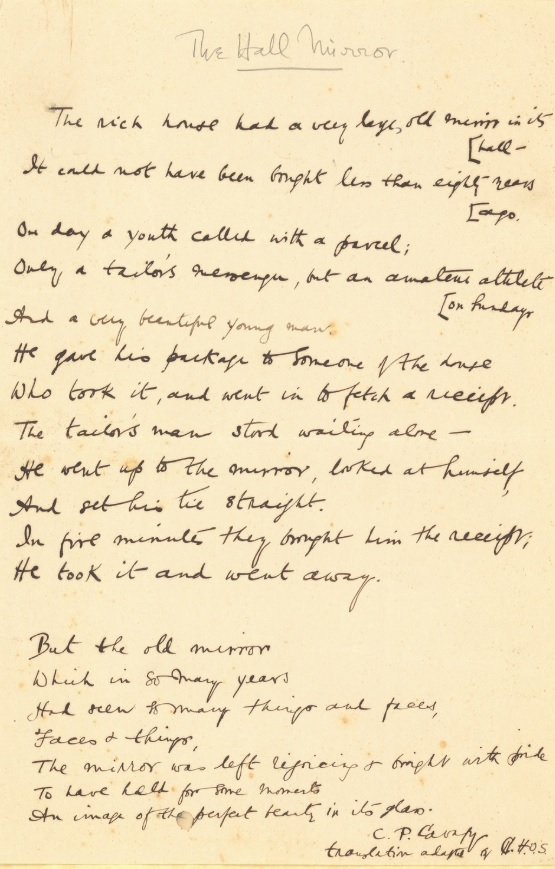
The rich house had a very large, old mirror in its hall. It could have been bought not less than eighty years ago. One day a youth called with a parcel; Only a tailor’s messenger, but an amateur athlete on Sundays And a very beautiful young man. He gave his package to someone of the house, Who took it and went in to fetch a receipt. The tailor’s man stood waiting alone – He walked up to the mirror, looked at himself and set his tie straight. In five minutes they brought him the receipt; He took it and went away.
But the old mirror Which in so many years Had seen so many thousands of things and faces, The mirror was left rejoicing And proud to have had hold for some moments An image of the perfect beauty in its glass.
Translated from Greek by C.H.O. Scaife in collaboration with Constantine P. Cavafy. Originally published in The Spectator on September 27, 1935.
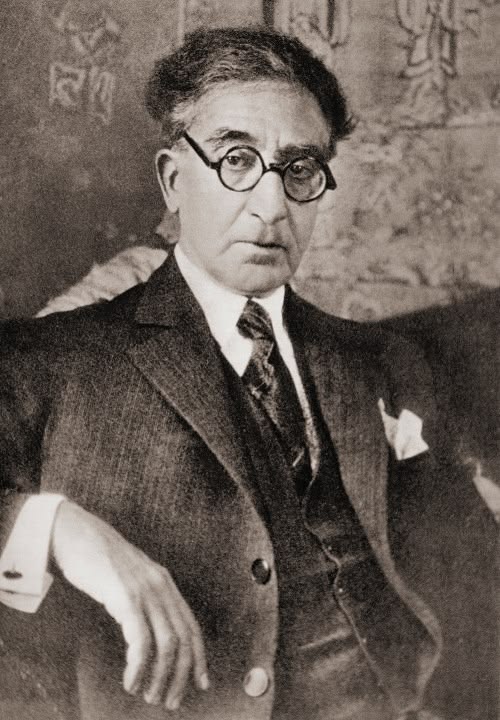
Constantine P. Cavafy (1863–1933) was an extraordinarily influential Egyptian-Greek poet widely considered the most distinguished voice of modern Greek literature and a towering figure of 20th-century Western poetry. Born and based mostly in the cosmopolitan hub of Alexandria, Egypt, his work uniquely blended historical realism, profound skepticism, and deeply personal, intimate expressions of homosexual desire. He spent over thirty years working as a quiet clerk in the Irrigation Service of the Egyptian Ministry of Public Works while writing poetry in his spare hours
The speaker looks at beautiful young people in the present and wonders where they were when he was a child. Every generation believes beauty belongs to someone else. Every generation eventually discovers that it was temporary.
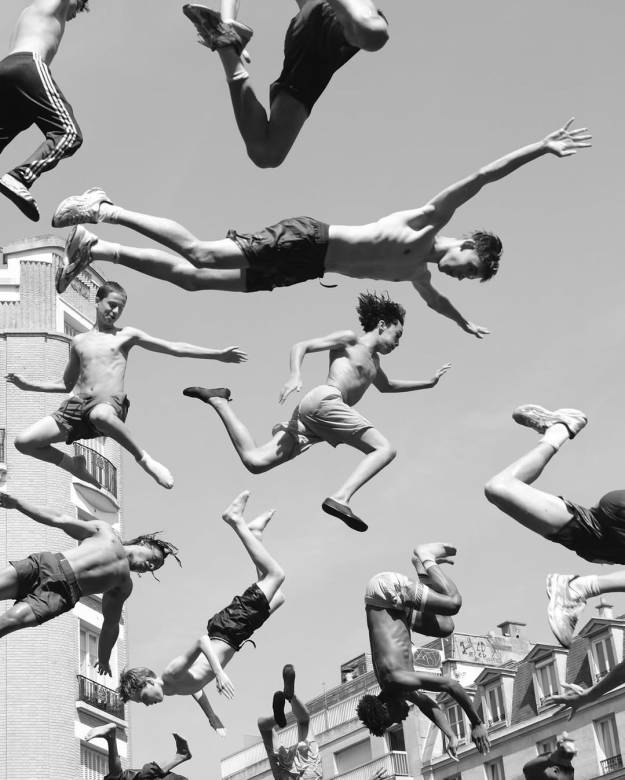
Canal Saint-Martin. Photo by Andrii Bulavka (2026)
Where were they when I was a kid, the gorgeous young I see?
Did they drop from the moon on each sand dune
or arrive at five just for me?
Where were they with their hair and their teeth and their shoulders and stomachs, too;
did they fall out of sight on each summer’s night, just to tempt me and bend me with fear?
I see them now crowd the streets and the beach, the subways and fashion stores,
they seem so cool, unruffled and cruel and make light fools of us all.
But as you expect, soon, quite direct, they’ll become just as you and I:
then the curious types from their shadows will gripe, just what did become of us all?
Perry Brass The poem originally appeared in Sex-Charge (1991).
Perry Brass is an acclaimed American author, journalist, poet, and pioneering LGBTQ+ rights activist. Born in Savannah, Georgia, in 1947, he became a core figure in the post-Stonewall gay liberation movement in New York City.
Mark Morrisroe, Self-Portrait with Broken Finger, Christmas 1984
I would have fallen in love with him. No doubt about that. And he would have ruined my life.
But that never happened.
A bullet rolled out of his ashes. Shot in the back at seventeen. That was all that remained.
Myles Vale
Mark Morrisroe (1959-1989) was an influential American photographer, performance artist, and filmmaker who served as a central figure in the Boston punk scene of the 1970s and the New York art boom of the 1980s. When he was 17 years old, he was shot in the back, leaving him with a bullet lodged next to his spine for the rest of his life. He died of AIDS complications. His last words to his friends were “take my photo”. On the second click of the shutter he was gone.
Fabian Strachan Woodley (1888–1957) was a Bristol-born teacher, journalist, and poet whose wartime writing evolved from youthful patriotism to profound melancholy after a devastating personal loss.
In June 1916, his lover, twenty-year-old Lieutenant Myles O’Donovan of the Royal Munster Fusiliers, a native of County Cork, was killed by shellfire. In response, Woodley wrote To Lieut O’D (1916), a deeply personal elegy in his memory.
The poem marked a turning point in Woodley’s work. Gone were the optimistic patriotic verses of his early war years, replaced by a poignant meditation on grief and the waste of young life. He evokes O’Donovan’s vitality and laughter before the brutal interruption of a screaming shell brings his life to an abrupt end in the trenches.
To Lieut O’D was later included in Woodley’s 1921 collection, A Crown of Friendship.
To Lieut. O’D (1916)
See him standing at the corner, Cynosure of friendly eyes, Challenging their kindly sallies, Combatting with swift replies.
Eyes alight with Life and Laughter, Brown eyes full of mirth and fun; Fresh face tanned by months of warfare, Lithe limbs browned by summer sun.
Suddenly a shell comes screaming, Through the blue vault overheard, Strikes – His laughing lips are silent, All his splendid youth lies dead.
Death! whose arrow countless thousands And unerring aim have proved, Could you not have aimed untruly, Spared for me the boy I loved?
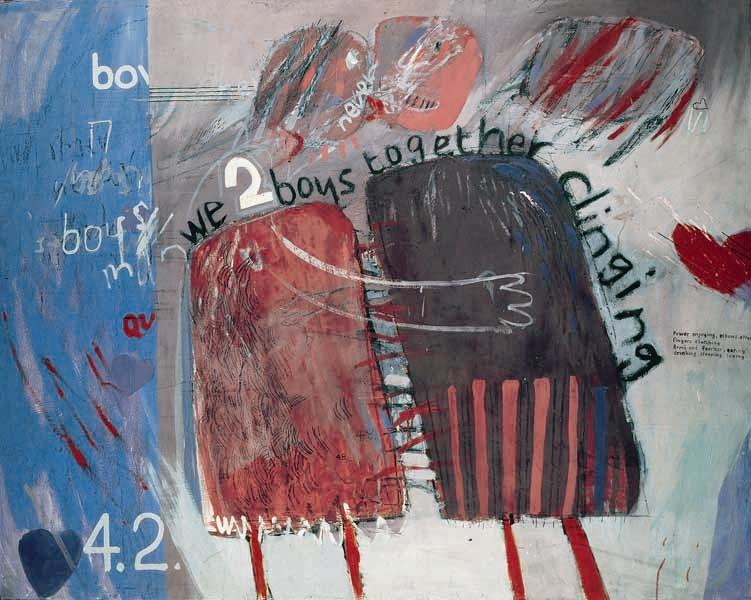
We Two Boys Together Clinging. David Hockney (1961). Its name derives from a poem by Walt Whitman and two lines from it are scribbled to the right. It also references a newspaper clipping detailing a climbing accident – ‘Two Boys Cling to Cliff All Night’ which Hockney interpreted as an illusion to his idol, Cliff Richard. (Arts Council Collection)
On the life of David Hockney… A strange thing happened. I mentioned to a friend that I wanted to watch A Bigger Splash — the 1974 documentary about the artist David Hockney, in which his lover of three or four years, Peter Schlesinger, leaves him during filming.
I still hadn’t watched it, and the following day, it was announced that Hockney had died at the age of 88.
The news reminded me of a few years ago when I was given a Hockney print, Two Boys Clinging Together. I made a convincing show of being overwhelmed by it, but the truth was rather different. The print never made it onto the wall; to my eye, it looked like something I might have painted when I was four. His work never entirely won me over.
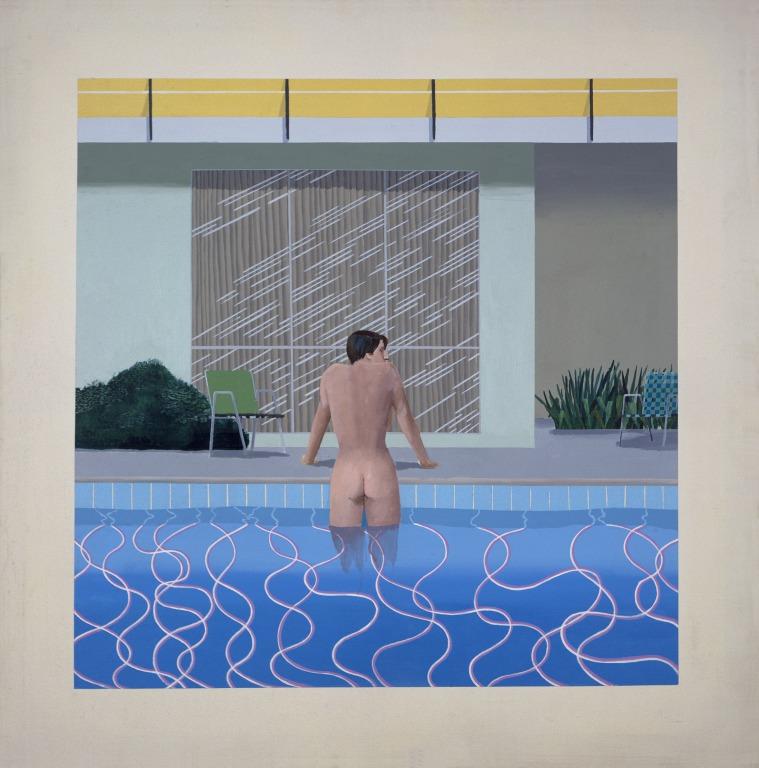
That said, I have always liked his California pool paintings from the 1960s and 1970s, although nobody has ever bought me one. My favourite is Peter Getting Out of Nick’s Pool (1966), which depicted the 19-year-old Schlesinger climbing from a swimming pool at the Hollywood apartment block where art dealer and gallery owner, Nick Wilder, lived.
I spent a few hours reading about Hockney — a man who, if I am honest, irritated me immensely. His dour Yorkshire monotone seemed at odds with the loud bow ties, red braces and trademark spectacles. He occupied the same corner of my imagination as the writer Alan Bennett; the two could almost have been twins. Yet it is impossible not to admire his courage. He was painting gay love at a time when homosexuality was still effectively illegal in Britain.
America held a particular attraction for him:
“I must admit, I’d begun to be interested in America from a sexual point of view; I’d seen American Physique Pictorial magazines when I first came to London. And they were full of what I thought were very beautiful bodies. I painted Domestic Scene from a photograph in Physique Pictorial, where there’s a boy with a little apron tied around his waist, scrubbing the back of another boy in a rather dingy American room; I thought, ‘That’s what a domestic scene must be like there.’”
But my favourite Hockney quotation comes from David Hockney in Paris, a BBC documentary from 1975:
“Men in white socks are very sexy. White tee-shirts are quite sexy, but not so sexy as socks.”
Peter Getting Out of Nick’s Pool. David Hockney (1966).
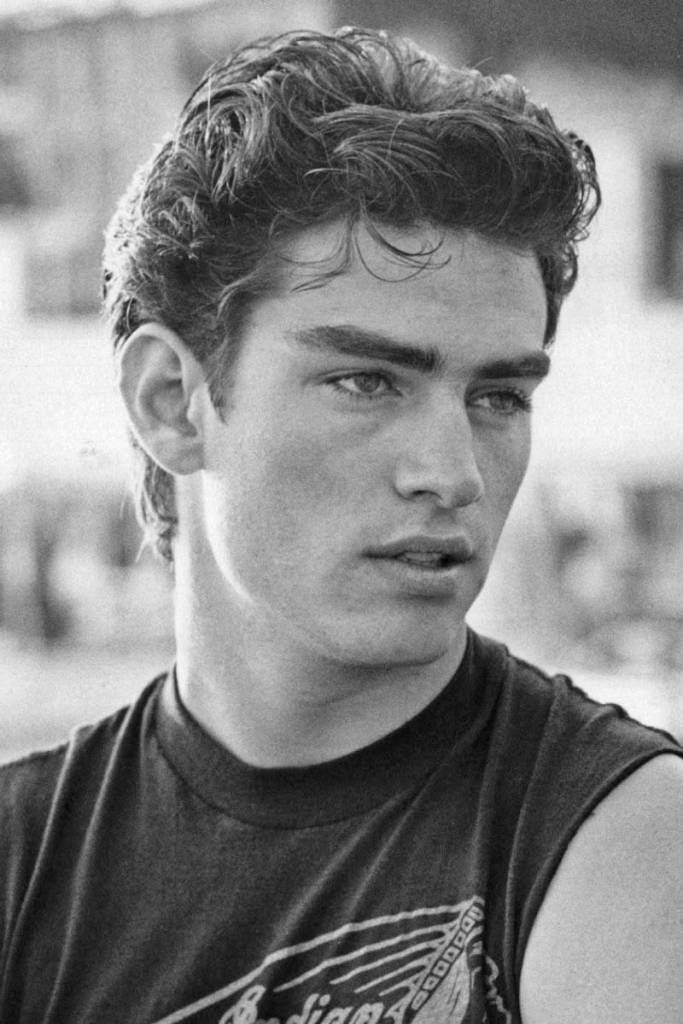
Rodney Harvey (1967–1998) was an American actor, dancer, and model celebrated for his appearances in critically acclaimed 1990s films like My Own Private Idaho.
On good looking guys who died young… It is an unhealthy fascination. I have a curious interest in those young guys who left us too soon. I have a list of the unfortunates and will get to them in future posts. But the list is tragically long. There’s something mythic about it. At the height of beauty, talent, or promise, they stop aging while we keep going. They are fixed in our memory and will never change; permanently charged with youth and possibility. Although, there are too many stories where death came about due to self destruction – the doomed poet, the tragic actor and the brilliant addict. I mourn them all and kid myself that if I’d been around them their fate might have been different.
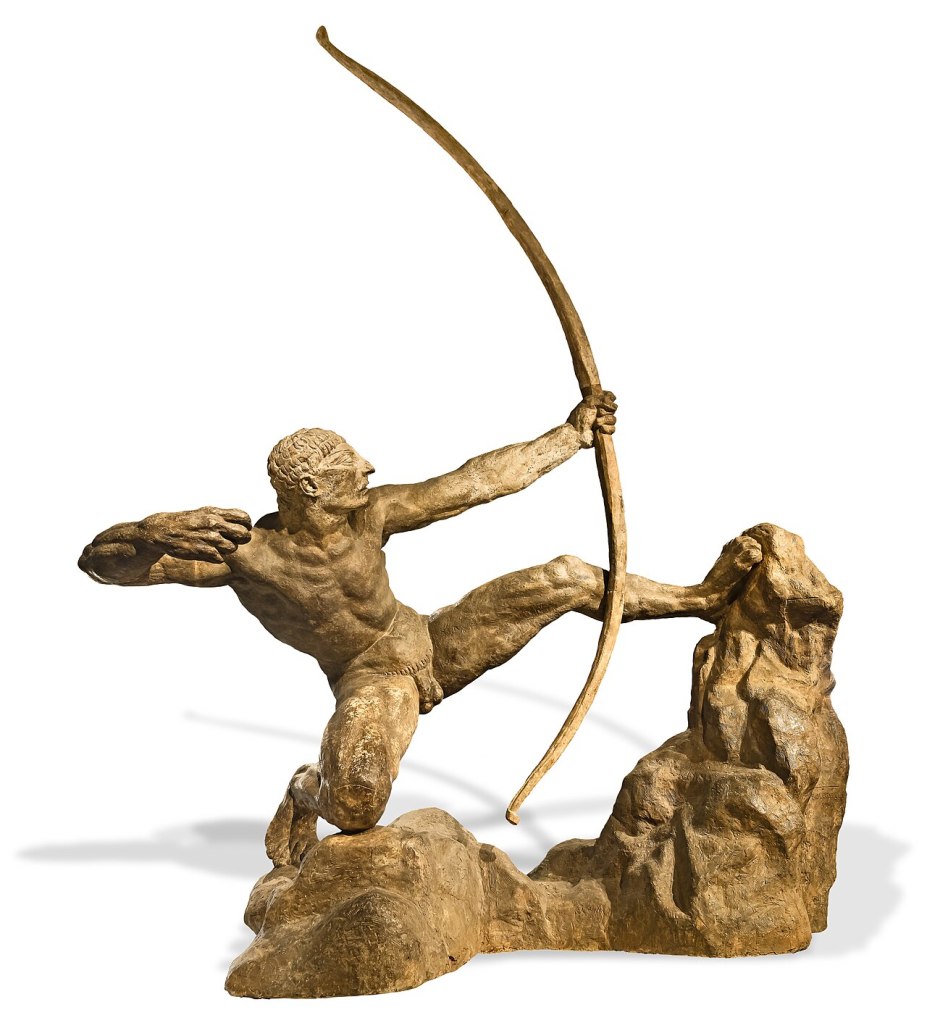
Héraklès Archer – Hercules the Archer . Antoine Bourdelle (1909) .
On a sculptor and a real-life model… I’m not entirely sure I like the sculpture, but I’m fascinated by how it was created. Hercules the Archer (1909), by the French sculptor Antoine Bourdelle (1861-1929), now exists in several versions, although it was originally commissioned by the financier and philanthropist Gabriel Thomas as a unique work.
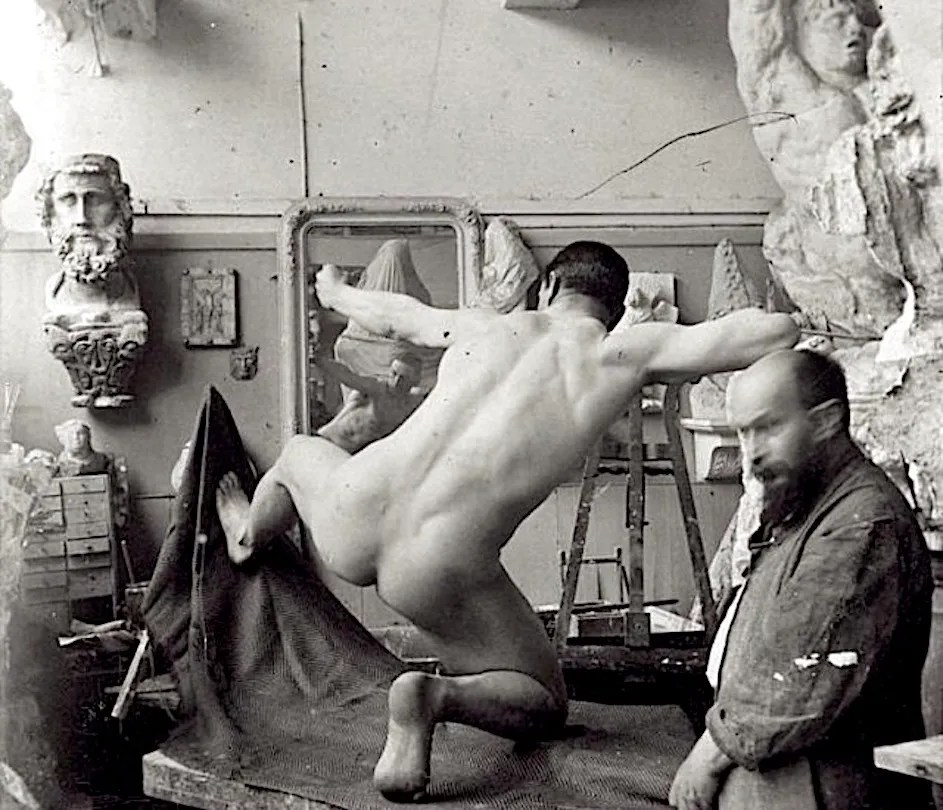
Bourdelle modelled the sculpture in clay during the summer of 1909, using his friend Paul Gustave André Doyen-Parigot (1854–1916), a captain in the French Army, as his model. An accomplished sportsman, Doyen-Parigot possessed the physical strength and athleticism required for the pose. The dramatic extension of the body and the intense muscular tension of archery allowed Bourdelle to emphasise the model’s powerful physique.
At Doyen-Parigot’s request for anonymity, however, Bourdelle altered the head, distancing the finished figure from a direct portrait and transforming it into the heroic image of Hercules.
Paul Gustave André Doyen-Parigot modelling for Antoine Bourdelle.
On having childhood regrets… What if I had understood what was happening? What if I had been brave enough to acknowledge it? What might have become of us? Would he still have been my best friend?
Why was I thinking about Darren this week? Perhaps because some questions never quite leave us. When he later discovered that I was gay, he drifted out of my life. We have not spoken since.
On finding a poem about Manly Love… Douglas Malloch (1877–1938) was an American poet, short-story writer and Associate Editor of American Lumberman, a trade paper in Chicago.
Manly Love… Deep in your heart understand the love of a man for a man; He’ll go with you over the trail, the trail that is lonesome and long; His faith will not falter nor fail, nor falter the lilt of his song. He knows both your soul and your sins, and does not too carefully scan,— The Highway to Heaven begins with the love of a man for a man!
– Donald Malloch
The poem is preserved in modern literary history as an early piece of Western gay literature. It is notably featured in The Columbia Anthology of Gay Literature, compiled by Byrne R. S. Fone. It was also collected in historic specialty anthologies such as Men and Boys (edited by Edward Mark Slocum), which curated historical verses exploring Greek love, male friendships, and same-sex devotion across different eras.
He was called Sajjad, and there was something dangerous about him. Rumour had it that he came from Baghdad and had fled to Europe to escape death threats from an armed militia. A man probably in his forties, he sat in the corner of the small bar smoking cheap cigarettes and drinking zammù — a mixture of water and aniseed. He seemed to look at nothing in particular, yet you understood that he heard everything. When he spoke, it sounded almost aggressive, and that frightened most people.
Alfio whispered in our ears: “If that man speaks to you, you must answer politely. Ignore him and he might turn unpleasant.”
And so we pretended that the threat in the corner did not exist.
“Mithli?” the man called Sajjad barked.
We hoped the word was not meant for our ears and ignored him.
“Mithli?” he shouted again, and this time there was no doubt that he was referring to us. His tone was far from friendly.
“Omosessuale? Homosexual?” he growled.
Severin smiled nervously and nodded.
The man called Sajjad looked at us with contempt, and for a moment we expected him to pull out a dagger and slaughter us. Instead, he spat on the floor. Then he slammed his fist against the table, causing his empty glass to topple over and smash on the floor. He jumped to his feet and hurried outside, but as he passed us he grunted a single phrase:
“Abu Nuwas.”
And that was the first time I had ever heard the name.
Afterwards, I wondered whether the man called Sajjad truly hated homosexuals, or whether he had been trying, in some strange way, to show sympathy. Was he imparting knowledge to us? Or was he simply a man of unsound mind?
Later, I discovered who Abu Nuwas was.
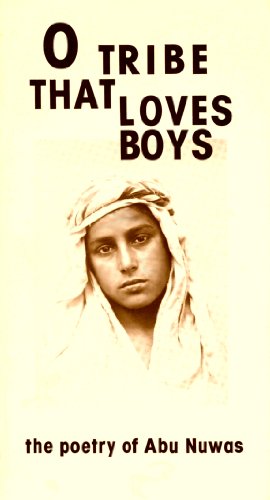
Born in Iran to a family of mixed Persian and Arab heritage, Abu Nuwas eventually settled in Baghdad during the late eighth century and became famed for his erotic verse, as well as his love of the debauched and degenerate. He was celebrated as one of the most influential Arabic poets of all time: renowned for his wine and hunting poems, but equally notorious for the profane and provocative imagery he used to subvert the authority of the caliph and mock the excesses of the court.
In one verse he called sodomy the “true jihad”. In another, two young boys fall in love and, instead of praying five times a day, fornicate five times whenever the call to prayer echoes across the city.
In the Muslim world, eroticism was regarded as sinful, while homo-eroticism was considered something beyond the ordinary boundaries of sin. Yet Abu Nuwas wrote without fear of execution or ostracism — and remarkably, that still appears to hold true today.
There is a statue of him in Baghdad, created by the renowned Iraqi sculptor Ismail Fattah Turk. It stands along Abu Nuwas Street on the banks of the Tigris River.
It took a long time for his work to be translated, and not everybody welcomed it. In 2001, the Egyptian Ministry of Culture reportedly burned around 6,000 copies of Abu Nuwas’s poetry, condemning it as homoerotic and offensive to Islam.
I have since discovered two verses that are perhaps the best known of his so-called “homoerotic” works, and, in the hands of the translator, are distinctly modern. When I read them, I imagine the man called Sajjad reciting them aloud — perhaps choking on the words and spitting on the floor.
Love in Bloom I die of love for him, perfect in every way, Lost in the strains of wafting music. My eyes are fixed upon his delightful body And I do not wonder at his beauty. His waist is a sapling, his face a moon, And loveliness rolls off his rosy cheek I die of love for you, but keep this secret: The tie that binds us is an unbreakable rope. How much time did your creation take, O angel? So what! All I want is to sing your praises.
In the Bath House In the bath-house, the mysteries hidden by trousers Are revealed to you. All becomes radiantly manifest. Feast your eyes without restraint! You see handsome buttocks, shapely trim torsos, You hear the guys whispering pious formulas to one another (“God is Great!” “Praise be to God!”) Ah, what a palace of pleasure is the bath-house! Even when the towel-bearers come in And spoil the fun a bit.
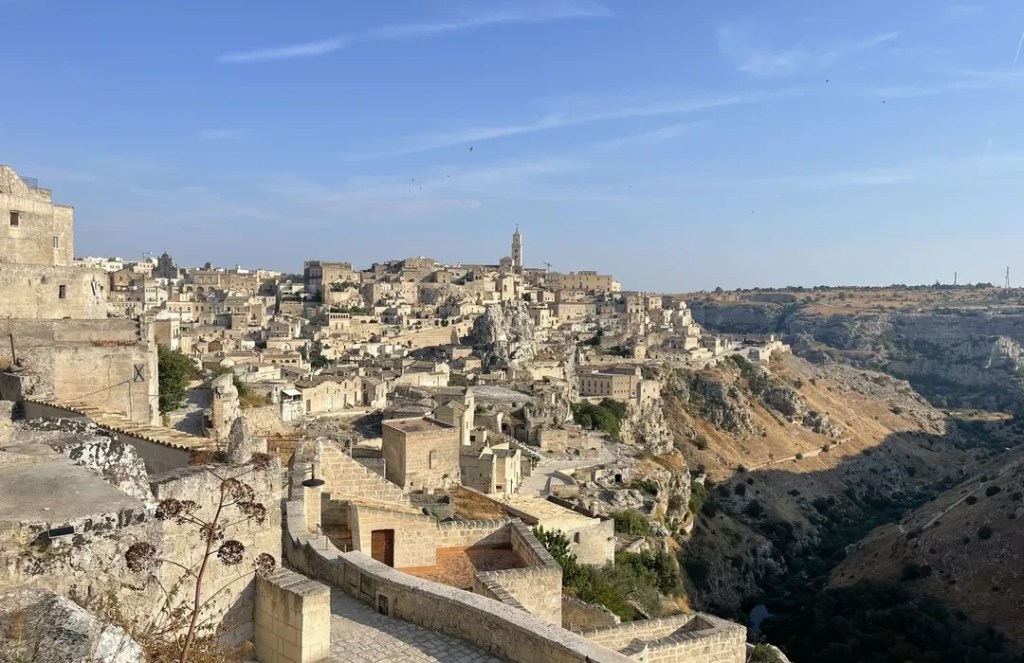
On leaving Montescaglioso… On from Montescaglioso—which I missed the moment I left on the small bus to Matera. I must return. The hilltop town exists in its own world, seemingly remote from the rest of Italy, yet it was warm and welcoming, and somehow managed to revive me.
It was really a minibus, stopping at every opportunity to pick up local women. For them, the journey to Matera felt like a day out—temporarily freed from household chores and feeding their families. They all seemed to know one another, speaking in rapid Italian, their voices rising and falling as they complained about the small details of their everyday lives. And yet, I couldn’t help feeling a quiet jealousy—that they could afford to live such ordinary, mundane lives.
There was only one other man on the journey, and he kept to himself, absorbed in his music. He looked about eighteen, and I imagined he was on his way to meet a girl in Matera. But then his phone rang, and the conversation turned to something entirely different: La Dolce Vita Orient Express, a new train service set to begin in May.
The route sounded almost romantic. It would begin in Rome, travel to Venice, then head down the Adriatic coast to Bari. From there, passengers would be shuttled to Matera—my destination—with its cave churches and underground water cisterns. Back on the train in Bari, the journey would continue towards Taormina in Sicily—which made my ears prick up—before heading on to Palermo and eventually returning to Rome.
It seemed the young man was being offered a job in Matera, one that would benefit from this new train service. He played it cool—neither accepting nor refusing—but you could tell he understood that opportunities like this don’t come around often.
The bus dropped me at Matera Centrale station, where I discovered that my train to Altamura was actually departing from Matera Sud, about two kilometres away. It required a short connecting train journey to get there. It was only once I was on that train that I learned Matera had once been derided as a symbol of poverty, yet had since reinvented itself as a creative hub—full of boutique hotels, buzzing cafés… and, of course, plenty of tourists.
On travelling to Taormina… It was surreal, but we met like lost friends—two people who shared a past, yet barely knew each other. I spotted Severin, with his blond hair and Germanic good looks, as we waited for the ITA Airways flight from Bari–Karol Wojtyła to Catania. The airport name didn’t sound remotely Italian, and I soon discovered why—it was Polish, named after Pope John Paul II.
Severin was from Bremen and had spent the last few years living in Turin. He, too, had been one of Pietro’s “lost” boys, and after Pietro’s sudden death had found himself with a modest sum of money and nowhere to live. I had been more fortunate, receiving a similar amount but allowed to remain in the Verona apartment, thanks to the generosity of Signora Bruschi. But now my home is back in England.
We hadn’t seen each other since that Christmas when Pietro had taken us out for a meal at a restaurant in Milan. It was there we met Elio, who turned out to be Pietro’s favourite—and who had inherited the bulk of his estate, enough to ensure he would never need to work again.
Severin, now in his late twenties, seemed genuinely pleased to see me, and was delighted to discover that we were both bound for Taormina. He looked thinner than I remembered, and had begun to grow a small goatee—something Pietro would never have approved of. Good on him, I thought. I noticed a bruise on his chin, and he explained he had been caught up in Turin’s May Day demonstrations, when protesters tried to break through a police cordon. I hadn’t expected Severin to have become quite such a rebel.
On the aircraft, we talked about old times, each of us offering a quiet, tentative sympathy to the other. Once, we had been adversaries; now, we were something closer to conspirators. Severin had tried to contact Elio after Pietro’s death, but had been met with a swift rebuff. He had also tried to reach me, but hadn’t known where to find me. The chance meeting at the airport had clearly delighted him.
Severin was heading to Taormina to work as a waiter for the summer season. The money Pietro had left him had run out, and now he survived by drifting from one job to the next.
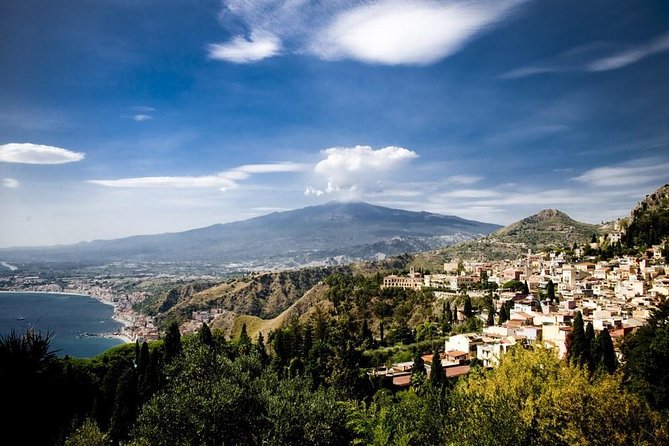
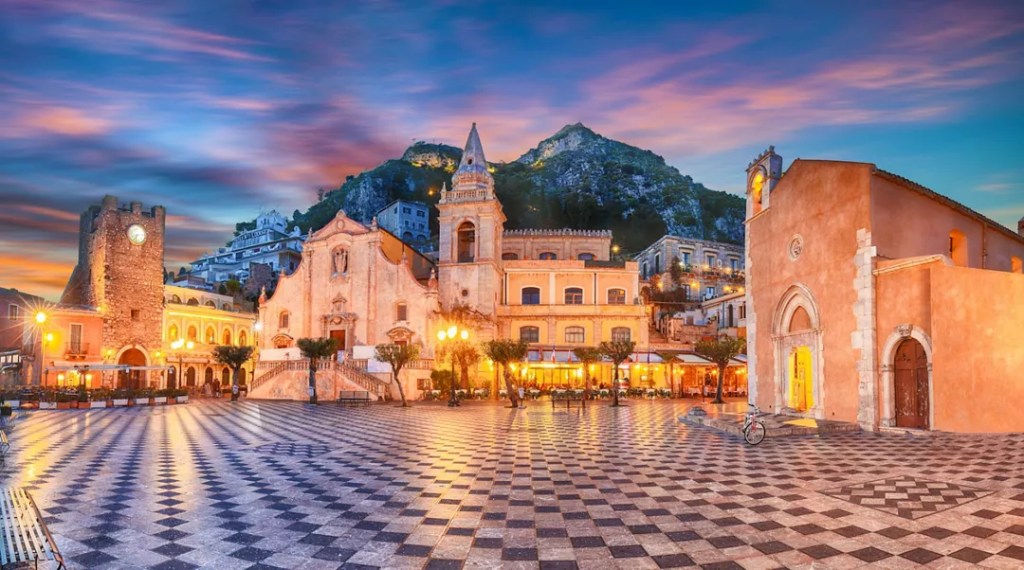
After arriving in Catania, we caught a train to Messina and got off at Taormina–Naxos. From there, we took the bus up into Taormina, where the heavens promptly opened. Inadequately dressed, we wandered through its charming maze of ancient, narrow cobbled alleyways, and along the bustling, elegant—largely pedestrianised—Corso Umberto. We dodged the hundreds of tourists clutching umbrellas, and after the calm of Montescaglioso, I found the crowds slightly overwhelming. Yet it was the smooth, endless stretch of the Mediterranean that held my gaze—and the uneasy thought that Mount Etna lay somewhere close by, hidden in the rainclouds.
It soon became clear that Severin had nowhere to stay. His plan had been to wander the streets of Taormina in search of something cheap. Until his job began—and with it, the promise of a room—the chances of finding affordable accommodation seemed slim. The town may once have existed in a kind of beautiful poverty, but ever since Victorian writers, poets, and artists had discovered it, its fortunes had changed. And soon, the La Dolce Vita Orient Express would be arriving too.
I was staying at a small hotel on Via Don Giovanni Bosco, its balconies overflowing with flowers, and—true to my nature—I offered Severin a bed until he found his footing. At the very least, it meant I wouldn’t be entirely alone as I tried to settle into a strange town.
On never trusting Mount Etna… Everybody in Taormina wants you to visit Mount Etna. It is one of the highest volcanoes in Europe, and one of the most active in the world. Alfio, who works on reception at my hotel, suggested that Severin and I take a guided tour. But we both look at Etna and feel quietly relieved by the forty-five kilometres between us and its summit. Never trust an active volcano.
From Taormina, a plume of white smoke drifts from the summit, with no immediate sign of eruption. Yet, according to Alfio, Etna has entered a new eruptive phase that began at Christmas. The crater, he says, is emitting lava, ash, and the occasional flow. He tries to reassure us that Etna poses no real threat to Taormina. Apart from the light dusting of ash that sometimes falls when the wind turns, he tells us to follow the advice of the locals—the Sicilian way is not to worry.
He recalls that, as a small child, he once saw flames suddenly shoot up from the crater, only to subside just as quickly. The same thing happened again the following morning.
Alfio doubts we’ll manage to get up at dawn, but suggests taking us to a hill above the ruined amphitheatre to watch the sunrise. Despite getting to bed at two in the morning, and waking with the lingering effects of strong wine, we let ourselves be dragged through the narrow streets.
The sun rose from the southern edge of Italy and caught the white dome of Etna, tinting it a soft, rose-pink. The colour spread quickly down the snow, deepening until the whole summit glowed like a ruby instead of pale white. Night’s shadows slipped off the slopes, giving way to a rich purple that sank into the valleys and over the orange groves, darkening as it went—until the morning light washed across everything, and the mountains returned to their steady, familiar greens and browns.
That was as near to Mount Etna as I cared to be.
On a poem about Taormina… I found a poem about Taormina on All Poetry which was written by someone referred to only as ecekaradag13, and who appears to have a fondness for Italy.
Taormina Above the Ionian Sea, this teatro of pretense where German tourists photograph Greek ruins through the lens of their prosperity, never seeing the Sicilian boys who sweep their marble steps for coins that disappear into foreign pockets. The ancient theater still echoes with tragedies more honest than the comedy performed daily by boutique owners selling “authentic” Sicily to cruise ship pilgrims seeking enlightenment at duty-free prices. Etna smolders in the distance, that honest mountain which at least admits its capacity for destruction, unlike the hoteliers who smile in four languages while their housekeepers scrub other people’s dreams from Egyptian cotton sheets. In the shadow of San Domenico, where Wilde once walked his particular exile, the local boys still gather at sunset, their beauty a currency more reliable than the lira, their bodies maps of an economy the guidebooks never mention. The bougainvillea blooms in violent purple protest against the limestone walls, while below, the working class of Giardini-Naxos send their children up the mountain to serve aperitivos to those who mistake privilege for culture, consumption for communion with the divine. This is paradise built on the backs of the invisible, where even the gods have learned to speak the international language of tourist euros.
To Find a Kiss of Yours: Federico García Lorca (Translation by Sarah Arvio)
To find a kiss of yours what would I give. A kiss that strayed from your lips dead to love. My lips taste the dirt of shadows. To gaze at your dark eyes what would I give. Dawns of rainbow garnet fanning open before God— The stars blinded them one morning in May. And to kiss your pure thighs what would I give. Raw rose crystal sediment of the sun.
Renowned for his vivid imagery and emotional intensity, Lorca’s work often circled longing and desire; here, those themes unfold through a sequence of questions—each one probing what the speaker might sacrifice for intimacy.
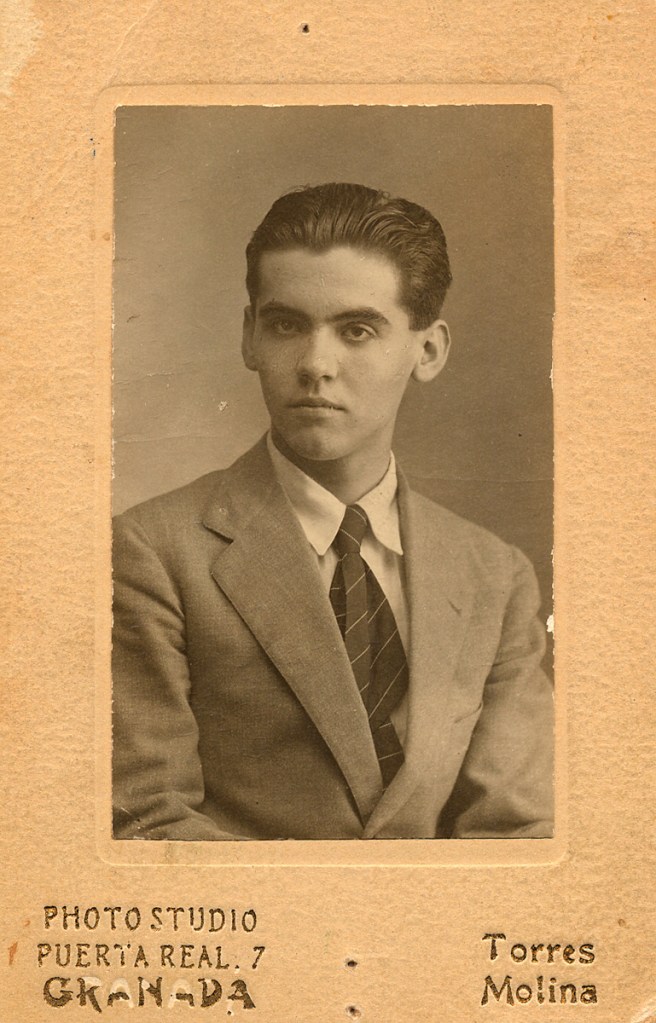
Federico García Lorca (1898–1936) This year marks the 90th anniversary of Lorca’s death. He was, by all accounts, a striking man: Iberian elegance, cultural poise, a magnetic presence. Thick, dark curls; penetrating eyes; a face alive with expression. Today, Lorca is recognised as one of Spain’s most important poets—his reputation only sharpened by the brutality of his death at just 38.
In the early days of the Spanish Civil War, Lorca was arrested in Granada, imprisoned, and within days taken to a roadside outside the city and shot by forces aligned with Francisco Franco. The exact reasons were never formally clarified. The regime’s official statement reduced his execution to a bureaucratic fiction: he had died of “war wounds.”
His body has never been recovered, despite repeated attempts to locate the mass graves into which victims like him were cast. Ian Gibson’s The Assassination of Federico García Lorca remains one of the most thorough investigations into the circumstances of his death, suggesting that his sexuality—at least as much as his politics—made him a target. One member of the execution squad reportedly boasted of firing “two bullets into his ass for being a queer.”
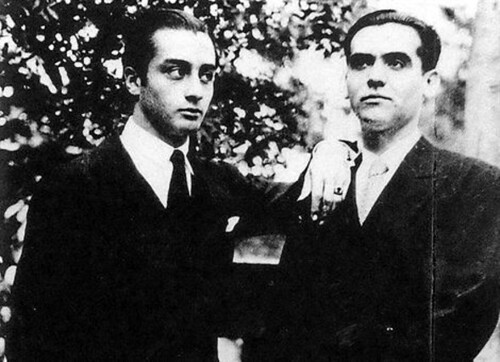
Lorca’s romantic life remains partly obscured, but figures associated with him include sculptor Emilio Aladrén Perojo, composer Manuel de Falla, and writer Juan Ramírez de Lucas. Whether he shared a romantic relationship with Salvador Dalí is still debated.
Across his work, Lorca returned again and again to the tension between desire and repression. Male longing appears coded, fractured, and often veiled—its intensity heightened precisely because it could not be spoken plainly within the society he inhabited.