Tag Archives: boy love

The Face I Never Saw Again

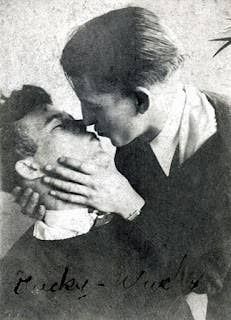
The Parting: Edwin Emmanuel Bradford (1910)

Two boys had met to bid “goodbye,”
One was my friend, the other 1;
He was going home—going home to die.

I know for long he talked to me,
But I think I only heard the sea—
It moaned and moaned incessantly,

I dared not look at him—I saw
The wind play with a wisp of straw:
‘Twas early Spring and cold and raw.

But when the station came in sight
Through parted clouds the sun shone bright.
Flooding the world with warmth and light.

A moment later in the train
I glanced at, with a stab of pain,
The face I never saw again.

The train went out: dark grew the sky
And all at once tempestuously
A storm of hail swept far and night.

But darkness could not blot or kill
That sunlit face—it never will:
By night and day I see it still.

Edwin Emmanuel Bradford’s The Parting first appeared in The Romance of Youth and Other Poems in 1910, with later editions appearing around 1920. It is tempting to read it as a wartime farewell between two young men, particularly because of its language of death and separation.

But the date matters.

This is 1910.

The First World War is still four years away.

So who, exactly, are these two boys?

Bradford gives us almost nothing. Just the meeting. The silence. The cold. The train. And that extraordinary final image of the boy’s face surviving everything — even darkness.

The poem belongs to the strange, fascinating world of early twentieth-century Uranian literature: writing that openly explored romantic and homoerotic relationships between men and adolescent boys.

Bradford himself lived an extraordinary double life. He was an Anglican vicar, respectable enough to be reviewed seriously and, remarkably, often favourably. At the same time, he was publishing poetry about male beauty, youth and desire.

That tension is part of what makes The Parting so haunting.

It never says what these boys are to each other.

Perhaps that was precisely the point.

Two boys meet.

One leaves.

And one face remains.
Boys, Daggers and Pseudonyms


“For the boy was beautiful: blond curly hair, blue eyes which seemed to catch all the dim light of the tap-room, a spare but tightly muscled chest seen through a shirt open to his navel (because, evidently, its buttons had long ago been parted from it). The lad moved about the edges of the room, in the shadows, with pitchers of water and cider, alert to the needs of the other guests but observant, too, of the traveler at the corner table. Once or twice their glances met, and then our spy or informer might have heard the young man continue under his breath, “Yes, with a little expert attention and some new garments you might be a worthy page for Torben Lerche!”

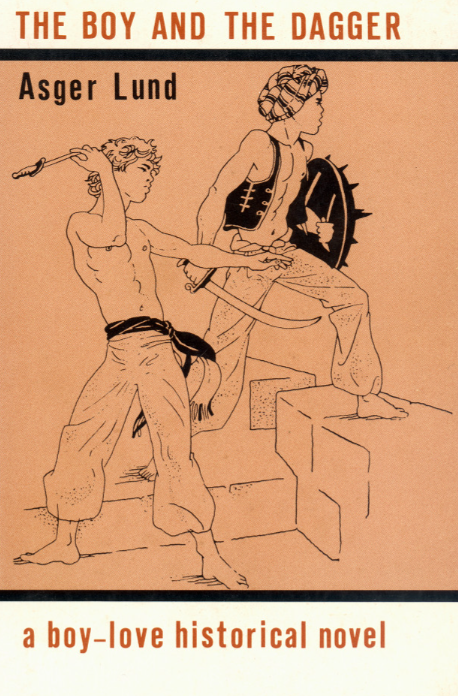
Asger Lund, The Boy and the Dagger (1961)
Drengen og dolken

This might be historical ‘boy-love pulp fiction’.

Or perhaps something stranger.

Asger Lund was one of the many names used by the Danish writer and artist Kjeld Asger Frydenlund (1929–2013). The Boy and the Dagger was originally published in Denmark in 1961, although my copy is the English edition, published in October 1982 by Spartacus in Amsterdam. It is described as a “boy-love historical novel” and illustrated by Richard Steen.

Germany. France. Spain. North Africa.

It sounds like an adventure novel, but there is something much more peculiar going on here.

Frydenlund was a draftsman before he became a writer. His influences included Art Nouveau, Pierre Joubert and comic strips. Mostly black and white. Strong lines. Boys.

And then the names begin to multiply.

Stanley W. Baker. Pete Freeman. Horst Irgens. Asger Lund. Richard Steen. Sometimes simply RS. All the same man.

From 1952 onwards, under RS and later Richard Steen, he produced drawings of boys in a stark black-on-white style. From around 1960, as Horst Irgens, the drawings became darker and more photographic, using heavy shadows, hatching and stippling.

Then, from the 1970s, came Asger Lund.

Writer. Artist. Pseudonym. Another identity.

There is something fascinating about it all. Not simply the book itself, but the strange little underground world around it — pulp novels, drawings, pseudonyms and magazines, all circulating in a culture that now feels almost impossibly distant.

The Boy and the Dagger.

Even the title sounds like something I should probably not be reading.

Stolen Words – Hopeless Love – J.G.F. Nicholson

Hopeless Love – Charlie Marseille (2026)

Mainly I strive to show by deed and word
How great my love for you, how deep and strong;
Daily you hear my heart’s one passionate song,
And still pass on as though you had not heard;
Your slightest smile, your gentlest glance can gird
My suppliant life with joy that lingers long, –
You touch my hand, and straight a gladsome throng
Of hopes are born, and all my soul is stirred.

But ah, you do not understand nor see,
And when my looks of my devotion tell
You deem it but some pitiful wayward spell;
Love comes not my interpreter to be,
And in your eyes, because you love not me,
My greatest fault is loving you too well!

From Love in Earnest – Sonnets, Ballades and Lyrics by J.G.F. Nicholson (1892)

Ignacio Martínez Moreno, in Uranian Poetry: The Homosocial and Homoerotic Paradox (2020), describes John Gambril (Francis) Nicholson as “a prisoner of his feelings, only able to express them through poetry.” Hopeless Love reveals a form of homoeroticism in which the lightest touch can unleash a flood of feeling—emotions that need not be reciprocated to ignite passion within the poetic voice.

Oh yes, I know this all too well.

I perceive beauty where others see none. I feel a desire that no one else seems able to recognise. He is the pearl concealed within a hard exterior. Through close proximity, a sense of deep familiarity takes hold, awakening attraction and affection that override his less generous qualities.

It is an obsessive infatuation, one in which reciprocation will never arrive—because he refuses, or is simply unable, to see the effect he has on me.

And no matter how hard I try… it is not recognised.

The Weight of Wonder

When You Look at Boys – Charlie Marseille (2026)

When you look at boys, do you really look – do you look in detail? People see Bradley and assume that beauty must imply intelligence. It doesn’t. The truth is, he’s a bit of a himbo. There’s a Yorkshire saying for people like that: “thick as pig shit.” And Bradley, I suppose, fits it perfectly. He smiles – handsome, devilish – with a guileless sense of wonder. But how long can I keep swallowing my frustration? Physical attraction fades quickly, and I realise the only role he can play is arm candy: a beautiful body, empty-headed, ornamental.

The Patron Saint of Foolhardy Teenage Boys


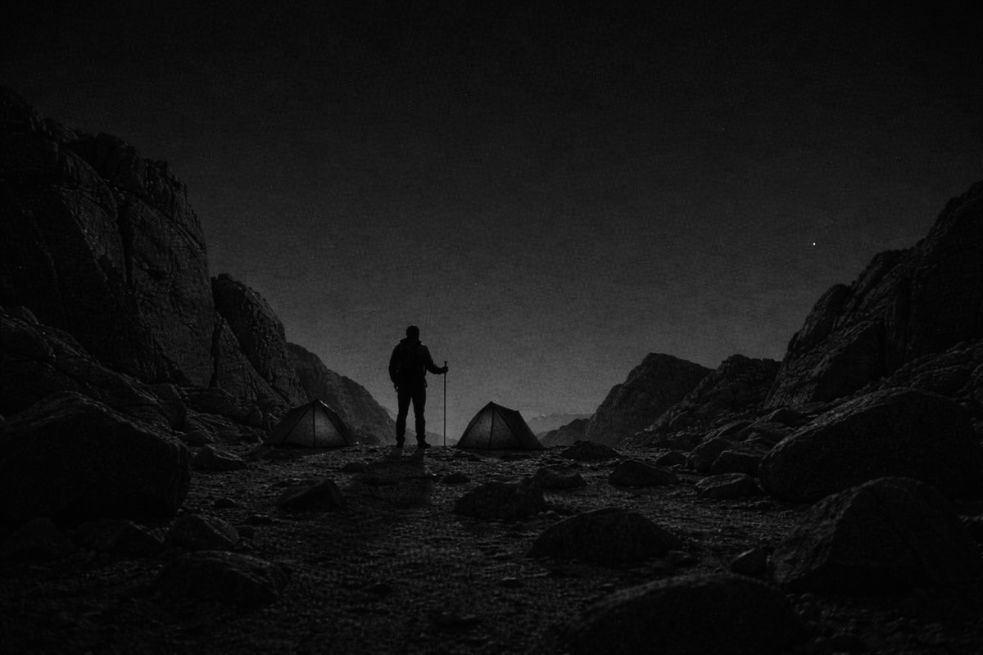
A solitary figure stands above Kinder Scout. He cannot be seen, yet he watches from afar. The darkness thickens over the peaks, and a westerly wind rises as if summoned from nothing, but neither deters him. This is not a place for the unprepared. The temperature will fall; the warmth of the day will slip away, unnoticed, into the stone.

As the figure observes the six boys pitching their tents, a quiet certainty settles within him: he is powerless. He cannot call out. He cannot warn them. Leaning on his stick, he endures the bitter air and waits, bound to witness how they will meet the night. Their laughter will thin, their bravado ebb, as loneliness takes hold. Escape will become a wish rather than a choice, and sleep the only surrender, each of them willing the morning to arrive.

When he is certain the boys have fallen into a restless, unhappy slumber, the figure moves. He steps softly across rock and scrub, listening, careful not to betray his presence. Only when he is satisfied that he will not frighten them does he pause to peer into each tent. There he sees them cocooned within their sleeping bags, clinging to one another, sharing the fragile warmth of slender, adolescent bodies against the cold.

At last, he chooses a broad, ancient rock and settles there, a silent sentinel. He remains, guarding their sleep, until the first pale glow of the new day begins to rise in the east.

Colvey / I know why you are such a bitch to the boys

Image: Lucas Barski

Colvey

There are things that people don’t know about you. And if they did, it’s unlikely that they would believe it.

The council house scruffs who think you are fucking cool in your Hoodrich gear. You talk to them like shit, and they are so thick, that even though they are scared, they think it is only a game.

But I know why you treat them so badly and keep them in their place.

I know your dark secret.

It is something that you don’t want them to know, and if they did, you know that you are finished.