
“For the boy was beautiful: blond curly hair, blue eyes which seemed to catch all the dim light of the tap-room, a spare but tightly muscled chest seen through a shirt open to his navel (because, evidently, its buttons had long ago been parted from it). The lad moved about the edges of the room, in the shadows, with pitchers of water and cider, alert to the needs of the other guests but observant, too, of the traveler at the corner table. Once or twice their glances met, and then our spy or informer might have heard the young man continue under his breath, “Yes, with a little expert attention and some new garments you might be a worthy page for Torben Lerche!”
Asger Lund, The Boy and the Dagger (1961)
Drengen og dolken
This might be historical ‘boy-love pulp fiction’.
Or perhaps something stranger.
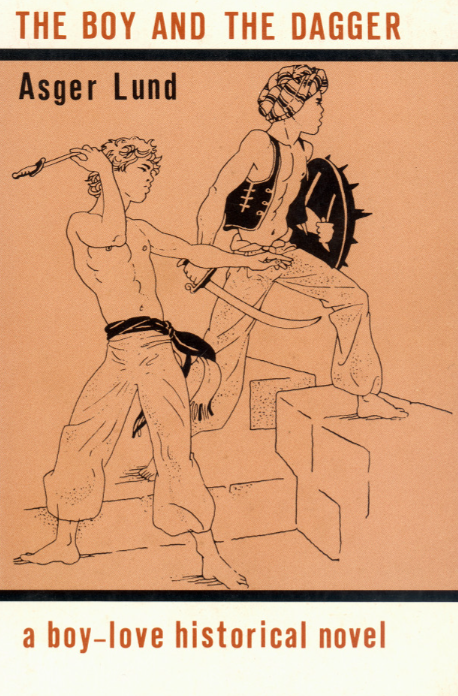
Asger Lund was one of the many names used by the Danish writer and artist Kjeld Asger Frydenlund (1929–2013). The Boy and the Dagger was originally published in Denmark in 1961, although my copy is the English edition, published in October 1982 by Spartacus in Amsterdam. It is described as a “boy-love historical novel” and illustrated by Richard Steen.
Germany. France. Spain. North Africa.
It sounds like an adventure novel, but there is something much more peculiar going on here.
Frydenlund was a draftsman before he became a writer. His influences included Art Nouveau, Pierre Joubert and comic strips. Mostly black and white. Strong lines. Boys.
And then the names begin to multiply.
Stanley W. Baker. Pete Freeman. Horst Irgens. Asger Lund. Richard Steen. Sometimes simply RS. All the same man.
From 1952 onwards, under RS and later Richard Steen, he produced drawings of boys in a stark black-on-white style. From around 1960, as Horst Irgens, the drawings became darker and more photographic, using heavy shadows, hatching and stippling.
Then, from the 1970s, came Asger Lund.
Writer. Artist. Pseudonym. Another identity.
There is something fascinating about it all. Not simply the book itself, but the strange little underground world around it — pulp novels, drawings, pseudonyms and magazines, all circulating in a culture that now feels almost impossibly distant.
The Boy and the Dagger.
Even the title sounds like something I should probably not be reading.

