Category Archives: Hot Boys, Great Art

Hot Boys, Great Art

A Cellist Elevated by His Bath: Philip Gladstone (2007)
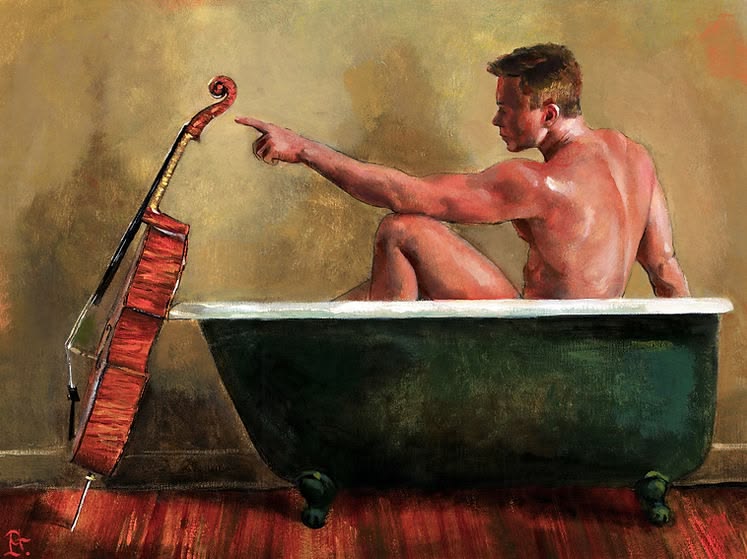

He had been in there for nearly an hour. Long enough for the water to cool, for the steam to disappear from the mirror, for the afternoon to slip into something approaching evening. He ought to have got out. There were things to do, people who might be waiting. But he had never been particularly good at doing what was expected of him.

Instead, he pointed at the cello.

There is nothing quite so exciting as a young guy in a bath. Especially one who brings his cello.

A Cellist Elevated by His Bath was painted in 2007 by American artist Philip Gladstone, whose work I’m beginning to think deserves considerably more attention.

Born in Philadelphia, Gladstone is known for his evocative figurative paintings, often featuring the male nude as protagonist, muse and general cause of distraction. He now paints full-time in a renovated barn studio at his antique farmhouse in rural Maine. Not a bad setting for an artist with such a particular eye for the male form.

This painting belongs to his long-running Tubs Series, in which bathers, animals and assorted objects find themselves in antique tubs that feel less like bathroom fixtures and more like protective, womb-like spaces. The results are surreal, dreamlike and just a little absurd.

And then there is the cello. The pose. The pointing finger.

I have questions. But I’m not sure I want answers.
Hot Boys, Great Art

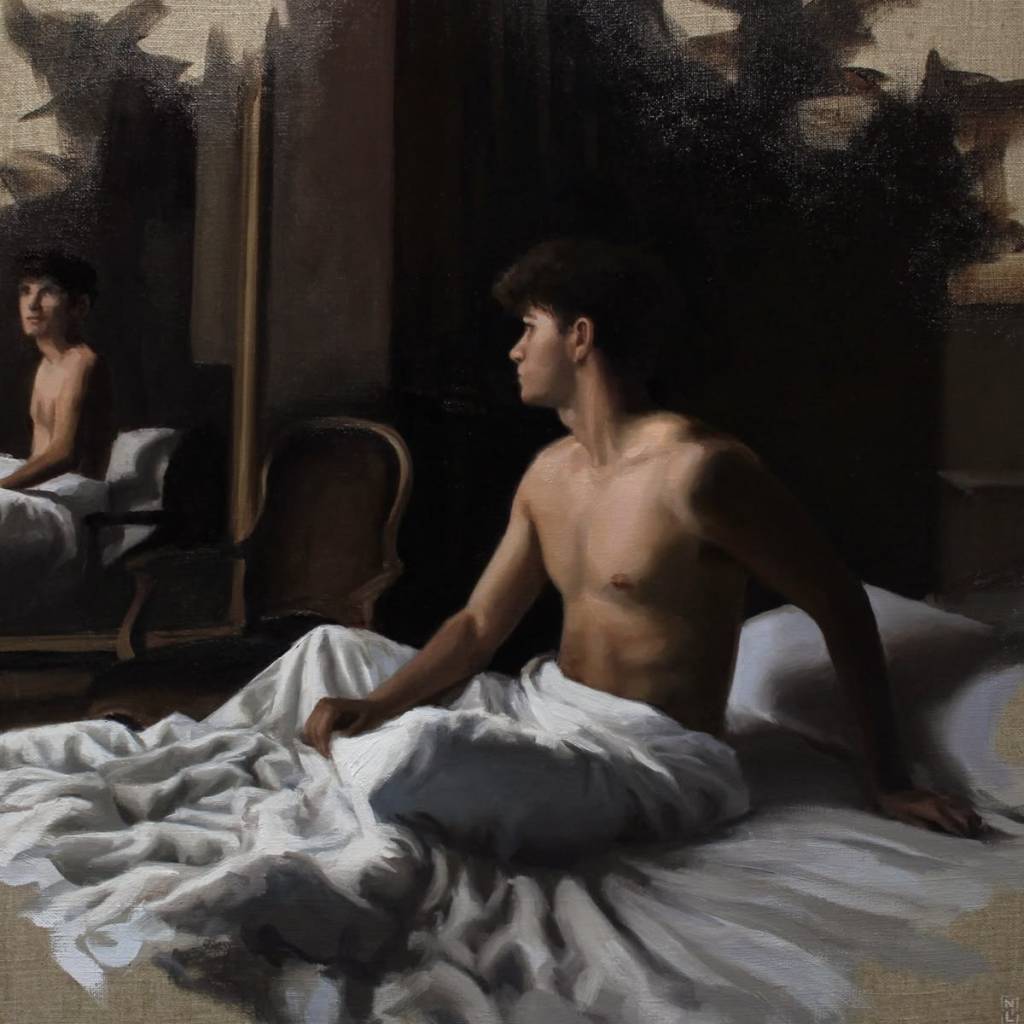
Després del somni (After the Dream): Nil Masip Boget (2025)


It makes you sick, doesn’t it?

Here’s someone who is only twenty years old, extremely good looking — and, annoyingly, an amazing artist too.

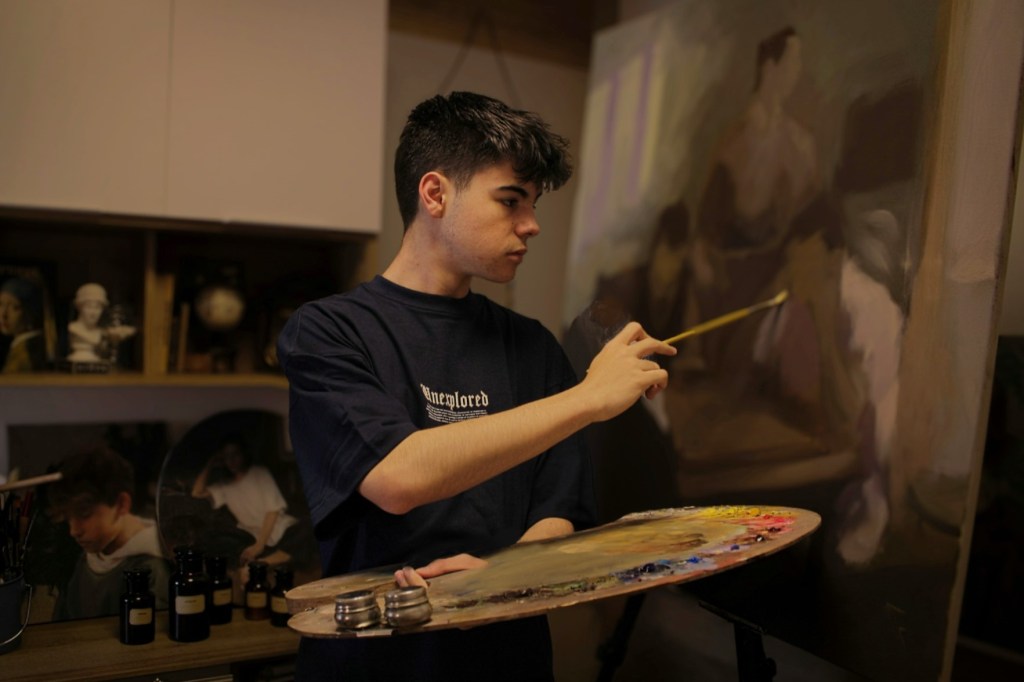
Barcelona-based Nil Masip Boget is a classical and figurative painter who trained at the Barcelona Academy of Art and Acadèmia La Gràcia. He has already won several awards, and his work is now held in public and private collections across Europe and the USA. He has also just had his first solo exhibition, sense por d’oblidar, at Inéditad Gallery in Barcelona.

He works mainly in oils, using light, colour and texture to create paintings that feel quiet and introspective. There is often a sense of silence in his work — moments caught somewhere between thought, memory and dream.

Després del somni (After the Dream) was the last oil painting he completed for Happiness Journey, a contemporary art exhibition held in Barcelona last year.

It shows a shirtless young man sitting on a bed, wrapped in crumpled white sheets. He looks away from us, towards the right of the canvas, while a mirror on the far left gives us a second, more distant view of him.

It is a beautifully strange composition. The dark background seems to remove the outside world altogether, leaving the boy suspended in some private, timeless space between sleep and waking. The mirror adds another layer — self-reflection, vulnerability, perhaps even the feeling of watching yourself from outside your own body.

Enough of the art criticism.

What actually caught my eye about this painting?

I shall leave you to guess.

Hot Boys, Great Art

La Ville dont le prince est un enfant: Raymond Carrance (1967)

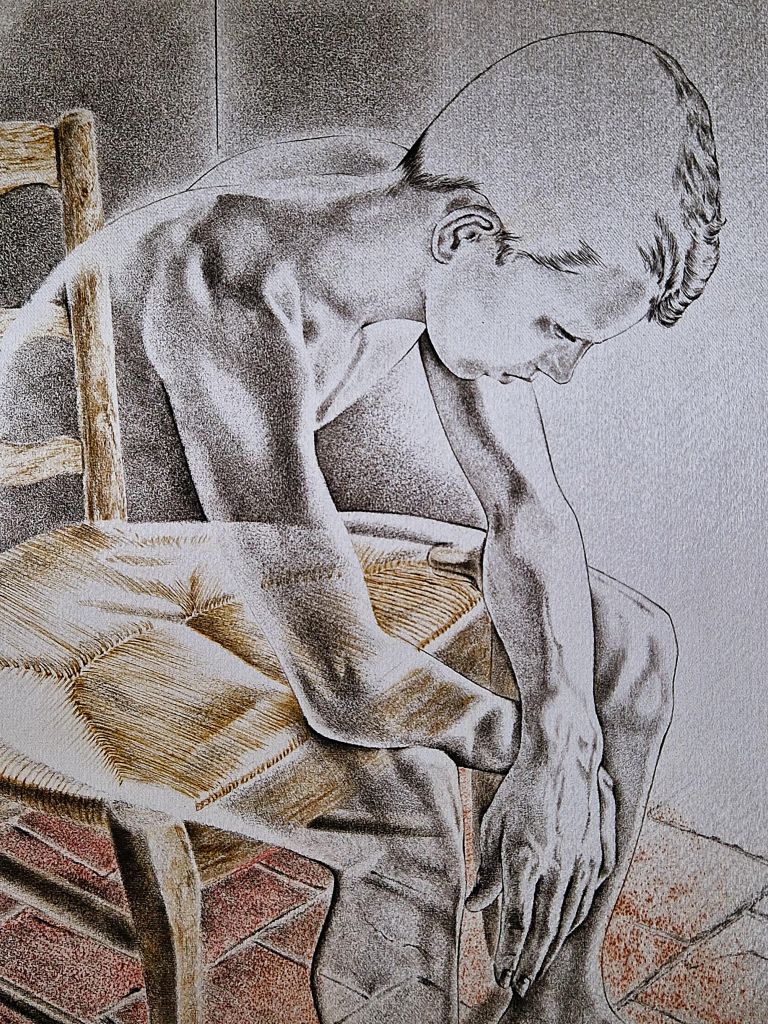
Raymond Carrance, working under the name Czanara, created a quietly intriguing body of homoerotic work during the 1950s and ’60s.

Much of it was private: drawings, engravings and photographs of male youth, sensuality and those strange, dreamlike worlds where beauty and desire tend to get a little blurred.

Carrance (1921–1998) was hardly a one-subject artist, though. He produced elaborate etchings and lithographs for works by Jules Renard and Cyrano de Bergerac, as well as illustrating a 1951 play by Henry de Montherlant, La Ville dont le Prince est un Enfant — The City Whose Prince is a Child.

And this is where things get interesting.

Montherlant’s play is set in a strict Catholic boys’ school before the Second World War. At its centre are André Sevrais, an older pupil; Serge Souplier, the younger boy with whom he forms an intense friendship; and the Abbé de Pradts, a school prefect whose feelings towards Souplier become increasingly complicated.

Friendship. Possession. Jealousy. Authority. Desire.

All the things a Catholic boys’ school presumably hoped to keep out of sight.

Carrance illustrated a 1967 edition of the play with a series of delicate, highly charged images. Knowing something of his private work as Czanara, the choice feels less than accidental.

The title itself comes from Ecclesiastes: “Woe to thee, O land, when thy king is a child.”

A rather ominous little biblical quotation for a book about boys, priests, desire and forbidden attachments.

And Carrance seems to have understood exactly how much could be said without saying very much at all.

Hot Boys, Great Art

Night in the Desert: George Quaintance (1951)


George Quaintance (1902–1957) was an American artist famous for his “idealised, strongly homoerotic” depictions of men in mid-century physique magazines. He often used historical settings to justify nudity, or to remove his subjects from the constraints of modern society. Muscular, semi-nude or completely nude men dominate his paintings, with the Wild West becoming one of his favourite settings. He would later influence artists such as Tom of Finland.

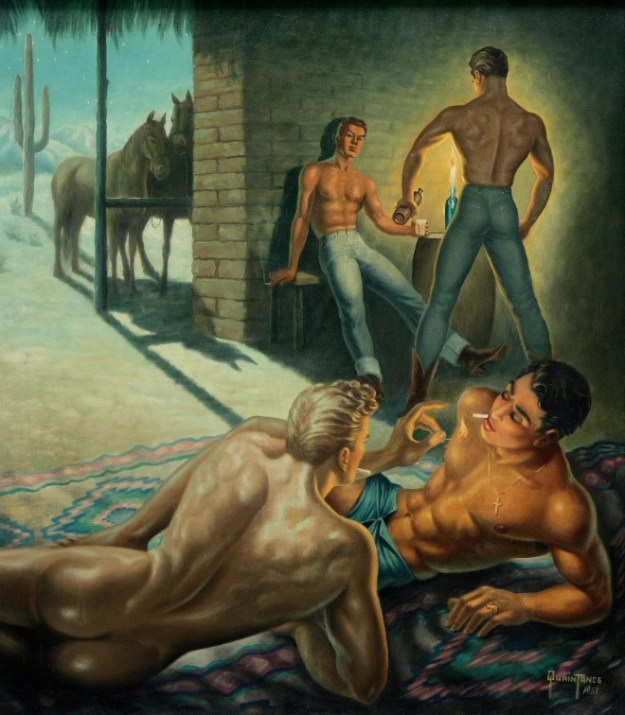
One of his iconic masterpieces was Night in the Desert (1951)

John D. Wainbright, on the LGBTQ encyclopedia, wrote:

“It portrays a reclining nude cowboy, well-honed musculature gleaming in the moonlight and blond hair perfectly coiffed. He is proffering a lighted match to a cigarette in the mouth of the dark handsome youth lying next to him, suggesting a shared post-coital moment. In the background, two equally hyper-masculine cowboys face each other clad only in Levis, legs provocatively spread.”

In this and several other paintings in the series, the blond cowboy bears a striking resemblance to Quaintance himself. He was something of an egotist, but he also kept himself in remarkable physical shape. Perhaps he understood better than most artists the appeal of the body he was painting.

On November 8, 1957, Quaintance suffered a heart attack. He was just 55.

In reporting his death, Bob Mizer described Quaintance as “a perfectionist” who “drove himself unmercifully”, working days and nights to finish a painting or sculpture, sometimes taking Benzedrine to keep himself awake.

His legacy is more than sixty signature oil paintings, now scattered among private collections and a handful of gay-oriented museums around the world. More importantly, he helped create an image of male beauty that could be unmistakably homoerotic while still hiding behind the conventions of the American frontier. Cowboys, muscles, moonlight. It was a pretty effective disguise.

Hot Boys, Great Art

Reclining Boy: Eugene Shako

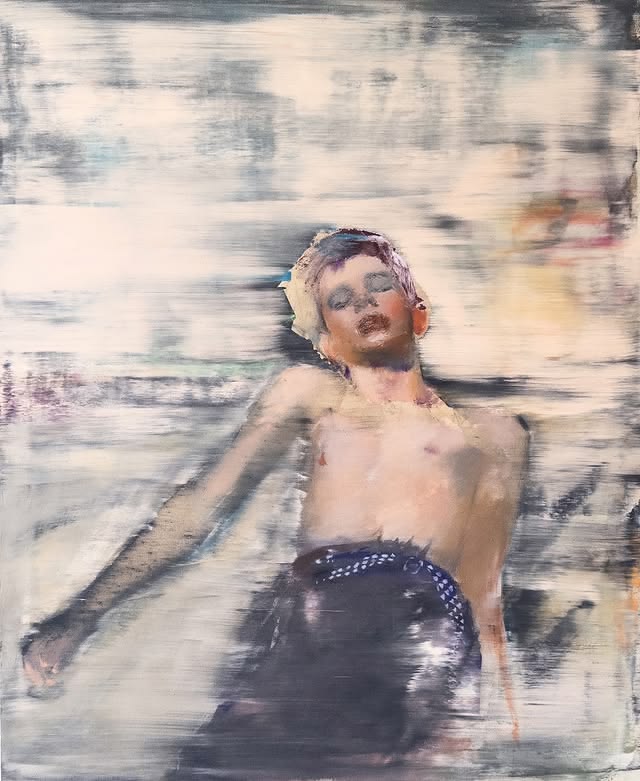
Reclining Boy was featured at the VCRB Gallery in Antwerp, Belgium, as part of Eugene Shako’s collective exhibition titled Silent Narratives, which ran from April 28 to June 7, 2026. 

Stillness.
Closed eyes.
Wet hair.
Bare skin.
The world rushing around him.
He doesn’t seem to care.
There is something beautiful about that.
Perhaps it is the vulnerability.
Perhaps it is the arrogance of youth.
Or perhaps
I simply want to lie beside him
and watch the world disappear.

There’s something about Shadko’s paintings that blurs reality with imagination.

The longer I look, the more I see.

And sometimes I wonder if I am seeing something that nobody else sees.

Shadko is a Belarusian artist living and working in Warsaw. His paintings begin with images — photographs, social media, something glimpsed online, something that catches his eye. He takes these fragments and passes them through himself. He studies them. Distorts them. Reimagines them.

Nothing remains quite as it was.

His paintings are often about faces and bodies. Youth. Vulnerability. Isolation. That strange fragility of adolescence.

His figures seem to exist somewhere outside reality. Alone. Spotlighted. Suspended in an imaginary world.

And perhaps that is what draws me in.

The feeling that there is something just beneath the surface.

Something I can see.

Something you might not.

Shadko studied at the Glebov Art College in Minsk and the Nicolaus Copernicus University in Toruń, Poland.

Hot Boys, Great Art

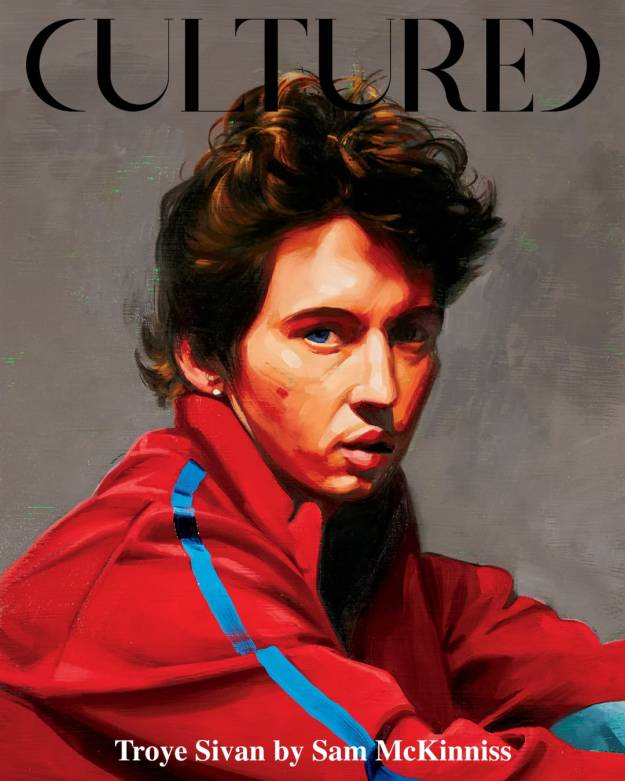
Troye Sivan: Sam McKinniss (2026)


The things that you discover.

Like, I didn’t know that Troye Sivan is really called Troye Sivan Mellet. That Sivan is the ninth month of the Hebrew calendar, usually falling in May or June, and that he was born in June — on 7 Sivan, as it happens.

And I still think he is a ‘dirty’ boy.

As far as art is concerned, Sivan has now popped up on the cover of the latest issue of CULTURED magazine, painted by American artist Sam McKinniss, who also interviewed him for the issue. The result is this rather gorgeous, slightly feverish portrait — and surely some magazine covers are destined to become collector’s items.

McKinniss, born in 1985 and based in New York, has been described as an ‘artist of celebrity’, having painted figures from popular culture and created the cover for Lorde’s Melodrama (2017), arguably one of his most memorable commissions.

He graduated from the Glasgow School of Art in 2005 before going on to exhibit throughout the United States and Europe. His paintings can veer from celebrity portraiture to lush, pop-cultural fantasy, with the occasional reclining male nude thrown in for good measure.

McKinniss first discovered Sivan on Instagram, when the then twenty-year-old had just released Blue Neighbourhood. He came across him again in 2018, when he saw Sivan in Joel Edgerton’s conversion-therapy drama Boy Erased. McKinniss remembered being impressed that someone from the pop world would take part in such a difficult and necessary film.

And now, years later, he has painted him.

Which, when you think about it, seems entirely appropriate.

Hot Boys, Great Art

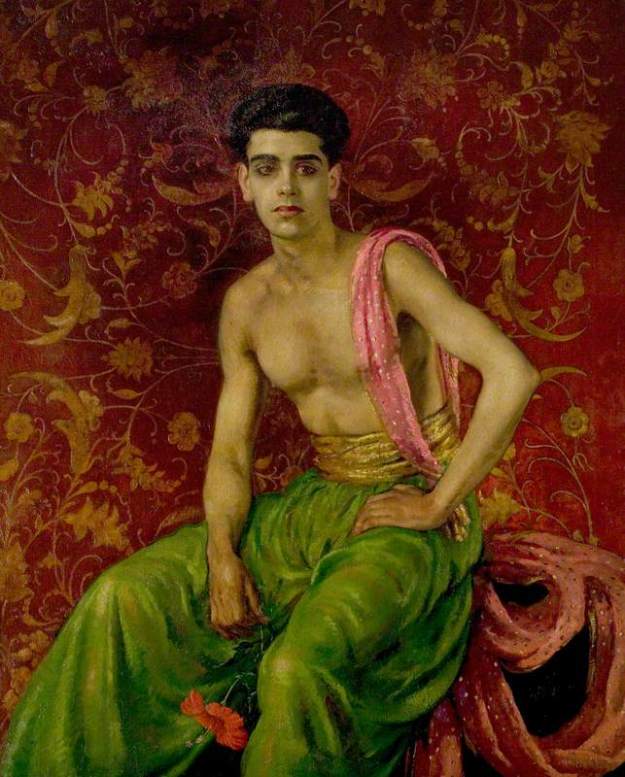
Hibiscus Flower: William Bruce Ellis Ranken (1922)

Ranken, William Bruce Ellis; Hibiscus Flower; Nottingham City Museums and Galleries; http://www.artuk.org/artworks/hibiscus-flower-46866

“A half nude youth of splendid beauty faces the spectator, wearing Oriental breeches of green, with a sash of gold, and a drapery of magenta — all this splendour relieved against a figured background of dark red and gold. The scarlet hibiscus flower, held ever so languidly by the golden youth, is intended to constitute the climax of all this Oriental glory.”

That was how The Scarlet Hibiscus was described when it was exhibited at the Modern Society of Portrait Painters exhibition at the Royal Institute, Piccadilly, in 1922. The artist was Edinburgh-born William Bruce Ellis Ranken.

The painting remained in Ranken’s private collection until his death in 1941, when his collection was dispersed among public museums and galleries across Britain.

Standing almost two metres tall in its frame, The Scarlet Hibiscus was eventually donated to Nottingham Castle Museum by Ranken’s sister, Janette. It has been known there ever since as Hibiscus Flower.

The identity of the sitter remains something of a mystery. Ranken’s sister suggested that he might have been the British ballet dancer Anton Dolin. The sitter’s darker complexion would seem to argue against that identification, although Ranken was hardly above exercising a little artistic licence.

Whatever his identity, the young man is unmistakably the star of the picture. This is male beauty turned into spectacle: highly stylised, intensely decorative and with a sensual concentration on the male form. It is precisely the kind of work that makes Ranken so fascinating today, particularly as questions surrounding his sexuality have become increasingly part of the discussion of his art.

Much of Ranken’s work was destroyed during the Second World War, while the fashionable world that had once embraced his particular brand of glamour had already begun to move on. By the time he died, his social and financial fortunes had considerably diminished.

Yet perhaps the most interesting thing about Ranken is how differently we see him now. Once regarded largely as a society portraitist whose moment had passed, he is increasingly being recognised as a pioneering queer British artist — and as a painter who was quite prepared to celebrate the beauty of the male body.

See also What William Bruce Ellis Ranken Never Said