Tag Archives: homoerotic art

Hot Boys, Great Art

Night in the Desert: George Quaintance (1951)
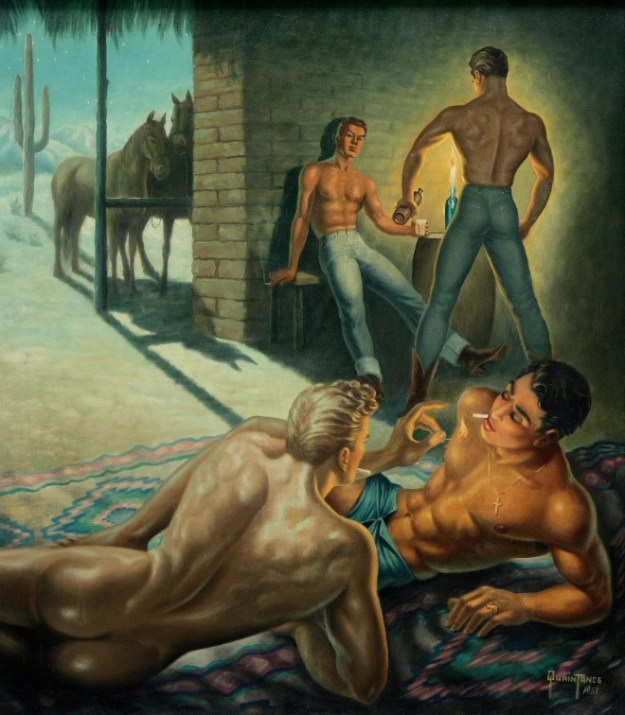

George Quaintance (1902–1957) was an American artist famous for his “idealised, strongly homoerotic” depictions of men in mid-century physique magazines. He often used historical settings to justify nudity, or to remove his subjects from the constraints of modern society. Muscular, semi-nude or completely nude men dominate his paintings, with the Wild West becoming one of his favourite settings. He would later influence artists such as Tom of Finland.

One of his iconic masterpieces was Night in the Desert (1951)

John D. Wainbright, on the LGBTQ encyclopedia, wrote:

“It portrays a reclining nude cowboy, well-honed musculature gleaming in the moonlight and blond hair perfectly coiffed. He is proffering a lighted match to a cigarette in the mouth of the dark handsome youth lying next to him, suggesting a shared post-coital moment. In the background, two equally hyper-masculine cowboys face each other clad only in Levis, legs provocatively spread.”

In this and several other paintings in the series, the blond cowboy bears a striking resemblance to Quaintance himself. He was something of an egotist, but he also kept himself in remarkable physical shape. Perhaps he understood better than most artists the appeal of the body he was painting.

On November 8, 1957, Quaintance suffered a heart attack. He was just 55.

In reporting his death, Bob Mizer described Quaintance as “a perfectionist” who “drove himself unmercifully”, working days and nights to finish a painting or sculpture, sometimes taking Benzedrine to keep himself awake.

His legacy is more than sixty signature oil paintings, now scattered among private collections and a handful of gay-oriented museums around the world. More importantly, he helped create an image of male beauty that could be unmistakably homoerotic while still hiding behind the conventions of the American frontier. Cowboys, muscles, moonlight. It was a pretty effective disguise.
Boys Burn Quiet: The Photographer Who Hid His Desire

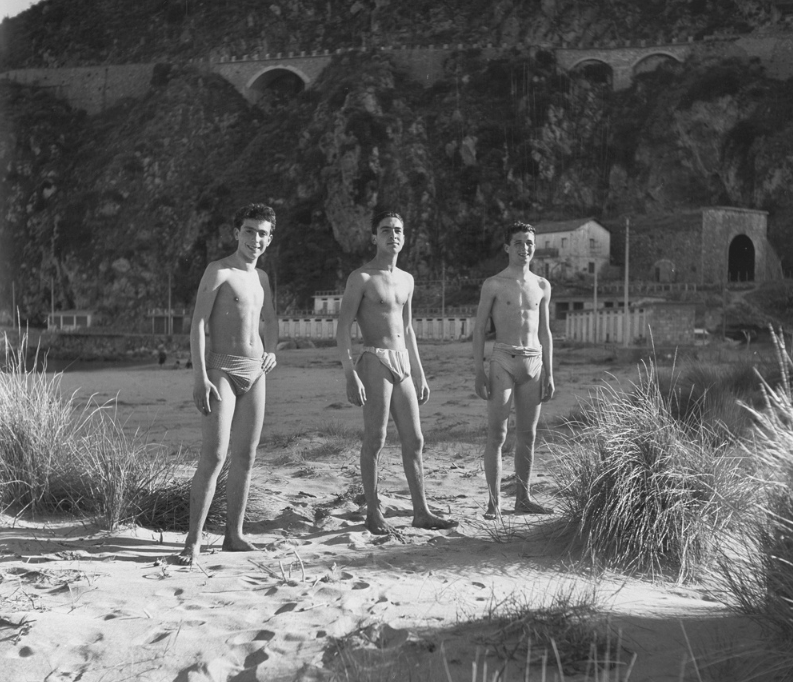
Calabria, three young men in bathing trunks on the beach , April 2, 1954. Konrad Helbig.

The story is sad in its own way. Imagine spending a lifetime taking more than a hundred thousand photographs of beautiful places around the Mediterranean. Many are published in travel magazines such as Merian and Atlantis, or used to illustrate the travel guides of the 1950s and 1960s. Then old age arrives, you die, and the work is left behind and forgotten. Later, someone sorting through your estate — a friend, perhaps, or a distant relative — discovers something that was probably meant to remain secret.

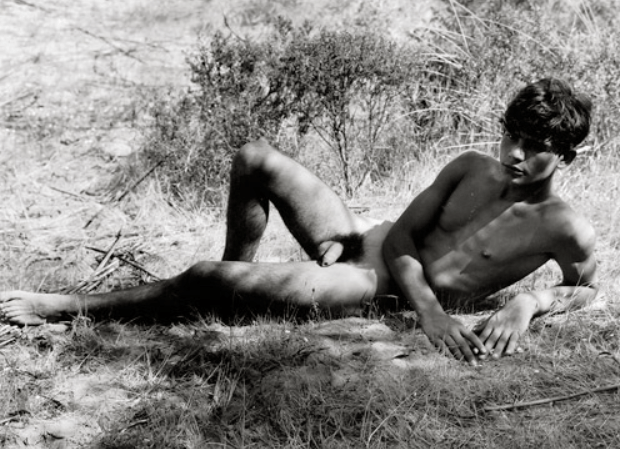
When Konrad Helbig died in the German city of Mainz in 1986, a completely unknown collection of black-and-white photographs was found among his possessions. They were images of young Sicilian men, many of them nude, and they had never been published; more likely, nobody had even known they existed. Now, forty years later, Helbig is remembered less as a travel writer and photographer than for these newly uncovered erotic images.

I have tried, and failed, to discover more about Helbig.

Searching through archives, I found only a single contemporary mention of him: a 1961 review following the publication of Umbria: The Heart of Italy, with text by Harald Keller and photographs by Konrad Helbig. The reviews were mixed, sometimes scathing. One correspondent wrote: “Herr Helbig’s black-and-white photographs cover art, architecture, and landscape with wide-ranging sympathy. (I say nothing of his five colour plates, which are frankly disastrous.)”

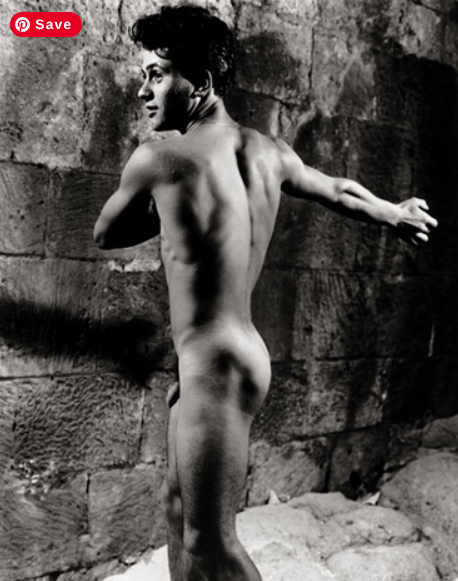
Young male nude with outstretched arm, 1950–1959. Konrad Helbig.

His first published photographic collection was a volume on Sicily in 1956, followed by collaborations with Karl Heinz Hoenig in 1959 and, later, with photographer Toni Schneiders on Archipelago in 1962.

Yet one cannot help wondering whether Helbig’s true artistic interest lay elsewhere: in his studies of the male nude, composed in the style of Classical Greek and Roman sculpture. Had those photographs become known during his lifetime, his reputation would almost certainly have been destroyed.

Konrad Helbig was born in Leipzig in 1917. He fought in the Second World War, was captured by Soviet forces, and remained a prisoner of war until 1947. After his release, he studied art history and archaeology, concentrating particularly on the Mediterranean world. Of his private life, however, very little is known. I have met someone who had known him — indeed, someone who had posed for him — but he either could not remember, or would not reveal, anything beyond the sparse details already available.

And what of the photographs themselves? Helbig’s best-known posthumous collection is Homo Sum (Latin for “I Am Human”), published in 2003 and featuring what were described as “his boldest erotic works from the 1950s and 1960s.” Another volume, Ragazzi, was published in 2001. First editions of both books now sell for hundreds of pounds.

Young male nude lying in high grass, Sicily, ca. 1950–1959. Konrad Helbig.