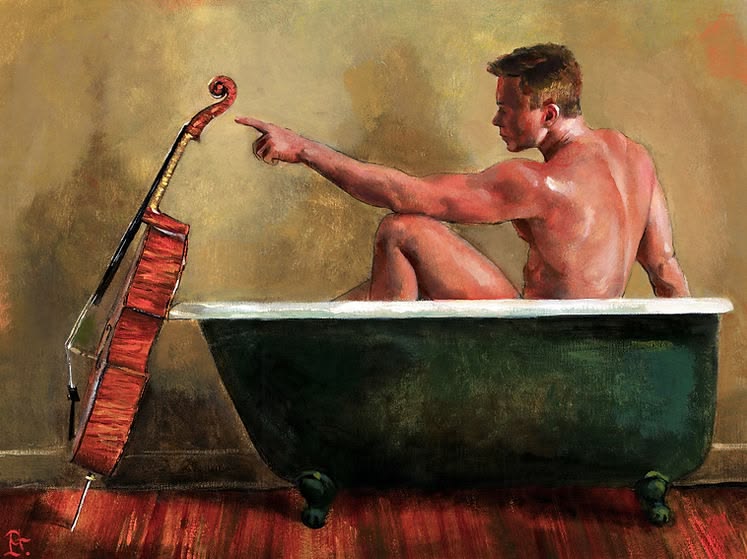
A Cellist Elevated by His Bath: Philip Gladstone (2007)
He had been in there for nearly an hour. Long enough for the water to cool, for the steam to disappear from the mirror, for the afternoon to slip into something approaching evening. He ought to have got out. There were things to do, people who might be waiting. But he had never been particularly good at doing what was expected of him.
Instead, he pointed at the cello.
There is nothing quite so exciting as a young guy in a bath. Especially one who brings his cello.
A Cellist Elevated by His Bath was painted in 2007 by American artist Philip Gladstone, whose work I’m beginning to think deserves considerably more attention.
Born in Philadelphia, Gladstone is known for his evocative figurative paintings, often featuring the male nude as protagonist, muse and general cause of distraction. He now paints full-time in a renovated barn studio at his antique farmhouse in rural Maine. Not a bad setting for an artist with such a particular eye for the male form.
This painting belongs to his long-running Tubs Series, in which bathers, animals and assorted objects find themselves in antique tubs that feel less like bathroom fixtures and more like protective, womb-like spaces. The results are surreal, dreamlike and just a little absurd.
And then there is the cello. The pose. The pointing finger.
I have questions. But I’m not sure I want answers.
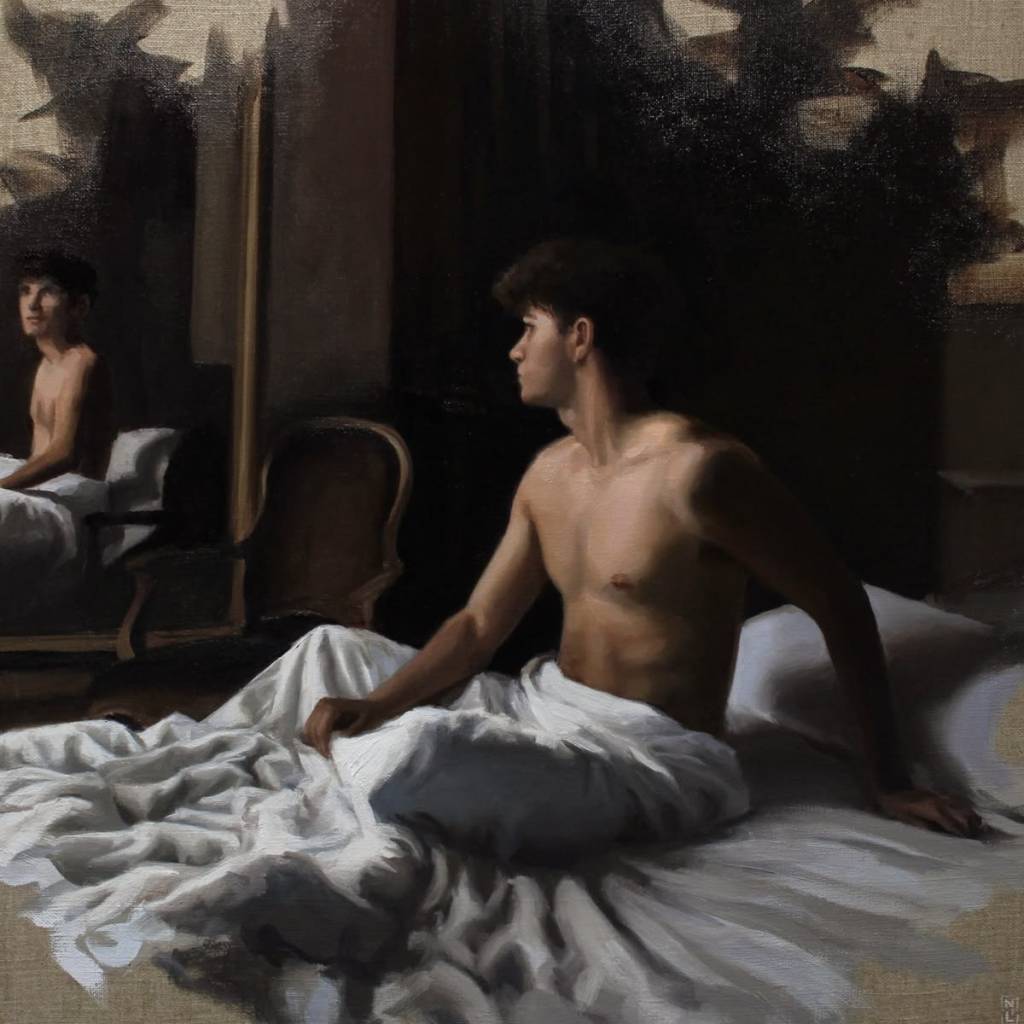
Després del somni (After the Dream): Nil Masip Boget(2025)
It makes you sick, doesn’t it?
Here’s someone who is only twenty years old, extremely good looking — and, annoyingly, an amazing artist too.
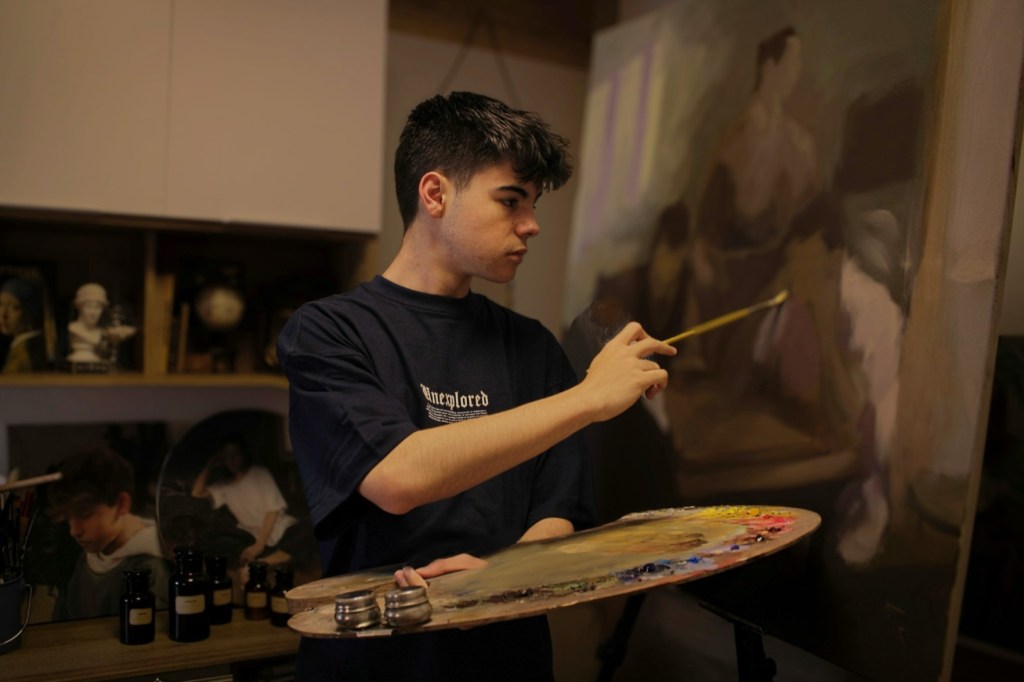
Barcelona-based Nil Masip Boget is a classical and figurative painter who trained at the Barcelona Academy of Art and Acadèmia La Gràcia. He has already won several awards, and his work is now held in public and private collections across Europe and the USA. He has also just had his first solo exhibition, sense por d’oblidar, at Inéditad Gallery in Barcelona.
He works mainly in oils, using light, colour and texture to create paintings that feel quiet and introspective. There is often a sense of silence in his work — moments caught somewhere between thought, memory and dream.
Després del somni (After the Dream) was the last oil painting he completed for Happiness Journey, a contemporary art exhibition held in Barcelona last year.
It shows a shirtless young man sitting on a bed, wrapped in crumpled white sheets. He looks away from us, towards the right of the canvas, while a mirror on the far left gives us a second, more distant view of him.
It is a beautifully strange composition. The dark background seems to remove the outside world altogether, leaving the boy suspended in some private, timeless space between sleep and waking. The mirror adds another layer — self-reflection, vulnerability, perhaps even the feeling of watching yourself from outside your own body.
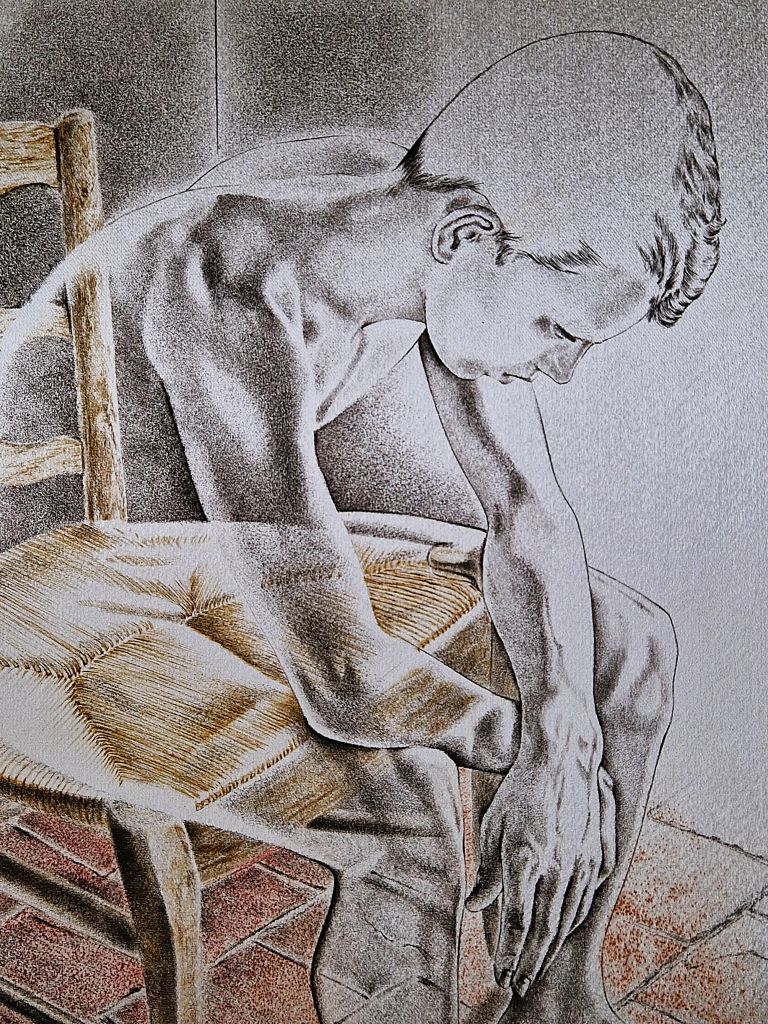
La Ville dont le prince est un enfant: Raymond Carrance (1967)
Raymond Carrance, working under the name Czanara, created a quietly intriguing body of homoerotic work during the 1950s and ’60s.
Much of it was private: drawings, engravings and photographs of male youth, sensuality and those strange, dreamlike worlds where beauty and desire tend to get a little blurred.
Carrance (1921–1998) was hardly a one-subject artist, though. He produced elaborate etchings and lithographs for works by Jules Renard and Cyrano de Bergerac, as well as illustrating a 1951 play by Henry de Montherlant, La Ville dont le Prince est un Enfant — The City Whose Prince is a Child.
And this is where things get interesting.
Montherlant’s play is set in a strict Catholic boys’ school before the Second World War. At its centre are André Sevrais, an older pupil; Serge Souplier, the younger boy with whom he forms an intense friendship; and the Abbé de Pradts, a school prefect whose feelings towards Souplier become increasingly complicated.
All the things a Catholic boys’ school presumably hoped to keep out of sight.
Carrance illustrated a 1967 edition of the play with a series of delicate, highly charged images. Knowing something of his private work as Czanara, the choice feels less than accidental.
The title itself comes from Ecclesiastes: “Woe to thee, O land, when thy king is a child.”
A rather ominous little biblical quotation for a book about boys, priests, desire and forbidden attachments.
And Carrance seems to have understood exactly how much could be said without saying very much at all.
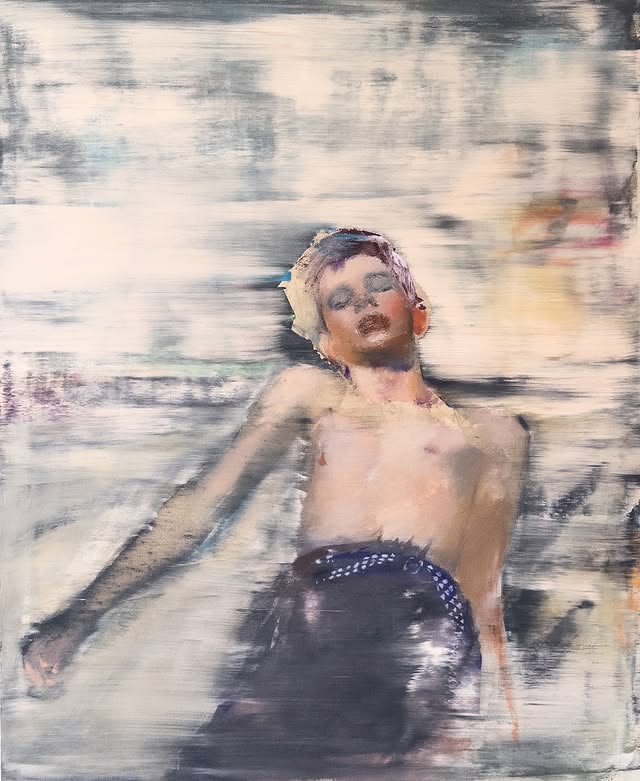
Reclining Boy was featured at the VCRB Gallery in Antwerp, Belgium, as part of Eugene Shako’s collective exhibition titled Silent Narratives, which ran from April 28 to June 7, 2026.
Stillness. Closed eyes. Wet hair. Bare skin. The world rushing around him. He doesn’t seem to care. There is something beautiful about that. Perhaps it is the vulnerability. Perhaps it is the arrogance of youth. Or perhaps I simply want to lie beside him and watch the world disappear.
There’s something about Shadko’s paintings that blurs reality with imagination.
The longer I look, the more I see.
And sometimes I wonder if I am seeing something that nobody else sees.
Shadko is a Belarusian artist living and working in Warsaw. His paintings begin with images — photographs, social media, something glimpsed online, something that catches his eye. He takes these fragments and passes them through himself. He studies them. Distorts them. Reimagines them.
Nothing remains quite as it was.
His paintings are often about faces and bodies. Youth. Vulnerability. Isolation. That strange fragility of adolescence.
His figures seem to exist somewhere outside reality. Alone. Spotlighted. Suspended in an imaginary world.
And perhaps that is what draws me in.
The feeling that there is something just beneath the surface.
Something I can see.
Something you might not.
Shadko studied at the Glebov Art College in Minsk and the Nicolaus Copernicus University in Toruń, Poland.
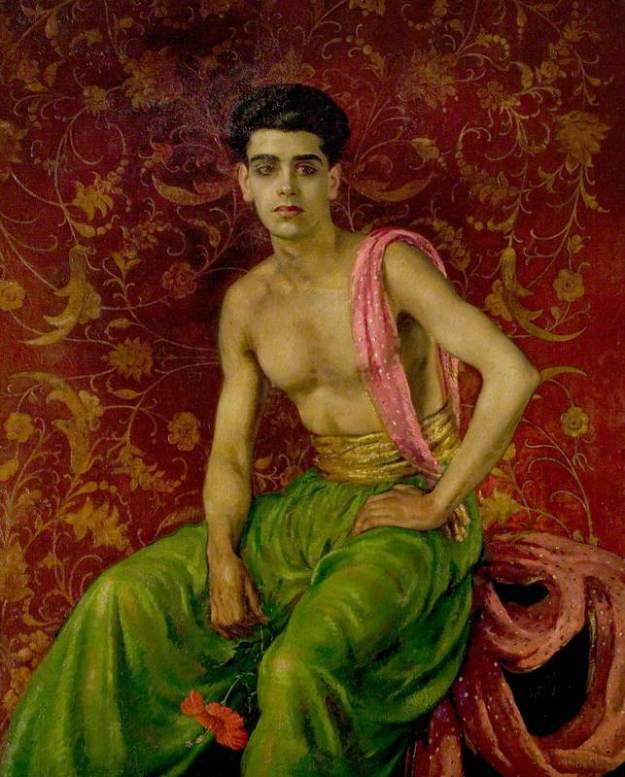
“A half nude youth of splendid beauty faces the spectator, wearing Oriental breeches of green, with a sash of gold, and a drapery of magenta — all this splendour relieved against a figured background of dark red and gold. The scarlet hibiscus flower, held ever so languidly by the golden youth, is intended to constitute the climax of all this Oriental glory.”
That was how The Scarlet Hibiscus was described when it was exhibited at the Modern Society of Portrait Painters exhibition at the Royal Institute, Piccadilly, in 1922. The artist was Edinburgh-born William Bruce Ellis Ranken.
The painting remained in Ranken’s private collection until his death in 1941, when his collection was dispersed among public museums and galleries across Britain.
Standing almost two metres tall in its frame, The Scarlet Hibiscus was eventually donated to Nottingham Castle Museum by Ranken’s sister, Janette. It has been known there ever since as Hibiscus Flower.
The identity of the sitter remains something of a mystery. Ranken’s sister suggested that he might have been the British ballet dancer Anton Dolin. The sitter’s darker complexion would seem to argue against that identification, although Ranken was hardly above exercising a little artistic licence.
Whatever his identity, the young man is unmistakably the star of the picture. This is male beauty turned into spectacle: highly stylised, intensely decorative and with a sensual concentration on the male form. It is precisely the kind of work that makes Ranken so fascinating today, particularly as questions surrounding his sexuality have become increasingly part of the discussion of his art.
Much of Ranken’s work was destroyed during the Second World War, while the fashionable world that had once embraced his particular brand of glamour had already begun to move on. By the time he died, his social and financial fortunes had considerably diminished.
Yet perhaps the most interesting thing about Ranken is how differently we see him now. Once regarded largely as a society portraitist whose moment had passed, he is increasingly being recognised as a pioneering queer British artist — and as a painter who was quite prepared to celebrate the beauty of the male body.
Mark Morrisroe, Self-Portrait with Broken Finger, Christmas 1984
I would have fallen in love with him. No doubt about that. And he would have ruined my life.
But that never happened.
A bullet rolled out of his ashes. Shot in the back at seventeen. That was all that remained.
Myles Vale
Mark Morrisroe (1959-1989) was an influential American photographer, performance artist, and filmmaker who served as a central figure in the Boston punk scene of the 1970s and the New York art boom of the 1980s. When he was 17 years old, he was shot in the back, leaving him with a bullet lodged next to his spine for the rest of his life. He died of AIDS complications. His last words to his friends were “take my photo”. On the second click of the shutter he was gone.
A twenty-something with soft, youthful features and a quiet demeanour. He is highly desirable; his image has become an indelible symbol of Californian beauty and desire.
There is a problem.
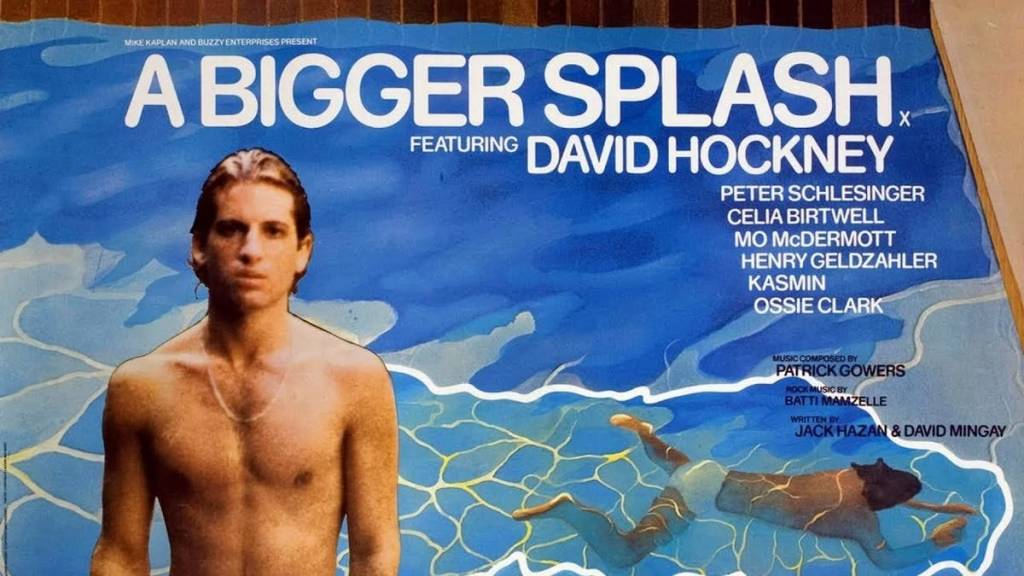
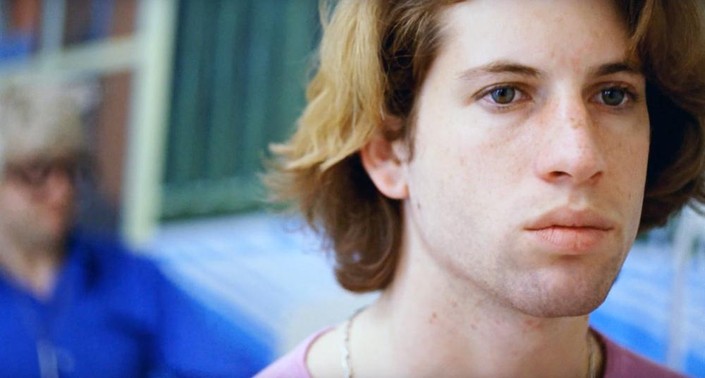
A Bigger Splash, directed by Jack Hazan, was a groundbreaking film that merged documentary with scripted drama to explore a poignant period in David Hockney’s life between 1971 and 1973.
Released in 1974, A Bigger Splash chronicles the emotional fallout and creative struggle that followed Hockney’s devastating break-up with his young partner and muse, Peter Schlesinger. It received mixed reviews, with Private Eye dismissively referring to it as A Bugger’s Pash.
And yes, I have fallen in love with Schlesinger as he was more than fifty years ago.
In the film we see Schlesinger, clad only in white briefs, dancing with himself before an easel. He gets it on with a friend, the actor Eddie Kalinsky, skinny-dips with a pool full of twinks, and later swims alone, completely naked, before climbing out and revealing everything we wanted to know.
He was a handsome fellow with long, floppy hair, and Hockney was understandably devastated to lose him. In retrospect, A Bigger Splash is a remarkable piece of filmmaking, freezing Schlesinger in time.
He was in his mid-twenties and was rumoured to have agreed to appear only during the final months of production, and only if he was paid.
Hockney was said to have been “utterly shattered” by A Bigger Splash and allegedly offered Hazan $20,000 to destroy it.
These old films play tricks on us. They invite us into an imagined one-to-one connection, creating the illusion that we know the subject’s true personality. We fill the historical gaps with our own desires, values and fantasies. In effect, we create the perfect partner.
But it is a one-sided, unreciprocated affair. It gives us the experience of romantic love and emotional attachment without the risk of rejection or conflict. He can never disappoint me, change his mind, or break the spell of his visual perfection.
Schlesinger became the myth of the eternal muse.
There is another problem.
Our minds struggle to comprehend the ageing process, and the fact that Schlesinger is alive and well, now approaching eighty, threatens to shatter that myth.
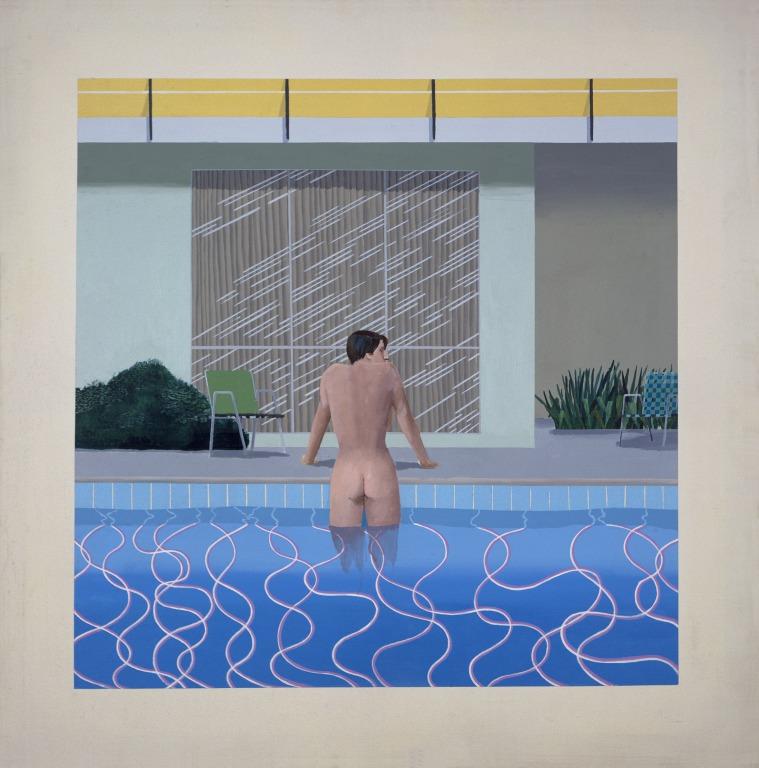
Schlesinger was born in 1948 in Encino, in California’s sun-drenched San Fernando Valley, the son of an insurance agent and a social worker. He studied drawing at UCLA and, in 1966, aged eighteen, met Hockney, who was teaching a summer class. He soon became the subject of one of Hockney’s best-known paintings, Peter Getting Out of Nick’s Pool.
He had stepped into an unfamiliar world, and who could have blamed him? Suddenly he was socialising with museum curator Henry Geldzahler and art dealers Nicholas Wilder and John Kasmin, while also befriending novelist Christopher Isherwood and artist Don Bachardy.
After graduating, Schlesinger moved to London with Hockney and enrolled at the Slade School of Fine Art. There he was introduced to Hockney’s bohemian circle, including the designer duo Ossie Clark and Celia Birtwell.
Hockney and Schlesinger were together for three years, and it was fortunate that Hazan chose the period of their separation as the backdrop for his documentary.
The question I kept asking myself was simple: why did the relationship end?
By then Hockney was in his thirties, and the imbalance in both age and influence inevitably played its part. Schlesinger struggled to establish an identity of his own while living within Hockney’s enormous social and professional orbit.
There was also the suggestion that Hockney became consumed by his work, leaving Schlesinger isolated, waiting for an artist who often seemed to prioritise the canvas over the relationship.
The cracks had already appeared.
The most convincing explanation, however, is that Schlesinger had fallen in love with someone closer to his own age—someone equally beautiful.
Schlesinger met the Swedish-born design student Eric Boman in March 1971 at Mr Chow’s restaurant in Knightsbridge. Following the London premiere of Visconti’s Death in Venice, Paloma Picasso invited Boman, Manolo Blahnik and Andy Warhol’s business partner Fred Hughes to dinner with Hockney and Schlesinger.
Hockney later regretted deciding not to attend.
“David was not interested,” recalled Boman, “so this adorable boy turned up at our table in a camel hair Ossie Clark coat.”
Schlesinger said it was love at first sight.
The final straw came a few months later during a group holiday in Cadaqués, Spain, where Schlesinger and Boman met again. Fatigued by constant drama, emotional claustrophobia and the pressure of being Hockney’s primary visual obsession, Schlesinger found himself drawn ever closer to Boman.
“Peter came with David Hockney and notoriously stayed on, causing their real dramatic and public break up. It was considered best that Peter and I go home, and we left at the crack of dawn in Ossie Clark’s Bentley, hoping to spend a night at Tony Richardson’s on the way, but he’d have none of it out of solidarity to DH. So we ended up at Mick and Bianca’s (Jagger). The next morning, Ossie put us on a train at Sainte-Anne, and since we had no reservations, the conductor let us stand in the corridor all the way to Paris in our swimsuits – the beginning of our new life.”
Hockney sank into depression and responded with bitterness and jealousy. In A Bigger Splash, he remarked that he might consider destroying the ‘Peter’ works. But, in fairness to Hockney, and all others who had lost their first love, who could have blamed him.
It took Schlesinger a long time to escape Hockney’s emotional pull. Jack Hazan later recalled in a Vice interview that Hockney would entice Schlesinger back under the pretence of painting him, simply so he could be near him. Schlesinger reportedly found this both “petulant” and “suffocating”, and longed to escape Hockney’s web.
One of the most important paintings from this period—and one that features in A Bigger Splash—is Portrait of an Artist (Pool with Two Figures). In 2018 it sold at auction for a record-breaking $90 million.
“I don’t even think it’s a portrait of me, really,” Schlesinger said. “The figure standing beside the pool was a solution to a ‘conceptual’ problem, regarding composition and light, rather than an outpouring of romantic longing.”
After the break-up, Schlesinger moved into his own studio around the corner from Hockney. His relationship with Boman involved a lengthy commute between Notting Hill and Battersea by bus and bicycle.
Alongside painting, Schlesinger had always been interested in photography, but it was Boman who made a career from it. After borrowing Schlesinger’s Pentax camera, he became highly sought after for his art, fashion and society photography.
“Eric is very methodical and likes setups. I just snap pictures and he doesn’t understand that,” Schlesinger once said.
Eric Boman
During the 1980s Schlesinger also became disenchanted with painting and turned instead to ceramics, an art form he continues to pursue.
The couple moved to New York in 1978 and, a year later, settled in a tenth-floor loft where the Flatiron District meets Chelsea, in a building that had once housed a girdle factory. Four years later they bought a mid-nineteenth-century Greek Revival house near Bellport on Long Island, where they spent their summers.
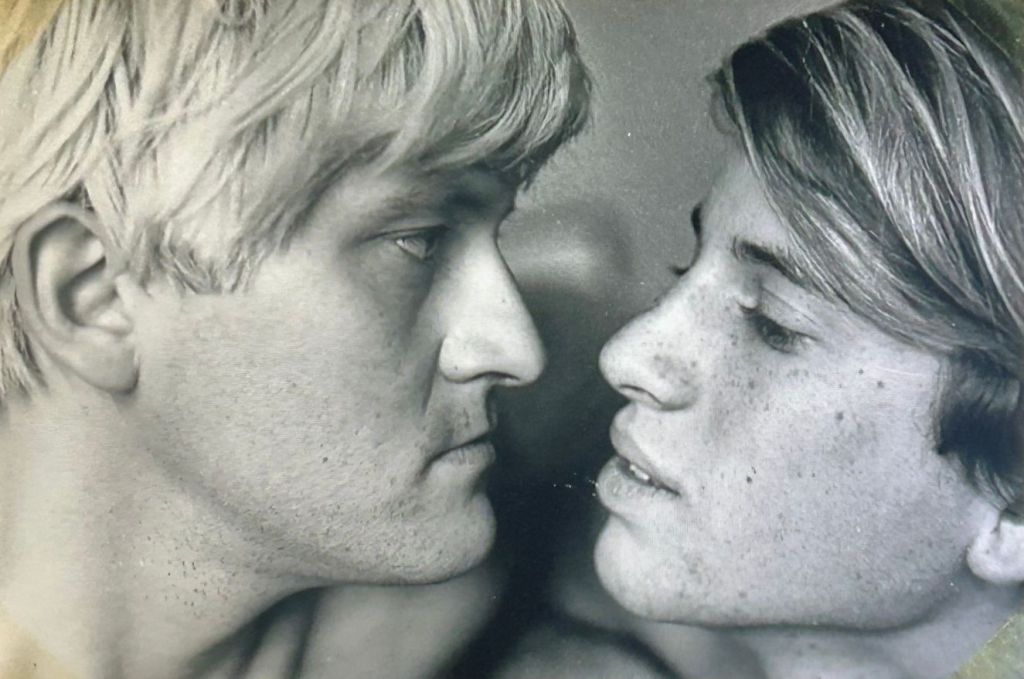
Schlesinger and Boman remained together for fifty-one years, with Hockney once referring to them as a “couple of old maids.”
Eric Boman died of pancreatic cancer in 2022.
In recent years Schlesinger said he had no contact with Hockney and, referring to A Bigger Splash, reflected: “It’s not about me. It’s so long ago, it’s like a different person.”
But Schlesinger is like a painting in a museum.
Perhaps the only way to live forever is inside a work of art, and Schlesinger’s life remains preserved in Hockney’s paintings and, to some extent, in A Bigger Splash.
It is vintage media: a pre-digital art world, a lost world of effortless style, leisure and raw creativity.
And I am still in love with the young Peter Schlesinger.
Peter Getting Out of Nick’s Pool. David Hockney (1966)
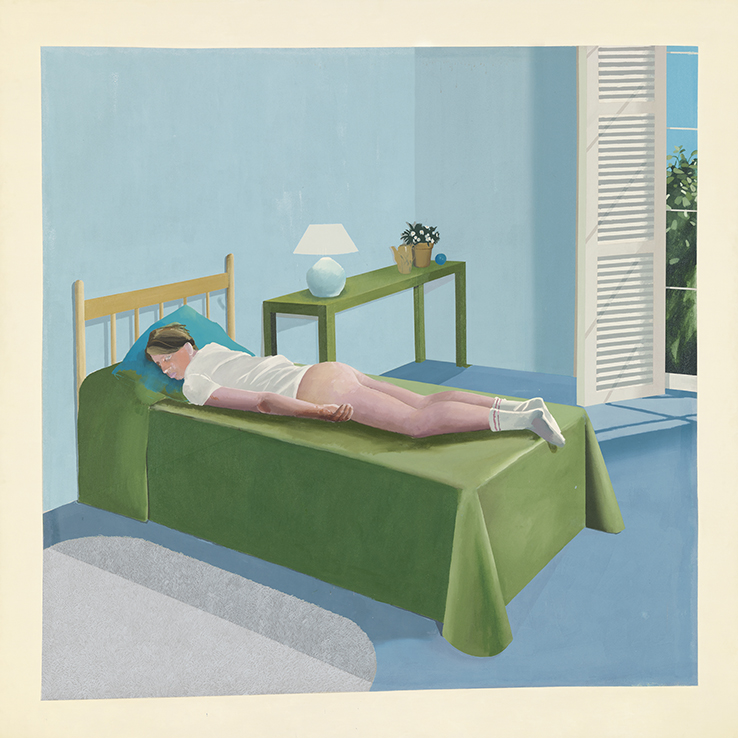
The Room, Tarzana. David Hockney (1967)
The last word. Peter Schlesinger’s Instagram post after Hockney’s death.
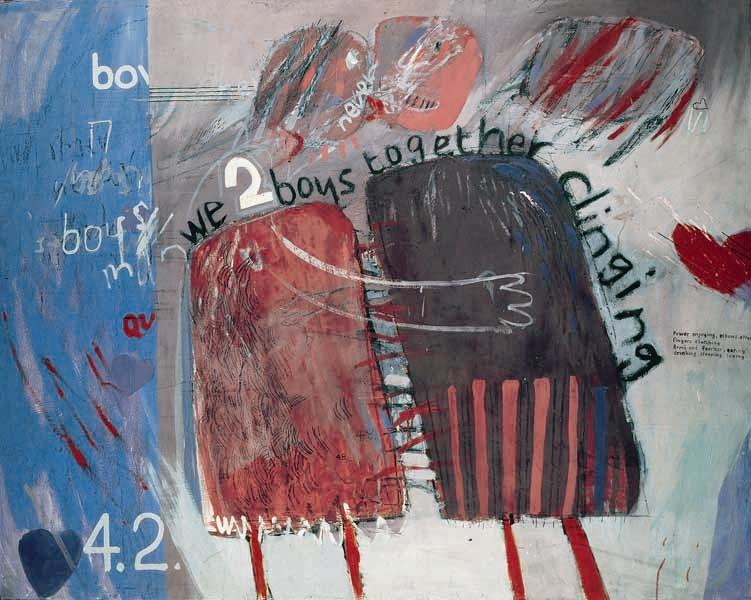
We Two Boys Together Clinging. David Hockney (1961). Its name derives from a poem by Walt Whitman and two lines from it are scribbled to the right. It also references a newspaper clipping detailing a climbing accident – ‘Two Boys Cling to Cliff All Night’ which Hockney interpreted as an illusion to his idol, Cliff Richard. (Arts Council Collection)
On the life of David Hockney… A strange thing happened. I mentioned to a friend that I wanted to watch A Bigger Splash — the 1974 documentary about the artist David Hockney, in which his lover of three or four years, Peter Schlesinger, leaves him during filming.
I still hadn’t watched it, and the following day, it was announced that Hockney had died at the age of 88.
The news reminded me of a few years ago when I was given a Hockney print, Two Boys Clinging Together. I made a convincing show of being overwhelmed by it, but the truth was rather different. The print never made it onto the wall; to my eye, it looked like something I might have painted when I was four. His work never entirely won me over.
That said, I have always liked his California pool paintings from the 1960s and 1970s, although nobody has ever bought me one. My favourite is Peter Getting Out of Nick’s Pool (1966), which depicted the 19-year-old Schlesinger climbing from a swimming pool at the Hollywood apartment block where art dealer and gallery owner, Nick Wilder, lived.
I spent a few hours reading about Hockney — a man who, if I am honest, irritated me immensely. His dour Yorkshire monotone seemed at odds with the loud bow ties, red braces and trademark spectacles. He occupied the same corner of my imagination as the writer Alan Bennett; the two could almost have been twins. Yet it is impossible not to admire his courage. He was painting gay love at a time when homosexuality was still effectively illegal in Britain.
America held a particular attraction for him:
“I must admit, I’d begun to be interested in America from a sexual point of view; I’d seen American Physique Pictorial magazines when I first came to London. And they were full of what I thought were very beautiful bodies. I painted Domestic Scene from a photograph in Physique Pictorial, where there’s a boy with a little apron tied around his waist, scrubbing the back of another boy in a rather dingy American room; I thought, ‘That’s what a domestic scene must be like there.’”
But my favourite Hockney quotation comes from David Hockney in Paris, a BBC documentary from 1975:
“Men in white socks are very sexy. White tee-shirts are quite sexy, but not so sexy as socks.”
Peter Getting Out of Nick’s Pool. David Hockney (1966).
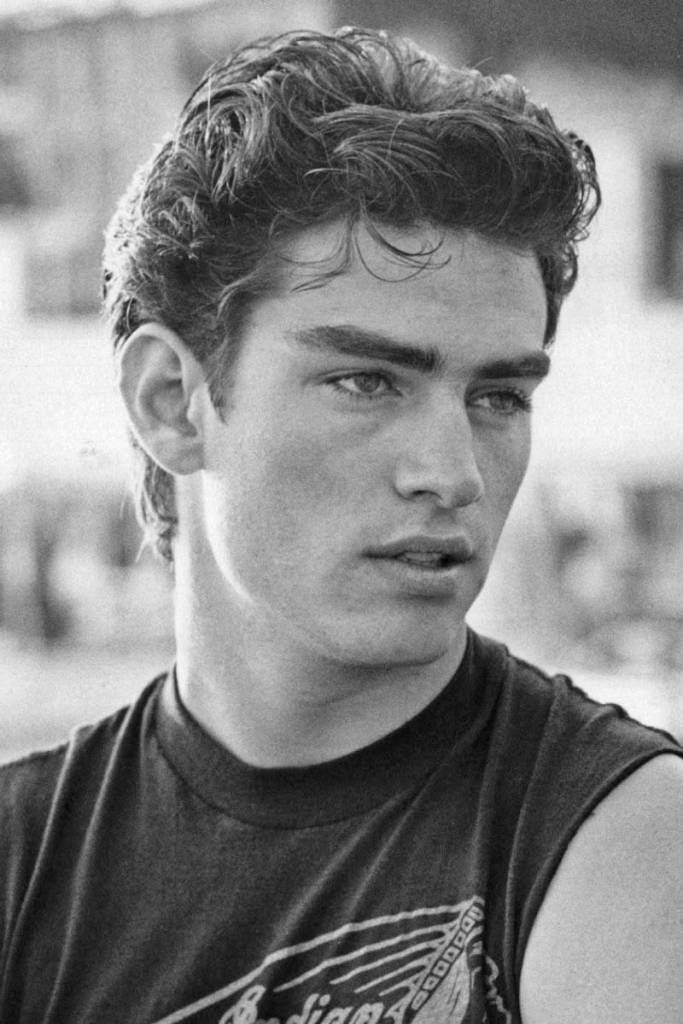
Rodney Harvey (1967–1998) was an American actor, dancer, and model celebrated for his appearances in critically acclaimed 1990s films like My Own Private Idaho.
On good looking guys who died young… It is an unhealthy fascination. I have a curious interest in those young guys who left us too soon. I have a list of the unfortunates and will get to them in future posts. But the list is tragically long. There’s something mythic about it. At the height of beauty, talent, or promise, they stop aging while we keep going. They are fixed in our memory and will never change; permanently charged with youth and possibility. Although, there are too many stories where death came about due to self destruction – the doomed poet, the tragic actor and the brilliant addict. I mourn them all and kid myself that if I’d been around them their fate might have been different.
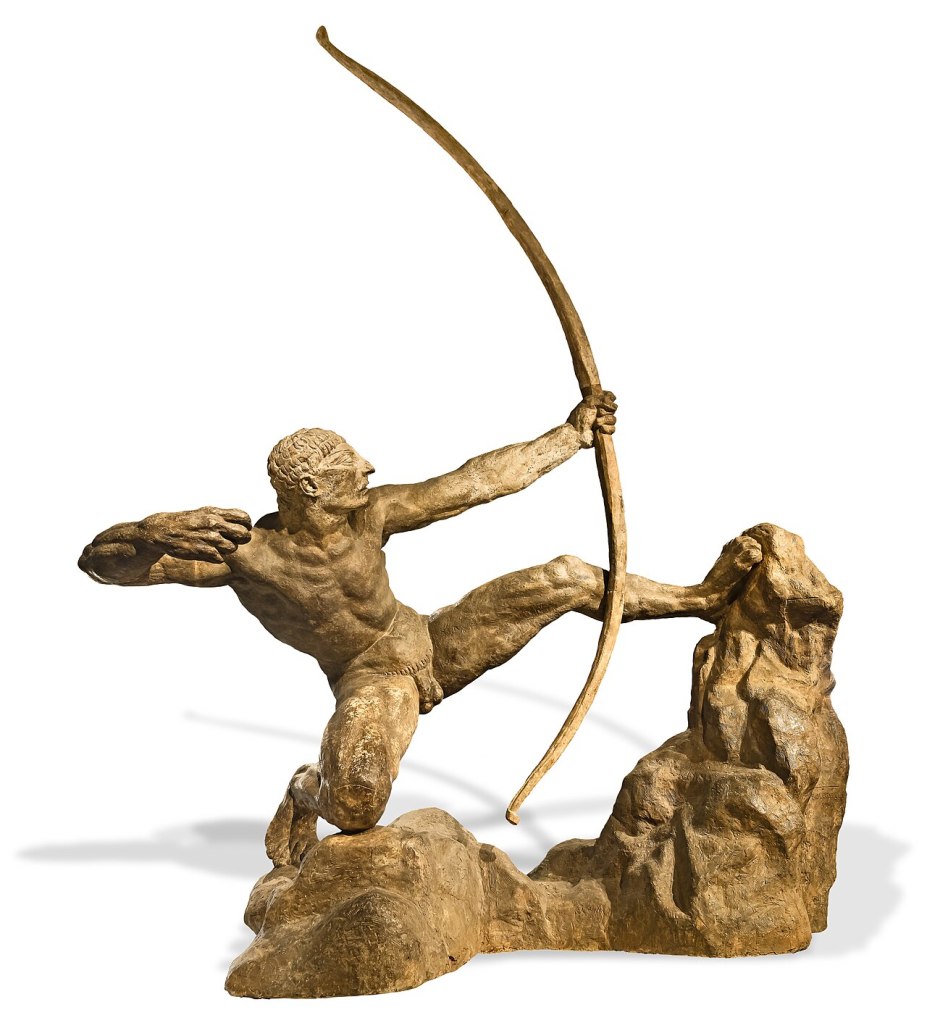
Héraklès Archer – Hercules the Archer . Antoine Bourdelle (1909) .
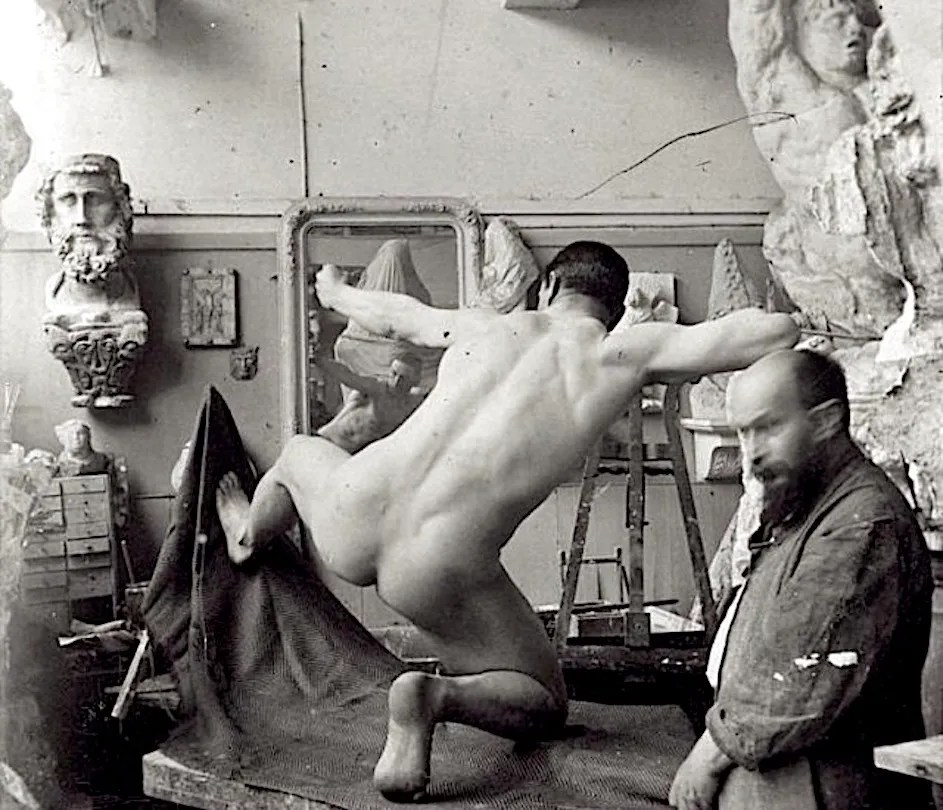
On a sculptor and a real-life model… I’m not entirely sure I like the sculpture, but I’m fascinated by how it was created. Hercules the Archer (1909), by the French sculptor Antoine Bourdelle (1861-1929), now exists in several versions, although it was originally commissioned by the financier and philanthropist Gabriel Thomas as a unique work.
Bourdelle modelled the sculpture in clay during the summer of 1909, using his friend Paul Gustave André Doyen-Parigot (1854–1916), a captain in the French Army, as his model. An accomplished sportsman, Doyen-Parigot possessed the physical strength and athleticism required for the pose. The dramatic extension of the body and the intense muscular tension of archery allowed Bourdelle to emphasise the model’s powerful physique.
At Doyen-Parigot’s request for anonymity, however, Bourdelle altered the head, distancing the finished figure from a direct portrait and transforming it into the heroic image of Hercules.
Paul Gustave André Doyen-Parigot modelling for Antoine Bourdelle.
On having childhood regrets… What if I had understood what was happening? What if I had been brave enough to acknowledge it? What might have become of us? Would he still have been my best friend?
Why was I thinking about Darren this week? Perhaps because some questions never quite leave us. When he later discovered that I was gay, he drifted out of my life. We have not spoken since.
On finding a poem about Manly Love… Douglas Malloch (1877–1938) was an American poet, short-story writer and Associate Editor of American Lumberman, a trade paper in Chicago.
Manly Love… Deep in your heart understand the love of a man for a man; He’ll go with you over the trail, the trail that is lonesome and long; His faith will not falter nor fail, nor falter the lilt of his song. He knows both your soul and your sins, and does not too carefully scan,— The Highway to Heaven begins with the love of a man for a man!
– Donald Malloch
The poem is preserved in modern literary history as an early piece of Western gay literature. It is notably featured in The Columbia Anthology of Gay Literature, compiled by Byrne R. S. Fone. It was also collected in historic specialty anthologies such as Men and Boys (edited by Edward Mark Slocum), which curated historical verses exploring Greek love, male friendships, and same-sex devotion across different eras.
David and Joshua left London behind and headed south-west. It was something they did every year before the tourist masses descended upon Cornwall. They hired a car and stayed in a holiday cottage on the edge of Bodmin Moor. It formed part of a working farm and had once belonged to the Lanhydrock estate and, like so many great houses with dwindling fortunes, it had been sold off more than a century earlier. Now it belonged to a farming couple who had converted the redundant outbuildings into holiday accommodation.
David always wrote well in the Cornish countryside, where the only sounds came from sheep, cattle, and the wind crossing the moor. While Joshua slept until lunchtime, David sat at the kitchen table with his laptop and worked. Several of his novels had been conceived there, and he could easily write chapters at a stretch while new ideas arrived effortlessly. The spell would only be broken when Joshua eventually emerged, bleary-eyed and searching for his first caffeine fix of the day.
Joshua wandered into the room wearing only his underwear, his hair tousled and dark stubble shadowing his chin. This was David’s favourite version of him: unguarded, still carrying traces of boyishness, utterly unconcerned with how he looked.
“What are we doing today?” Joshua asked, as though David possessed the answer to everything.
But the plan had already been decided the night before: they were going to Falmouth.
Only in recent years had they fallen in love with the town. They had visited once before and been underwhelmed, but David’s growing fascination with Henry Scott Tuke had drawn them back, and gradually Falmouth had worked its charm upon them.
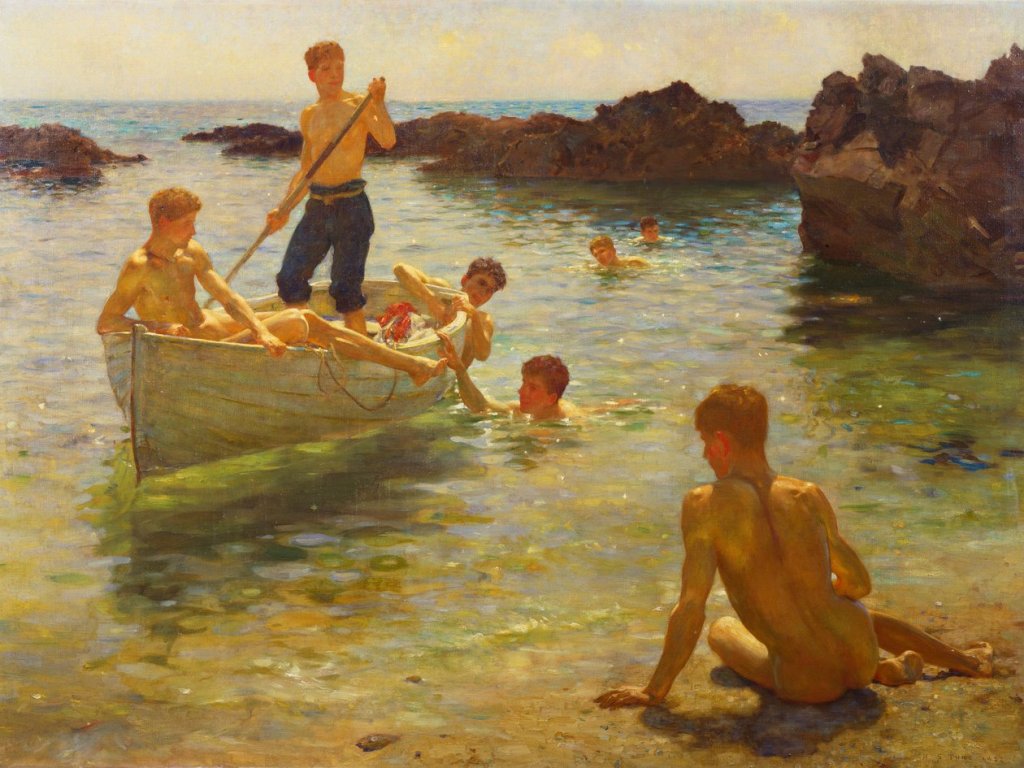
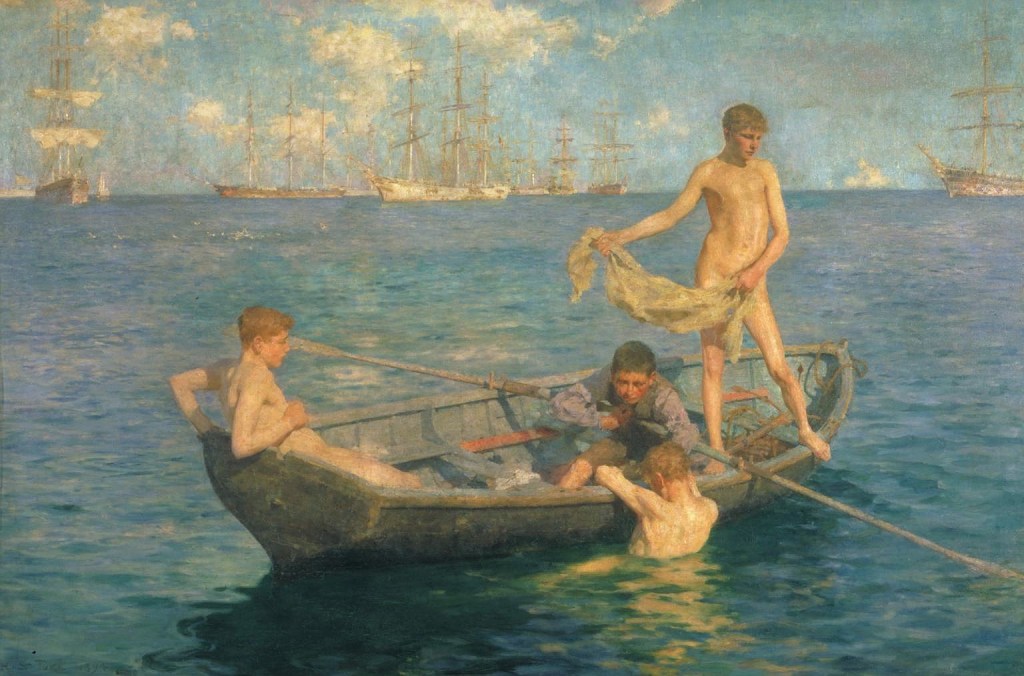
The story of Henry Scott Tuke fascinated David. For years he had encountered the paintings without consciously realising it. He had always been drawn to those bright, sunlit depictions of naked young men on beaches and boats. He had first noticed one in an art gallery and then began spotting others across the country. Tuke’s work seemed to exist everywhere now — reproduced on book covers, sold as canvas prints online, endlessly circulating through the internet. In death, he had become far more famous than he had ever been in life.
Once, David and Joshua had been fortunate enough to view The Tuke Collection in the archives of Falmouth Art Gallery. Together they examined more than two hundred canvases rarely seen by the public. That had been the moment Joshua fell in love with the paintings too.
Since then, David had tried to learn everything he could about Tuke and had managed to acquire almost every book written about him. He dreamed of owning an original Tuke painting one day, though even with his generous income he knew such a thing would forever remain beyond his reach.
It was nearly two in the afternoon by the time they arrived in Falmouth. After a brief visit to the art gallery, they were delighted to discover that one of Tuke’s paintings was on display: Study of Boys Bathing — two naked young men playing beside a dog.
“It’s a sign,” Joshua remarked, and David was inclined to agree.
But the real purpose of their visit was the grave.
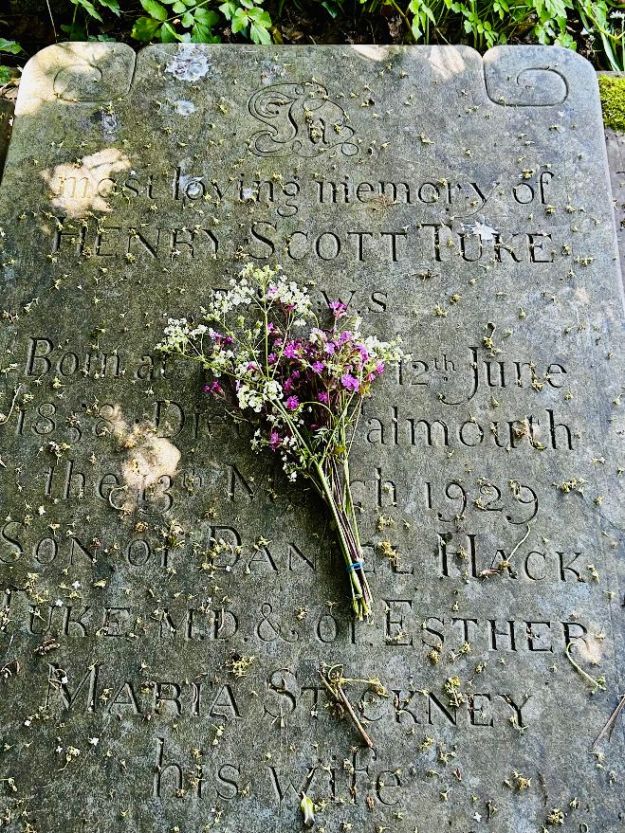
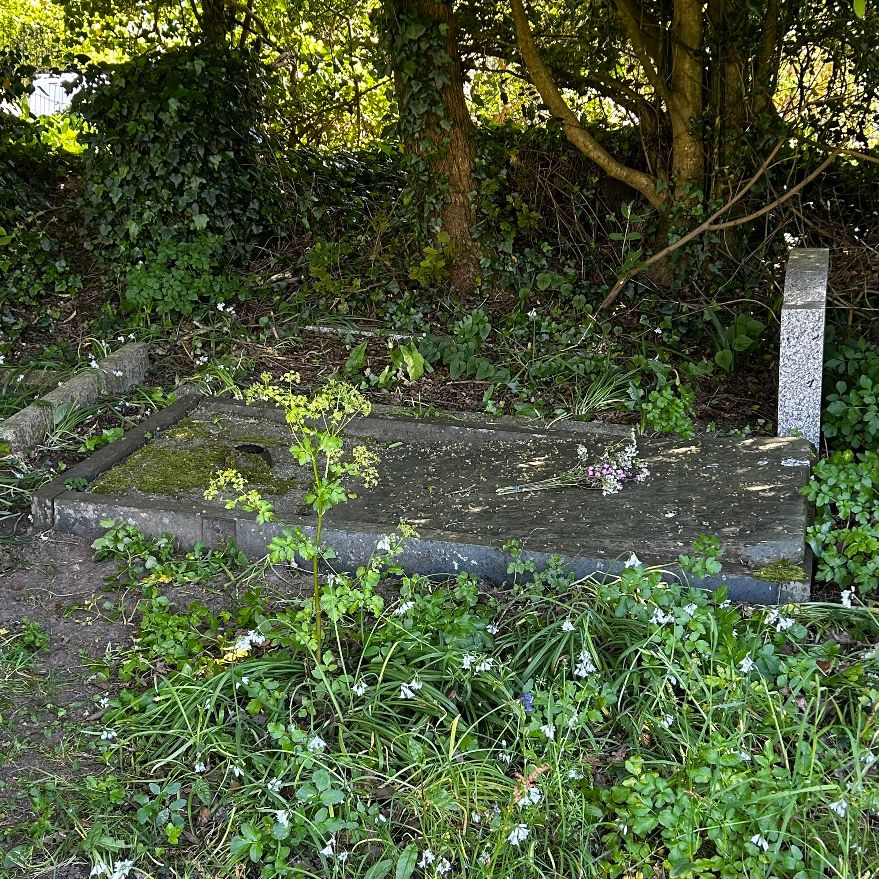
Henry Scott Tuke lay buried in the oldest and highest part of Falmouth Cemetery. The cemetery had been laid out in the 1850s with sweeping views towards Swanpool Beach, where Tuke had lived. Now the place had become overgrown, its once-open vistas obscured by trees and tangled greenery.
David liked graveyards. They offered solitude and a place for reflection.
The early morning rain had given way to sunshine by the time they arrived. They passed a workman digging out an old grave who glanced at them with mild suspicion; few people carried flowers among these neglected plots anymore. These were the forgotten dead. Joshua had picked the wildflowers himself from a lane beside the farm that morning.
Tuke’s grave stood beneath the shadow of sycamore trees in a quiet corner of the cemetery. Joshua laid the flowers upon the flat stone and stepped back while David retrieved a folded piece of paper from his pocket. He began to read aloud. Nearby, the workman paused in his digging to listen to whatever strange ritual these two visitors were performing.
“Under the wide and starry sky, Dig my grave and let me lie; Glad did I live, and gladly die And I lay me down with a will.
This be the verse you ‘grave for me: Here he lies where he longed to be; Home is the sailor, home from the sea, And the hunter, home from the hill.”
The lines came from Requiem, the famous short poem written by the Scottish author Robert Louis Stevenson in 1880, and later used as his own epitaph.
If the dead were capable of hearing, then the words might have carried a certain familiarity. The same poem had been recited by Geoffrey Harrington Sainsbury, one of Tuke’s nephews, during the funeral in March 1929 — the same year David’s father had been born. The mourners had stood beside the open grave, lined with flowers and evergreen branches, while a cold easterly wind swept across the hillside.
David and Joshua knew their little performance beneath the spring sunshine might appear faintly ridiculous to anyone watching, yet somehow it felt like the only fitting tribute they could offer the artist.
“I suspect,” David said, “that not many people make pilgrimages like we do.”
At the back of his mind lingered the forthcoming exhibition of photographs by Wilhelm von Gloeden that he had agreed to help curate. Von Gloeden’s use of adolescent models had already provoked criticism in some circles. David realised some people might now interpret Tuke’s paintings in a similar way, yet he remained convinced that the work was unique — unlike anything else in British art.
“The problem,” he told Joshua, “is that people now see this work as intensely sexual. Tuke’s contemporaries saw something very different. To them, the naked young male body represented innocence — a celebration of youth and vitality. Lithe bodies in sunlight. Escapism. Pastoral beauty.”
Joshua had heard variations of this argument many times before.
“Look at it another way,” he replied. “The male nude has existed in European art since the Renaissance. All Tuke really did was revive that classical tradition.”
“The Victorians had no problem with it,” David said. “They regarded his paintings as healthy and life-affirming. But after his death the work fell out of fashion because his style suddenly seemed too traditional.”
David blamed the First World War. Afterwards, Tuke’s paintings must have appeared hopelessly rose-tinted — relics of a gentler and more innocent world.
“Do you think Tuke was gay?” Joshua asked.
“Without question,” David replied. “But you have to admire him for one thing: there was never a stain against his character. He had homosexual friends, some of whom were publicly disgraced, but nothing ever attached itself to him. Lucky old bastard — spending his life surrounded by beautiful young men.” He paused, glancing back towards the grave. “Did he sleep with his models? Did the paintings satisfy certain urges? We’ll never know. And we have his sister to thank for that.”
“What do you mean?”
“One of life’s great frustrations. If Tuke’s diaries had survived, they might have revealed everything. They would have made extraordinary reading.”
“What happened to them?”
“His sister commissioned a biography and handed over twelve volumes of diaries to the writer. Apparently the finished manuscript shocked her so badly that she refused to publish it. Imagine if it had survived somewhere — forgotten in an attic or archive.” David shook his head. “Instead, she burned almost all the diaries and wrote a sanitised version herself.”
Joshua listened while taking photographs of the grave and the wildflowers with his phone, already preparing the image he would upload to social media later.
“You know,” David continued, “I’d love to write a modern biography of Tuke. But I suspect everything we know about him has already been written. Unless…”
Joshua glanced up.
“Unless I could discover something entirely new. The more I think about it, the real story isn’t Tuke himself — it’s the boys he painted. Imagine being able to trace them. To discover what became of them after the sunlight and the boats and the summers were over.”