Tag Archives: Rodney Harvey

Boys Burn Quiet: Rodney Harvey – Beautiful and Forgotten

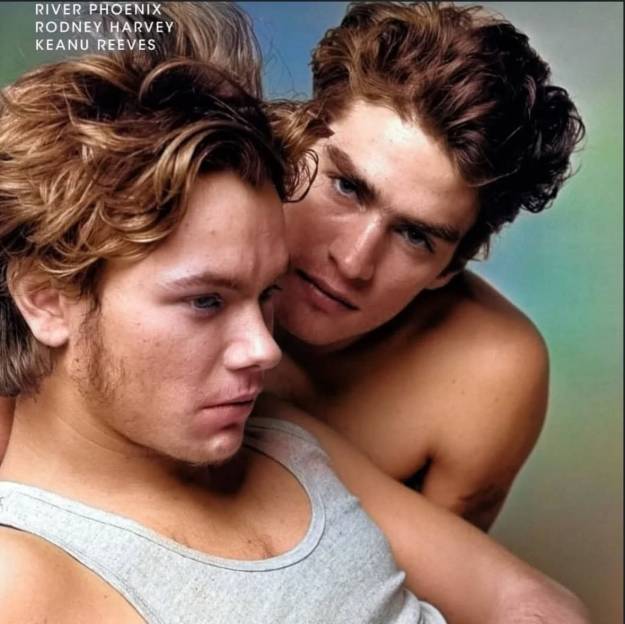
‘The Curse of Idaho’ – River Phoenix with Rodney Harvey

In December 1998, Holly Millea wrote a piece for Premiere magazine about the death of actor and model Rodney Harvey, who had died eight months earlier. It is a long and painful read — almost too painful to finish — but it remains the definitive account of a young man who had everything placed before him and slowly watched it disappear. It was an extraordinary piece of journalism.

Rodney Harvey. A half-Italian, half-Irish boy from the rough streets of South Philadelphia who grew up wanting to be one of two things: an actor or a horse jockey. And when I say he was bad, I mean it in the most endearing sense. If there was trouble to be found, it was usually Rodney who found it. Fighting, petty crime, drugs — the catalogue of youthful misbehaviour seemed to follow him. Yet everybody adored him. He was charming, fearless, mischievous… and impossibly beautiful.

So beautiful that he achieved one of his ambitions almost by accident: spotted on the street while attempting to buy a gun, he was cast as Jose in Mixed Blood (1984), a film about Brazilian drug dealers in Manhattan’s Lower East Side who go to war with a rival Latino gang.

That was the beginning.

Other roles followed in Five Corners, Salsa, Guncrazy, Twin Peaks, and My Own Private Idaho. But perhaps he became best known to a younger audience as Sodapop Curtis in the television adaptation of S.E. Hinton’s The Outsiders.

His looks also made him a favourite of photographer Bruce Weber, who photographed Harvey alongside Madonna for Life magazine and cast him in his Chet Baker documentary Let’s Get Lost. His face was so striking that Calvin Klein used him in a campaign for Obsession for Men.

For a while, there seemed to be no stopping Rodney Harvey.

“He was one of the biggest life-grabbers. I don’t know many people that beautiful and fun and exciting and sensitive and strong and anxious about life,” said his friend Drew Barrymore, who was part of a circle that included David Arquette, Balthazar Getty and Amanda Anka.

Then there were the women — relationships with Lisa Marie, his Salsa co-star Magali Alvarado, and later Roxana Zal. Harvey could attract almost anyone he wanted, but his addictions and destructive behaviour left a trail of pain among those who cared for him.

The life of crime and drugs that had followed him from South Philadelphia eventually returned to claim him.

Some pointed to My Own Private Idaho, Gus Van Sant’s film in which Harvey played Gary, a street hustler. Stories circulated about excess, wild parties and drug use around that period, and some believed that this was when his heroin addiction became impossible to control.

Drugs had always existed in Harvey’s world, but money and fame gave him the means to descend further.

Bruce Weber later recalled photographing the cast of Idaho and noticing a change in Harvey. The brightness remained, but there was a sadness behind his eyes that nobody seemed able to reach.

The so-called “Curse of Idaho” had already claimed the life of River Phoenix in 1993 and became linked, in the public imagination, with Harvey’s own tragic decline.
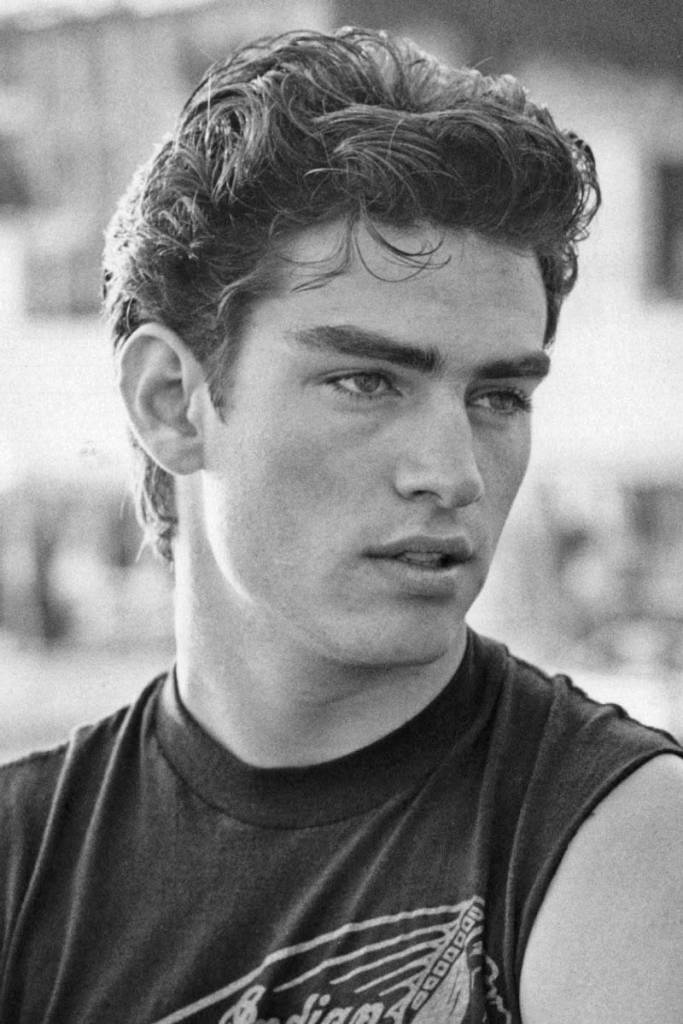
Rodney Harvey (1967-1998)

By the time Guncrazy was released in 1992, Harvey’s reputation in Hollywood had deteriorated. The young man who had once been considered a rising star was now consumed by addiction. He spent his money, stole from friends and strangers alike to support his habit, and was repeatedly arrested. There were stories of wealthy older men who continued to help him, even after he had betrayed their trust — perhaps unable to resist the memory of the beautiful young man he had once been.

Even his appearance changed beyond recognition. The striking face that had graced magazine pages and advertising campaigns disappeared. In its place was a man ravaged by addiction — thin, scarred and physically broken.

Millea’s article contained part of a letter Harvey wrote while serving one of his many jail sentences:

“I knew that the life I was leading was going nowhere. I had spent hundreds of thousands of dollars. My acting career was over, my respect, all my morals, were gone.”

The end came in April 1998.

Harvey checked into a small room at the Hotel Barbizon in Los Angeles. A maid discovered him dead the following morning.

“A pair of black sunglasses lay at his feet on the linoleum floor along with some used syringes, an empty balloon, a hollow metal tube, and the bottom half of a 7Up can sticky with brown residue.”

A spent syringe still hung from his left forearm.

That final attempt to find euphoria, relief and escape had instead become the moment that ended everything.

Perhaps the greatest sadness is that generations who came afterwards barely know that Rodney Harvey ever existed. A young man who was once photographed by the greatest artists of his era, who moved among Hollywood’s brightest stars and who seemed destined for immortality, has largely faded from cultural memory.

And yet that may be his legacy. Rodney Harvey remains preserved in photographs, films and the memories of those who loved him — a haunting reminder of how beauty, talent and opportunity can never, on their own, save a person from themselves. A rose that bloomed brilliantly, withered too soon, but whose brief fragrance still lingers.
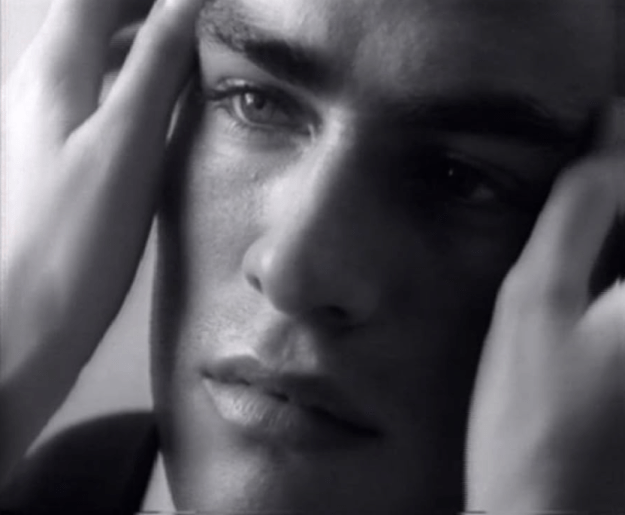
Rodney Harvey for Calvin Klein’s fragrance Obsession (1990)

 My Week, For What It Was Worth

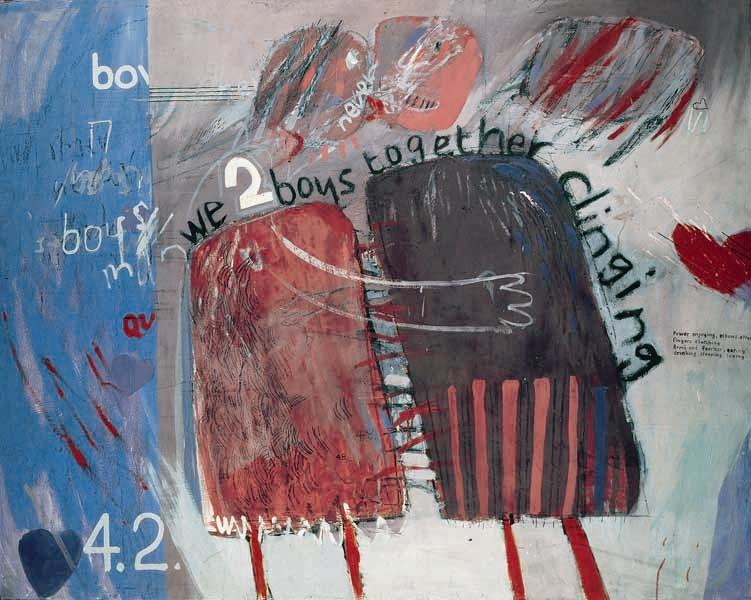
We Two Boys Together Clinging. David Hockney (1961). Its name derives from a poem by Walt Whitman and two lines from it are scribbled to the right. It also references a newspaper clipping detailing a climbing accident – ‘Two Boys Cling to Cliff All Night’ which Hockney interpreted as an illusion to his idol, Cliff Richard. (Arts Council Collection)

On the life of David Hockney…
A strange thing happened. I mentioned to a friend that I wanted to watch A Bigger Splash — the 1974 documentary about the artist David Hockney, in which his lover of three or four years, Peter Schlesinger, leaves him during filming.

I still hadn’t watched it, and the following day, it was announced that Hockney had died at the age of 88.

The news reminded me of a few years ago when I was given a Hockney print, Two Boys Clinging Together. I made a convincing show of being overwhelmed by it, but the truth was rather different. The print never made it onto the wall; to my eye, it looked like something I might have painted when I was four. His work never entirely won me over.

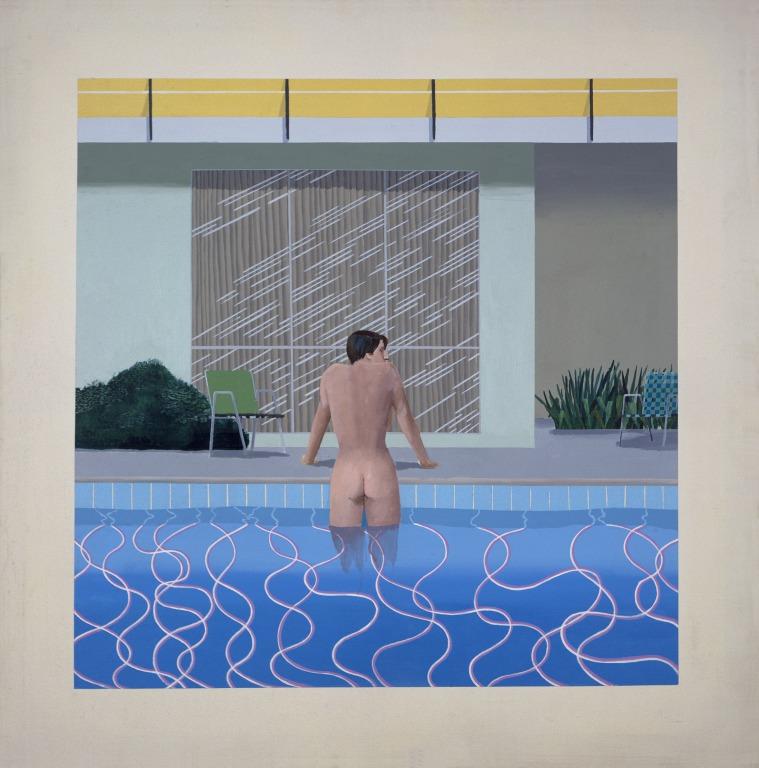
That said, I have always liked his California pool paintings from the 1960s and 1970s, although nobody has ever bought me one. My favourite is Peter Getting Out of Nick’s Pool (1966), which depicted the 19-year-old Schlesinger climbing from a swimming pool at the Hollywood apartment block where art dealer and gallery owner, Nick Wilder, lived.

I spent a few hours reading about Hockney — a man who, if I am honest, irritated me immensely. His dour Yorkshire monotone seemed at odds with the loud bow ties, red braces and trademark spectacles. He occupied the same corner of my imagination as the writer Alan Bennett; the two could almost have been twins. Yet it is impossible not to admire his courage. He was painting gay love at a time when homosexuality was still effectively illegal in Britain.

America held a particular attraction for him:

“I must admit, I’d begun to be interested in America from a sexual point of view; I’d seen American Physique Pictorial magazines when I first came to London. And they were full of what I thought were very beautiful bodies. I painted Domestic Scene from a photograph in Physique Pictorial, where there’s a boy with a little apron tied around his waist, scrubbing the back of another boy in a rather dingy American room; I thought, ‘That’s what a domestic scene must be like there.’”

But my favourite Hockney quotation comes from David Hockney in Paris, a BBC documentary from 1975:

“Men in white socks are very sexy. White tee-shirts are quite sexy, but not so sexy as socks.”

Peter Getting Out of Nick’s Pool. David Hockney (1966).
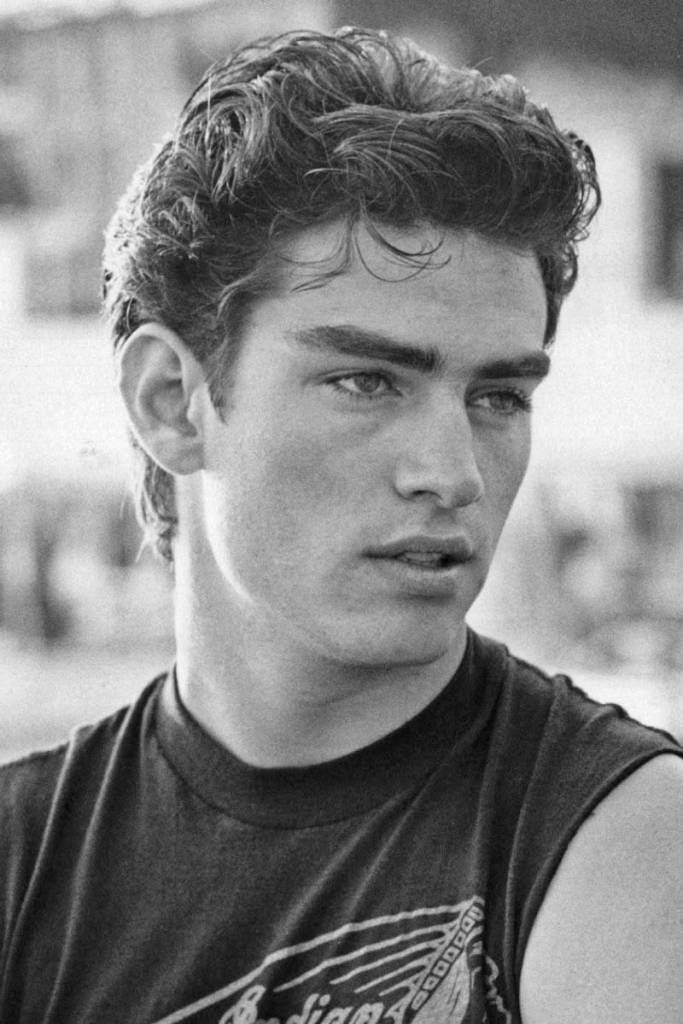
Rodney Harvey (1967–1998) was an American actor, dancer, and model celebrated for his appearances in critically acclaimed 1990s films like My Own Private Idaho.

On good looking guys who died young…
It is an unhealthy fascination. I have a curious interest in those young guys who left us too soon. I have a list of the unfortunates and will get to them in future posts. But the list is tragically long. There’s something mythic about it. At the height of beauty, talent, or promise, they stop aging while we keep going. They are fixed in our memory and will never change; permanently charged with youth and possibility. Although, there are too many stories where death came about due to self destruction – the doomed poet, the tragic actor and the brilliant addict. I mourn them all and kid myself that if I’d been around them their fate might have been different.

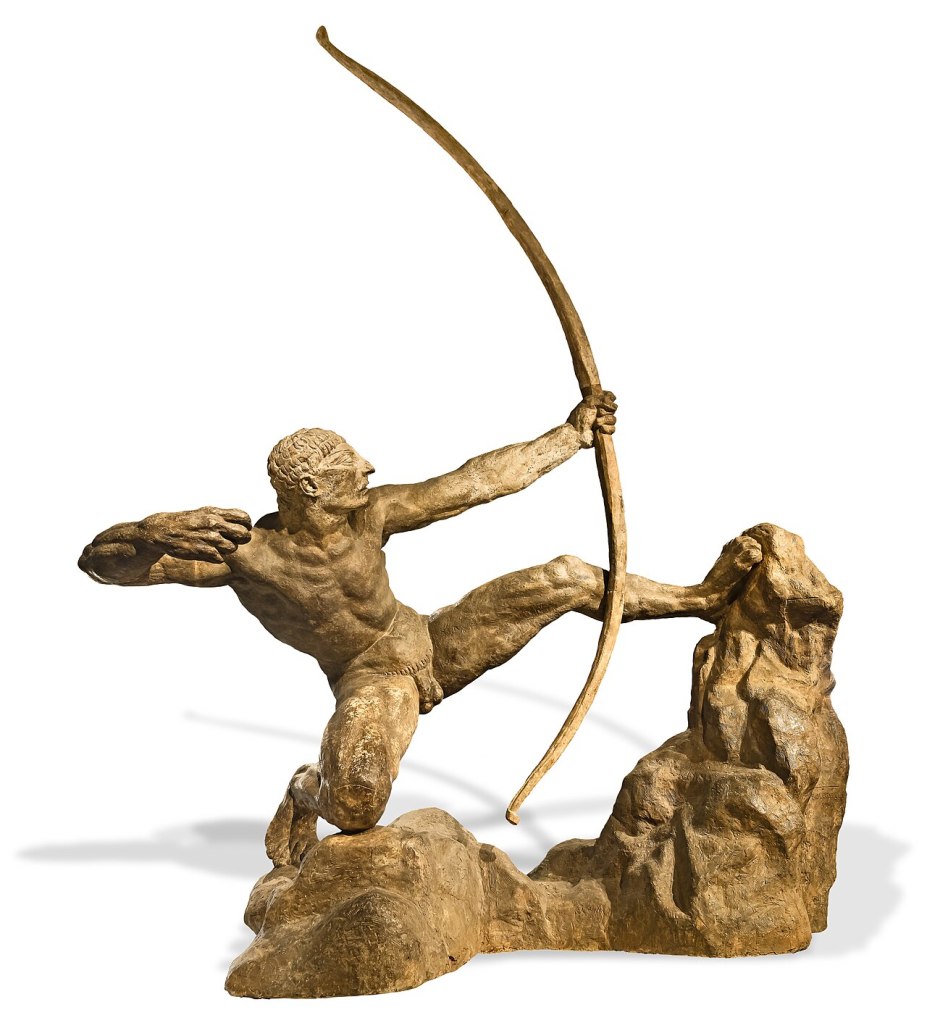
Héraklès Archer – Hercules the Archer . Antoine Bourdelle (1909) .

On a sculptor and a real-life model…
I’m not entirely sure I like the sculpture, but I’m fascinated by how it was created. Hercules the Archer (1909), by the French sculptor Antoine Bourdelle (1861-1929), now exists in several versions, although it was originally commissioned by the financier and philanthropist Gabriel Thomas as a unique work.

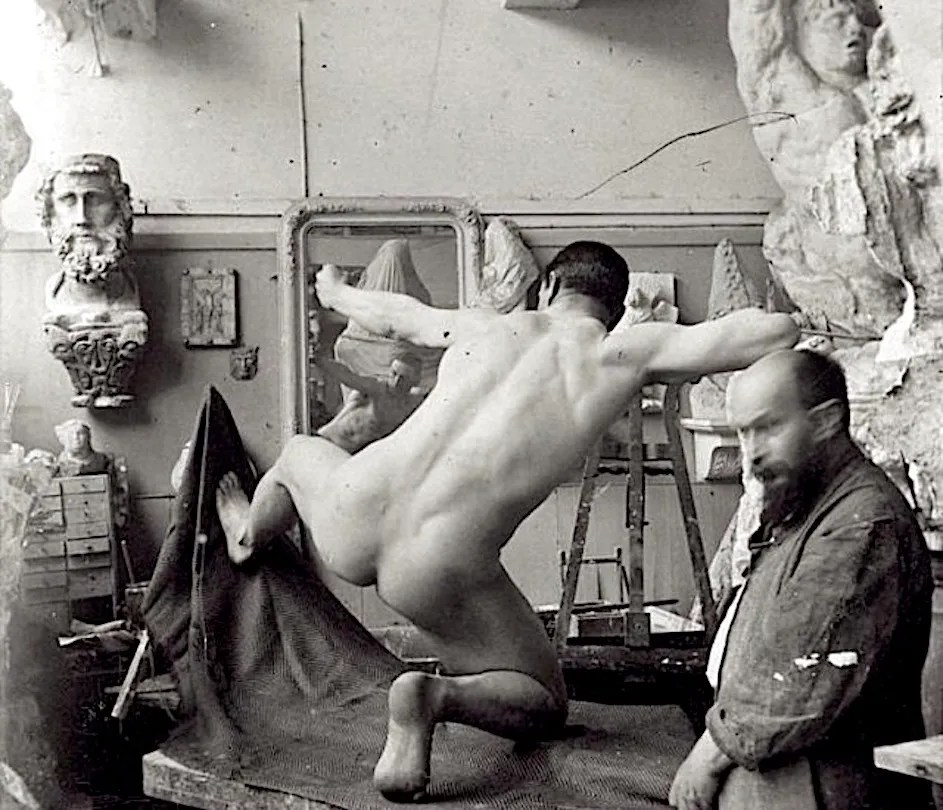
Bourdelle modelled the sculpture in clay during the summer of 1909, using his friend Paul Gustave André Doyen-Parigot (1854–1916), a captain in the French Army, as his model. An accomplished sportsman, Doyen-Parigot possessed the physical strength and athleticism required for the pose. The dramatic extension of the body and the intense muscular tension of archery allowed Bourdelle to emphasise the model’s powerful physique.

At Doyen-Parigot’s request for anonymity, however, Bourdelle altered the head, distancing the finished figure from a direct portrait and transforming it into the heroic image of Hercules.

Paul Gustave André Doyen-Parigot modelling for Antoine Bourdelle.

On having childhood regrets…
What if I had understood what was happening? What if I had been brave enough to acknowledge it? What might have become of us? Would he still have been my best friend?

Why was I thinking about Darren this week? Perhaps because some questions never quite leave us. When he later discovered that I was gay, he drifted out of my life. We have not spoken since.

On finding a poem about Manly Love…
Douglas Malloch (1877–1938) was an American poet, short-story writer and Associate Editor of American Lumberman, a trade paper in Chicago.

Manly Love
Deep in your heart understand
the love of a man for a man;
He’ll go with you over the trail,
the trail that is lonesome and long;
His faith will not falter nor fail,
nor falter the lilt of his song.
He knows both your soul and your sins,
and does not too carefully scan,—
The Highway to Heaven begins
with the love of a man for a man!


– Donald Malloch

The poem is preserved in modern literary history as an early piece of Western gay literature. It is notably featured in The Columbia Anthology of Gay Literature, compiled by Byrne R. S. Fone. It was also collected in historic specialty anthologies such as Men and Boys (edited by Edward Mark Slocum), which curated historical verses exploring Greek love, male friendships, and same-sex devotion across different eras.

On the cute and willing…

Johannes Knop shot by Gabriela Bluske (2026).