Category Archives: Backstory

Charles-Henri Ford: A Very Good Looking Penis


The first time I saw Charles-Henri Ford I was immediately drawn to his penis.

I am rather proud of that opening line.

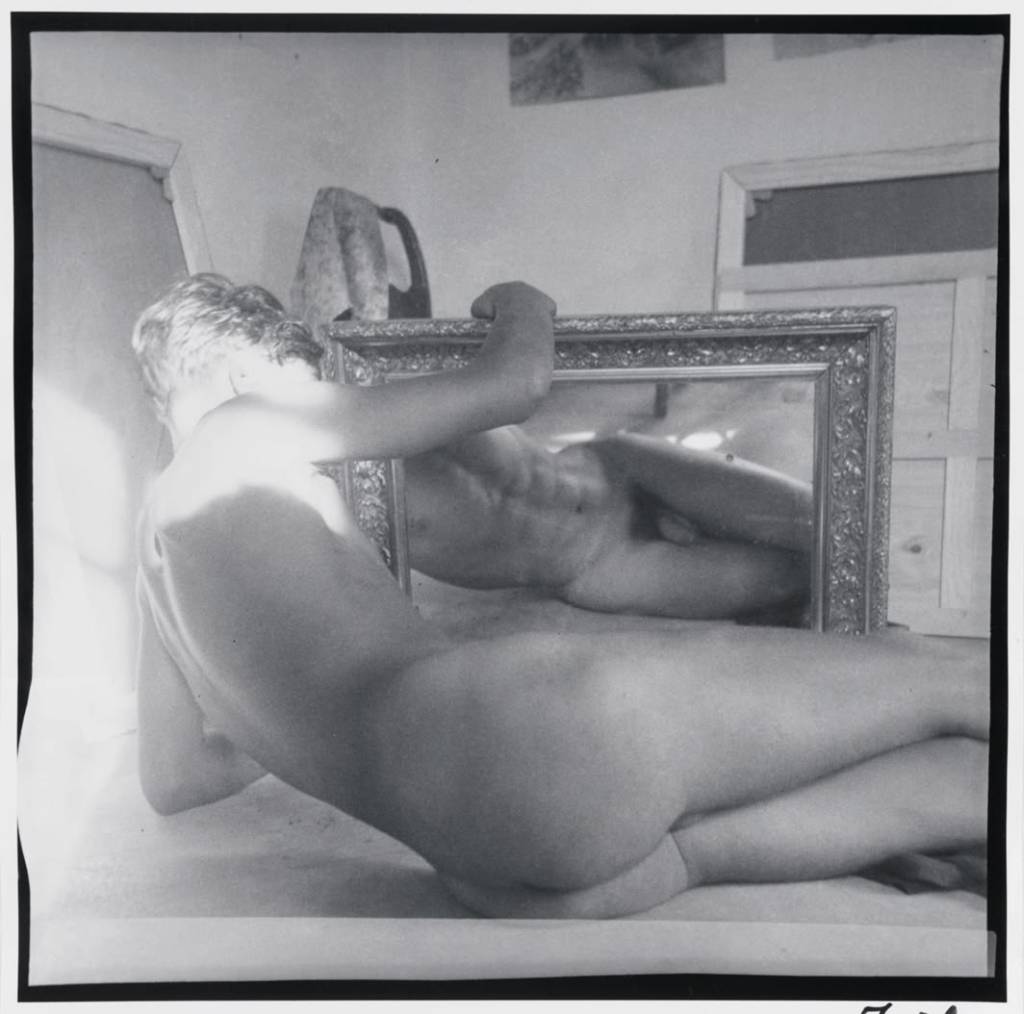
I am referring to Self-Portrait with Mirror, a nude photograph from 1937 in which Ford’s reflection appears in a gilded looking glass. Naked and reclining, he poses in a manner that recalls Velázquez’s Rokeby Venus. That was how I came to notice his penis.

Ford died in 2002, aged ninety-four, by which time that particular penis would presumably have been rather less impressive: shrivelled, fairly useless and probably best left alone.

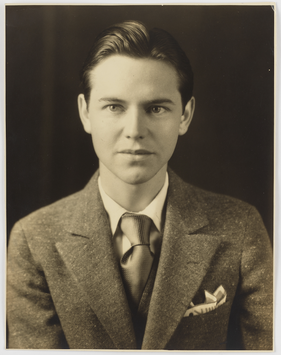
I have since discovered a great deal about Charles-Henri Ford, including the fact that he was, as a young man, incredibly good-looking.

He also appears to have been blessed with a rather formidable sense of his own destiny. As a teenager, Ford claimed to have had a vision that he would become famous, inspired by Marie Bashkirtseff, the Russian writer and artist who had apparently declared that she would become famous within a year — and did.

“When I read that,” Ford recalled, “I said to myself, Well, if she can do it, I can do it!

He did.

Ford became a surrealist poet, magazine editor, filmmaker, photographer, collage artist and co-author of what has been described as one of the first openly gay American novels. He was part of Gertrude Stein’s circle in Paris during the 1930s and, three decades later, became an important influence on Andy Warhol.

He had his first poem accepted by The New Yorker and eventually published sixteen books of poetry. In 1933, he co-wrote with Parker Tyler The Young and Evil, a novel based on their adventures in the high-camp homosexual underworld of Greenwich Village.

Edith Sitwell thought very little of it. She described the book as “entirely without soul, like a dead fish stinking in hell” and threw it into her fireplace.

That seems a little harsh, even by the standards of Edith Sitwell.

The book was published in Paris but banned in Britain and America until the 1960s, although smuggled copies circulated through bohemian circles.

In America, Ford was perhaps best known as the editor of two influential magazines.

In 1929, he launched Blues: A Magazine of New Rhythms, an experimental poetry magazine whose subtitle was A Bi-Sexual Bi-Monthly. It lasted only a handful of issues. A decade later came View, a glossy vehicle for the surrealists, particularly the group surrounding André Breton.

Its pages featured young artists and writers alongside established figures: Allen Ginsberg, Pablo Picasso, Henry Miller, Paul Klee, Lawrence Durrell, Georgia O’Keeffe, Joan Miró, Alexander Calder, Marc Chagall and René Magritte. View published the first English translations of Albert Camus and Jean Genet, as well as the first monograph devoted to Marcel Duchamp.

Ford was not, however, entirely reliable when it came to his own biography.

He claimed to have been born in 1913. In fact, he was born in 1908, in Mississippi, in one of his family’s hotels. He later altered the spelling of his middle name because he was tired of being asked whether he was related to Henry Ford.

His family owned a chain of hotels across the southern states, and much of Ford’s childhood was spent moving from one to another with his parents and younger sister, the actress Ruth Ford.

He was sent to a succession of Roman Catholic boarding schools, from most of which he claimed to have been expelled. His editorial career began there. He produced The Brass Monkey, a typewritten gossip sheet with the twin objectives of entertaining his fellow pupils and scandalising the school authorities.

It was, in retrospect, excellent preparation.

Ford moved to Paris in search of a publisher for The Young and Evil, which American publishers had rejected. “Life is short and the jails are uncomfortable,” one apparently explained.

Paris, meanwhile, was offering precisely the sort of life Ford wanted.

“Everything was exciting at the time because you could live on practically nothing and you could meet everyone. They would gather at different cafes: the queers at Le Select, the Surrealists at Les Deux Magots. It was a life that nobody knew in New York.”

Ford travelled to Tangier with his new lover, the exotic and beautiful Djuna Barnes, whose cult novel Nightwood he helped to type.

The romance, like much in Ford’s life, did not last.

The pair returned to Paris after discovering that rats had eaten their clothes.

Back in Paris, Ford abandoned Barnes and embarked on a passionate affair with the Russian artist Pavel Tchelitchew. The relationship contributed to his break with Gertrude Stein, who disliked Tchelitchew after Edith Sitwell had fallen in love with him.

Unfortunately for Sitwell, Tchelitchew did not return her feelings.

Ford and Tchelitchew made no particular effort to conceal their relationship, which merely rubbed salt into Sitwell’s wounds. Years later, the writer Philip Hoare described the pair as a “mercurial” couple. Tchelitchew once complained to Ford, “You’re eating me!” They regarded themselves as “two mad monks” and conducted their affairs with such flamboyant publicity that when Cecil Beaton encountered them in Spain in 1934, their constant altercations apparently drove him to distraction.

Ford eventually returned to New York with Tchelitchew, before going back to Europe and embarking on a new career as a photographer and artist.

His turbulent relationship with Tchelitchew finally ended with the artist’s death in Rome in 1957.

Five years later, Ford returned to America.

He was soon taken up by a new generation of artists, among them Andy Warhol. From the mid-1960s, Ford began producing what he called his Prose Poems: large, colourful collages combining poetry, painting and the visual language of pop art.

He also directed Johnny Minotaur in 1972, a film featuring Allen Ginsberg.

Ford was now an extraordinary survivor from another artistic age, but he continued to reinvent himself.

During the final decade of his life, his companion was Indra Tamang, a Nepalese artist whom Ford had met in Kathmandu.

Philip Hoare later visited Ford in his apartment and found an elegant, slightly fragile survivor of the world he had inhabited so vividly.

Hoare wrote, Ford was “vital but almost painfully thin”, with thick silver hair and immensely graceful hands. He entertained his guests to tea, served by his Nepalese companion, and told stories in a soft Southern drawl, full of self-amusement and a certain modesty.

And so the man whose penis had first caught my attention became, gradually, rather more interesting than his penis.

Although, obviously, it was a very good-looking penis.
Everybody Was Mad About the Boy

How a Noël Coward song survived almost a century—through secret longing, a television commercial, and one unforgettable face whose name has been lost.


A young man, still in his teens, was arranging T-shirts inside a clothes shop on Corso Porta Borsari in Verona. He straightened the rails, turned every hanger so it faced the same direction, then stood back to admire his handiwork.

As he worked, he hummed.

The tune was unmistakable.

Not because it is often heard these days, but because it belongs to another age entirely. Hearing it drift across a fashionable shop on a warm Italian afternoon was quietly disarming. It also hinted, perhaps, at something about the young man himself.

The song was Mad About the Boy.

Nearly a century has passed since Noël Coward wrote it, yet it continues to surface in the most unexpected places. It has survived changing fashions, changing attitudes and changing audiences, acquiring new meanings with each generation that rediscovers it.

For many people, that rediscovery came in 1992.

A memorable television advertisement for Levi jeans, directed by Tarsem Singh and inspired by the 1968 Burt Lancaster film The Swimmer, followed a striking young man as he dived from one suburban swimming pool to another. Each dive seemed to carry him into a different decade. There were immaculate post-war families tending barbecues, cocktail parties beneath tiki umbrellas and elegant suburban gardens that belonged to another America altogether. Time became as fluid as water.

Only at the final pool did he stop. A young woman joined him on the diving board before they disappeared together into an Olympic-sized pool.

Playing throughout was Dinah Washington’s recording of Mad About the Boy.

The commercial introduced millions of viewers to a song that was already sixty years old. It also transformed Washington’s 1961 recording into the definitive version, entering the British charts more than thirty years after she had recorded it with Quincy Jones.

Yet the young man who captivated millions simply disappeared from public memory. There’s something rather poignant about that. It echoes the song itself—everyone was “mad about the boy,” yet nobody seems to know who he was. 

The song itself had always been more intriguing than most people realised.

When Coward wrote Mad About the Boy for his 1932 revue Words and Music, it appeared to be a witty lament sung by four very different women—a society hostess, a schoolgirl, a maid and a prostitute—all hopelessly infatuated with the same film star. It quickly became the show’s sensation.

Beneath its polished wit, however, lay something more complicated.

The lyrics speak of embarrassment, secrecy and sleepless nights. They even refer to the boy’s “gay appeal”, a phrase that meant something rather different in 1932, yet has acquired an unmistakable resonance with the passing of time. Long before homosexuality could be openly discussed, the song had become one that many queer listeners instinctively recognised as their own—not because Coward ever declared it so, but because the emotions it expressed were painfully familiar.

Coward himself only deepened the ambiguity.

After the London opening of Words and Music, he entertained Joan Crawford and Douglas Fairbanks Jr., the actor often said to have inspired the song. Fairbanks later laughed off the suggestion.

“I always thought it was Gary Cooper.”

Whether the boy existed at all would remain one of the song’s enduring mysteries.

When Words and Music was revived in New York eight years later under the title Set to Music, Coward wrote an additional verse. This time the singer was not a woman but a respectable businessman whose increasingly desperate attempts to explain his fascination with another man became both comic and surprisingly daring.

It proved too daring.

The verse was cut before audiences ever heard it.

Mad about the boy,
I know it’s silly but I’m mad about the boy,
And even Doctor Freud cannot explain
Those vexing dreams
I’ve had about the boy.
When I told my wife,
She said:
” I’ve never heard such nonsense in my life! “
Her lack of sympathy
Embarrassed me
And made me frankly glad about the boy.
My doctor can’t advise me,
He’d help me if he could;
Three times he’s tried to psychoanalyze me,
But it’s just no good.
People I employ
Have the impertinence
To call me Myrna Loy.
I rise above it,
Frankly love it,
‘Cos I’m absolutely
MAD ABOUT THE BOY!

The Novel That Outlived Its Author


E.M. Forster spent much of his life hiding a part of himself.

In a diary entry from 1964 he wrote:

‘I should have been a more famous writer if I had written or rather published more, but sex has prevented the latter’.

Between 1905 and 1910 he published four novels—Where Angels Fear to Tread, The Longest Journey, A Room with a View and Howards End. By the time A Passage to India appeared in 1924, Forster had grown weary of writing about marriage and the relationships between men and women. It would be the last novel published during his lifetime.

Instead, his imagination increasingly turned towards relationships between men. He wrote stories that explored same-sex desire but refused to publish them, convinced that the world in which he lived was not ready for them.

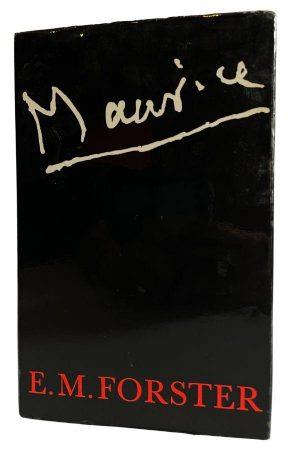
His novel Maurice finally appeared in 1971, a year after his death. It tells the story of Maurice Hall, whose love affair with his Cambridge friend Clive Durham ultimately gives way to a deeper relationship with the young gamekeeper Alec Scudder. Defying class prejudice, social convention and the threat of blackmail, the novel ends not in tragedy but in hope.

Forster wrote Maurice in 1913–14, yet he could never quite let it go. He revised the manuscript in 1932 and again between 1952 and 1960, repeatedly reworking the ending while remaining determined that the lovers should find happiness.

It is difficult not to wonder whether Maurice became the life that Forster wished he might have lived himself.

While at Cambridge he was infatuated with Hugh Owen Meredith, who is widely believed to have inspired the character of Clive. He was also drawn to working-class men and, in 1930, began a relationship with the London policeman Bob Buckingham that lasted for forty years. During his travels abroad he formed other relationships, reportedly experiencing sex for the first time with a soldier on an Egyptian beach when he was thirty-eight.

In 1970, the biographer P. N. Furbank observed:

“He achieved physical sex very late, and found it easier with people outside his own social class; and it remained a kind of private magic for him – an almost unattainable blessing, for which another person was mainly a pretext.”

The executor of Forster’s estate was Professor W. J. H. Sprott of Nottingham University, best known for translating Sigmund Freud’s New Introductory Lectures on Psycho-Analysis. Among Forster’s papers he discovered the manuscript of Maurice, together with the unfinished novel Arctic Summer, largely written in 1911, which also explored homosexual themes.

There were also a number of short stories written between 1903 and 1958. Published posthumously in 1972, only two had appeared during Forster’s lifetime; the remainder were either overtly homoerotic or explicitly gay stories that would almost certainly have been considered indecent by contemporary standards.

Within his closest circle, Forster made little attempt to conceal his sexuality. He shared successive drafts of Maurice with trusted friends including Siegfried Sassoon, Lytton Strachey, Edward Carpenter, Christopher Isherwood, Xiao Qian and Forrest Reid.

Beyond that circle, however, he was intensely guarded.

In 1962, John Bayley wrote in The Guardian that “the homosexual themes underlie all his novels.”

Forster replied:

“Are you aware that homosexuality is still a criminal offence, and any public implication of it therefore objectionable.”

As Kate Symondson notes on the British Library website, Forster was only sixteen when Oscar Wilde was sentenced in 1895 to two years’ hard labour—the maximum penalty—for homosexual acts. It was a warning that stayed with him for the rest of his life.

The dangers faced by Maurice and Alec were not merely fictional. They reflected the laws, prejudices and fears that shaped Forster’s own existence.

Only in 1967, with the passing of the Sexual Offences Act, were private homosexual acts between men over the age of twenty-one decriminalised in England and Wales. By then Forster was eighty-eight years old, and the novel that had meant so much to him still remained unpublished.

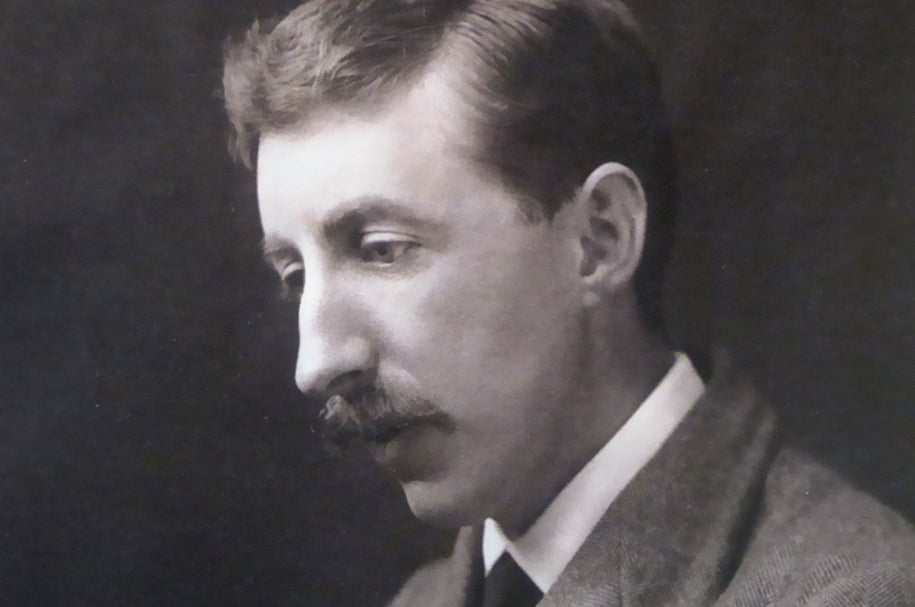
E.M. Forster (1879-1970)

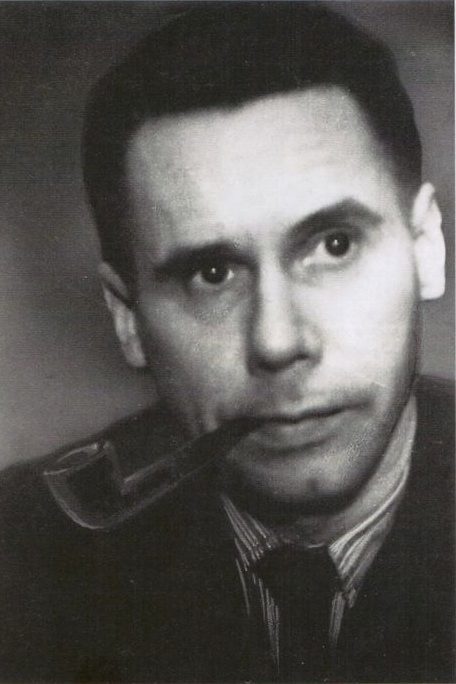
At the Edge of the Night: The Lost Life of Friedo Lampe

‘I will send you a book,’ said Severin. ‘It is a German classic, but I shall make sure you get the English translation. But before you read it, you must promise me one thing: research the dead author first. Then you will understand the sadness behind it.’”

True to his word, a package appeared on the doorstep a few weeks later. Inside was a copy of At the Edge of the Night by Friedo Lampe.

Cut to 2 May 1945. Kleinmachnow, a municipality on the outskirts of Berlin. Hitler has been dead for two days. Soviet troops occupy the capital. Germany is collapsing, and everyone is afraid of what comes next.

A shabbily dressed man walks along the street, shoulders hunched inside clothes that hang too loosely from his thin frame. To suspicious eyes he resembles one of the many fugitives trying to disappear into the chaos of defeat. Two Soviet soldiers stop him and demand identification.

He hands over his papers.

But the photograph shows a sturdier, healthier-looking man. The exhausted figure standing before them looks nothing like it.

The soldiers shoot him dead.

That is almost everything we know about the death of Friedo Lampe — librarian, editor, and novelist — a writer who experienced remarkably little good fortune during his lifetime.

Born in Bremen in 1899, Lampe suffered from bone tuberculosis in his left ankle as a child, leaving him permanently disabled. He studied literature, philosophy, and art history in Heidelberg, Munich, and Freiburg before eventually working as a writer and editor.

His debut novel, Am Rande der Nacht (At the Edge of the Night), appeared in 1933, the year Hitler came to power. Lampe later remarked that the book had been “born into a regime where it could not breathe.” Writing to a friend shortly after publication, he confessed: “What do you think of it now it’s in print? Very shocking? I’m worried.”

He had every reason to be.

The Nazis quickly placed the novel on their list of “damaging and undesirable writings.” Its dreamy nocturnal atmosphere, homoerotic undertones, and depiction of a relationship between a Black man and a German woman were enough to condemn it. Copies were seized; many were almost certainly burned.

Yet even then, perceptive readers recognised its brilliance. Hermann Hesse admired the novel in 1933 and later wrote that what had struck readers “as so beautiful and powerful has not paled… it proves itself with the best, and captivates and delights just as then.”

Lampe continued writing despite censorship and growing political danger. After working for Hamburg’s public library, he moved to Berlin in 1937 to work as an editor for Rowohlt. His prose ballad Das dunkle Boot (The Dark Boat) appeared in 1936, followed by the novella Septembergewitter (September Thunderstorm) in 1937. Neither achieved significant recognition, and Rowohlt itself was seized by the Nazis in 1939.

Throughout the war Lampe lived in quiet fear. Under Paragraph 175, homosexuality remained criminalised, and gay men faced surveillance, arrest, imprisonment, and deportation to concentration camps. Lampe, himself homosexual, lived cautiously and privately. In 1943 he narrowly escaped catastrophe after being blackmailed by a male prostitute in Berlin; only the intervention of his publisher’s lawyer prevented the affair from escalating into a criminal case.

Friends described him as reserved rather than solitary: a chain-smoker, obsessive reader, and compulsive buyer of books. “It really is an illness with me,” he once admitted. “I simply must buy every book, even when I don’t have the money.”

Misfortune seemed to pursue him relentlessly.

“I never had much luck with books,” Lampe remarked bitterly in 1944. The previous year an air raid had destroyed his Berlin apartment and with it his vast personal library. Two weeks later another bombing raid destroyed the Leipzig printing works preparing a new volume of his stories, Von Tür zu Tür (From Door to Door). In 1944 he was conscripted into the German Foreign Office, where he worked analysing intercepted enemy communications.

Then came the end of the war — and his senseless death on a roadside in Kleinmachnow.

Lampe was buried beneath a simple wooden cross bearing the words: Du bist nicht einsam — “You are not alone.”

For decades he remained little more than a literary footnote. Am Rande der Nacht was republished in expurgated form in 1949, 1955, and 1986, with supposedly offensive passages removed. Only in 1999, the centenary of Lampe’s birth, did the first complete unexpurgated edition finally appear.

That restoration transformed his reputation.

Modern German critics increasingly came to regard Am Rande der Nacht as one of the great lost novels of the Weimar era: lyrical, melancholic, cinematic, and unlike anything else produced in Germany at the time. Lampe’s readership steadily grew into something close to a cult following. His collected letters were published in 2018; an English translation of At the Edge of the Night finally appeared in 2019, introducing him to a wider audience decades after his death. Johann-Günther König’s long-overdue biography followed soon after.

Today Friedo Lampe occupies the strange position reserved for certain artists: neglected in life, cherished in retrospect. The writer once condemned and erased by the Nazis is now included in The Oxford Companion to German Literature and discussed as an important rediscovered voice of twentieth-century German fiction. Perhaps that is the consolation history occasionally offers — that literature can outlive the regimes, prejudices, and accidents that once tried to silence it.

The Grudge Against Glory

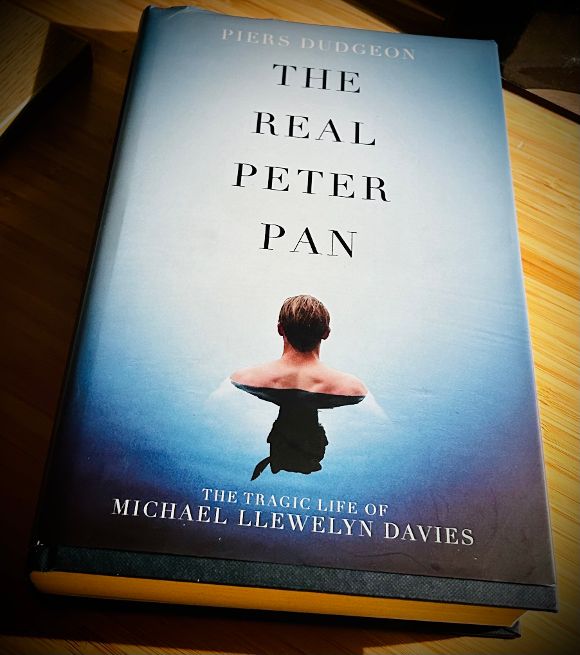
Fate is inscrutable, chance is unreadable, and circumstance is unfathomable. No one knows what he may one day suffer. The private sorrows of Sir James Barrie illustrate the insecurity of mortal happiness. Life has bestowed on him fame without stint and wealth without measure. All over the world his plays are spouting money as a gusher spouts oil. Riches pursue him day and night. He cannot escape from the golden rivers. But fame and fortune do not exempt him from the furtive blows of fate. Of his four foster-sons, Michael Llewelyn Davies was the best beloved. On the eve of his twenty-first year he perishes like Milton’s Lycidas. The witless unreason of the tragedy shocks us. Is there a grudge against glory, a spite against fame, a vendetta against dazzling fortune? Is there immunity in obscurity?

– Sunday Express – 22 May 1921


Jeff Buckley – Beautiful Things Drown

Rawly talented. Jeff Buckley. Photographed by Merri Cyr

Something strange had happened beforehand. A young guy sold me my cinema ticket. Soft features, dark curls, expressive eyes. Soft-spoken. All the time he smiled as though sharing a secret only he understood.

There were other staff around, but when I bought a coffee he served me again. He looked astonishingly vulnerable when he realised he’d screwed up making my hazelnut coffee. And then he scanned my ticket when I headed into the screening.

He might have been Jeff Buckley, if only he’d known who he was.

The cinema was empty, as though this showing were meant for my eyes alone—someone who only discovered him after he was already dead. That strange, almost mystical aura: the romantic legend whose story remains unfinished. It’s Never Over, Jeff Buckley.

A Pre-Raphaelite look—with scratchy stubble—and the whisper of a small child that could rise suddenly into a soaring falsetto, almost devotional. Was there ever anyone who captivated me so completely?

I heard the murmur of Cinema Boy: “The face that once commanded admiration and became a ruin, a tragic testament to a sad end.” That someone so beautiful would go swimming and never come back. My heart insists it was intentional.

One album—both his coming-out and his epitaph. One of the greatest albums ever recorded.

Six days. That’s all it took. A body decomposing, bloating. Skin that once felt so good to touch became pruned, pale and waterlogged—brownish, yellowish, ugly. Corpse wax. A moral fable in which the loss of physical perfection mirrors the decay of the soul.

The film ended. And Cinema Boy—who was probably called Will, or Aaron—came into the cinema to clear up after me.

He was still smiling to himself.

It’s Never Over: Jeff Buckley, a 2025 feature-length documentary directed by Amy Berg (known for Deliver Us From Evil and Janis: Little Girl Blue). It is the first comprehensive documentary authorised by the Jeff Buckley Estate.

Jeffrey Scott Buckley. Guardian angel. Born: Anaheim, California (1966). Died: Memphis, Tennessee (1997), aged 30.

Stolen Words – Hopeless Love – J.G.F. Nicholson

Hopeless Love – Charlie Marseille (2026)

Mainly I strive to show by deed and word
How great my love for you, how deep and strong;
Daily you hear my heart’s one passionate song,
And still pass on as though you had not heard;
Your slightest smile, your gentlest glance can gird
My suppliant life with joy that lingers long, –
You touch my hand, and straight a gladsome throng
Of hopes are born, and all my soul is stirred.

But ah, you do not understand nor see,
And when my looks of my devotion tell
You deem it but some pitiful wayward spell;
Love comes not my interpreter to be,
And in your eyes, because you love not me,
My greatest fault is loving you too well!

From Love in Earnest – Sonnets, Ballades and Lyrics by J.G.F. Nicholson (1892)

Ignacio Martínez Moreno, in Uranian Poetry: The Homosocial and Homoerotic Paradox (2020), describes John Gambril (Francis) Nicholson as “a prisoner of his feelings, only able to express them through poetry.” Hopeless Love reveals a form of homoeroticism in which the lightest touch can unleash a flood of feeling—emotions that need not be reciprocated to ignite passion within the poetic voice.

Oh yes, I know this all too well.

I perceive beauty where others see none. I feel a desire that no one else seems able to recognise. He is the pearl concealed within a hard exterior. Through close proximity, a sense of deep familiarity takes hold, awakening attraction and affection that override his less generous qualities.

It is an obsessive infatuation, one in which reciprocation will never arrive—because he refuses, or is simply unable, to see the effect he has on me.

And no matter how hard I try… it is not recognised.

Edmund John: The dead do not speak, and what remains is conjecture

Edmund John (1883–1917)

“I give my white-skinned boy a pearl
Fair as his body and as strange
As still pools veiled in mists that change
Their mysteries as they wreathe and curl:
— So that his visions ever be
Wondrous and subtle as the sea,
I give my white-skinned boy a pearl.”

This verse comes from The Seven Gifts by Edmund John, published in the May 1916 edition of The English Review. It was introduced with the following note: “Suggested by the fragment of a letter from an Athenian father to his son, in the time of Pericles, now in the possession of Sydney Oswald, Esqre.”

The note was almost certainly fiction—an artful screen to disguise the real impulse behind the poem. Edmund John liked writing about boys.

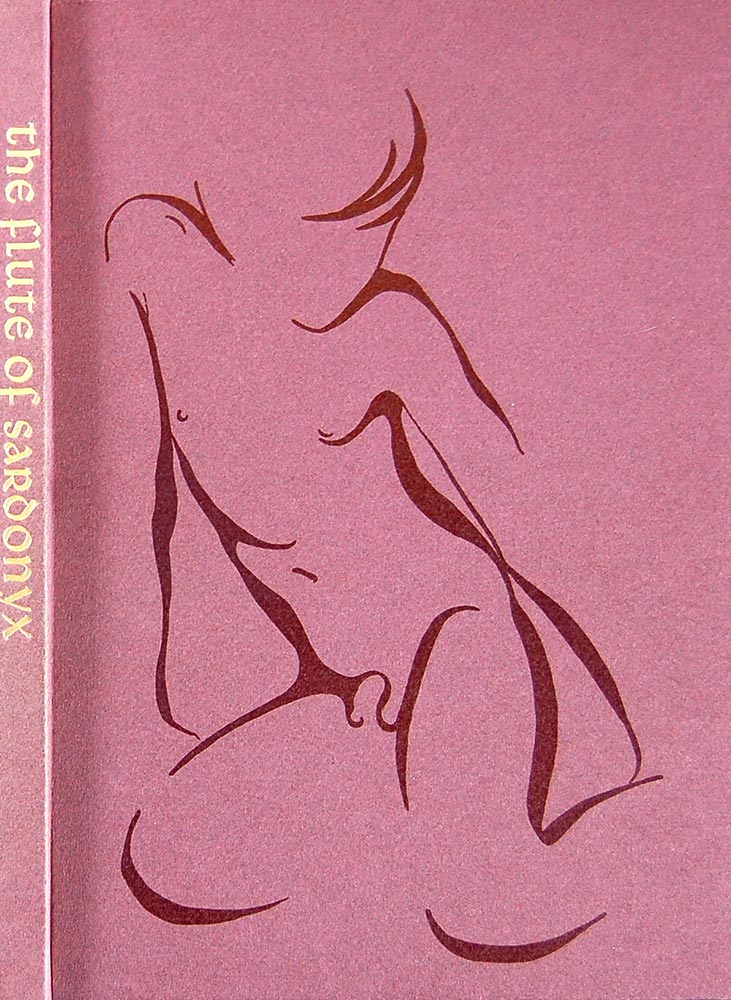
One of Britain’s most obscure poets, Edmund John (1883–1917) was never afforded the opportunity to establish a reputation. His premature death at thirty-three ensured that his name would slip quietly into obscurity. Only three volumes of poetry were published: The Flute of Sardonyx (1913), The Wind in the Temple (1915), and the posthumous Symphonie Symbolique (1919). Today, he is largely forgotten, his small but striking body of work almost entirely overlooked.

John was born in Woolwich on 27 November 1883 to a Welsh father and a Scottish mother. He studied science—particularly biology and chemistry—before turning to philosophy. With his brother, he ran a boys’ school in Crouch End, supplementing his income by coaching undergraduates.

Travel appears to have played an important role in his development as a poet. The introduction to Symphonie Symbolique suggests that Cuba left a lasting impression:

“Where the glowing colours of the South, the luxuriance of the tropics, provided his palette with a richness that it did not possess before, and gave to his verse an almost exotic warmth and splendour.”

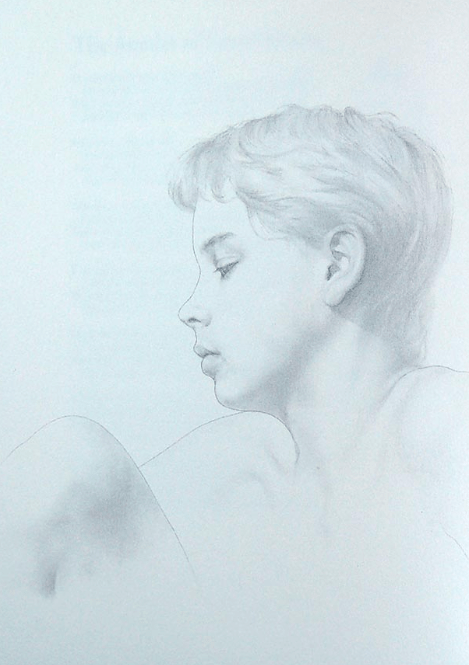
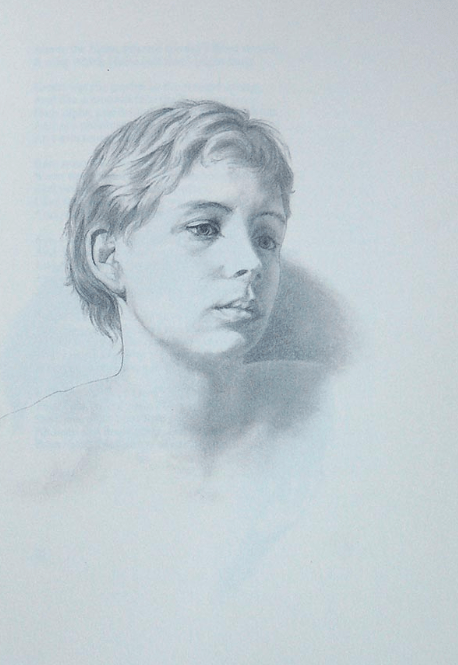
The Flute of Sardonyx (1913). Reprinted in 1991 (The Old Stile Press) with pencil drawing by Nicholas Wilde

His first book of poetry, The Flute of Sardonyx, gained immediate notoriety upon publication. Critics were, for the most part, receptive—perhaps because many failed to grasp its implications. One who did not was James Douglas, a prominent literary critic, who launched a fierce attack on both Edmund John and Stephen Williams, author of the book’s introduction.

“Williams in the introduction of The Flute of Sardonyx seeks to justify or excuse these poems by citing Milton’s definition of poetry, and he implies that Milton meant by the word ‘sensuous’ not merely the normal, healthy, and wholesome senses of the normal, healthy, and wholesome human being, but also the debased, depraved and degraded sensations of a perverted and abnormal erotomania. I have not the slightest doubt that in a court of law an English jury and an English judge would not hesitate to condemn Mr John as being guilty of a gross offence against elementary propriety. I demand without delay the volume should be withdrawn in deference to what I believe to the inevitable and inexorable verdict of public opinion.”

One poem in particular, Salome, provoked Douglas’s outrage.

“These stanzas, I venture to affirm, are of a vileness hitherto unparalleled in English poetry. Nothing approximating to or of approaching depravity has, as far as I am aware, ever been tolerated in English literature.”

Others were scarcely more forgiving. A. E. Manning Foster, writing in The Bookmarker, observed:

“Salome is an Aubrey Beardsley picture in words, and yet it is not entirely pleasing. Mr John brings into his poem what Oscar Wilde in his play on Salome and Flaubert in his short story never did—an unhealthy, perverted strain.”

Herbert Jenkins, John’s publisher, abruptly withdrew The Flute of the Sardonyx, later reissuing it in a revised edition that was, as one commentator noted, “meeker than the Shakespeare we use at school.”

One of the few surviving biographical sketches of Edmund John appears in George Norman Douglas’s memoir Looking Back: An Autobiographical Excursion (1933).

“We met through his sending verses to The English Review after the publication of The Flute of Sardonyx, and it often struck me how greatly his person resembled his writings—sensuous and ornate, elaborate in manner, a little over-dressed, too many rings and tiepins, too much thought expended upon the colour of socks. He would have grown out of these incongruities had he lived. Meanwhile he was young and handsome.

“He could drink like a fish and remain perfectly sober. In those days I bought my whisky in kegs, and it was alarming to see how he could put it away. Good company! At such moments he cast off that veil of precocity, though a certain refinement always clung to him; it was part of his nature.”

John’s second volume, The Wind in the Temple, published in 1915, was widely praised.

“The superb loveliness of these stanzas are beyond praise,” wrote the Westminster Gazette. “Seldom has the enhancing beauty of Greek thought so captivated the soul of a poet; seldom has this enchantment been rendered so felicitously in modern verse.” The Evening Standard noted: “Although owing much to Arthur Symons, these poems have a magic all their own, for Mr John knows the value of the leash, the most difficult of all lessons to be learnt.”

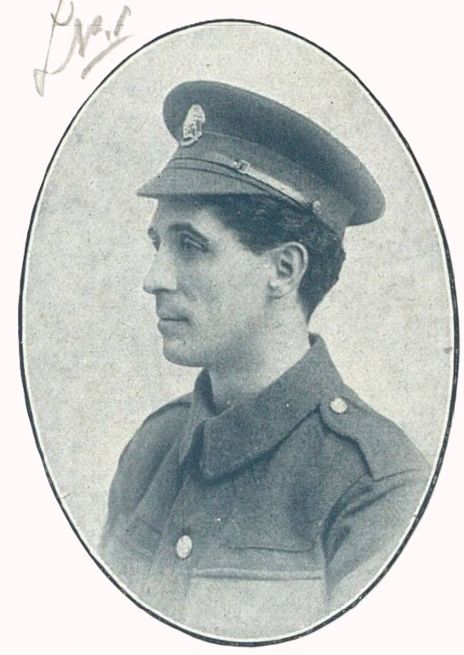
Edmund John in military uniform

Around this time, John enlisted in the 28th (London) Battalion, the Artist’s Rifles, to fight in the First World War. Founded in 1859 amid fears of a French invasion, the regiment attracted volunteers from public schools, universities, and the creative professions—painters, musicians, actors, architects.

John’s death in 1917 might easily be assumed to have been a casualty of war. Douglas, however, suggests otherwise.

“In his correspondence he told me that he had been invalided out of the army (in 1916) on account of his heart. He had also married for money, as he frankly confessed. His tastes were luxurious; coaching, and an occasional volume of verse would never make him feel at ease. It looked as if all were going well, yet I did not like the nervous tones of his letters….”

Seeking to recover his health, John travelled to Italy and settled in Taormina.

“It is a site of great distances—its soft colouring—its streets hushed at noonday as by some weird enchantment—its leaning walls in flower—its secluded gardens—its terraces—its lemon and almond groves; its crystal air, crystal and flare at noon, opal and pearl at either edge of the day; its castled crests and crumbling ruins.”

An obituary followed:

“On the 28th February (1917), at Taormina, Sicily, Edmund John, of heart failure, beloved husband of Kate Dalliba John, of Florence, and dearly loved eldest son of Thomas and Margaret John of 20 Cranley Gardens, London, aged thirty-three.”

Douglas corrected the record bluntly:

“I replied to John’s letter on the 19th of February 1917. On the 28th of the same month he killed himself. A miserable ending of which he seemed to have had a presentiment.”

From this point onward, certainty dissolves. The dead do not speak, and what remains is conjecture.

Certainly, John suffered from a debilitating heart condition and bouts of depression. But other forces may have contributed.

“Ah God, it was the Hope gave to me,
Within the womb, of things unknown and fair,
The Bud that blossomed into this Despair.
Art Thou content, O God, with thus Thy work?
Art Thou content that Thou hast planned so well?
That Thy cold hands have thrust me into Hell?”

The Flute of Sardonyx. Pencil drawing by Nicholas Wilde (1991)

John’s poetry is suffused with Uranian themes—a term coined in the nineteenth century by Karl Heinrich Ulrichs, before the invention of the word homosexual.

“His eyes are brothers to the sun and sky,
His body’s fragrance haunts the murmuring wood,
And all the flowers are singing where he stood,
And all the leaves are chanting their reply.”

In The Wind in the Temple, love is repeatedly figured as adolescent beauty.

“His body is like milk edged with rose-colour rare,
With vine and lure of hemlock in his red-gold hair,
Night-kissed, that burns and gleams;
His grave sweet scarlet lips are parted voicelessly,
His eyes like stars reflected in a violet sea
Of dawn and dreams.”

And elsewhere:

“Harder, press harder with your scarlet mouth;
Lie close, limbs woven of the passionate South;
Twine nearer, subtle satin limbs of June,
Burn your gold scented body into mine,
Cling to my lips with yours of Graecian wine,
Cling closer till the blood come and life swoon…”

Yes, Edmund John was a Uranian poet, and he harboured pederastic desires. Men and Boys (1924) reproduced part of a letter he wrote to a “young friend”:

“I have received your adorable, illustrated letter this morning and loved it so much I immediately made an altar before it, lit by amber candles in copper candlesticks, burnt incense before it and kissed its extreme beautifulness.”

Did his homosexuality weigh heavily upon him?

That John died in Taormina is suggestive. Long regarded as a “Queer Eden” for artists and intellectuals, the town was famed for its beauty, Greek mystique, and relative tolerance—an atmosphere reinforced by Wilhelm von Gloeden’s homoerotic photographs of local youths. Oscar Wilde and André Gide had passed through; later visitors would include Truman Capote, Tennessee Williams, Gore Vidal, Jean Cocteau, Thomas Mann, Somerset Maugham, and Roger Peyrefitte.

There is also the unresolved mystery of John’s marriage to Kate Dalliba, reportedly solemnised in Florence.

“Kate Dalliba, of St. John’s Wood. Famous for her Sunday night salon, referred to as The House of Music. Wealthy musicians in evening dress rub shoulders with poor and budding young geniuses in wrinkled light clothes and soiled linen. All here is democracy, art, Bohemianism.”

Born into a wealthy family in Cleveland, Ohio, Dalliba used her fortune to support artists such as Ezra Pound, Ida Rubinstein, Olga Rudge, and Ildebrando Pizzetti. She lived in Florence and maintained her London house as a free lodging and performance space for travelling musicians and artists.

It is entirely possible that John, described by George Norman Douglas as being poor, was drawn to her wealth. He had openly admitted that he married her for money. The rich older woman and the handsome young poet might have passed, outwardly, as a conventional May–December match.

Whether Dalliba later recognised the truth of the arrangement—and whether this recognition had consequences for John—remains unknown. She herself lost most of her fortune in the Wall Street Crash of 1929.

What remains is a handful of poems, a scandal, a life cut short, and the faint outline of a gifted, troubled poet whose voice—sensuous, excessive, and dangerous—proved too much for his time.

The Flute of Sardonyx. Pencil drawing by Nicholas Wilde (1991)

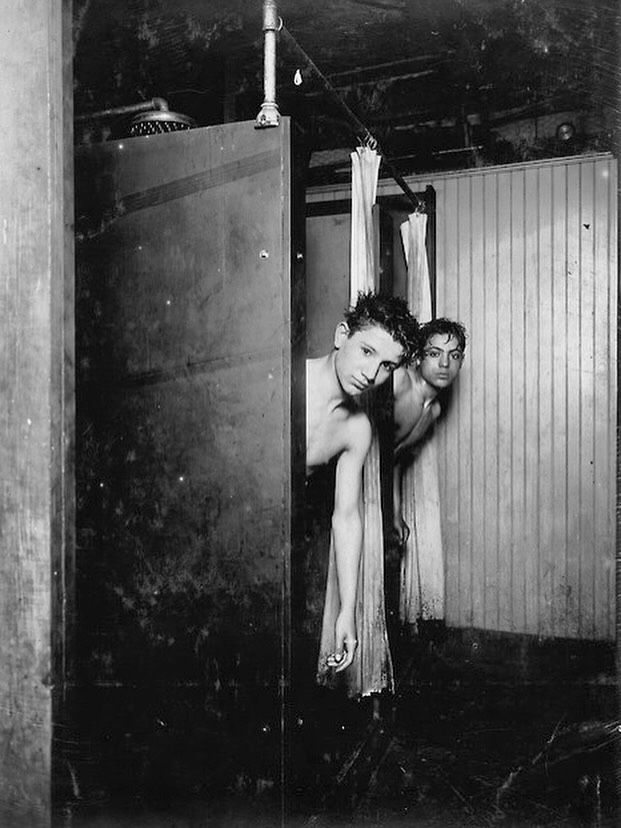
Shower Baths: Running the Messages, New York, 1910

A famous photograph by Lewis Wickes Hine, taken in July 1910, showing young male telegraph messengers using shower baths at the Postal Telegraph Company on Broadway, New York. Hine, working for the National Child Labor Committee, documented the harsh conditions of child labour, but this image highlighted a positive aspect: the company provided showers, recognising good grooming was good for business and tips, a rare perk for these boys.

“No, sir — it ain’t no cinch, lemme tell ya. This life’s all leg-work. We don’t get no steady pay, not by the day nor the week — it’s by the message, an’ that means you’re on the jump all the time. Soon as I dump one off, I’m tearin’ back to the office for another.

“Two bits an’ a half is what I get for each one I sling, an’ if I tote back an answer for the wire, that’s three more cents in my pocket. That’s why I’ll hang around for a reply — I ain’t no chump.

“A boy that drags his feet or lays down on the job won’t make nothin’, but a hustler like me? I clean up. I knock out thirty messages a day if my legs hold. That’s near twenty miles on the hoof, an’ don’t forget the stairs — an’ New York’s lousy with ’em. Offices from the street clear up to the sixth, seventh floor, an’ you gotta hoof it every step.”

The Shadowed Hand Behind the Letter


Being the transcript of a letter unearthed in the long-sealed vaults of the Royal Bank of Scotland, November 2025

George Walker Wood
66 Cavendish Street,
Marylebone
London

29 November, 1881

My dear Reader,

If by curious chance you hold this manuscript in your hands, I entreat you to read its contents with the utmost seriousness. Only by such attentive perusal shall you perceive that the pages which follow are both an explanation and a justification for their long concealment.

Should it prove that I still draw breath when these lines meet your eye, then I beg of you—burn them without delay, and disclaim all knowledge of ever having encountered them. The shame that would ensue from their divulgence is of so dreadful a nature that I scarcely dare commit the thought to paper.

I shall therefore begin at the point where first I made the acquaintance of one Johane—an Irish youth of some four-and-twenty years, of humble condition, and with every outward appearance of one who might easily draw misfortune to my door. He was, however, most commonly called Jack, and by that familiar name I shall refer to him henceforth. Dear Jack belonged to a loose fraternity of young loafers and street-bred rascals—variously known as the “London Boys”—a wild and merry set whose manners were as questionable as their morals, yet whose very recklessness possessed, for me, an unaccountable fascination.

In time I grew most attached to Jack, and he attended me frequently at my lodgings in Marylebone. There, behind doors safely bolted, we indulged in certain intimacies which, though common enough within that unseen sphere of which London pretends ignorance, would cause polite society to feign horror. Jack’s person was slight, his garments threadbare and ill-assorted, and he bore all the marks of those who are forced to wrest their sustenance from the streets; yet beneath that rough exterior there was a warmth and vigour not easily described. When fortune smiled and I had a few coins to spare, he would remain with me until morning, and those nights—cold, anxious, sweet as they were—remain fixed in my memory.

I suspect that my landlady, Mrs. Chivers, a stout matron of no small curiosity, had taken something of a liking to Jack as well; for once I discovered him seated at her kitchen table devouring a modest breakfast of bread and scrape. The glint of mischief in his eye, as he looked up at me over the crust, told me all I needed to know. She had chosen to see nothing of the nature of my rooms above.

My days were spent at the old desk overlooking Cavendish Street, where I composed articles for The London Figaro and The Dark Blue. Yet I had long nourished the ambition to attempt a novel—something that might echo, however faintly, the triumph of A Tale of Two Cities. My parents, never slow to remind me of my deficiencies, assured me that I lacked both imagination and creative faculty, that I was fit only to set down facts and order them neatly upon a page.

Still, I could not forget the tales Jack whispered to me during those winter nights—tales of gentlemen of rank who sought his company at a high price; of drawing-room adventures veiled beneath the richest draperies; of temptations and behaviours of which the world speaks only in scandalised murmurs. Spurred by these accounts, I sought the acquaintance of a certain printer known to an associate of Henry Ashbee—a man whose livelihood depended upon the discreet production of pamphlets of a decidedly provocative character.

Mr. William Lazenby, a sharp-eyed fellow, showed interest in my idea and agreed to an initial impression of two hundred and fifty copies. He offered me a share of the profits, subtracting his considerable costs, should I but write with candour. The sums he mentioned far exceeded any I had yet earned, and the promise of so easy a reward was exceedingly tempting. He informed me that the book should be sold exclusively by mail-order through an address in Paris, and insisted that I adopt a nom de plume, lest I bring inevitable ruin upon myself.

When I conveyed the scheme to Jack, he immediately demanded—nor without justice—a share of the proceeds, and further insisted that his own name be affixed to the work. I warned him that the police might take a dim view of such recklessness, but he merely laughed and declared that the “mutton-shunters”, knowing full well he could neither read nor write, would never suppose him connected to any printed matter. With that he tumbled himself upon the bed in his usual impudent fashion and suggested that we commence our “research” without delay.

By June the manuscript was completed, and I had settled upon what I deemed a most fitting title—The Sins of the Cities of the Plain. Though Mr. Lazenby scoffed at it, he conceded that the biblical suggestion would doubtless catch the eye of those gentlemen who take an interest in such hidden matters. I confess I feared that certain passages, dealing as they did with the concealed customs of our clandestine fraternity, might prove too recognisable to those acquainted with that shadowed realm.

Lazenby nevertheless published the work in two parts, and it found immediate favour among readers eager to feast upon the covert indulgences of the great and respectable.

Though I tremble at the thought of its reception, I take comfort that my own name has thus far escaped suspicion. I offer here my apologies to Mr. Simeon Solomon and Mr. James Campbell Reddie—both of whom have been unjustly whispered about in connection with this deception. Jack, meanwhile, basks in the admiration of his companions and seems persuaded that a century hence his name will still be spoken among certain circles of “inverts”, as he jests.

This very day I have deposited my first earnings at the Lombard Street branch of Messrs. Glyn, Mills, Currie & Co., alongside this confession, sealed and hidden, to remain in the vault until such time as Providence ordains its discovery. Should that day come, I trust that The Sins of the Cities of the Plain shall be regarded as a truthful and unvarnished portrait of those whose society I have come to cherish.

Ever, dear Reader, your faithful servant,

𝒢. 𝒲𝒶𝓁𝓀𝑒𝓇 𝒲𝑜𝑜𝒹
⌣⌣⌣⌣⌣⌣⌣⌣⌣
George Walker Wood

*****

Now read on to separate fact from fiction.

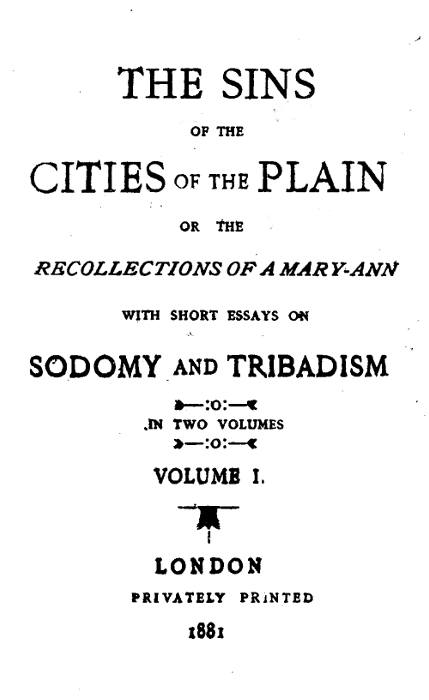
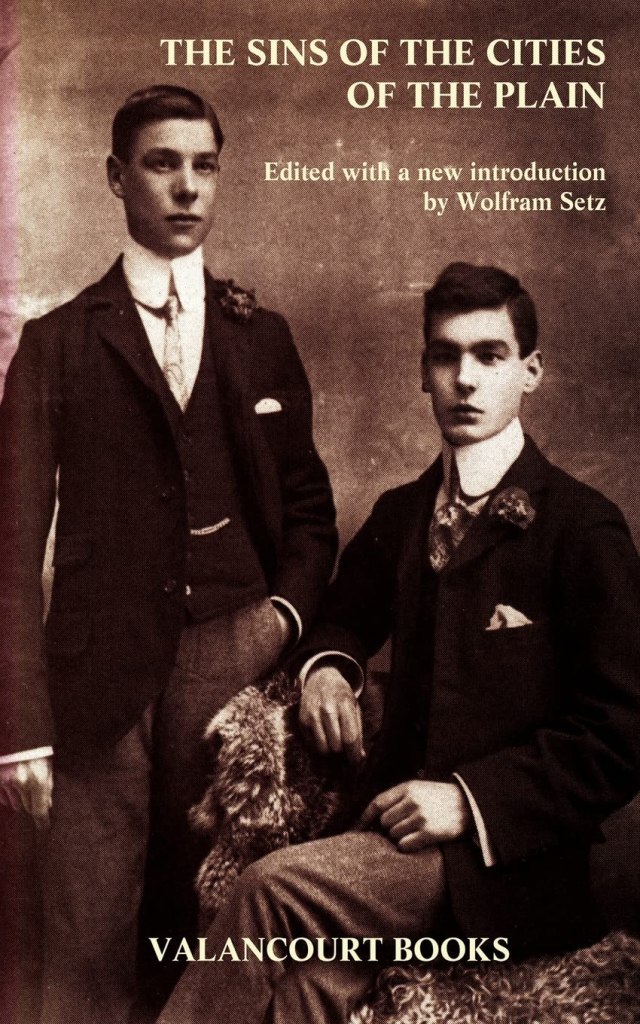
This edition contains the unabridged text of the first edition housed at the British Library, together with a new introduction by Wolfram Setz and a facsimile reproduction of the original volumes’ title pages.

The Sins of the Cities of the Plain is an influential Victorian erotic novel, originally published anonymously in 1881 and widely considered one of the first works of exclusively gay pornography in English. It is a fictionalized memoir attributed to real-life Irish prostitute Jack Saul.

The book is a narrative, presented as the “recollections” or “memoirs” of Jack Saul, detailing his experiences as a young male prostitute (a “Mary-Ann” or “rentboy”) in the clandestine gay underworld of Victorian London. It traces his escapades from boarding school into young adulthood, describing his sexual encounters with various men, from schoolboys and guardsmen to wealthy aristocrats and members of high society.

While attributed to Jack Saul, the actual author is debated by scholars, with some suggesting a ghostwriter or figures like the painter Simeon Solomon or James Campbell Reddie were involved. The book was privately printed in two volumes in 1881 by William Lazenby to avoid obscenity laws and sold for a high price.

The original printings are unobtainable today, but modern editions are widely available from various publishers, such as Valancourt Books and Mint Editions.