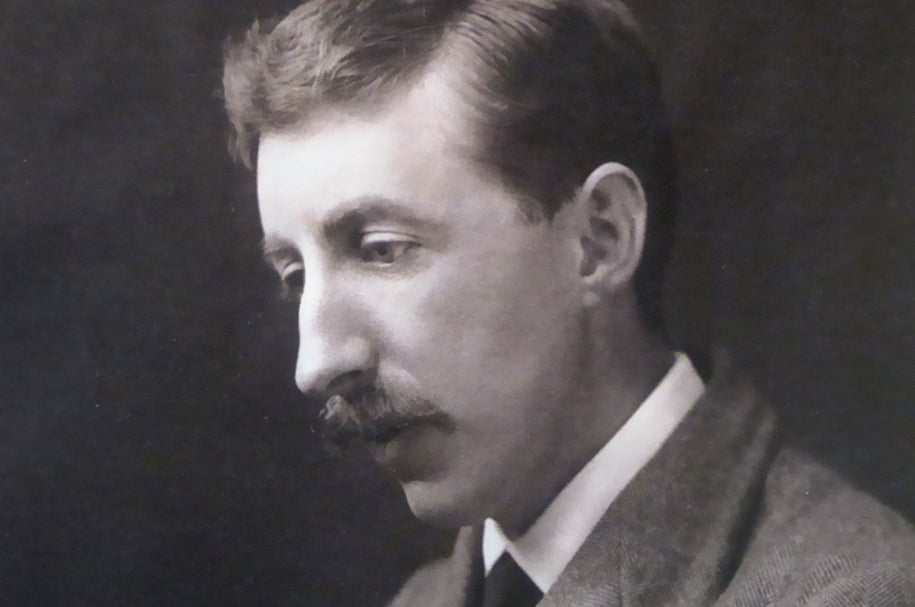
E.M. Forster spent much of his life hiding a part of himself.
In a diary entry from 1964 he wrote:
‘I should have been a more famous writer if I had written or rather published more, but sex has prevented the latter’.
Between 1905 and 1910 he published four novels—Where Angels Fear to Tread, The Longest Journey, A Room with a View and Howards End. By the time A Passage to India appeared in 1924, Forster had grown weary of writing about marriage and the relationships between men and women. It would be the last novel published during his lifetime.
Instead, his imagination increasingly turned towards relationships between men. He wrote stories that explored same-sex desire but refused to publish them, convinced that the world in which he lived was not ready for them.
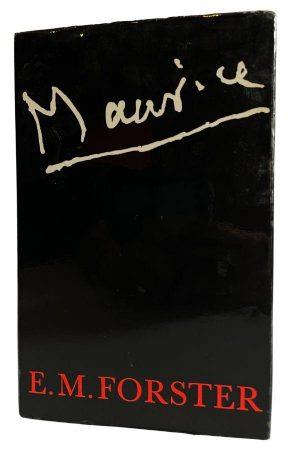
His novel Maurice finally appeared in 1971, a year after his death. It tells the story of Maurice Hall, whose love affair with his Cambridge friend Clive Durham ultimately gives way to a deeper relationship with the young gamekeeper Alec Scudder. Defying class prejudice, social convention and the threat of blackmail, the novel ends not in tragedy but in hope.
Forster wrote Maurice in 1913–14, yet he could never quite let it go. He revised the manuscript in 1932 and again between 1952 and 1960, repeatedly reworking the ending while remaining determined that the lovers should find happiness.
It is difficult not to wonder whether Maurice became the life that Forster wished he might have lived himself.
While at Cambridge he was infatuated with Hugh Owen Meredith, who is widely believed to have inspired the character of Clive. He was also drawn to working-class men and, in 1930, began a relationship with the London policeman Bob Buckingham that lasted for forty years. During his travels abroad he formed other relationships, reportedly experiencing sex for the first time with a soldier on an Egyptian beach when he was thirty-eight.
In 1970, the biographer P. N. Furbank observed:
“He achieved physical sex very late, and found it easier with people outside his own social class; and it remained a kind of private magic for him – an almost unattainable blessing, for which another person was mainly a pretext.”
The executor of Forster’s estate was Professor W. J. H. Sprott of Nottingham University, best known for translating Sigmund Freud’s New Introductory Lectures on Psycho-Analysis. Among Forster’s papers he discovered the manuscript of Maurice, together with the unfinished novel Arctic Summer, largely written in 1911, which also explored homosexual themes.
There were also a number of short stories written between 1903 and 1958. Published posthumously in 1972, only two had appeared during Forster’s lifetime; the remainder were either overtly homoerotic or explicitly gay stories that would almost certainly have been considered indecent by contemporary standards.
Within his closest circle, Forster made little attempt to conceal his sexuality. He shared successive drafts of Maurice with trusted friends including Siegfried Sassoon, Lytton Strachey, Edward Carpenter, Christopher Isherwood, Xiao Qian and Forrest Reid.
Beyond that circle, however, he was intensely guarded.
In 1962, John Bayley wrote in The Guardian that “the homosexual themes underlie all his novels.”
Forster replied:
“Are you aware that homosexuality is still a criminal offence, and any public implication of it therefore objectionable.”
As Kate Symondson notes on the British Library website, Forster was only sixteen when Oscar Wilde was sentenced in 1895 to two years’ hard labour—the maximum penalty—for homosexual acts. It was a warning that stayed with him for the rest of his life.
The dangers faced by Maurice and Alec were not merely fictional. They reflected the laws, prejudices and fears that shaped Forster’s own existence.
Only in 1967, with the passing of the Sexual Offences Act, were private homosexual acts between men over the age of twenty-one decriminalised in England and Wales. By then Forster was eighty-eight years old, and the novel that had meant so much to him still remained unpublished.