
‘I will send you a book,’ said Severin. ‘It is a German classic, but I shall make sure you get the English translation. But before you read it, you must promise me one thing: research the dead author first. Then you will understand the sadness behind it.’”
True to his word, a package appeared on the doorstep a few weeks later. Inside was a copy of At the Edge of the Night by Friedo Lampe.
Cut to 2 May 1945. Kleinmachnow, a municipality on the outskirts of Berlin. Hitler has been dead for two days. Soviet troops occupy the capital. Germany is collapsing, and everyone is afraid of what comes next.
A shabbily dressed man walks along the street, shoulders hunched inside clothes that hang too loosely from his thin frame. To suspicious eyes he resembles one of the many fugitives trying to disappear into the chaos of defeat. Two Soviet soldiers stop him and demand identification.
He hands over his papers.
But the photograph shows a sturdier, healthier-looking man. The exhausted figure standing before them looks nothing like it.
The soldiers shoot him dead.
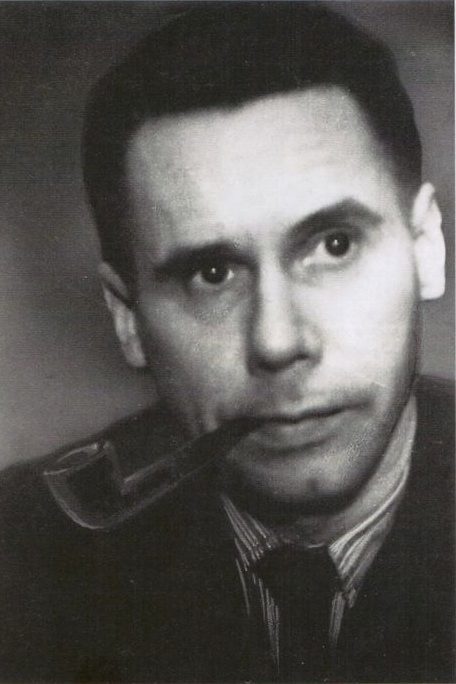
That is almost everything we know about the death of Friedo Lampe — librarian, editor, and novelist — a writer who experienced remarkably little good fortune during his lifetime.
Born in Bremen in 1899, Lampe suffered from bone tuberculosis in his left ankle as a child, leaving him permanently disabled. He studied literature, philosophy, and art history in Heidelberg, Munich, and Freiburg before eventually working as a writer and editor.
His debut novel, Am Rande der Nacht (At the Edge of the Night), appeared in 1933, the year Hitler came to power. Lampe later remarked that the book had been “born into a regime where it could not breathe.” Writing to a friend shortly after publication, he confessed: “What do you think of it now it’s in print? Very shocking? I’m worried.”
He had every reason to be.
The Nazis quickly placed the novel on their list of “damaging and undesirable writings.” Its dreamy nocturnal atmosphere, homoerotic undertones, and depiction of a relationship between a Black man and a German woman were enough to condemn it. Copies were seized; many were almost certainly burned.
Yet even then, perceptive readers recognised its brilliance. Hermann Hesse admired the novel in 1933 and later wrote that what had struck readers “as so beautiful and powerful has not paled… it proves itself with the best, and captivates and delights just as then.”
Lampe continued writing despite censorship and growing political danger. After working for Hamburg’s public library, he moved to Berlin in 1937 to work as an editor for Rowohlt. His prose ballad Das dunkle Boot (The Dark Boat) appeared in 1936, followed by the novella Septembergewitter (September Thunderstorm) in 1937. Neither achieved significant recognition, and Rowohlt itself was seized by the Nazis in 1939.
Throughout the war Lampe lived in quiet fear. Under Paragraph 175, homosexuality remained criminalised, and gay men faced surveillance, arrest, imprisonment, and deportation to concentration camps. Lampe, himself homosexual, lived cautiously and privately. In 1943 he narrowly escaped catastrophe after being blackmailed by a male prostitute in Berlin; only the intervention of his publisher’s lawyer prevented the affair from escalating into a criminal case.
Friends described him as reserved rather than solitary: a chain-smoker, obsessive reader, and compulsive buyer of books. “It really is an illness with me,” he once admitted. “I simply must buy every book, even when I don’t have the money.”
Misfortune seemed to pursue him relentlessly.
“I never had much luck with books,” Lampe remarked bitterly in 1944. The previous year an air raid had destroyed his Berlin apartment and with it his vast personal library. Two weeks later another bombing raid destroyed the Leipzig printing works preparing a new volume of his stories, Von Tür zu Tür (From Door to Door). In 1944 he was conscripted into the German Foreign Office, where he worked analysing intercepted enemy communications.
Then came the end of the war — and his senseless death on a roadside in Kleinmachnow.
Lampe was buried beneath a simple wooden cross bearing the words: Du bist nicht einsam — “You are not alone.”
For decades he remained little more than a literary footnote. Am Rande der Nacht was republished in expurgated form in 1949, 1955, and 1986, with supposedly offensive passages removed. Only in 1999, the centenary of Lampe’s birth, did the first complete unexpurgated edition finally appear.
That restoration transformed his reputation.
Modern German critics increasingly came to regard Am Rande der Nacht as one of the great lost novels of the Weimar era: lyrical, melancholic, cinematic, and unlike anything else produced in Germany at the time. Lampe’s readership steadily grew into something close to a cult following. His collected letters were published in 2018; an English translation of At the Edge of the Night finally appeared in 2019, introducing him to a wider audience decades after his death. Johann-Günther König’s long-overdue biography followed soon after.
Today Friedo Lampe occupies the strange position reserved for certain artists: neglected in life, cherished in retrospect. The writer once condemned and erased by the Nazis is now included in The Oxford Companion to German Literature and discussed as an important rediscovered voice of twentieth-century German fiction. Perhaps that is the consolation history occasionally offers — that literature can outlive the regimes, prejudices, and accidents that once tried to silence it.

