
“Spendid, perfectly splendid!” replied the Colonel. “Eighteen, by Jove! You’ve timed your lives wonderfully, my boys. To be eighteen in 1914 is to be the best thing in England. England’s wealth used to consist in other things. Nowadays you boys are the richest thing she’s got. She’s solvent with you, and bankrupt without you. Eighteen, confound it! It’s a virtue to be your age, just as it’s a crime to be mine. Now, look here” – the Colonel drew up his chair, as if he were going to get to business – “look here. Eighteen years ago you were born for this day. Through the last eighteen years you’ve been educated for it. Your birth and breeding were given you that you might officer England’s youth in this hour. And now you enter upon your inheritance. Just as this is the day in the history of the world so yours is the generation. No other generation has been called to such grand things, and to such crowded, glorious living. Any other generation at your age would be footling around, living in a shallow existence in the valleys, or just beginning to climb a slope to higher things. But you” – here the Colonel tapped the writing-table with his forefinger – “you, just because you’ve timed your lives aright, are going to be transferred straight to the mountain-tops. Well, I’m damned. Eighteen!”
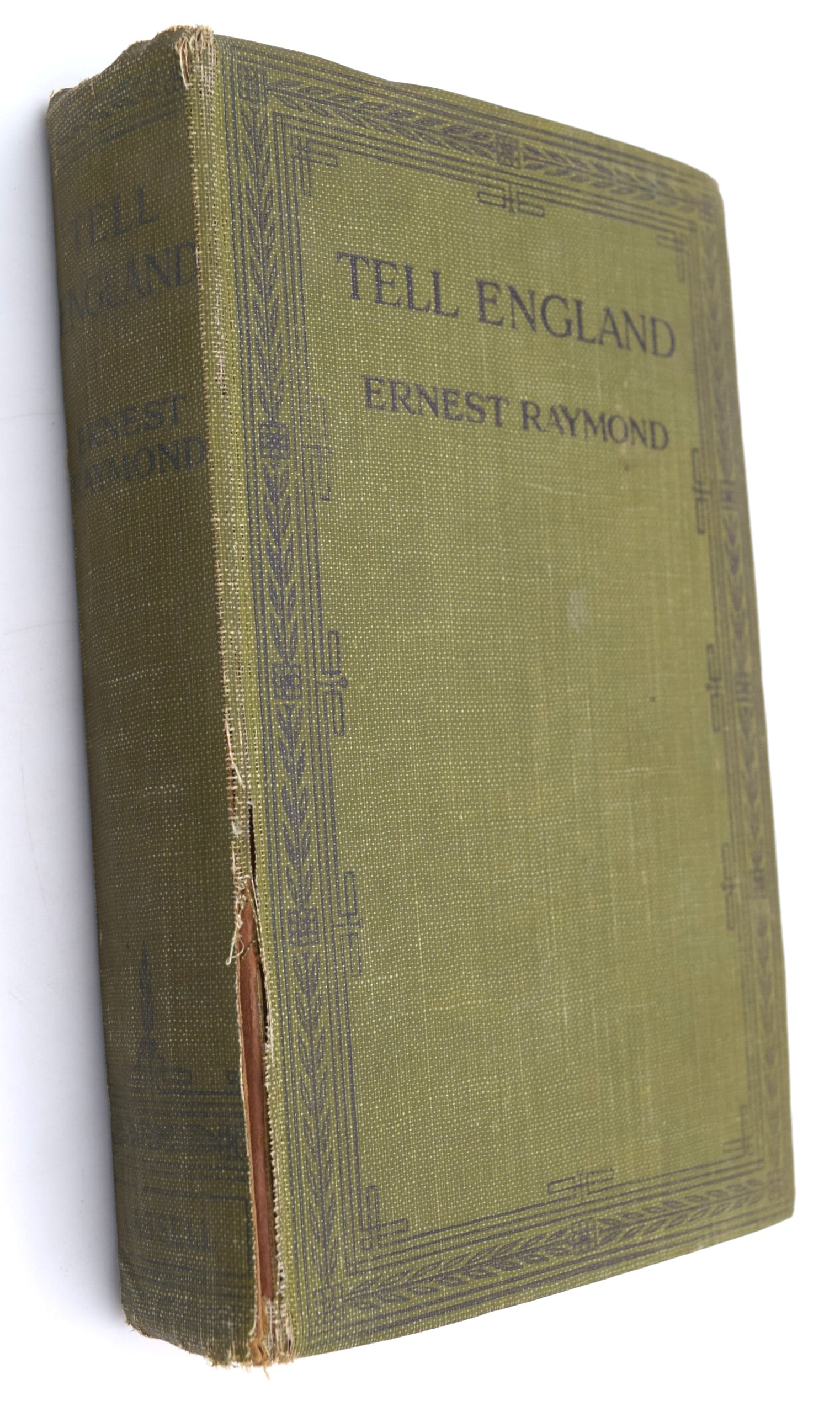
The passage is taken from Tell England: A Study in a Generation, a novel written by Ernest Raymond and published in February 1922 in the United Kingdom. Its themes are the First World War and the young men sent to fight it. The body of the novel is divided into two halves (or “books”), both narrated by Rupert Ray. The first book tells the story of his and his friends’ progress through school; while the second deals with the experiences of (specifically) Ray and his friend Edgar Doe during the war.
Forty-five years after the novel’s publication, Raymond wrote: “Another thing that is a cause of wonder to me as I re-read the book is the indubitable but wholly unconscious homosexuality in it,” since “‘homosexuality’ was a word which — absurd as this seems now — I had never heard.”

