Tag Archives: World War One

The Truth Died at Ors

Wilfred Owen (1893-1918) photographed about 1910

“It seemed as though it was happening to somebody else. He heard the rattle of German machine guns and believed they were aimed elsewhere. He pitied the unfortunate comrades who fell into the mud and filthy water, yet silently thanked the Lord that it was them and not him. Surely He had made him immune to this brutal enemy. He was too young to die.

Then his tunic exploded before his eyes. Chunks of blood, cloth and gore splattered across his chest and stomach like enormous raindrops. There was no pain. Not at first. Then came the realisation that these were the very bullets meant for somebody else. After that came the searing pain—sharp, sudden, inexplicable. His insides had exploded. The Lord had deserted him after all.

Those were his final thoughts as he fell to his knees: that he was going to die, and his secret would remain with him on the banks of the Sambre–Oise Canal at Ors.

*****

I am one of those who subscribes to the view that the poet was homosexual. Others, of course, suggest otherwise. His connections with a homosexual literary circle that included Siegfried Sassoon, Robbie Ross, Osbert Sitwell and Scottish writer C.K. Scott Moncrieff is well documented. 

The truth of the matter died with Owen at Ors in November 1918.

Wilfred Owen had only five poems published during his lifetime. The vast majority of his work was published posthumously, much of it written between August 1917 and September 1918 during his stay at Craiglockhart Hospital in Edinburgh and a subsequent period in Scarborough.

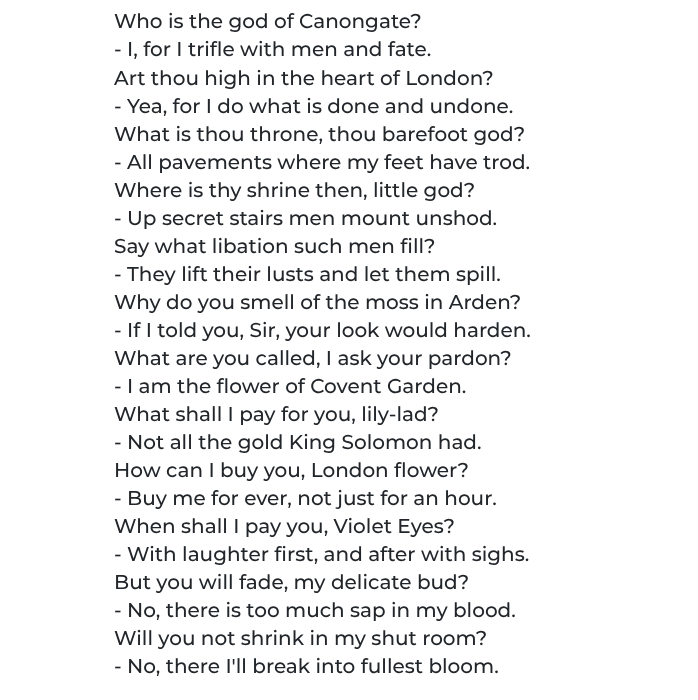
One such poem, Who Is the God of Canongate?, is believed to have been written at Scarborough in November 1917, when Owen joined the Manchester Regiment, billeted at the Clarence Gardens Hotel (now the Clifton Hotel), where he spent much of his free time writing in a turret bedroom.

The poem has often been interpreted as an evocation of male prostitution in Canongate, Edinburgh, and Covent Garden, London, collectively represented as a “little god” who walks the pavements barefoot. This “lily-lad” is visited up “secret stairs” by men who “lift their lusts and let them spill”.

Did Owen write from experience? Or had he merely heard stories that inspired the poem?

Alas, we shall never know.
Stolen Words: “You’ve timed your lives wonderfully, my boys.”

“Spendid, perfectly splendid!” replied the Colonel. “Eighteen, by Jove! You’ve timed your lives wonderfully, my boys. To be eighteen in 1914 is to be the best thing in England. England’s wealth used to consist in other things. Nowadays you boys are the richest thing she’s got. She’s solvent with you, and bankrupt without you. Eighteen, confound it! It’s a virtue to be your age, just as it’s a crime to be mine. Now, look here” – the Colonel drew up his chair, as if he were going to get to business – “look here. Eighteen years ago you were born for this day. Through the last eighteen years you’ve been educated for it. Your birth and breeding were given you that you might officer England’s youth in this hour. And now you enter upon your inheritance. Just as this is the day in the history of the world so yours is the generation. No other generation has been called to such grand things, and to such crowded, glorious living. Any other generation at your age would be footling around, living in a shallow existence in the valleys, or just beginning to climb a slope to higher things. But you” – here the Colonel tapped the writing-table with his forefinger – “you, just because you’ve timed your lives aright, are going to be transferred straight to the mountain-tops. Well, I’m damned. Eighteen!”

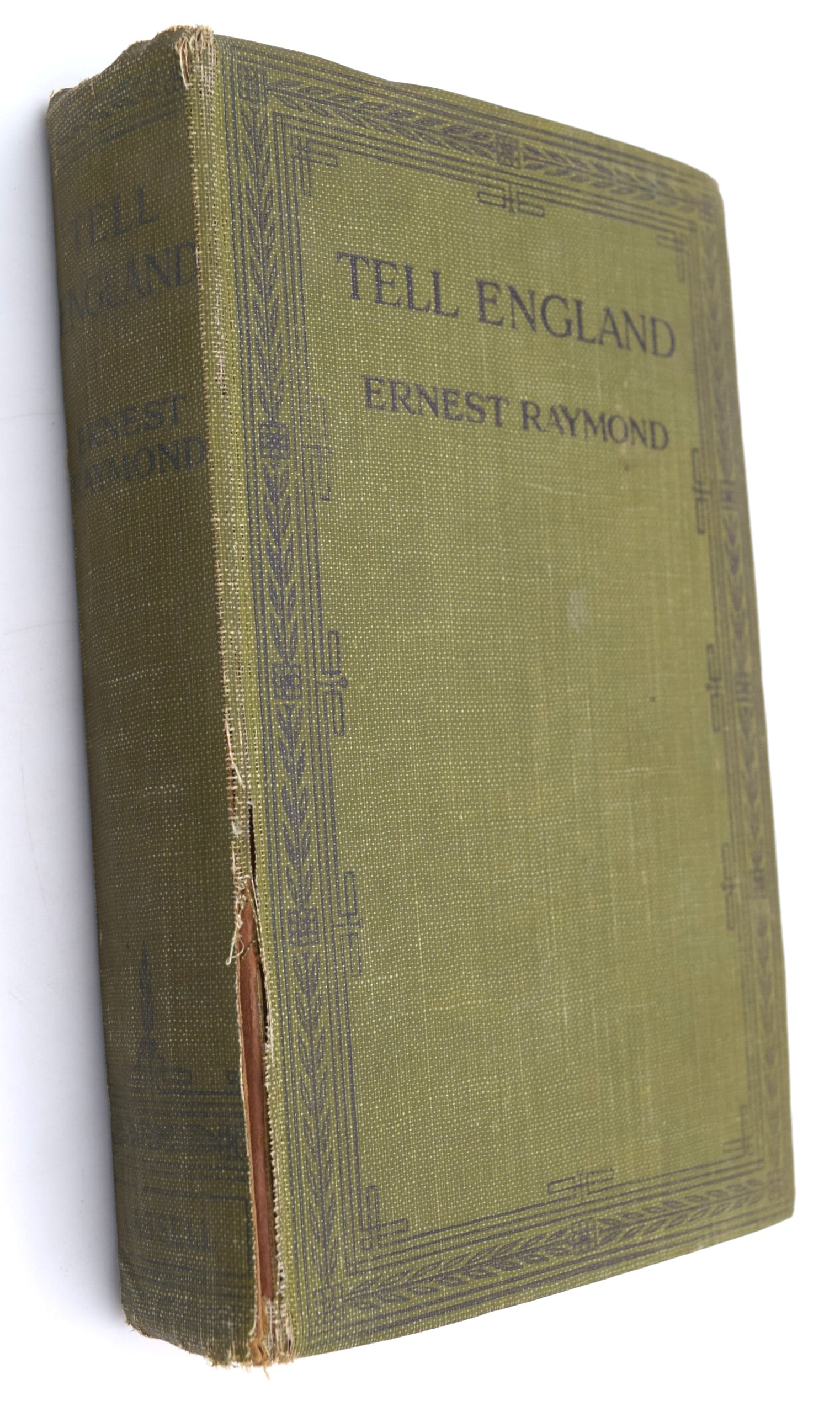
The passage is taken from Tell England: A Study in a Generation, a novel written by Ernest Raymond and published in February 1922 in the United Kingdom. Its themes are the First World War and the young men sent to fight it. The body of the novel is divided into two halves (or “books”), both narrated by Rupert Ray. The first book tells the story of his and his friends’ progress through school; while the second deals with the experiences of (specifically) Ray and his friend Edgar Doe during the war.

Forty-five years after the novel’s publication, Raymond wrote: “Another thing that is a cause of wonder to me as I re-read the book is the indubitable but wholly unconscious homosexuality in it,” since “‘homosexuality’ was a word which — absurd as this seems now — I had never heard.”