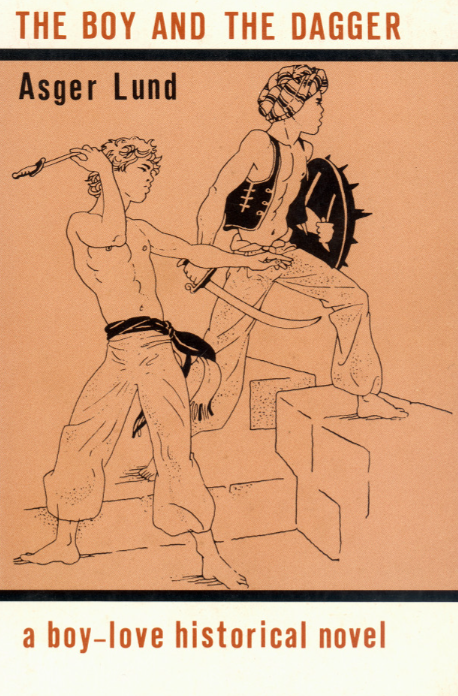
“For the boy was beautiful: blond curly hair, blue eyes which seemed to catch all the dim light of the tap-room, a spare but tightly muscled chest seen through a shirt open to his navel (because, evidently, its buttons had long ago been parted from it). The lad moved about the edges of the room, in the shadows, with pitchers of water and cider, alert to the needs of the other guests but observant, too, of the traveler at the corner table. Once or twice their glances met, and then our spy or informer might have heard the young man continue under his breath, “Yes, with a little expert attention and some new garments you might be a worthy page for Torben Lerche!”
Asger Lund,The Boy and the Dagger(1961) Drengen og dolken
This might be historical ‘boy-love pulp fiction’.
Or perhaps something stranger.
Asger Lund was one of the many names used by the Danish writer and artist Kjeld Asger Frydenlund (1929–2013). The Boy and the Dagger was originally published in Denmark in 1961, although my copy is the English edition, published in October 1982 by Spartacus in Amsterdam. It is described as a “boy-love historical novel” and illustrated by Richard Steen.
Germany. France. Spain. North Africa.
It sounds like an adventure novel, but there is something much more peculiar going on here.
Frydenlund was a draftsman before he became a writer. His influences included Art Nouveau, Pierre Joubert and comic strips. Mostly black and white. Strong lines. Boys.
And then the names begin to multiply.
Stanley W. Baker. Pete Freeman. Horst Irgens. Asger Lund. Richard Steen. Sometimes simply RS. All the same man.
From 1952 onwards, under RS and later Richard Steen, he produced drawings of boys in a stark black-on-white style. From around 1960, as Horst Irgens, the drawings became darker and more photographic, using heavy shadows, hatching and stippling.
Then, from the 1970s, came Asger Lund.
Writer. Artist. Pseudonym. Another identity.
There is something fascinating about it all. Not simply the book itself, but the strange little underground world around it — pulp novels, drawings, pseudonyms and magazines, all circulating in a culture that now feels almost impossibly distant.
The Boy and the Dagger.
Even the title sounds like something I should probably not be reading.
*David remembered exactly what he was doing in the month Joshua was born.
It was October 1986, and David had just started writing for Blitz. In the same week, he also began writing for Look-In, the children’s magazine built around ITV’s seemingly endless supply of kids’ programmes. The contrast could hardly have been greater.
Blitz was all style, fashion and culture. Look-In required David to find words that might appeal to schoolchildren without making him sound like an adult trying desperately to appeal to schoolchildren. Yet, strangely enough, his best work turned out to be for the latter.
His editor praised him for bringing to life such characters as T-Bag, Super Gran and the cast of Jossy’s Giants. At twenty-two, David decided it was probably best not to put this particular achievement on his rapidly evolving CV.
His ambition was to write for The Face. That never came to fruition, but not for want of trying.
That summer, David had met Nick Kamen, whom he regarded as the most beautiful man in the world. With a confidence that now seemed almost incomprehensible, Kamen had agreed to be interviewed. There was no fee involved. They met twice in Hyde Park, where David discovered that he was a pleasant young man and, more importantly, precisely the sort of person David hoped might one day make excellent boyfriend material.
There was, however, one small problem.
Kamen was completely straight.
He also giggled whenever David flirted with him.
They recorded several hours of material, which inexplicably disappeared over the years. Kamen had dutifully talked about boxer shorts, Levi 501s and Madonna for what was probably the thousandth time, but had also opened up about his interests and ambitions.
Somewhere in a box in the attic at Cleaver Square there was, David was fairly sure, a typed manuscript of the interview, flatly rejected by The Face and, as far as he could remember, everybody else who had subsequently seen it.
There was also a chance that the box contained the fading photographs of the stunt David and his drunken friends had pulled that same year.
They had gone into a late-night launderette on Paddington Street, stripped down to their boxer shorts and attempted to recreate Kamen’s famous advert. They photographed one another with a Polaroid 600 and had the pictures developed at SupaSnaps.
The results had been less than inspiring.
Skinny white bodies. Boxers far too baggy. Not a hint of the effortless eroticism that had made Kamen famous.
Bloody hell, David thought. If Kamen had lived, he’d be sixty-four now.
Meanwhile, nine months earlier, Terry and Brenda Turner had suffered the consequences of a shag.
Joshua Turner was born.
His name had all the makings of an artist.
All of this came to light when David broached the subject of Joshua’s upcoming fortieth birthday.
David had decided to take Joshua away for his October birthday week.
They hadn’t been abroad together for a while.
When they had first met, David had spoiled Joshua with trips all over Europe. He hadn’t expected a relationship with a young man in his twenties to last, and this was his attempt to keep him for as long as possible. The boy from Thamesmead had suddenly stepped into a world that wasn’t meant for him, but he had taken to it with gusto.
Except the relationship had lasted.
Sixteen years, to be precise.
Eventually, the novelty of city breaks wore off.
In recent years, with a solid income from his artwork, Joshua had taken to travelling alone. A few days here, a few days there.
At first, David had been suspicious of these random jaunts.
There had been a photograph of Joshua on Instagram. He was leaning against a balcony rail, his back to the camera. David had immediately wanted to know who had taken it.
“A friend from Barcelona,” Joshua had said, irritated by the question.
David had been forced to accept that Joshua was entitled to live his own life.
But the fortieth birthday meant that they would travel together again.
“I’d like to go to Italy,” Joshua decided.
That got David thinking.
“Verona?”
“Absolutely not,” Joshua retorted.
“Why not?”
Joshua had looked at David with a raised eyebrow.
“If you’re suggesting that we’re going to meet up with Miles, then the answer is definitely no.”
“He’ll have left Verona by October,” David reasoned.
“No.”
Joshua had realised a long time ago that David was secretly in love with Miles.
The feeling was not reciprocated. David held no attraction for Miles whatsoever.
If only I was thirty years younger, David mused.
Joshua, however, still regarded Miles as a threat, and their friendship was cool at best.
“I’m thinking Rome or Venice. Or both.”
David began working on a plan, but Joshua had known him long enough to spot it.
“And if Miles comes anywhere near us, I shall be on the first plane home.”
David had to admit defeat.
He changed the subject.
“You do realise that it will also be your father’s seventieth birthday while we’re away?”
“That’s tough luck.”
“But won’t you be expected to see him?”
“No.”
It hadn’t been the easiest time when Joshua’s parents discovered that he was gay. After weeks of arguments, they had eventually accepted that nothing they did was going to change anything.
That fragile peace came to an end when they discovered that Joshua was moving in with David, a man twice his age.
Joshua’s father tracked David down and accosted him in the street. He had accused David of many things, but one word had hit home.
Paedophile.
David hadn’t spoken to Joshua’s parents since.
Of course, the relationship wasn’t meant to last. David’s friends had told him so. Somehow, much to their amazement, and occasionally his, it had held together.
David had struck gold.
Joshua was polite and never caused a problem. Unlike most men his age, he turned out to be a homebody, shunning wild nights out in favour of spending time at home with David.
David encouraged him to leave his job serving on the tills at Morrisons and rather enjoyed the idea of looking after Joshua financially. But it had been a strain when the family fortune nosedived and David’s income from writing dipped.
Back then, David had rented rooms in Paddington, or the edges of Tyburnia, as he liked to call it.
And then Uncle William left Cleaver Square to him.
They moved to Kennington and couldn’t quite believe the number of rooms that were suddenly available to them. Joshua insisted that they should each have a room for their work: David for his writing, Joshua for his art.
David soon realised that his young lover had talent. Sketching, photography, creating monstrosities out of almost nothing. He paid for Joshua to study at art school, which widened his horizons considerably.
Joshua was intent on becoming famous and used David’s connections to climb the social ladder.
And David watched as the passive young man he had first met turned into someone with an unwavering focus.
The boy from Thamesmead was no more.
The journey had been fun, and the two of them loved each other immensely.
But they no longer had sex.
David couldn’t remember the last time they had been intimate. He could, however, remember the last time Joshua had rejected his advances.
He had said he was tired and wanted to sleep.
David had heard that excuse before.
That was six years ago, and he vowed never to embarrass himself like that again.
For a while, David had thought it was because of his age. He compared them to Christopher Isherwood and Don Bachardy, W. H. Auden and Chester Kallman, perhaps even Andy Warhol and Jed Johnson.
Eventually, David realised that Joshua would have to satisfy his own urges, which explained his suspicions about the brief excursions abroad.
David told himself that he no longer cared.
That was far from the truth.
His sex drive hadn’t waned. The opportunities had.
Joshua, to borrow the words of Boy George, gave the distinct impression that he would rather have a cup of tea.
Oh, to be young again, thought David.
And then he wondered whether it was youth he really missed.
“And if we are found out?” asked Maurice. He was still on his knees in the thicket, and, as he looked up to where his companion stood in an awkward fumbling attitude, his face seemed even more than usually pale and meagre in the grey broken light. It was with rather forced nonchalance that Carruthers answered. “O, the sack, I suppose.” – and he stopped aghast at the other’s expression. Then as only at one other time in a long and well-rewarded life did he feel that a millstone round his neck might perhaps be less offensive than the picture of those small, startled features hung for all eternity before his eyes.
At the age of eighteen, Charles Kenneth Scott-Moncrieff (1889–1930) published his story Evensong and Morwe Song in the pageant issue of New Field, the literary magazine he edited at Winchester School. Circulated widely among parents, pupils, and masters, the magazine reached far beyond the school itself. The story caused such a scandal that the issue was immediately suppressed and its editor expelled.
David decided to spend the afternoon on his own. Moments like this had become rare.
He had spent the morning writing, but his concentration had deserted him. Leaving Joshua creating something unidentifiable in the studio, he wandered towards Little Portugal and ended up nursing a cappuccino outside Starbucks.
Portuguese families had first settled around Notting Hill and Ladbroke Grove before rising rents gradually pushed many south of the Thames. The neighbourhood around South Lambeth Road eventually became known as Little Portugal, although, today, there seemed remarkably few Portuguese about.
Places like this had always fed David’s imagination.
He would settle into his chair and watch the procession of strangers pass by; ordinary people following lives known only to themselves. He would invent those lives as they walked.
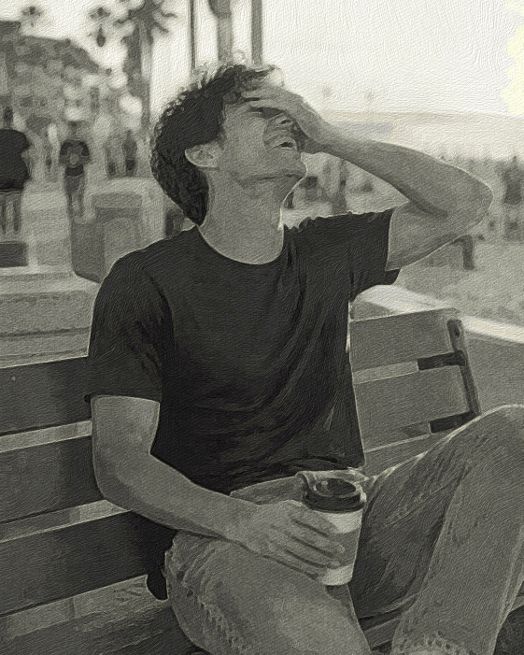
His attention always drifted towards solitary young men moving with effortless confidence. Summer had finally arrived and they appeared in shorts, T-shirts and trainers, a backpack slung casually over one shoulder. David had never quite lost his fascination with male legs.
Not long ago he had stumbled across an idea for a book.
It would require an entirely different kind of research.
He imagined choosing a young man at random. There was only one rule: he had to be someone David found beautiful enough to want to sleep with. Realistically, he thought, the feeling would almost certainly not be mutual. Most would be straight, but that hardly mattered. David would give each one a name, follow discreetly behind and see where life carried him. Every journey would become a chapter. Every stranger, a story.
So far, the idea had remained just that.
When he mentioned it to Joshua, he had received a look of genuine concern.
“You do realise you’re describing stalking?”
David had laughed, but the accusation lingered.
Even so, the idea continued to delight him.
When a handsome young man with thick dark curls appeared at the end of the street, David briefly wondered whether today might finally be the day.
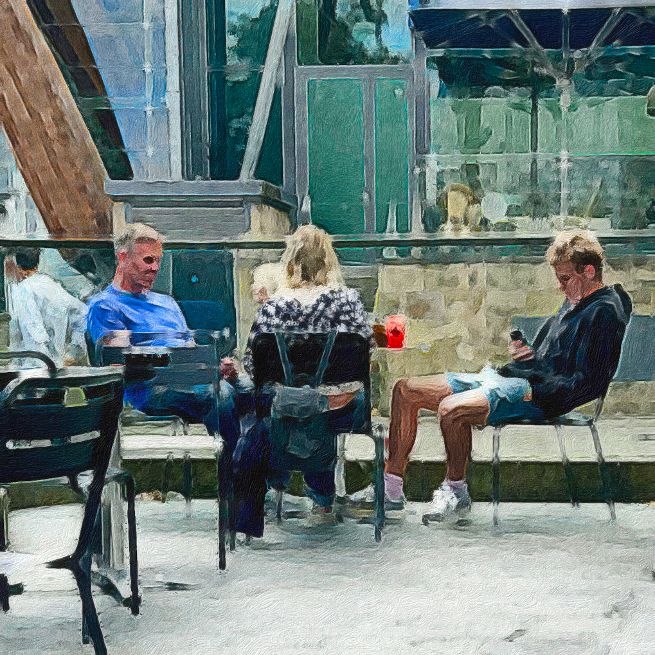
Instead, his attention shifted to the table beside him.
An older man and a much younger one had just sat down together.
A couple? Father and son?
Before David could decide, a woman appeared carrying coffees.
Mother.
The younger man was exceptionally handsome. Tallish, blond, wearing a designer top, blue shorts and unexpectedly bright pink socks. The socks made David smile. Stretching his legs in front of him, the young man absent-mindedly stroked the smooth skin of one shin before rubbing the back of his knee as though it had begun to ache.
David found himself listening.
Only the boy’s voice carried.
It was unmistakably Home Counties.
“She’s strange,” he said. “And she walks funny too.”
His parents laughed. His mother replied too quietly for David to catch.
“I know what you’re saying,” the boy answered, “but I don’t think that’s going to happen.”
David suspected she was trying to engineer a romance.
The father smiled with quiet satisfaction.
David recognised the expression immediately.
It was the face of a man who knew exactly how handsome his son was.
The longer David looked at him, the more he could imagine the father at the same age. Once equally beautiful. Once perhaps exactly the kind of man David might have taken home without a second thought.
The mother passed over a muffin.
The boy demolished it without the slightest concern for calories. Crumbs scattered down the front of his T-shirt before he brushed them away.
“We obviously flirt with each other,” he said, “but what’s the point of flirting with someone who doesn’t want you?”
My God.
How could anybody not want you?
He was exactly the kind of boy David loved to be seen beside. Someone impossibly attractive who might patiently sit in a garden listening to his stories while pretending to prune roses.
Then again, David suspected the illusion would disappear the moment he started talking about girlfriends.
Once upon a time, David had been that boy.
Only now did he realise how fortunate he had been.
At the time, he never knew.
His mother resumed talking while the boy scrolled through his phone, somehow managing to follow both conversations at once.
“It’ll take a month or so to grow,” he said, barely looking up.
Life would be much easier if parents never got in the way.
The father, who had spoken hardly at all, glanced towards David.
David instinctively lowered his eyes to his own phone.
The screen was still open on an interview with a twenty-something influencer from New York.
“The guys I fuck outside my relationship don’t look anything like my boyfriend. They’re all, like, fifty-five with massive tits. Why would I eat what I can get at home?”
David smiled despite himself.
Why don’t I ever meet people like that?
The thought faded almost as quickly as it arrived.
Another, quieter one took its place.
He was growing old.
Not suddenly.
Not dramatically.
Simply, unmistakably.
He imagined himself in ten years time.
An old man sitting alone on a bench. Shoulders rounded beneath the weight of time. Hands resting on his knees, or wrapped around the handle of a walking stick. A faded wool jacket buttoned to the neck. A flat cap pulled low across his brow. Scuffed trainers tied with thick laces.
Watching the world continue without ever asking him to join in.
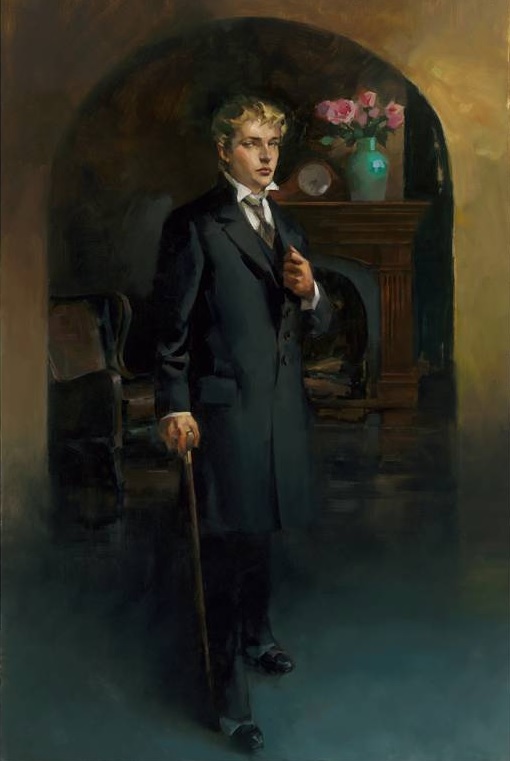
Image: The Picture of Dorian Gray – Gregrory Manchess
‘One evening about seven o’clock I determined to go out in search of some adventure. I felt that this gray, monstrous London of ours, with its myriads of people, its splendid sinners, and its sordid sins, as you once said, must have something in store for me. I fancied a thousand things. The mere danger gave me a sense of delight. I remembered what you had said to me on that wonderful night when we first dined together, about the search for beauty being the poisonous secret of life. I don’t know what I expected, but I went out, and wandered eastward, soon losing my way in a labyrinth of grimy streets and black grassless squares.’
From ‘A Picture of Dorian Gray’ by Oscar Wilde (1890)
A deeply coded text. While The Picture of Dorian Gray does not explicitly describe sexual acts, it is widely considered a foundational queer or homoerotic novel. The language, deep obsession between male characters, and themes of hidden desires heavily reflect same-sex attraction, which led to the book being used as evidence in Oscar Wilde’s 1895 trial for homosexuality.
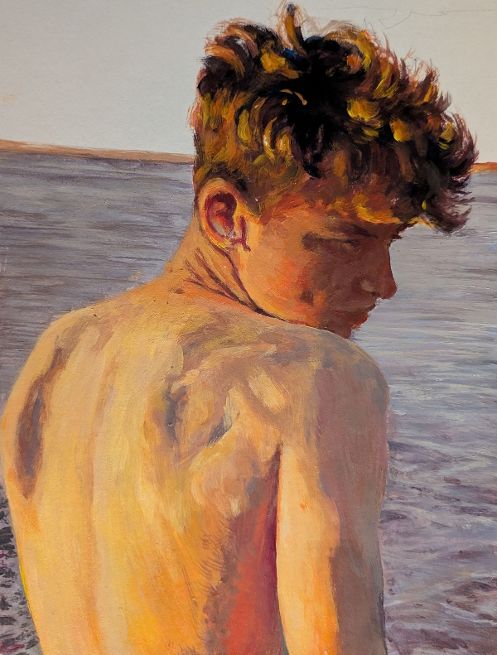
Henry had spent the morning sketching on the beach while his model sat naked upon a rock, gazing out to sea. He tried to capture the figure before him: broad, well-defined shoulders flowing into a powerful back that narrowed elegantly at the waist; sculpted arms, the muscles cleanly delineated beneath pale skin; strong, athletic legs whose proportions conveyed both grace and strength. The healthy glow of youth accentuated every subtle interplay of light and shadow across his form. Yet Henry knew that no matter how many times he put pencil to paper, he could never truly recreate the beauty before him. Johnny had cost half a crown, and he had earned it by remaining perfectly still for the better part of the morning.
It was shortly before midday when they heard the shots—two sharp reports that reverberated around the cove, causing Henry to drop his pencil and Johnny to start. Both looked about for the source of the disturbance, but nobody was in sight.
“It came from down there,” Johnny shouted, pointing towards the caves.
Before Henry could react, the boy was already running along Newporth Beach, seemingly oblivious to the fact that he was still naked.
“Be careful, Johnny!” Henry called, hurrying after him.
The body lay in the first cave. By the time Henry arrived, Johnny was standing over the motionless figure.
“Is he dead?” Henry asked.
“As dead as he’ll ever be,” Johnny replied. “There’s a gun on the floor, but no blood.”
Henry picked it up—a six-chambered revolver—before kneeling beside the corpse and turning it onto its back.
“Two shots to the mouth,” he murmured.
The strangest thought crossed his mind: the seed of a painting. The naked youth standing over a dead man. Absurd, he told himself.
“I’m afraid I know who this is,” Henry said at last, a note of sadness in his voice. “Harry Tilly, of Boslowick.”
He rose and turned to Johnny.
“Run along and find the policeman. Tell him to come here at once. But get dressed first, or the scandal will be greater than it already is.”
*****
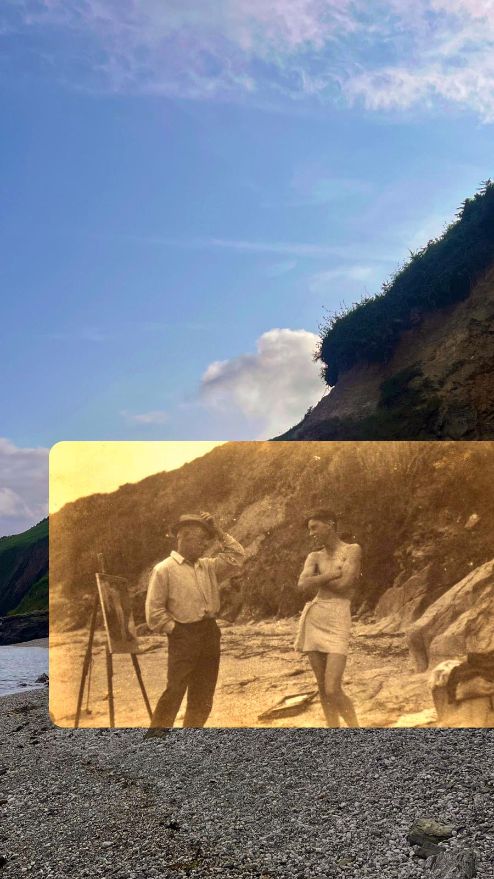
David pieced the story together in his head as he followed Joshua down the steep track—or what passed for one—towards Sunny Cove. He had recently come across a newspaper article from 1894 describing how the artist Henry Scott Tuke and one of his models had discovered the body of a Falmouth solicitor in a cave on Newporth Beach. Most of David’s ideas grew from forgotten histories, but only now had it occurred to him that the incident might provide the foundation for a novel.
Brambles, nettles and dense undergrowth crowded the route, obscuring their footing. Before long, the path dissolved into a treacherous slope of loose slate, fractured rock and powdery earth. One careless step could send them tumbling onto the beach below, though ropes had been fixed to the cliffside to assist those bold enough to attempt the final descent.
‘Tuke’s House’ had once stood on the clifftop, but it had vanished long ago. Seventy years earlier, thousands of tons of rock and soil had collapsed into the sea near Pennance Cottage, forcing its occupants to abandon it. The empty building soon became a playground for local children, who tore up floorboards and left a trail of destruction until the structure was deemed unsafe. Its owner, Mrs Trench Fox, eventually ordered it demolished. Tuke had been dead for twenty-five years, and few mourned the loss.
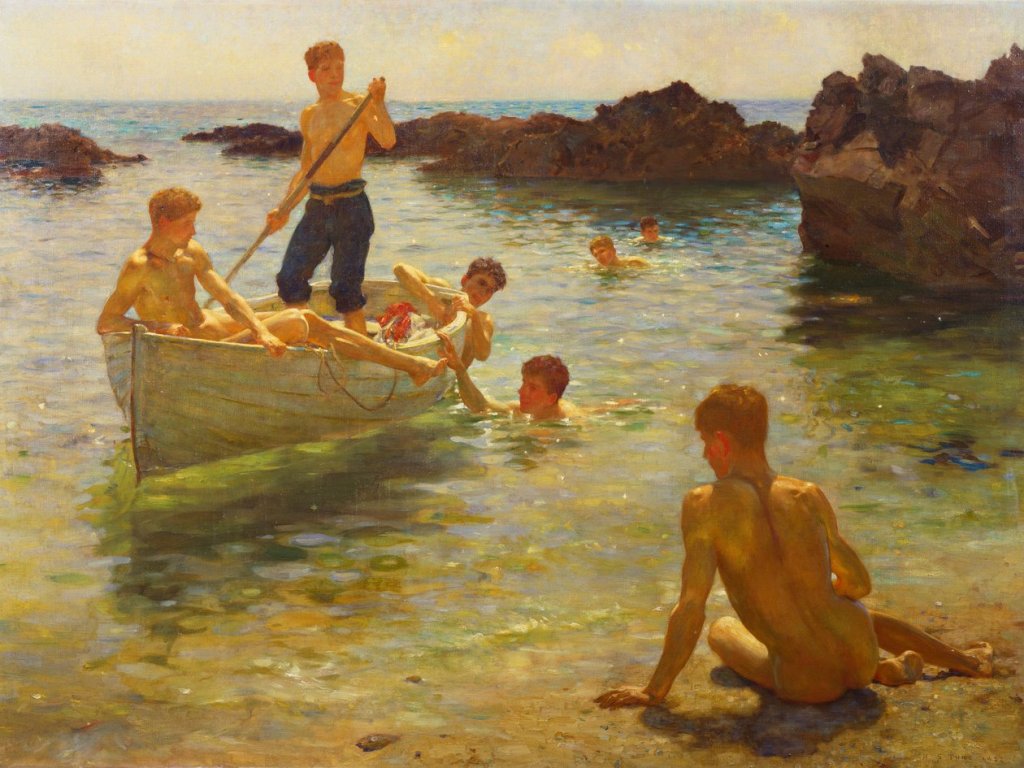
Most of Tuke’s male nudes had been painted on the beaches below—Tuke’s Beach, Sunny Cove and Newporth Beach—names familiar only to locals. To outsiders fortunate enough to find them, they appeared to be a single uninterrupted stretch of coastline.
David and Joshua had discovered Sunny Cove the previous year. On that occasion, the weather had been cool and overcast, and they had the beach entirely to themselves. Few people ventured here; only those who knew where to find it. Together they had wandered along the narrow stretch of pebbles, exploring the rocky ledges and platforms while imagining the summers when Tuke and his models had spent long, sunlit days on the shore.
This time, however, the weather was glorious, and the beach no longer felt as though it belonged exclusively to them.
“Shit,” muttered David. “There are people here.”
“And an eyeful of old man penis,” Joshua added.
It was true. Half a dozen men were sunbathing completely naked.
“I didn’t realise it was a nudist beach,” David said.
“Not just a nudist beach,” Joshua replied in a low voice, “but probably a good place for blokes to go cruising.”
David slipped on his sunglasses and pretended to check his phone, giving himself an excuse to study their fellow beachgoers.
“My God,” he said. “The place is full of gay grandads.”
It was not entirely unfair. Most of the men were well past their prime, their sun-darkened skin weathered like old leather.
“The truth is, they’re probably younger than you are,” Joshua replied with a mischievous grin.
“Maybe, but at least I haven’t lost my looks. And I still have a decent figure.”
David felt obliged to maintain the fiction that he remained an Adonis, though deep down he knew the evidence was becoming less convincing with every passing year.
As they spread out their towels, he became acutely aware that the other men were watching them too. The object of their attention was clearly Joshua, who had already stripped down to his underwear.
“Henry Scott Tuke had an endless supply of beautiful young models,” David grumbled. “I get naked old men with tiny dicks.”
He found himself wondering whether Joshua intended to go completely nude. Even in a pair of Calvin Kleins, Joshua was striking: handsome, slim, and blessed with long, elegant legs. More importantly, he knew it. David had no doubt that Joshua would make the most of every advantage nature had given him.
Joshua made his way into the sea, wincing as the sharp pebbles bit into his feet. It was, he seemed to think, a small price to pay for the opportunity to perform before an audience.
David heard footsteps crunching across the shingle. One of the men—a naked, pot-bellied figure—waded into the water a short distance from Joshua. David watched with growing irritation as the pair splashed through the waves, as though participating in some obscure mating ritual.
Joshua had always been attracted to older men; after all, that was how he and David had ended up together. Lately, however, David found that fact increasingly difficult to ignore. He searched for the correct term. Chronophilia? Gerontophilia? When he had been Joshua’s age, older men had held no appeal for him—certainly not men old enough to be his father. In that respect, at least, he had remained remarkably consistent. He still preferred younger men, although the age gap widened with every passing year.
Joshua eventually returned to his side.
“That guy’s dick is too shrivelled to appeal to anybody,” David muttered.
“It’s because it’s cold,” Joshua replied, shivering. He glanced around as though only just noticing the older man who had joined him in the sea. “Hmm,” he said thoughtfully. “I wonder what he’ll say about me when I get naked.”
“I think not,” David said sharply, unhappy with the direction of the conversation.
“I think you should take off your clothes,” Joshua suggested.
“I think not,” David repeated.
He pulled a book on Italian cinema from his rucksack and opened it. Beside him, Joshua stretched out and closed his eyes.
*****
The young man wore shorts and a T-shirt and appeared to be in his early twenties. Handsome, though not in a conventional way, David thought. Perhaps interesting was the better word. There was something about him — something difficult to define — that immediately drew David’s attention. He chose a spot near David and Joshua.
David found himself reading the same sentence of his book again and again, unable to concentrate as the young man began removing his clothes. If there is a God, he prayed silently, let him strip naked. It seemed, for once, that God was listening, because that was exactly what he did. Joshua, meanwhile, appeared to have fallen asleep.
The young man settled onto his towel, drawing his knees to his chest.
“Hi,” he said to David.
David returned an awkward nod, reluctant to speak too loudly and wake Joshua.
“I’m Daniel,” the young man continued.
Joshua raised a hand in a vague gesture of acknowledgment, waving at nobody in particular. He seemed to have little interest in the newcomer, but made it clear that he was aware of his presence.
David searched for something clever to say — something that might break the ice, but nothing that might reveal too much of his interest.
“It’s a lovely day,” was all he managed.
The brief exchange gave David an opportunity to study Daniel more closely. He was slender, his pale body possessing a quiet, unassuming beauty that held David’s attention.
“Are you on holiday?” Daniel asked.
“Yes,” David replied. “And you?”
“I’m a student. Film studies at Falmouth University. I noticed you’re reading a book about Italian cinema, so I guess you’re interested in films too. What do you do?”
It was the question David always dreaded. He preferred people not knowing who he was. Though, he admitted to himself, there was a part of him that wondered whether Daniel might be impressed to discover he was speaking to a famous author.
“I’m a chef,” David lied.
Joshua let out a small laugh.
“Do you mind if I join you both?”
David, naturally, raised no objection and gestured for him to move closer. He watched as Daniel spread his towel beside them. At that precise moment, Joshua removed his Calvin Kleins and stretched himself fully beneath the sun.
David felt decidedly overdressed and, despite himself, slightly guilty; everyone else on the beach was naked except him. Daniel looked along the shoreline, his gaze taking in the scattered sunbathers before briefly settling on Joshua.
“Arthur’s Beach,” he remarked. “Why is it called Arthur’s Beach?”
The words Arthur’s Beach had been painted in yellow on a prominent rock overlooking the shore.
Joshua spoke for the first time.
“Because,” he said wearily, “many years ago, a local man named Arthur used to greet people by asking, ‘Had a good afternoon on Arthur’s Beach?’ before wandering off again.”
The story was true, and the name had endured so completely that it now appeared in naturist guides and travel forums alike.
“Looking at you sitting here, Daniel,” David interjected, “you could have stepped out of one of Tuke’s paintings.”
The expression on Daniel’s face made it clear that he had no idea what David was talking about.
“Henry Scott Tuke? The painter? Famous for his young men on the beaches of Cornwall?”
Still no reaction.
David searched his phone for some of Tuke’s most famous paintings and handed it to Daniel. He studied the images carefully, but his expression revealed nothing.
“Most of them were painted here,” David said. “On this very beach.”
Daniel raised an eyebrow, and David found himself charmed by his innocence — not an innocence of youth, but of someone who had simply never encountered this small corner of artistic history.
“The interesting thing about Tuke’s male nudes is that they are remarkably tasteful. Not once does he reveal any genitalia.”
As soon as the words left his mouth, David’s eyes drifted instinctively towards Daniel’s body. He immediately looked away, a flush rising to his face, as though he had inadvertently betrayed his own curiosity.
“I think I may have seen some of these paintings before,” Daniel conceded.
David detected a flicker of mischief in his eyes.
“Tuke was a gentleman,” David continued, eager to defend the long-dead artist while also diverting attention from his own embarrassment. “His models wrote about his kindness and his integrity.”
“The figures look quite young.”
“Yes,” David admitted, with a trace of uncertainty.
“We can guess,” Daniel said.
“But it is difficult to prove. We’ll never know the exact ages of all his models.”
David waited for Joshua to come to his rescue, to offer some reassuring observation that might settle the discussion. Nothing came. Instead, Daniel’s expression shifted into something approaching a smirk, and David realised he was being gently provoked.
“Well, if you really think I could have stepped out of one of Tuke’s paintings, then I’m flattered if you think I look young enough.”
Joshua opened his eyes and turned towards them.
“There seems to be an element of flirting taking place here,” he observed with a playful smile.
“Not at all,” David replied too quickly.
“Take your clothes off, David. Stop spoiling the party.”
David stared at Joshua in disbelief. Then he looked at Daniel, who merely shrugged, as though to say, Why not?
But Joshua knew David would never undress—not anymore, and certainly not in front of Daniel. Instead, David steered the conversation elsewhere.
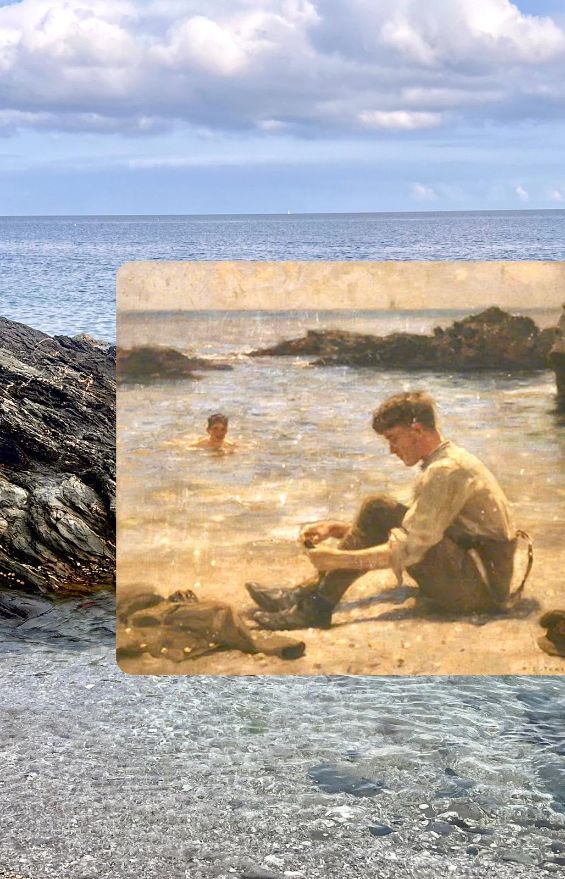
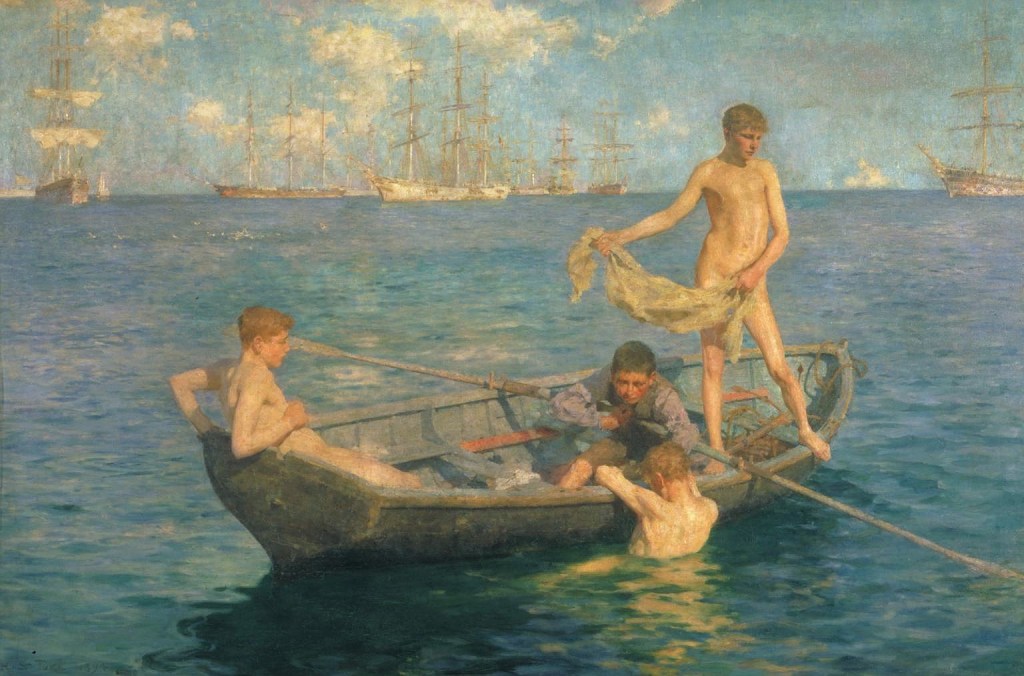
“There’s another Tuke painting you might find interesting.” He searched for it on his phone. “It’s called A Cadet on Newporth Beach, near Falmouth, with Another Boy in the Sea. You’ll notice that the cadet is fully clothed.”
He showed the image to Daniel.
“Do you know who the cadet is? It’s T. E. Lawrence — Lawrence of Arabia — and it was painted here as well.”
“Yes, fully clothed,” Daniel agreed. “But probably in the process of getting undressed.”
“Spendid, perfectly splendid!” replied the Colonel. “Eighteen, by Jove! You’ve timed your lives wonderfully, my boys. To be eighteen in 1914 is to be the best thing in England. England’s wealth used to consist in other things. Nowadays you boys are the richest thing she’s got. She’s solvent with you, and bankrupt without you. Eighteen, confound it! It’s a virtue to be your age, just as it’s a crime to be mine. Now, look here” – the Colonel drew up his chair, as if he were going to get to business – “look here. Eighteen years ago you were born for this day. Through the last eighteen years you’ve been educated for it. Your birth and breeding were given you that you might officer England’s youth in this hour. And now you enter upon your inheritance. Just as this is the day in the history of the world so yours is the generation. No other generation has been called to such grand things, and to such crowded, glorious living. Any other generation at your age would be footling around, living in a shallow existence in the valleys, or just beginning to climb a slope to higher things. But you” – here the Colonel tapped the writing-table with his forefinger – “you, just because you’ve timed your lives aright, are going to be transferred straight to the mountain-tops. Well, I’m damned. Eighteen!”
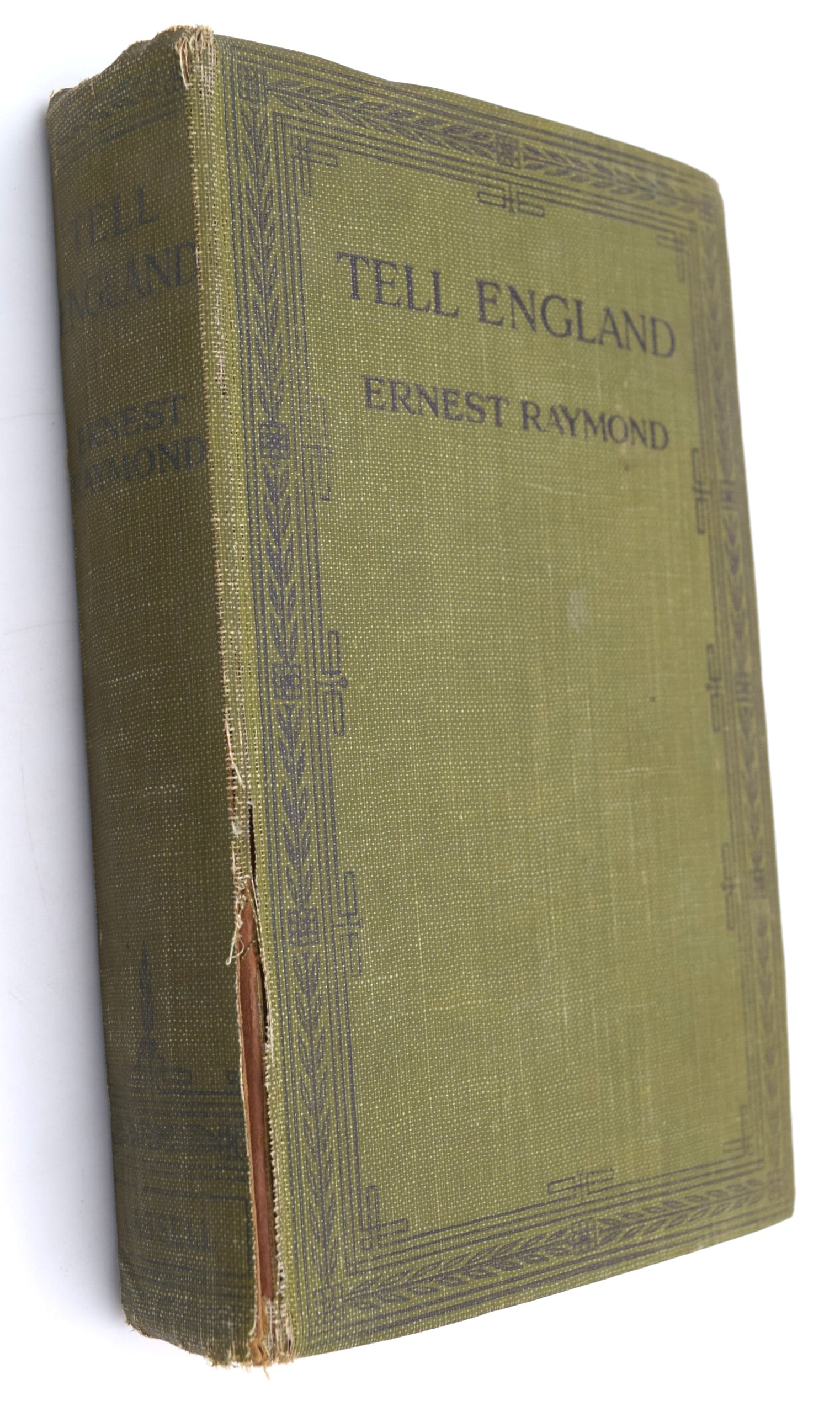
The passage is taken from Tell England: A Study in a Generation, a novel written by Ernest Raymond and published in February 1922 in the United Kingdom. Its themes are the First World War and the young men sent to fight it. The body of the novel is divided into two halves (or “books”), both narrated by Rupert Ray. The first book tells the story of his and his friends’ progress through school; while the second deals with the experiences of (specifically) Ray and his friend Edgar Doe during the war.
Forty-five years after the novel’s publication, Raymond wrote: “Another thing that is a cause of wonder to me as I re-read the book is the indubitable but wholly unconscious homosexuality in it,” since “‘homosexuality’ was a word which — absurd as this seems now — I had never heard.”
David and Joshua left London behind and headed south-west. It was something they did every year before the tourist masses descended upon Cornwall. They hired a car and stayed in a holiday cottage on the edge of Bodmin Moor. It formed part of a working farm and had once belonged to the Lanhydrock estate and, like so many great houses with dwindling fortunes, it had been sold off more than a century earlier. Now it belonged to a farming couple who had converted the redundant outbuildings into holiday accommodation.
David always wrote well in the Cornish countryside, where the only sounds came from sheep, cattle, and the wind crossing the moor. While Joshua slept until lunchtime, David sat at the kitchen table with his laptop and worked. Several of his novels had been conceived there, and he could easily write chapters at a stretch while new ideas arrived effortlessly. The spell would only be broken when Joshua eventually emerged, bleary-eyed and searching for his first caffeine fix of the day.
Joshua wandered into the room wearing only his underwear, his hair tousled and dark stubble shadowing his chin. This was David’s favourite version of him: unguarded, still carrying traces of boyishness, utterly unconcerned with how he looked.
“What are we doing today?” Joshua asked, as though David possessed the answer to everything.
But the plan had already been decided the night before: they were going to Falmouth.
Only in recent years had they fallen in love with the town. They had visited once before and been underwhelmed, but David’s growing fascination with Henry Scott Tuke had drawn them back, and gradually Falmouth had worked its charm upon them.
The story of Henry Scott Tuke fascinated David. For years he had encountered the paintings without consciously realising it. He had always been drawn to those bright, sunlit depictions of naked young men on beaches and boats. He had first noticed one in an art gallery and then began spotting others across the country. Tuke’s work seemed to exist everywhere now — reproduced on book covers, sold as canvas prints online, endlessly circulating through the internet. In death, he had become far more famous than he had ever been in life.
Once, David and Joshua had been fortunate enough to view The Tuke Collection in the archives of Falmouth Art Gallery. Together they examined more than two hundred canvases rarely seen by the public. That had been the moment Joshua fell in love with the paintings too.
Since then, David had tried to learn everything he could about Tuke and had managed to acquire almost every book written about him. He dreamed of owning an original Tuke painting one day, though even with his generous income he knew such a thing would forever remain beyond his reach.
It was nearly two in the afternoon by the time they arrived in Falmouth. After a brief visit to the art gallery, they were delighted to discover that one of Tuke’s paintings was on display: Study of Boys Bathing — two naked young men playing beside a dog.
“It’s a sign,” Joshua remarked, and David was inclined to agree.
But the real purpose of their visit was the grave.
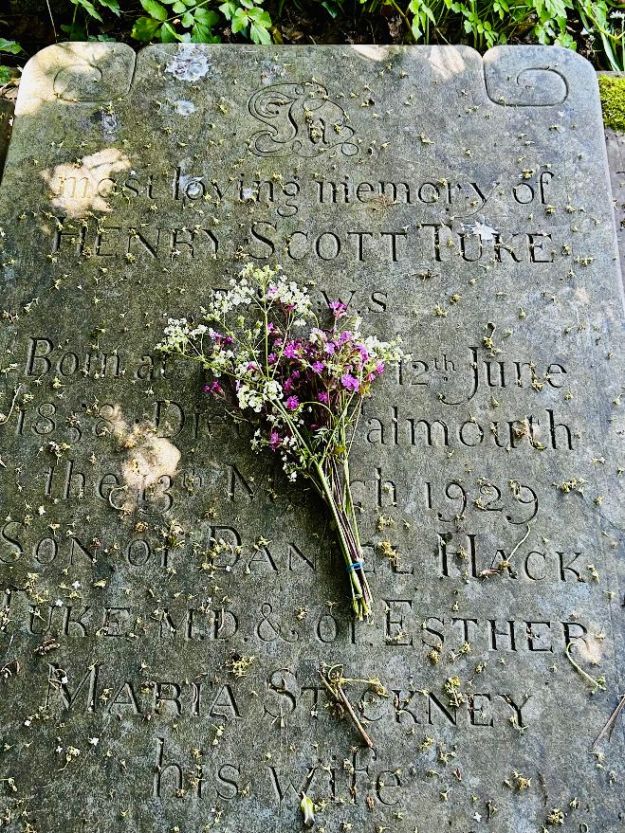
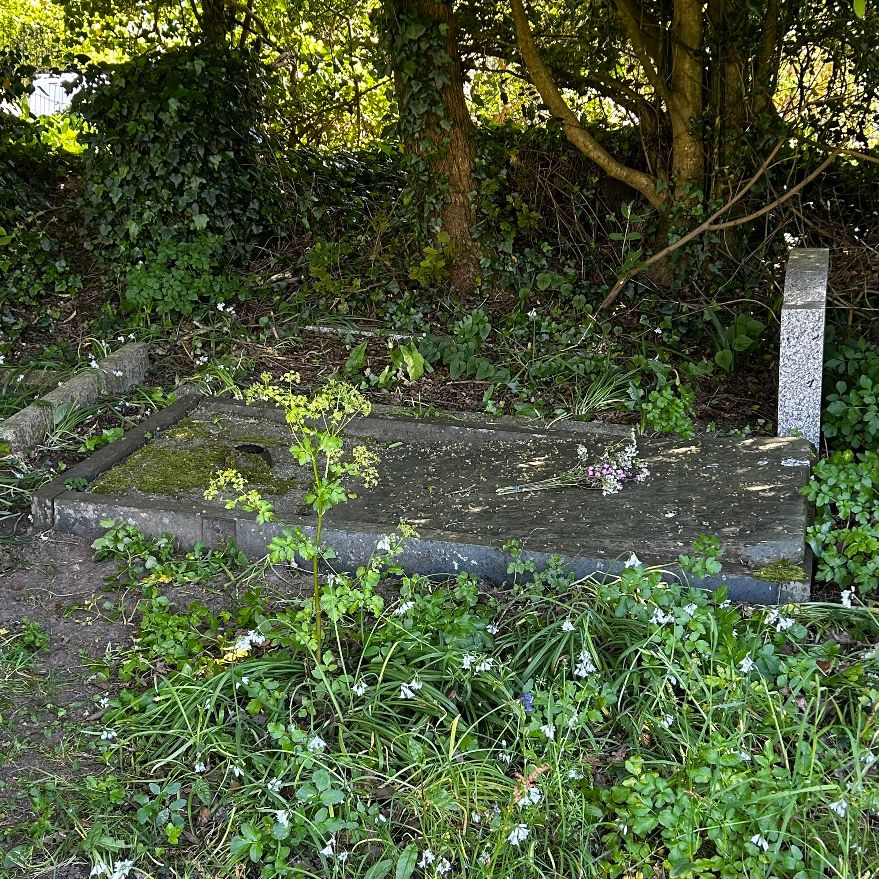
Henry Scott Tuke lay buried in the oldest and highest part of Falmouth Cemetery. The cemetery had been laid out in the 1850s with sweeping views towards Swanpool Beach, where Tuke had lived. Now the place had become overgrown, its once-open vistas obscured by trees and tangled greenery.
David liked graveyards. They offered solitude and a place for reflection.
The early morning rain had given way to sunshine by the time they arrived. They passed a workman digging out an old grave who glanced at them with mild suspicion; few people carried flowers among these neglected plots anymore. These were the forgotten dead. Joshua had picked the wildflowers himself from a lane beside the farm that morning.
Tuke’s grave stood beneath the shadow of sycamore trees in a quiet corner of the cemetery. Joshua laid the flowers upon the flat stone and stepped back while David retrieved a folded piece of paper from his pocket. He began to read aloud. Nearby, the workman paused in his digging to listen to whatever strange ritual these two visitors were performing.
“Under the wide and starry sky, Dig my grave and let me lie; Glad did I live, and gladly die And I lay me down with a will.
This be the verse you ‘grave for me: Here he lies where he longed to be; Home is the sailor, home from the sea, And the hunter, home from the hill.”
The lines came from Requiem, the famous short poem written by the Scottish author Robert Louis Stevenson in 1880, and later used as his own epitaph.
If the dead were capable of hearing, then the words might have carried a certain familiarity. The same poem had been recited by Geoffrey Harrington Sainsbury, one of Tuke’s nephews, during the funeral in March 1929 — the same year David’s father had been born. The mourners had stood beside the open grave, lined with flowers and evergreen branches, while a cold easterly wind swept across the hillside.
David and Joshua knew their little performance beneath the spring sunshine might appear faintly ridiculous to anyone watching, yet somehow it felt like the only fitting tribute they could offer the artist.
“I suspect,” David said, “that not many people make pilgrimages like we do.”
At the back of his mind lingered the forthcoming exhibition of photographs by Wilhelm von Gloeden that he had agreed to help curate. Von Gloeden’s use of adolescent models had already provoked criticism in some circles. David realised some people might now interpret Tuke’s paintings in a similar way, yet he remained convinced that the work was unique — unlike anything else in British art.
“The problem,” he told Joshua, “is that people now see this work as intensely sexual. Tuke’s contemporaries saw something very different. To them, the naked young male body represented innocence — a celebration of youth and vitality. Lithe bodies in sunlight. Escapism. Pastoral beauty.”
Joshua had heard variations of this argument many times before.
“Look at it another way,” he replied. “The male nude has existed in European art since the Renaissance. All Tuke really did was revive that classical tradition.”
“The Victorians had no problem with it,” David said. “They regarded his paintings as healthy and life-affirming. But after his death the work fell out of fashion because his style suddenly seemed too traditional.”
David blamed the First World War. Afterwards, Tuke’s paintings must have appeared hopelessly rose-tinted — relics of a gentler and more innocent world.
“Do you think Tuke was gay?” Joshua asked.
“Without question,” David replied. “But you have to admire him for one thing: there was never a stain against his character. He had homosexual friends, some of whom were publicly disgraced, but nothing ever attached itself to him. Lucky old bastard — spending his life surrounded by beautiful young men.” He paused, glancing back towards the grave. “Did he sleep with his models? Did the paintings satisfy certain urges? We’ll never know. And we have his sister to thank for that.”
“What do you mean?”
“One of life’s great frustrations. If Tuke’s diaries had survived, they might have revealed everything. They would have made extraordinary reading.”
“What happened to them?”
“His sister commissioned a biography and handed over twelve volumes of diaries to the writer. Apparently the finished manuscript shocked her so badly that she refused to publish it. Imagine if it had survived somewhere — forgotten in an attic or archive.” David shook his head. “Instead, she burned almost all the diaries and wrote a sanitised version herself.”
Joshua listened while taking photographs of the grave and the wildflowers with his phone, already preparing the image he would upload to social media later.
“You know,” David continued, “I’d love to write a modern biography of Tuke. But I suspect everything we know about him has already been written. Unless…”
Joshua glanced up.
“Unless I could discover something entirely new. The more I think about it, the real story isn’t Tuke himself — it’s the boys he painted. Imagine being able to trace them. To discover what became of them after the sunlight and the boats and the summers were over.”