
Cola returned from Torricelle with important news. Signora Valenti had asked him for my mobile number. Why she wanted it, he had no idea, but he had seen no reason not to give it to her.
I could think of several.
“She will contact you,” Cola said before tucking into the meatballs his mother had prepared. As far as he was concerned, that was the end of the matter.
Bianchi sat opposite, his bare foot brushing against my knee beneath the table. He hadn’t quite followed the conversation and raised an eyebrow, waiting for someone to explain.
Signora Bruschi stood at the hob, stirring a pan with her back to us. Even so, I knew she was listening to every word.
She was a wily woman.
When Cinzia had pleaded for Bianchi to stay with me because Lorenzo was making life difficult for him at home, Signora Bruschi had seen straight through the lie. She allowed him to remain, but not with me. While I had been banished to Cola’s room, Bianchi had temporary use of mine. Now she was clearing out a room in the attic that would soon become his.
Signora Valenti wasted no time.
Later that evening a message arrived asking whether I was free to meet her for coffee the following day.
I read it aloud and was about to reply that I wasn’t available when Signora Bruschi wiped her hands on her apron and joined us at the table.
“It would be rude to refuse,” she said. “After all, you have no reason not to go.”
Signora Bruschi invariably had the final word.
“But,” she added after a pause, “I think it would be better if Bianchi came with you.”
Bianchi’s face lit up.
Cola grinned.
“She wants your body,” he said.
At eleven the following morning we arrived at Liston 12 on Piazza Bra, its terrace overlooking the Roman Arena. It was crowded with tourists, most of whom had no idea they could have paid half the price simply by walking a few streets farther.
I scanned the tables until I spotted Signora Valenti sitting in the shade. She raised a hand to attract our attention.
She wasn’t alone.
Edoardo sat beside her.
Valentina Valenti looked effortlessly glamorous. Her long blonde hair was tied back and oversized designer sunglasses concealed much of her face. She wore a pale pink summer dress and white Jimmy Choo heels.
She rose to greet us, kissing each of us lightly on the cheek. Bianchi’s appearance seemed not to concern her in the slightest as she motioned for us to sit before signalling a waiter for four espressos.
Edoardo remained where he was, idly turning the pages of a menu. He looked profoundly bored by the ritual of introductions.
After I introduced Bianchi, Signora Valenti inclined her head politely.
“I had expected you to send me samples of your work,” she said. “When you didn’t, I was forced to find it online. It wasn’t easy.”
“I’m sorry,” I replied. “I write under a pen name.”
“I know,” she said with a faint smile. “But I am well connected. I know people who are very good at finding whatever I need.”
She reached into an expensive handbag and produced a leather notebook filled with beautifully handwritten notes.
“I know you’re a travel writer. I’ve read several of your articles. They’re well written…” She looked up. “If a little dull.”
Across the table Edoardo gave a quiet snort of amusement.
His dark hair was slicked back as though he had only just stepped out of the shower. A faint scar ran across one cheek. The moment he realised I had noticed it, he covered it with his hand. It was his eyes that lingered with me, however—cold, watchful and instinctively unfriendly.
“I’d like to offer you a job,” Signora Valenti continued.
“A job?”
“My husband’s business has become extremely successful and is expanding internationally. I want you to write the history of the estate—from its modest beginnings to what it has become today.”
“Why me?”
The waiter arrived balancing our coffees with exaggerated care, placing each cup before us as though performing on stage. Signora Valenti dismissed him with an impatient flick of her hand.
“Why not?”
I searched for a polite way to decline without giving offence.
“Everything you need will be available to you,” she continued. “There are boxes of historical records at Torricelli that must be sorted through. Edoardo has agreed to help.”
Judging by the expression on his face, Edoardo had agreed to nothing. He was here because his mother had decided he would be.
The project held little appeal. Neither did the prospect of spending weeks in Edoardo’s company.
“I’m delighted that’s settled,” she said brightly. “I should have been very disappointed had you refused.”
She waited, knowing perfectly well no objection was coming.
“Excellent,” she concluded. “Then it’s agreed.”
A cigarette appeared from nowhere. She lit it with practised elegance and leaned back looking entirely satisfied with herself.
Bianchi looked equally pleased.
“This means you’ll stay in Verona longer.”
“Which creates one problem,” I said. “The rules say I have to leave Italy soon. I’m only here as a tourist.”
“Problems like that don’t exist in our world.”
It was the first time Edoardo had spoken. His voice was flat, almost bored.
“Exactly,” said his mother. “Now, let’s discuss your fee.”
The offer was generous.
Three thousand euros was considerably more than I had ever been paid for a commission, and although the project would take time, it would still leave me free to accept other work.
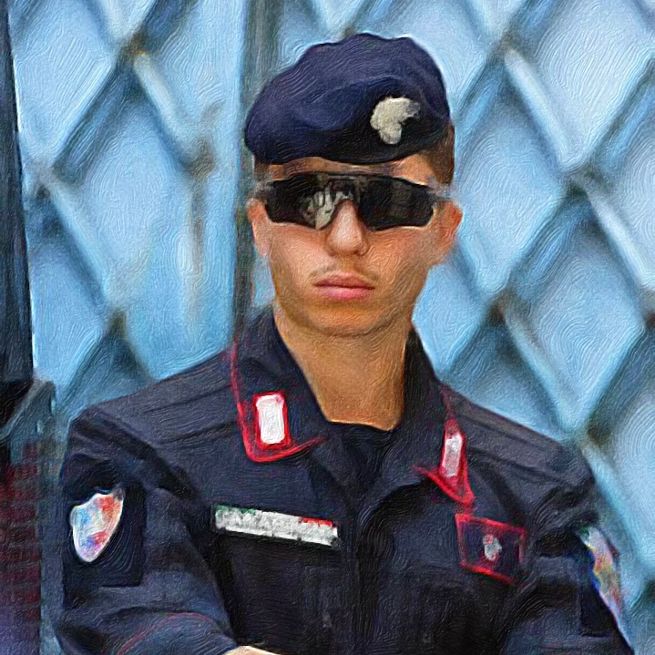
An Alfa Romeo belonging to the Carabinieri was parked outside Signora Bruschi’s house when we returned.
“Che ci fanno qui?” Bianchi asked.
Two uniformed officers were just leaving. The younger of the pair held the front door open as we approached, taking a moment longer than necessary to look us up and down.
He seemed vaguely familiar.
Tall. Handsome. Short-cropped hair.
Our eyes met for several seconds, as though each of us felt we ought to recognise the other.
“Buongiorno,” he said quietly.

