The church doors swung open and the newlyweds emerged into the afternoon heat beneath a shower of rice and the ringing of bells.
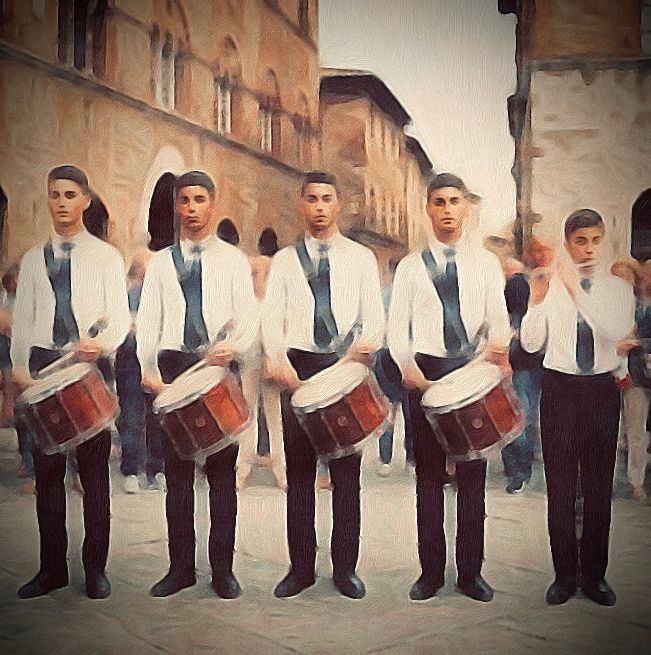
Forty paces away, five young musicians stood against the ancient stone wall of the piazza.
Four drummer boys and a piccolo.
They were impossibly handsome. Young, dark-haired and brown-skinned, dressed in white shirts, black trousers and polished black shoes. They stood in a neat row, looking rather more serious than the occasion required.
I fall in love too easily.
As the bride and groom stepped into the sunlight, the drummers raised their sticks.
The first strike seemed to shake the whole piazza.
Then the piccolo began.
A bright, piercing melody rose above the deep thunder of the drums, slipping between the old buildings and disappearing somewhere among the terracotta roofs. The five boys played without looking at the wedding guests. They simply stood there and played, as though the music belonged to them and we had merely been permitted to hear it.
I watched them.
I knew nothing about them.
Not their ages, where they lived, what they did when they weren’t playing at weddings. I didn’t even know their names.
And yet, for those few minutes, I loved them.
When the music ended, the bells suddenly seemed very loud.
The boys lowered their instruments. There was no bow, no waiting for applause. They simply turned and walked away, disappearing into a narrow alley beside the church.
As they went, one loosened his black tie. Another rolled up his sleeves. One of the drummers said something that made the others laugh.
And that was all.
They vanished into the old town, five young Italians swallowed by the afternoon.
I stood there for a moment longer.
It seemed terribly unfair that people could enter your life so completely and then disappear from it without ever knowing they had been there.
I would never see them again.
I would never know their names.
But for a few minutes in a sunlit piazza, four drummer boys and a piccolo had made me fall in love.
While researching the death of Alessandro Momo, I came across an Italian article whose opening paragraph said almost everything that needed to be said. The Italians have a remarkable ability to get straight to the point — no throat-clearing, no sentimental padding, just the thing itself.
I wish I could tell you who wrote it. Unfortunately, I haven’t been able to identify the author. So I can only reproduce the English translation here, and leave the original writer their anonymity.
The Asphalt Doesn’t Remember
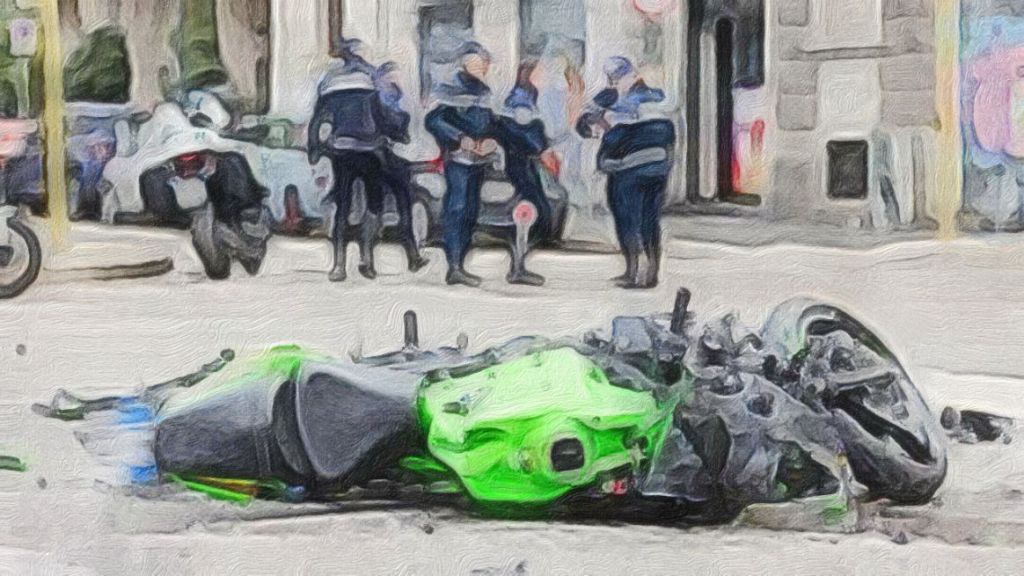
“The asphalt doesn’t remember. So many boys have been torn apart. Crushed into the streets along with their scooters. Their skin scraped away on the road. Like an apple. Like cheese scattered over pasta.
Plastic, blood, rubber, raw flesh, the cast iron of engines. Then tar. Crushed stone. The proportions change, but this is the asphalt of Rome.
I have immense admiration for those who fight invisible battles every day, push through intense pain, and somehow find the strength to rebuild their lives. Their journeys are a reminder that healing is possible, and that even the darkest periods can eventually give way to hope.
I came across Zach Montana on Instagram.
This guy pushes my buttons.
A little digging online reveals that Zach has been open about his mental health struggles following a drive-by shooting at his home. The trauma profoundly affected his well-being, plunging him into severe panic disorder and debilitating insomnia.
Those dark days are there to see online, and they make for disturbing viewing. There is something unsettling about watching somebody caught in the grip of fear, unable to escape his own mind.
The 28-year-old singer and TikTok creator began listening to ambient music in the middle of the night as a way of managing his disorder. There is something strangely intimate about that: the small rituals people invent to get themselves through the hours when sleep refuses to come.
A Boy in Love, Unfortunately …
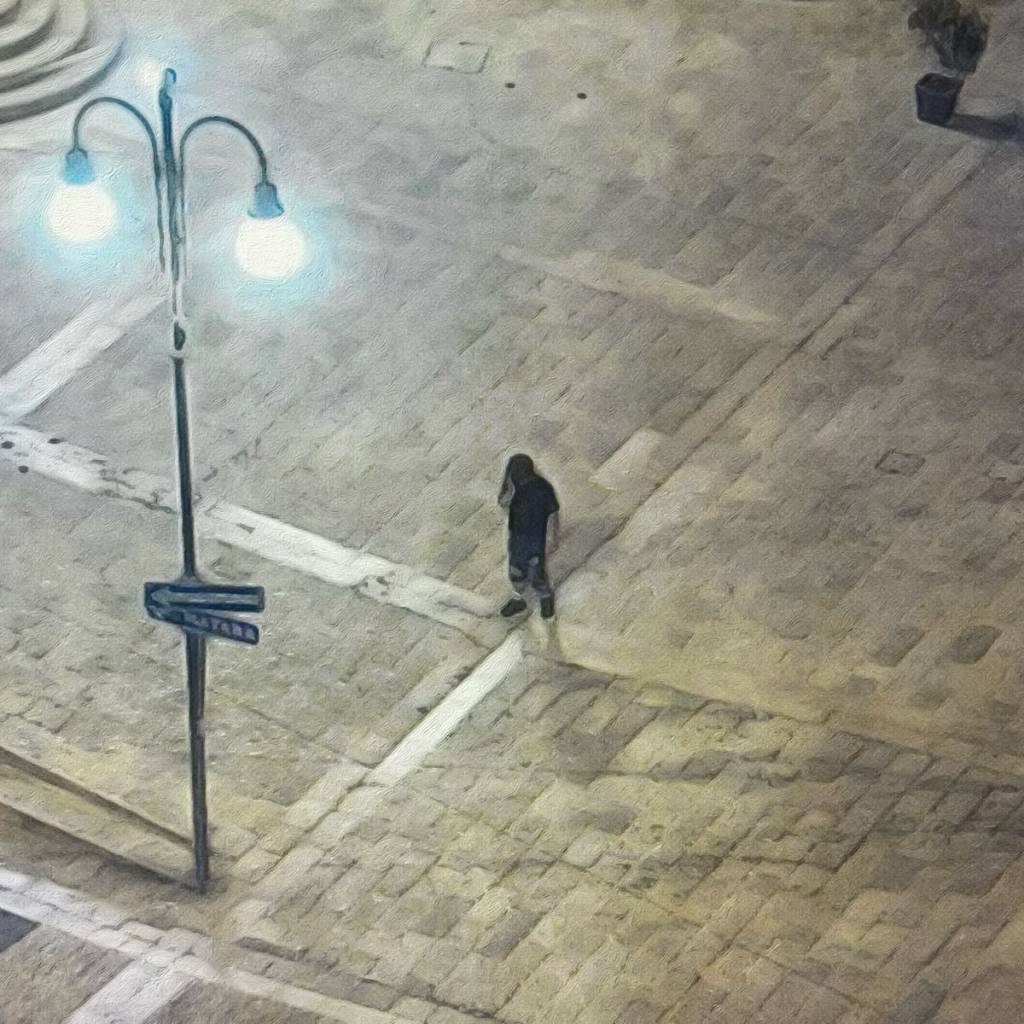
He’d been pacing around the piazza for, like, an hour, one hand going absolutely feral with the gestures while the other was glued to his phone. Yeah. This boy was down bad. In love, basically.
Michelangelo and Other Bad Ideas …
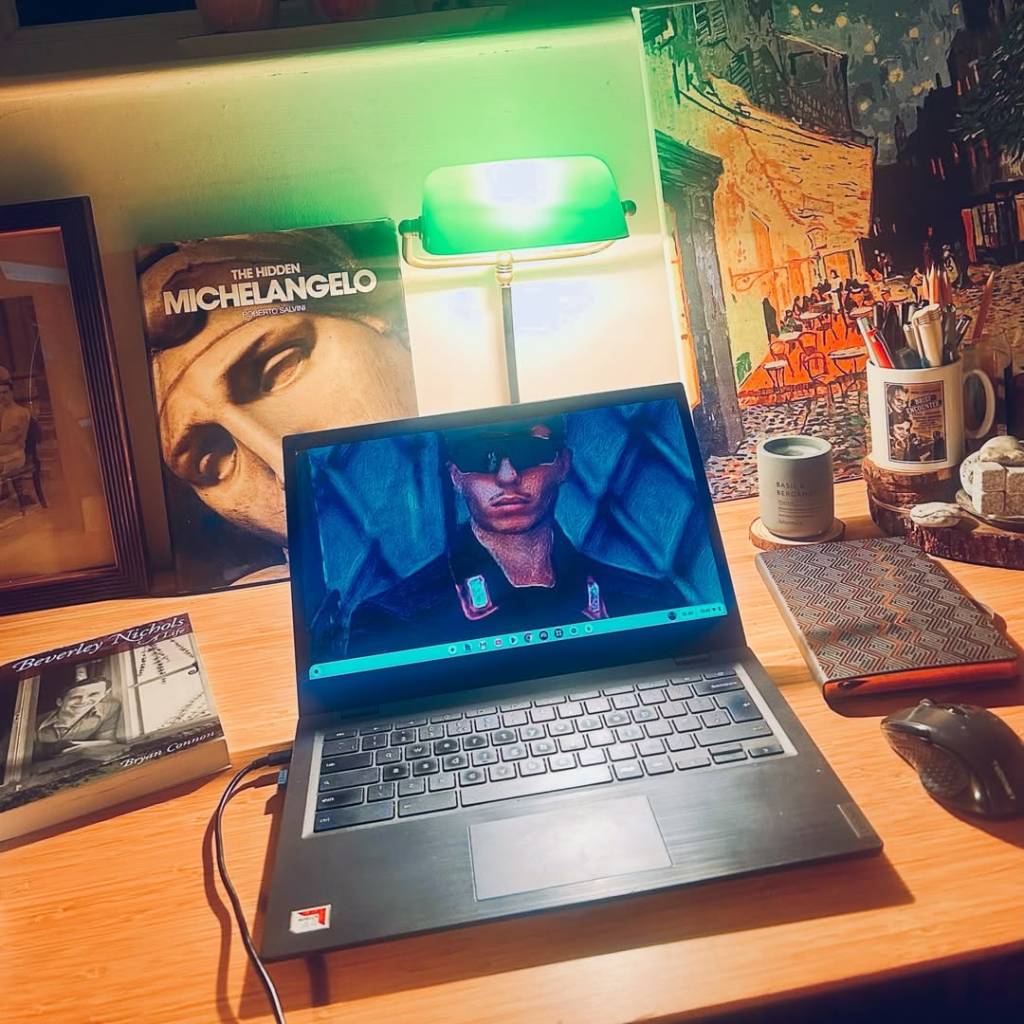
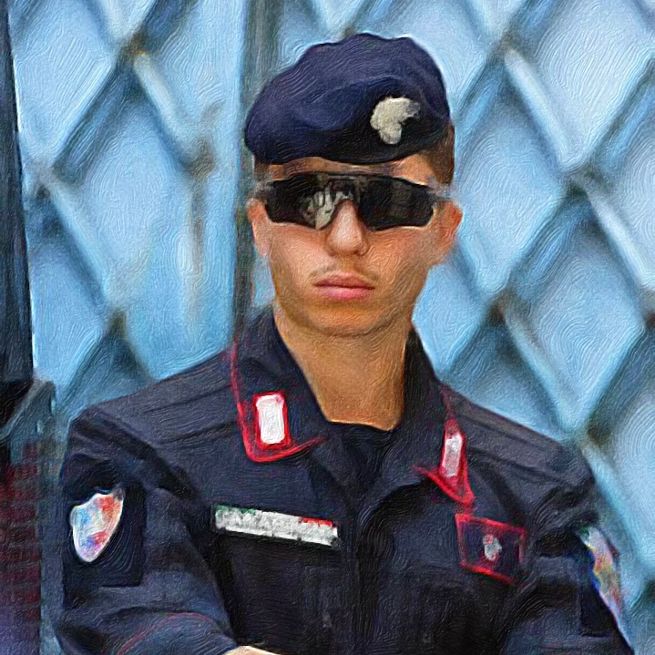
The handsome carabiniere. Main character energy, but make it literary. Michelangelo, old books & questionable late-night thoughts. Romanticising the chaos since forever.
A Dirty Mind …
Am I the only one who thinks Troye Sivan is dirty?
Not filthy dirty. Seductive dirty.
There is something about the way he moves. Videos like Rush and My My My! are all uninhibited physicality, nightlife sweat and celebratory desire. He looks tough, physical, almost animal-like. There is something raw about it. Something that hints at naughty desires without ever quite spelling them out.
Then there is that wild, untamed intensity. Roguish. Edgy. He has the look of someone who might push a boundary simply to see whether anyone notices.
But perhaps he is dirty in another way.
I imagine a mind that can take an innocent remark and give it an entirely different meaning. A fondness for crude jokes, suggestive words and the sort of playful naughtiness that turns an ordinary moment into something else entirely.
A dirty mind.
Desire used mischievously, perhaps, to heighten the excitement.
I’m getting ahead of myself.
Yes.
Troye Sivan is dirty.
Under the Surplice …
Thinking that my agnostic tendencies were showing, Signora Bruschi insisted that I go to Holy Mass with her.
I’d never realised that it was such a social occasion.
Before it started, Signora Bruschi stood outside talking to the dozens of women she knew. They wafted folding fans, complained about the heat, and predicted how hot it would be inside the church. But this was merely the forerunner to what really mattered: the latest gossip from the neighbourhood.
I was a spectator who didn’t quite grasp the conversations, smiling and frowning according to the situation.
My interest waned.
Attention switched to the teenage boys milling around the entrance.
They all favoured crisp white T-shirts with black shorts. They all seemed to dress the same in Italy: bella figura, that cultural obsession with looking effortlessly put together while remaining practical in the intense heat.
Style is treated as a social responsibility rather than a temporary trend. The sharp contrast of clean white against stark black creates an instant athletic frame. The T-shirts are rarely sloppy or oversized, and the shorts typically sit perfectly above the knee.
It is a reliable summer uniform: a neutral canvas for the things that really matter—expensive sunglasses, a luxury watch, pristine trainers.
The boys prodded one another and tried to trip each other up. The same things teenage boys did in every country.
But then they were called to action.
They disappeared through an arched doorway beside the church. One by one, they slipped into white cotte, their black curls making it difficult to tell them apart.
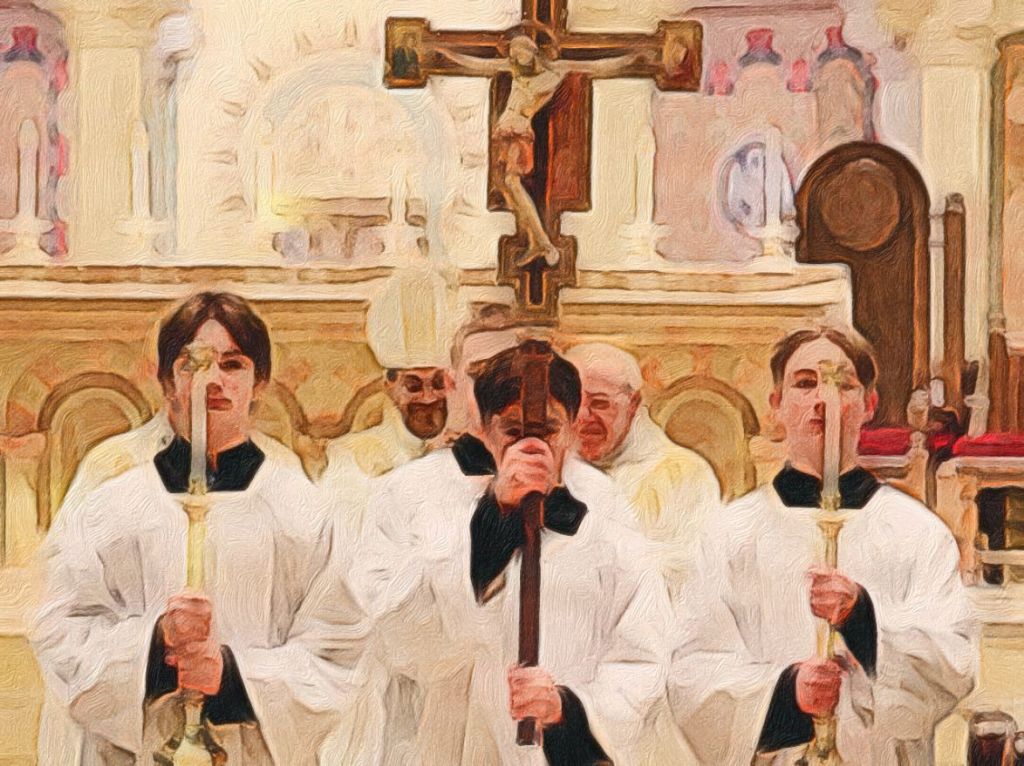
They reappeared as altar servers, suddenly possessed of an air of importance. One carried the processional cross, which he propped against the wall of an adjacent house. The others clutched unlit candles.
And then they waited while everyone went into church.
Cantiamo te, Signore della vita was sung. Don Carlo and the chierichetti walked down the aisle in a serious procession, the processional cross held high and the boys carrying flickering candles.
The tomfoolery had been left outside.
These boys—some happy to be there, others clearly not—were rising to the challenge. For a few minutes, they seemed to understand that something was expected of them and that they were capable of becoming something other than the boys who had been pushing and shoving outside.
And I smiled.
They paraded past, their clothes hidden beneath long white surplices; their true identities given away by flashy new trainers—Nike Air Force 1s, Adidas Sambas and New Balance 550s.
It was the trainers that betrayed them.
Beneath the white cotton, beneath the solemn expressions and the ritual and the incense, they were still those same boys outside the door. The church had given them candles, a cross and a moment of gravity, but it hadn’t managed to take away their swagger.
Perhaps that was what I liked about it. For all its ceremony, Holy Mass had not changed them at all. It had simply given them another costume to wear.
Signora Bruschi received a visit from an old neighbour, Signor Luigi Bevilacqua, an elegant man who owns a second-hand bookshop filled with volumes I cannot read because they are all in Italian. They sat together over coffee, exchanging news of people they had known for years. Signora Bruschi is not usually one for gossip, but she seemed happy to make an exception on this occasion.
Signor Bevilacqua belongs to the historic Bevilacqua-Lazise family, whose legacy includes Paolo Veronese’s magnificent Bevilacqua-Lazise Altarpiece, which I admired in the Museo di Castelvecchio.
Like Signora Scala next door, however, these old aristocratic families survive largely in name alone. Signor Bevilacqua is a man of modest means who shops at Eurospin and watches Un posto al sole on television. There was something rather pleasing about that contrast.
Curiosity sent me down the inevitable rabbit hole. The history of the Bevilacqua-Lazise dynasty is so extensive that it is easy to wander from one fascinating detail to the next until you realise you have strayed a very long way from where you began.
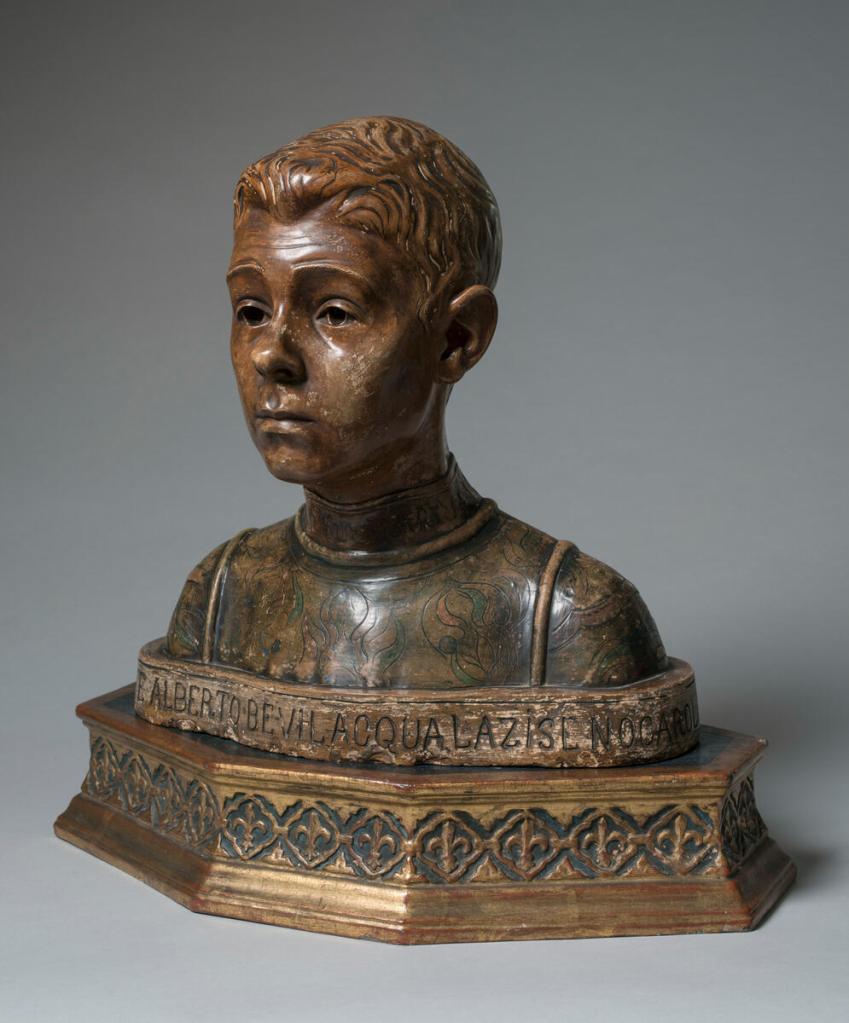
I suspect that Conte Alberto Bevilacqua may have been one of Luigi’s forebears. A member of the Bevilacqua-Lazise family, Alberto is best remembered as the youthful subject of an 1899 terracotta portrait bust by the sculptor Hendrik Christian Andersen. The bust was acquired by Henry James, who displayed it on the chimneypiece at Lamb House in Rye.
James wrote:
“I’ve struck up a tremendous intimacy with dear little Conte Alberto, & we literally can’t live without each other. He is the first object my eyes greet in the morning & the last at night.”
The sculpture captures Alberto as a boy with an eager, inquisitive expression—not unlike Bianchi—and it remains at Lamb House today as part of the National Trust collection.
My favourite quote …
“I think that there’s something very, very severely neurologically deficient about the generation right under me. I think screenagers, as they call them now, are fucked. God go with them. Good luck.” – Katya Zamolodchikova
Coffee Before Country …
Lautaro bought me a coffee. It was a peace offering, as if to say, I might be from Argentina, but please don’t judge me. I turned my back on him and laughed, which, in truth, was rather childish.
Everything Sounds Better in Italian …
Sitting on the steps of an old Catholic church, I listened to a young man speaking with his mentor. He worked his way through a list of places where they might hold a meeting. He had clearly done his homework, arriving with notes and a carefully considered list of options. His mentor questioned each suggestion, and the young man answered thoughtfully.
They spoke in Italian that I could follow—slowly, passionately—and somehow this entirely mundane conversation sounded impossibly romantic.
The Church, the Ball, the Boys …
Late afternoon. I sat on an old bench, a memorial to Concetta Rossini, who died in 1996.
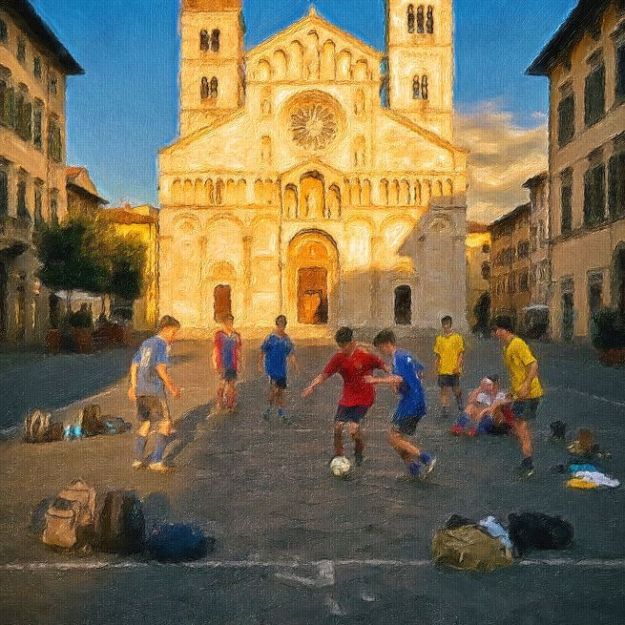
Teenage boys played football—World Cup heroes, though none of them Italian. Echoing thuds. The hollow knock of a plastic ball rebounding off weathered travertine steps and ancient wooden doors. Worn backpacks and abandoned electric scooters became goalposts against a sacred backdrop that had witnessed centuries of community life.
Sharp, rhythmic cries of “Lascia! Batti! Tira!” ricocheted off the high stone walls, mingling with the peal of the church bells. Apart from me, the only spectators were weathered marble saints, rose windows and towering columns, silently watching the fleeting, restless energy of youth.
The sharp, geometric shadows cast by the church’s Baroque façade slowly crept across the piazza, offering a cool sanctuary from the heavy afternoon heat. Just a few feet away, sunlight blazed across the cobblestones, drawing a glowing boundary as the game flowed in and out of the light.
To those boys, this might just as easily have been the San Siro or the Stadio Olimpico.
Great Freedom, Small Mercies …
I watched Great Freedom—Große Freiheit in German—with Bianchi. Franz Rogowski plays Hans Hoffmann, a man repeatedly imprisoned under Paragraph 175, the law that criminalised homosexuality.
Halfway through the film, Bianchi asked why Rogowski “spoke funny”. Irritatingly, he had a point. I later discovered that Rogowski’s distinctive speech is the result of surgery to repair a cleft palate and lip during childhood. I told Bianchi not to be so cruel, whereupon he kicked me hard with his bare foot, managing only to hurt himself in the process.
One character, Oskar, played by Thomas Prenn, immediately caught my eye. Unfortunately, my newfound admiration was short-lived, as he promptly fell to his death from a rooftop.
Bianchi noticed my disappointment and, in his own uniquely compassionate way, consoled me by kicking me with his other foot.
Given that Prenn’s character is German, I was surprised to discover that the actor was born in Innichen, Italy, before studying at the Ernst Busch Academy of Dramatic Arts in Berlin. Fluent in both Italian and German, he would be the ideal person to translate between Bianchi, Severin and me—assuming he was available and prepared to tolerate us.
Cola returned from Torricelle with important news. Signora Valenti had asked him for my mobile number. Why she wanted it, he had no idea, but he had seen no reason not to give it to her.
I could think of several.
“She will contact you,” Cola said before tucking into the meatballs his mother had prepared. As far as he was concerned, that was the end of the matter.
Bianchi sat opposite, his bare foot brushing against my knee beneath the table. He hadn’t quite followed the conversation and raised an eyebrow, waiting for someone to explain.
Signora Bruschi stood at the hob, stirring a pan with her back to us. Even so, I knew she was listening to every word.
She was a wily woman.
When Cinzia had pleaded for Bianchi to stay with me because Lorenzo was making life difficult for him at home, Signora Bruschi had seen straight through the lie. She allowed him to remain, but not with me. While I had been banished to Cola’s room, Bianchi had temporary use of mine. Now she was clearing out a room in the attic that would soon become his.
Signora Valenti wasted no time.
Later that evening a message arrived asking whether I was free to meet her for coffee the following day.
I read it aloud and was about to reply that I wasn’t available when Signora Bruschi wiped her hands on her apron and joined us at the table.
“It would be rude to refuse,” she said. “After all, you have no reason not to go.”
Signora Bruschi invariably had the final word.
“But,” she added after a pause, “I think it would be better if Bianchi came with you.”
Bianchi’s face lit up.
Cola grinned.
“She wants your body,” he said.
At eleven the following morning we arrived at Liston 12 on Piazza Bra, its terrace overlooking the Roman Arena. It was crowded with tourists, most of whom had no idea they could have paid half the price simply by walking a few streets farther.
I scanned the tables until I spotted Signora Valenti sitting in the shade. She raised a hand to attract our attention.
She wasn’t alone.
Edoardo sat beside her.
Valentina Valenti looked effortlessly glamorous. Her long blonde hair was tied back and oversized designer sunglasses concealed much of her face. She wore a pale pink summer dress and white Jimmy Choo heels.
She rose to greet us, kissing each of us lightly on the cheek. Bianchi’s appearance seemed not to concern her in the slightest as she motioned for us to sit before signalling a waiter for four espressos.
Edoardo remained where he was, idly turning the pages of a menu. He looked profoundly bored by the ritual of introductions.
After I introduced Bianchi, Signora Valenti inclined her head politely.
“I had expected you to send me samples of your work,” she said. “When you didn’t, I was forced to find it online. It wasn’t easy.”
“I’m sorry,” I replied. “I write under a pen name.”
“I know,” she said with a faint smile. “But I am well connected. I know people who are very good at finding whatever I need.”
She reached into an expensive handbag and produced a leather notebook filled with beautifully handwritten notes.
“I know you’re a travel writer. I’ve read several of your articles. They’re well written…” She looked up. “If a little dull.”
Across the table Edoardo gave a quiet snort of amusement.
His dark hair was slicked back as though he had only just stepped out of the shower. A faint scar ran across one cheek. The moment he realised I had noticed it, he covered it with his hand. It was his eyes that lingered with me, however—cold, watchful and instinctively unfriendly.
“I’d like to offer you a job,” Signora Valenti continued.
“A job?”
“My husband’s business has become extremely successful and is expanding internationally. I want you to write the history of the estate—from its modest beginnings to what it has become today.”
“Why me?”
The waiter arrived balancing our coffees with exaggerated care, placing each cup before us as though performing on stage. Signora Valenti dismissed him with an impatient flick of her hand.
“Why not?”
I searched for a polite way to decline without giving offence.
“Everything you need will be available to you,” she continued. “There are boxes of historical records at Torricelli that must be sorted through. Edoardo has agreed to help.”
Judging by the expression on his face, Edoardo had agreed to nothing. He was here because his mother had decided he would be.
The project held little appeal. Neither did the prospect of spending weeks in Edoardo’s company.
“I’m delighted that’s settled,” she said brightly. “I should have been very disappointed had you refused.”
She waited, knowing perfectly well no objection was coming.
“Excellent,” she concluded. “Then it’s agreed.”
A cigarette appeared from nowhere. She lit it with practised elegance and leaned back looking entirely satisfied with herself.
Bianchi looked equally pleased.
“This means you’ll stay in Verona longer.”
“Which creates one problem,” I said. “The rules say I have to leave Italy soon. I’m only here as a tourist.”
“Problems like that don’t exist in our world.”
It was the first time Edoardo had spoken. His voice was flat, almost bored.
“Exactly,” said his mother. “Now, let’s discuss your fee.”
The offer was generous.
Three thousand euros was considerably more than I had ever been paid for a commission, and although the project would take time, it would still leave me free to accept other work.
An Alfa Romeo belonging to the Carabinieri was parked outside Signora Bruschi’s house when we returned.
“Che ci fanno qui?” Bianchi asked.
Two uniformed officers were just leaving. The younger of the pair held the front door open as we approached, taking a moment longer than necessary to look us up and down.
He seemed vaguely familiar.
Tall. Handsome. Short-cropped hair.
Our eyes met for several seconds, as though each of us felt we ought to recognise the other.
Cinzia had come up with the solution to a problem that Signora Bruschi had created.
I slept with Cola while Bianchi slept alone in my bed.
Cola was now nineteen, tall and slim, and drove a bright yellow Abarth 500 that sounded loud, throaty and aggressive when he arrived back home in the early hours after spending the evening with Cinzia.
He had climbed into his own bed, almost forgetting that somebody had gatecrashed.
“I thought that the bed would be empty,” he teased. “I was certain that you would have crept upstairs to be with Bianchi.”
“And suffer the sharp tongue of your mother? Not likely. I half expected her to be sitting outside the door to make sure that we didn’t.”
Morning brought little relief. Cola’s room was much smaller than my apartmentand the heat of the night had been unbearable. Neither had slept well. Cola kicked me to make sure that I was awake and whispered in my ear.
“It is time to get up. I must go and see Signor Valenti and would like you to come along with me.”
“Who is Signor Valenti?” I groaned.
“He is the man that I work for,” he explained, “and he will have a list of jobs that need doing.”
During the night I wondered whether Bianchi had explored my apartment. He had always been curious, the sort of boy who wanted to know everything. I hoped I hadn’t left anything incriminating lying around. Then I remembered the crumpled copy of Le Pénis beside my bed. I had little doubt he would have read it from cover to cover.
“I’d expected to spend the day with Bianchi,” I muttered.
“That is not going to happen. Cinzia and Bianchi have arranged to go to the summer festival at Gardaland today and will not be back until late. Unfortunately, they do not have tickets for us and so we shall be left behind to drive one another crazy.”
I was disappointed.
“We must go to church,” Cola announced.
I pulled a face.
“Why?”
“I have things to confess.”
Cola burst out laughing and hit me hard on the arm.
Bianchi was subdued at breakfast. He refused to eat or drink while he waited for his lift that would take him to Gardaland. He made polite conversation but his usual brightness had deserted him
“Is everything okay, Bianchi?”
He nodded but didn’t reply.
I’m not sure why it is, but silence makes me feel uneasy. But when he held his gaze a moment longer than necessary, it suggested the problem might not have been with me.
We waited on the pavement for the arrival of his friend, Antonio, who, Cola had explained, was Bianchi’s best friend.
He turned up in a noisy old Fiat Panda with Cinzia beside him.
Antonio was messy, with dark curly hair, soulful brown eyes, and a slightly crooked nose. He wore a worn-out denim jacket and football shirt sporting the blue and yellow of Hellas Verona.
He got out of the car and kissed Bianchi on the cheek before hugging him tightly. Bianchi blushed.
Cinzia hurried them into the car.
“We shall see you this evening,” she called from the car window.
Bianchi waved as they drove off and soon afterwards sent a message on his phone.
I hoped we might have spent more time together today. Gardaland was Cinzia’s idea. We shall talk this evening.
Cola drove me to Torricelle in the hills north of Verona. I had once been here with Pietro and remembered the panoramic views of the Adige River and the city below. It was also where I saw one of the most beautiful sunsets. He blasted Sfera Ebbasta through the speakers, making conversation almost impossible. But he seemed proud to be taking me to see Signor Valenti.
“He is a very rich man and lives in a wonderful house in its own grounds. I have told him all about you.”
“How did you meet, and what is it that you do for him?”
“Oh, I work around his house and do jobs around the estate,” he replied.
It all seemed an unlikely world for someone like Cola, and that he had not explained how he had met Signor Valenti had not gone unnoticed.
Away from the historic centre, the land turned green with olive groves, vineyards and lush vegetation. We climbed the hillside and eventually came to a set of stone pillars on the right. Cola spun off the road and dropped down a long winding driveway that was cast in deep shadow by a rich canopy of giant oak trees.
When we burst back into the sunlight it revealed a large house that seemed to be made up of adjoining boxes with floor-to-ceiling glass walls. Parked in front of it was another bright yellow Abarth 500 that was identical to the one that Cola drove.
As Cola parked beside it, I received a message on my phone. It was from Cinzia.
I have an idea. I shall speak with Cola’s mother tomorrow.
For the second time in 24 hours Cinzia had devised a solution to a problem. I grinned and Cola looked at me with bemusement.
“Why are you smiling?”
“I don’t know your girlfriend well, but I am starting to realise that she can be very cunning when she wants to be.”
I had the feeling that whoever lived inside this house would never enjoy the privacy that lesser folk in poorer houses enjoyed. The outside was everywhere you looked.
The house felt strangely empty. Expensive homes often do. Every room had space to breathe, yet there was little evidence that anybody truly lived there.
I longed for the comfort and simplicity of Signora Bruschi’s modest home.
Cola led me through rooms that contained modern sofas and stylish chairs, sleek tables with contemporary sculpture and lots of fresh flowers in huge vases – but little else.
Signor Valenti looked like he was in his forties, with the first signs of grey showing in his black hair. He had once been handsome but still retained the trim figure of somebody who might once have been an athlete. He was smartly dressed with white chinos and an azure blue shirt and seemed stereotypical of the Italian businessman; casual but with a sense of importance.
A woman sat with him around a glass-topped table that had been set up outside. This, I presumed, was Signora Valenti who had once been a beautiful woman. She looked about the same age as her husband with long blonde hair that had been carefully tied back.
“Nicola.” Signor Valenti seemed pleased to see Cola and gestured for us to be seated. A faint smile showed on Signora Valenti’s lips but she seemed uninterested in our arrival.
Cola poured coffee for us both and spoke in fluent Italian to his host – fast and furious and I had difficulty keeping up. Eventually, Signor Valenti turned towards me and offered his hand.
“I am delighted to meet you, Miles. Please call me Alessandro, and this is my wife, Valentina.” It had a ring to it – Valentina Valenti. “And that,” he nodded towards the swimming pool,” is my son Edoardo.”
A young man swam the length of it before coming to a stop. Only his head could be seen, his wet hair plastered back, as he treaded water. He looked at us with curiosity, but, like his mother, never uttered a word. I waved a greeting but Edoardo didn’t acknowledge it. He, too, it seemed, was devoid of pleasantries.
While Alessandro and Cola talked business, I enjoyed the view.
Finally, Valentina came to life.
“My husband owns everything that you see before you.”
“Impressive,” I replied.
“These are our vineyards and olive groves, and in the buildings to the right is where wine and olive oil is manufactured.”
The Valenti family enjoyed fabulous wealth.
“My husband is also a property developer and has a vast portfolio around Verona.”
Valentina spoke matter of factly, as though defending the reasons for their good fortune. It was as if she was trying to make a point. She put on large sunglasses and I could no longer tell whether she was looking at me or her son.
Cola had the habit of making me appear like somebody I wasn’t. In his eyes, I was unique, although he had no idea what it was that I wrote.
“Nicola tells us that you are a writer,” she said with a little more warmth.
Alessandro and Cola left us and walked to the edge of the terrace. Alessandro pointed to various parts of his estate, and Cola nodded in understanding.
“Poor Cola is receiving a long list of jobs. It will keep him occupied for weeks which is exactly what my husband wants. And when those jobs are completed, he will give Cola another long list of things to do. Cola is your friend. But he is also Alessandro’s plaything.”
I didn’t quite understand.
“He enjoys having Cola around because he is everything that Edoardo is not. Cola is the son that he wanted. Edoardo is not. My son is spoiled and has no desire to work.”
Edoardo had climbed out of the pool and was rubbing himself down with a towel. I expected him to join us but he walked straight into the house with a scowl.
“Edoardo is jealous of Cola because he gets exactly the same privileges as he does. Edoardo does not consider that Cola works hard for what he gets, whilst he does little.”
“Where did your husband meet Cola?”
She brushed a hand through her hair.
“Oh, I do not know,” she sighed.
Alessandro and Cola disappeared onto the next garden terrace and now we were alone. Valentina flicked through Italian Vogue, not once stopping to read anything; the actions of a bored housewife.
A WhatsApp message from Bianchi flashed up. It was a photograph from Gardaland – a selfie. Cinzia was grinning while Bianchi had his arm around his friend. They seemed to be enjoying themselves.
Antonio was not conventionally handsome, but his grin was infectious; he looked happiest of all.
“You are frowning, Miles,” said Valentina, without looking up from the magazine.
“No, signora.”
“I would like you to send me some of your work.” It was a command rather than a request.
We returned to the car after Alessandro had finished with Cola.
Edoardo was checking his gelled hair in the wing mirror of the second Abarth. He had showered and dressed and wore a fragrance that reminded me of bergamot and pineapple. He was dressed entirely in white; his shirt was loose and unbuttoned to show the smoothness of his chest.
“Arrivederci,” I said to him.
Edoardo said nothing, started the car and sped away.
“I seem to bring out the worst in people,” I suggested to Cola as we drove back to Verona. “First Lorenzo, and now Edoardo.”
“Edoardo is strange. He resents that I work here but will not complain because he relies on his father’s wealth. He is not a problem.”
“But he stands to inherit everything one day.”
“No,” Cola quipped. “He will get nothing. They will leave it all to me.”
He laughed, but I had known Cola since a boy, and knew that when he joked it was to hide something serious.
After Torricelle, the streets of Verona provided welcome relief; I was returning to where I felt comfortable and could act myself again. But Cola was able to step effortlessly between contrasting worlds.
Verona was in slumber. The pavements were empty; everyone had retreated into the shadows to find whatever coolness remained. Shopkeepers sat on chairs and fanned themselves. Dogs slept under tables. Teenage boys removed their shirts and lounged on street corners.
Bianchi sent another photo.
The photograph showed Bianchi and Antonio eating ice cream with great blobs balanced on the ends of their noses. It was gloriously childish. Whatever melancholy had shadowed Bianchi that morning had disappeared.
“We are all small boys at heart,” Cola remarked while looking at my phone and driving far too fast.
“C’è un ragazzo che viene a trovarti ogni giorno e ti chiede quando torni.” There is a boy who comes to visit you every day and asks when you are coming back.
Bianchi had been turning up at Signora Bruschi’s doorstep daily.
“Credo di essere nei guai. Sono nei guai grossi.” I think I am in trouble. I am in serious trouble.
Bianchi messaged me too, sometimes several times a day, and each time I replied with words designed to prolong the chase.
“Torna presto, per favore. Ho bisogno di parlarti.”
“I will come over soon,” I promised.
But that was last year, and I never did.
Bianchi was now seventeen, and on his birthday I sent the same number of red roses. His sister, Cinzia, provided me with updates. In her eyes, I had crossed a line. The time had come to make a commitment.
Cola, meanwhile, painted another picture.
“There is only one way to end his heartache,” he wrote. “There is only one way to calm a stormy sea.”
I was never entirely certain what he meant.
I had missed Cola.
He was now nineteen and no longer the skinny boy I remembered. I suspected that he had been spending time in the gym. His body had broadened, his shoulders were stronger, and he seemed taller than ever. With temperatures stuck in the mid-thirties, he wore sunglasses, a baggy white T-shirt and black shorts that showed off his long, sun-darkened legs.
But some things had not changed.
He still drove too fast, as if the possibility of death around the next bend had never occurred to him. He pushed the bright yellow Abarth 500 along the E70 before leaving the main road and cutting through the countryside towards San Giorgio in Salici.
Before I had arrived, Cola had sent me one of his strange messages:
In love, conversation is direct but risks becoming too harsh; measure your tone. In love, you desire stability, but someone is testing you.
I wondered whether it was a warning.
San Giorgio is a highly venerated figure in Italian Catholicism. He is also St George, the patron saint of England.
“Maybe it is a sign,” Cola said, his arms stretched along the steering wheel as he reclined in his seat.
I had arrived in Verona the previous night. Cola had collected me from Villafranca Airport and wasted no time suggesting that we visit his girlfriend, Cinzia, and her brother, Bianchi.
His mother, Signora Bruschi, had been less enthusiastic.
“The boy is too young,” she warned. “He is not old enough to know what he wants. Are you not happy with your boyfriend?”
I did not have the energy to explain about Charlie. I had neither seen nor heard from him since our falling-out in Paris, and the likelihood was that I never would again. My future suddenly seemed to contain too many possible paths.
Cola had not told Cinzia that we were coming.
“She is working this morning, but it is a half-day and she will be home around lunchtime. There is always somebody at home.”
I had my reservations.
My appearance in San Giorgio in Salici might reopen wounds that had only partially healed. Bianchi still messaged me, though now perhaps only once a week. It felt as if he was slowly moving on, while leaving a door open in case I chose to meet him halfway.
Cinzia was different. She had hoped that I would satisfy her younger brother’s desires and now believed that I had treated him badly.
Would I still be welcomed in the same way as the year before?
“I must tell you that Lorenzo will be there,” Cola warned.
“Who is Lorenzo?”
“Cinzia and Bianchi’s older brother. I suggest that you ignore whatever he says.”
“What do you mean?”
“Lorenzo is trouble — for his family and for himself. He makes life difficult for Bianchi because he is gay.”
Cola ran his hand through his short hair, leaving only one hand on the steering wheel, which did little to calm my nerves.
San Giorgio in Salici emerged from the Veronese countryside, surrounded by flourishing vineyards, a village that seemed little more than a collection of houses stretching along its roads. Cola screeched to a halt on Via Celà and announced that we had arrived.
The building where Cinzia and Bianchi lived looked tired. Four storeys high, its crumbling exterior had been patched with uneven concrete repairs. The ground floor contained a garage and storage rooms; the floors above were residential.
“They live at the top,” Cola said, pointing towards a balcony that stretched across the façade.
I followed him up the communal stairs. There was no lift. On one of the walls somebody had sprayed a single word of graffiti.
Vaffanculo.
“Go fuck yourself,” Cola translated.
I had long realised that Italians rarely knocked on doors or rang bells when they were not strangers. Once Cola had made sure I was behind him, he walked straight into the apartment and moved down a long corridor lined with family photographs.
The living room was filled with more memories — framed pictures, hand-painted ceramics and Catholic iconography: crucifixes, rosaries and a statue of Padre Pio. A large dining table stood by the window, covered with fine linen and carefully arranged dinnerware.
A young man — presumably Lorenzo — was stretched across a sofa watching a game show. He looked at us but did not move. Cola greeted him with a high-five and exchanged a few words in Italian.
Lorenzo turned his eyes towards me.
There was suspicion there.
He spoke quietly to Cola, but his expression suggested that he had already decided he did not like me.
“Cinzia is not home yet,” Cola explained. “Bianchi has gone to the grocery store with his mother and will be back soon. Sit down.”
There was an obvious resemblance between Lorenzo and Bianchi, although the older brother was taller, with shorter hair and the kind of beauty that seemed almost commonplace among young Italian men.
I remembered something David Hockney once said: if handsome New York boys ranked at one hundred, handsome Italian boys were almost certainly at one thousand.
But Lorenzo lacked Bianchi’s warmth.
“He does not speak English,” Cola said. “But Bianchi has been learning at the liceo.”
I remembered the days when our conversations had relied on Cinzia’s excellent English and her willingness to translate.
“Be careful of Lorenzo,” Cola continued in a lowered voice, although Lorenzo undoubtedly knew we were discussing him. “He hates that Bianchi is gay and will not like the idea of you being here, especially if he thinks you have come to take his brother away.”
“Then why did you insist that I come, Cola?” I asked.
“They are family to me,” he replied. “Just as you are like a big brother to me, Miles. But Lorenzo spends time with bad people — criminals who go into Verona to steal from shops and tourists. I do not like it, but he is Cinzia’s brother, and I must respect him.”
Suddenly, the apartment door slammed.
“Bianchi. Vieni qui. C’è qualcuno che ti aspetta.”
“Aspettare?” he replied.
There was a muffled exchange in the kitchen, followed by the sounds of cupboards opening and closing. Then their mother laughed — a sharp, joyful shriek, as though Bianchi had said something unexpected.
“Bianchi!” Lorenzo shouted impatiently.
It is difficult to describe the expression on his face when he appeared.
He stood in the doorway.
His eyes widened. His eyebrows lifted. His mouth fell slightly open as he struggled to draw breath.
On my trip around the world … A great deal of time has been spent talking to Severin, who is thoroughly enjoying his new life in Sicily. He has started work as a waiter in Taormina, where the heat is intensifying by the day.
When he is not working, he is busy fending off the advances of Alfio, the hotel receptionist who took an immediate liking to him. Severin has his reservations about Alfio and wishes he would stop asking him to spend the night. The only person with whom he truly feels comfortable, he tells me, is myself, and that is because we share a history — at least, in a non-sexual sense.
Severin insists that Alfio carries a flick knife in his back pocket and fears that he might use it against him if he does not get his way. I tell him that the chances of this happening are remote. Alfio, from what I have seen, is one of the sweetest and most charming hosts imaginable and the least likely person to become a murderer.
“It is Sicilian blood,” Severin claims. “Alfio is related to an influential family who are not afraid to inflict death upon their enemies.”
I ask where he acquired this alarming information, and he tells me it came from a young prostitute who — as it transpires — also had designs on Severin and had seen the two of them together in Piazza IX Aprile. German boys, it seems, can sometimes fail to recognise the simple mechanics of jealousy.
Alfio had, however, managed to secure tickets for them both to watch the new season of House of the Dragon on a large screen during the Taormina Film Festival. It is here that Severin and I differ greatly; I can think of few things more unbearable than sitting through several hours of fantastical nonsense.
Severin’s greatest excitement, however, was that Russell Crowe and his entourage had visited the restaurant where he works. He immediately called Alfio and instructed him to come over, only for him to be mistaken for a member of the paparazzi upon arrival and denied entry. In the end, Severin smuggled Alfio into his room above the restaurant, from where he was able to watch Russell Crowe dining through the window.
Severin’s colleagues dared him to ask for an autograph, no doubt hoping that he might provoke the actor’s notoriously volatile temperament. Alas, Severin was far too busy.
“After work,” Severin complained, “I had such a difficult time getting Alfio to leave because he was expecting to stay the night. And when I finally managed it, I discovered that my best boxer shorts were missing — although he denied knowing anything about them.”
Severin has also asked when I intend to return to Taormina, though that is unlikely to be for some time. Instead, he has already begun making plans for the autumn.
“I am going to go on a world tour, and I would like you to come with me,” he announced.
It soon became clear that his definition of a ‘world tour’ was somewhat more modest — Rome, Madrid, Lisbon, and Paris; a Gen Z interpretation of the Grand Tour.
The flaw in his plan is that he is unlikely to save enough money to accomplish it — and neither, for that matter, am I. Instead, I have suggested that, once the season has ended, he might join me in Verona at the home of Signora Bruschi, an idea which currently holds little appeal for him.
“But we would have such fun together,” he pleads.
The truth is that, when the time comes, Severin may find it far more difficult to leave Taormina than he presently imagines.
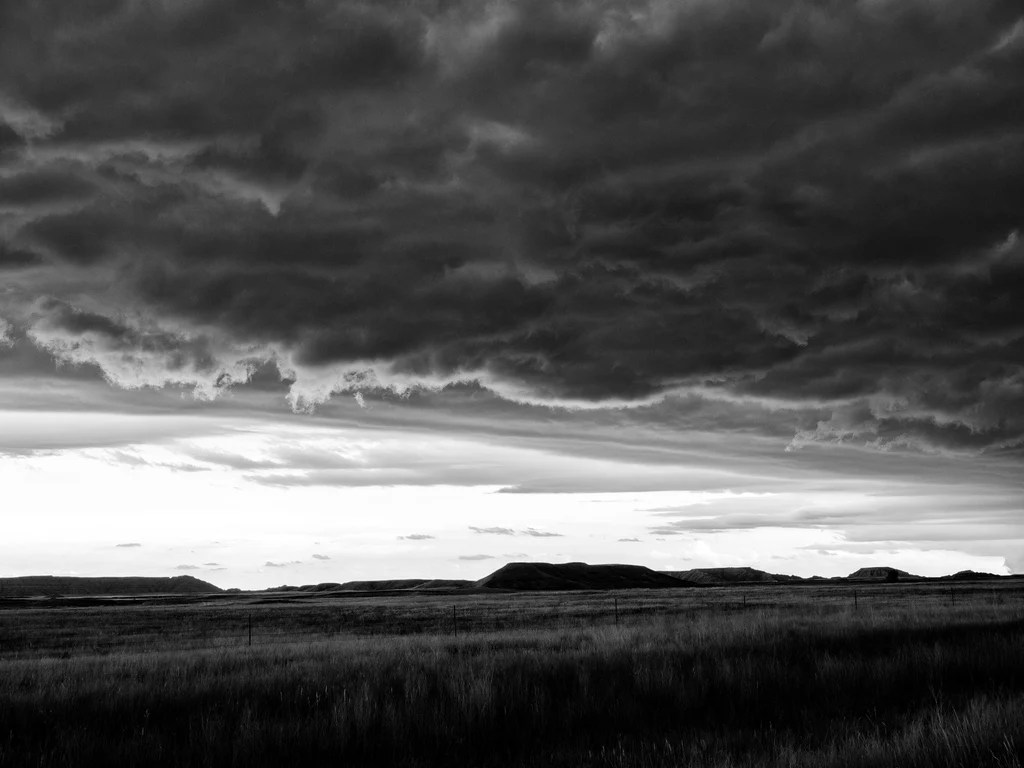
On not knowing where to go … Dark clouds. I’m in a wide open space. I’m standing. I’m all alone and staring into space. They blow across the landscape not knowing where to go. I tell myself, that is exactly how I’m feeling. Days and weeks have become one; time wasted on someone who doesn’t understand you.
On meeting someone from Archer City … Levi, the Polish boy with the broad Yorkshire accent, refers to those who attend the documentary festival as “lanyard wankers”. The bar where he works plays host to large numbers of them and he has very little time for their sort.
“They come in wearing lanyards around their necks and treat us like shit. Like they’re big shots with the most important jobs in the world and we should be grateful for their presence. Fucking wankers.”
Well, we met a lanyard wanker. He was American, and the badge around his neck informed us that he was called Michael and had worked on a documentary exploring border security between Mexico and Texas.
“You must try and see it,” he drawled, “and tell me what you think.”
When somebody says this, it usually means that you are contractually obliged to tell them that it is wonderful, even if it turns out to be a complete pile of shit.
But much to Levi’s disappointment, Michael was actually rather sweet, and unusually interesting.
“I come from Archer City,” Michael proudly told us. “About twenty-five miles south of Wichita Falls.”
Levi immediately broke into a rendition of Wichita Lineman to demonstrate that he had at least heard of the place.
“Wrong Wichita,” Michael corrected him. “That song is about Wichita, Kansas, although Jimmy Webb actually got the inspiration for it while driving through the Texas and Oklahoma panhandles. Archer City and Wichita Falls are most definitely in Texas.”
Michael asked what we did. I explained that I was a writer, which was somehow misconstrued as meaning that I was an author, and I saw no reason to correct him. Levi grinned and explained that he was merely a handsome barman.
“You ever heard of Larry McMurtry?”
The question was aimed squarely at me, because handsome barmen are apparently incapable of knowing anything about Larry McMurtry.
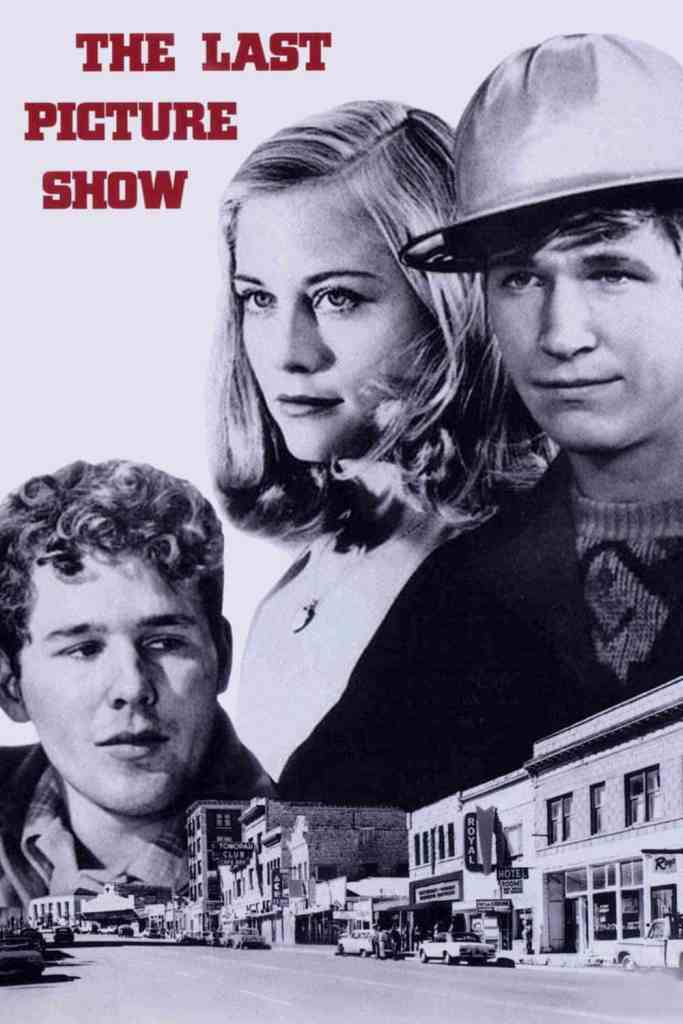
“McMurtry came from Archer City. It’s where they filmed his novel The Last Picture Show back in ’71, and its sequel, Texasville, in 1990.”
I had never seen the film, but it turned out that the handsome barman had.
“The Last Picture Show. Black and white. Classic film,” Levi declared. “Jeff Bridges, Cybill Shepherd and Timothy Bottoms.”
Michael looked impressed.
“Well, I have to admit, it’s a bleak film.”
“What’s it about?” I asked.
“Pitfalls, escapades, sex — but really, it’s about a teenage boy growing up in the 1950s. Back in the 70s, my grandpa was a Baptist deacon and a school board member who was fiercely opposed to them filming in Archer City. ‘Sickness in the stomach and further degradation and decay of the morals and attitudes we foist upon the youth of this county,’ he declared.
“Grandpa Joe was the stereotypical Texan — a bolo tie on Sundays, polished cowboy boots, a white shirt and khaki trousers. But he lost the battle, and do you know what he did, boys? He only went and appeared in the film as an extra.
“My folks never let him forget that. I don’t think they ever stopped reminding him.”
On finding out that I am a Zillennial … Nobody has ever described me in such a way before. I was somewhat startled to discover that I am apparently a Zillennial — a member of a curious micro-generation born between 1993 and 1998, the very year in which I entered the world. I only just made it.
It places me on a peculiar threshold: old enough to remember the final days of an analogue childhood, yet young enough to have grown into adulthood alongside the digital revolution. I belong to that brief moment in time when children still played outside until the streetlights came on, but later found themselves navigating a world of smartphones, social media, and an existence increasingly lived through screens.
There is something rather comical about discovering, at the age of twenty-eight, that one belongs to a category that nobody had previously thought to tell them existed. I mentioned it to my friend Joshua, who described my birth year as 1998 B.W. Intrigued, I asked him to explain.
On playing football with the Boys of Taormina… I have never been attracted to German boys. They can be among the most beautiful, but the language itself has always struck me as cold and harsh. Yet Severin, from Bremen, changed all that. He has been with me for a week now, sleeping beside me in the small hotel on Via Don Giovanni Bosco. Alfio, the receptionist, seemed rather taken with him and turned a blind eye when I asked whether Severin could stay until he got settled. His new job as a waiter has been delayed for another week, though the restaurant promised that his room would soon be ready.
I learned that Severin had a boyfriend, a Spaniard called Estaban, who had remained behind in Turin. He spent a great deal of time on the phone to him, usually trying to reassure him that, although he was sharing a bed with another guy, nothing had happened.
That was partly true. We had both once been Pietro’s “boys”, and there was a reluctance on either side to go where a dead man had already been. It was as though Pietro still maintained some hold over us; we might almost have been brothers, and anything sexual felt faintly incestuous. Yet every morning, when I woke, I would find Severin with his arm draped around me, cuddling, it seemed, with someone he trusted.
Severin is easy to be around: always a few steps behind me wherever I go, yet never overstaying his welcome. He has told me much about his homeland, where his father taught at the University of Bremen and his mother at the University of the Arts. Bremen, he said enthusiastically, was a working-class city that had built its fortune on its port and shipyards — a fact not lost on the Allies during the Second World War, when the city was heavily bombed.
After leaving school, Severin worked at Beck’s Brewery, but was dismissed after being caught having sex with a fellow worker on the bottling line. His abrupt departure prompted him to travel across Europe, eventually ending up in Turin, where he met Pietro and became, in effect, a kept man.
Pietro had obviously singled Severin out for his Nordic looks — a twenty-first century vision of the Aryan “master race”: blond hair, blue eyes, pale skin. There was also the fact that Severin was athletic, and a devoted supporter of Werder Bremen.
Severin discovered that I too liked football and had once played competitively when I was younger. That discovery prompted him to buy a cheap football and seek out a patch of wasteland where we could have a kickabout. Before long, local boys began drifting over to join in, and soon we found ourselves playing fierce, high-intensity matches, with slabs of concrete serving as goalposts.
It became an Italo-Anglo-German affair, proof that football can be loved by everyone, regardless of nationality. Alas, the Italian boys put Severin and me to shame; too many years of smoking, drinking, and inactivity had rendered us ineffective against the tireless boys of Taormina. But it made me feel like a young boy again – innocent and carefree.
The focus is the big phallus… Alfio had a night off and promised to take us to Castelmola, a picturesque medieval hilltop village perched directly above Taormina. “It will be the perfect night for you guys,” he said with a wink, though it seemed more likely that he fancied his chances with Severin, who remained entirely oblivious to his advances.
Alfio ordered a taxi, and a journey that should have taken ten minutes was completed in half the time. The dusty Mercedes hurtled up the steep, narrow, winding road, revealing breathtaking glimpses of Mount Etna and the Ionian coast below.
We arrived in a small square, from which Alfio led us up a short flight of stone steps into Bar Turrisi. Judging by the greetings he received, he appeared to know everyone there.
Alfio explained that Castelmola had grown around the ruins of a tenth-century Norman castle, its streets narrow, ancient, and full of charm. Bar Turrisi, however, was something else entirely. Opened after the war and passed down through generations, it was said to have been founded by descendants of families who had migrated centuries earlier from Pompeii, bringing with them the city’s ribald fertility symbols. The restaurant, Alfio told us with evident delight, still celebrated that inheritance.
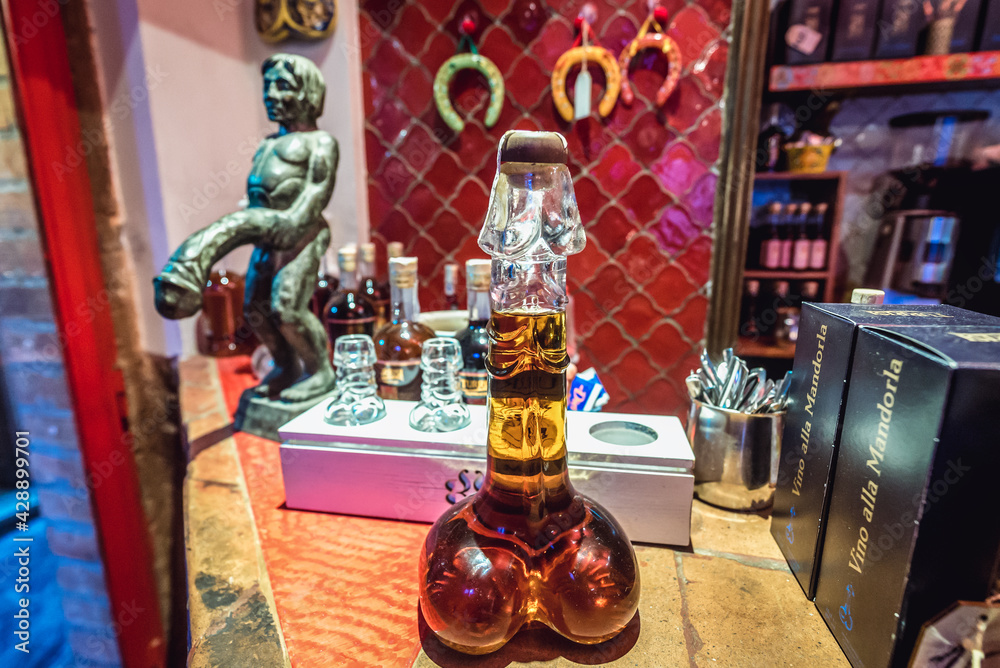
At first, the significance of this escaped both Severin and me, but we soon understood. Across all four storeys, there were penises everywhere one looked: wall paintings, well-endowed statues, phallic liquor bottles, shot glasses, lamps, mirrors, even the plumbing fixtures above the bathroom sinks. The food menu itself was shaped like a penis.
“I knew you would be impressed,” Alfio said, guiding us towards a table overlooking Taormina below. “The people here never wanted to be part of Taormina. They value their independence. But Castelmola was founded to watch over and protect the town.” Unfortunately, night was already beginning to fall, and the views slowly disappeared. The blue sea darkened into a black mass, though the lights of Taormina still sparkled beneath us.
“They filmed The White Lotus at the Four Seasons San Domenico Palace in Taormina,” Alfio told us. “The cast used to come here regularly. They started calling this place ‘the penis bar’.”
Alfio ordered a Sicilian pizza, its ingredients largely a mystery to me apart from the cheese, though it tasted wonderful. We washed it down with a local almond wine, supposedly an aphrodisiac, which Alfio clearly hoped might improve his chances with Severin. As for me, I seemed excluded from his ambitions, though he nevertheless ordered another bottle — this one in a distinctly phallic shape, decorated with traditional Sicilian artwork — and insisted that I drink a generous amount of it.
As my stupor deepened, I found myself wondering how one might write about an overdose of penises without making it sound tacky — which, strangely enough, it was not. “They are symbols of sexual potency and fertility,” Alfio explained smugly, once again for Severin’s benefit, “and also of the virility of Sicilian men.” Severin, meanwhile, remained blissfully unaware of the attention directed at him.
It was only when yet another bottle of almond wine appeared, and Alfio insisted that I finish most of it, that I finally grasped his strategy: get me drunk enough, and he might have Severin to himself. By then, however, it was too late for me to do much about it.
The next morning I woke with a punishing hangover, Severin’s arm once again draped around me. My head throbbed, and Severin seemed in no hurry to wake himself. Still, I managed a smile. Alfio’s attempt to seduce him had failed.
On hearing a story that amused me…but shouldn’t have At a restaurant in Taormina, an old man told us the story of his brother, Salvatore, who, back in 1958, had been abandoned by the woman he was supposed to marry. The humiliation drove him into such despair that he swallowed an overdose of sleeping pills. He was taken to hospital in Syracuse, where, still determined to end his life, he hurled himself from a window — only to land on a balcony below. Bruised but alive, he was carried back upstairs. Three hours later, he climbed to the very same window and jumped again. This time he missed the balcony and died.
“Oh,” I laughed awkwardly, “third time lucky.”
The old man responded by banging his walking stick sharply against the table, which suggested that my attempt at humour had not been appreciated.
On not upsetting a Sicilian… “The Cosa Nostra is still active in Sicily,” Alfio told us. “But these days it is discreet. Drugs, the pizzo, infiltrating businesses — that is where the money is.”
“What is the pizzo?” I asked.
“Protection money,” he replied. “Money extracted through intimidation or extortion. It comes from the Sicilian word pizzu — ‘beak’ in English. To let someone ‘fari vagnari u pizzu’ — ‘wet their beak’ — means to pay them off.”
The warning beneath Alfio’s explanation was perfectly clear: do not offend the Mafia. Fortunately, that seemed unlikely. I would soon be leaving Sicily — and leaving Alfio and Severin behind with it.
“But honour can be dangerous too,” Alfio continued. “Even an ordinary man in the street feels the need to defend his honour. So you must be careful not to insult him.”
Severin then recalled an unsettling story he had once read online, one that seemed to confirm Alfio’s point.
In 1993, a father, unable to bear the shame of having a homosexual son who worked as a prostitute, allegedly paid for him to be murdered. The son was shot in the stomach while soliciting clients in Messina. His father was later jailed for hiring an eighteen-year-old assassin to carry out the attack.
“There, you see?” Alfio said triumphantly. “That old man in the restaurant — the one whose brother needed three attempts to kill himself — was offended by your joke. But he only banged his walking stick on the table, when he could just as easily have paid someone to shoot you.”
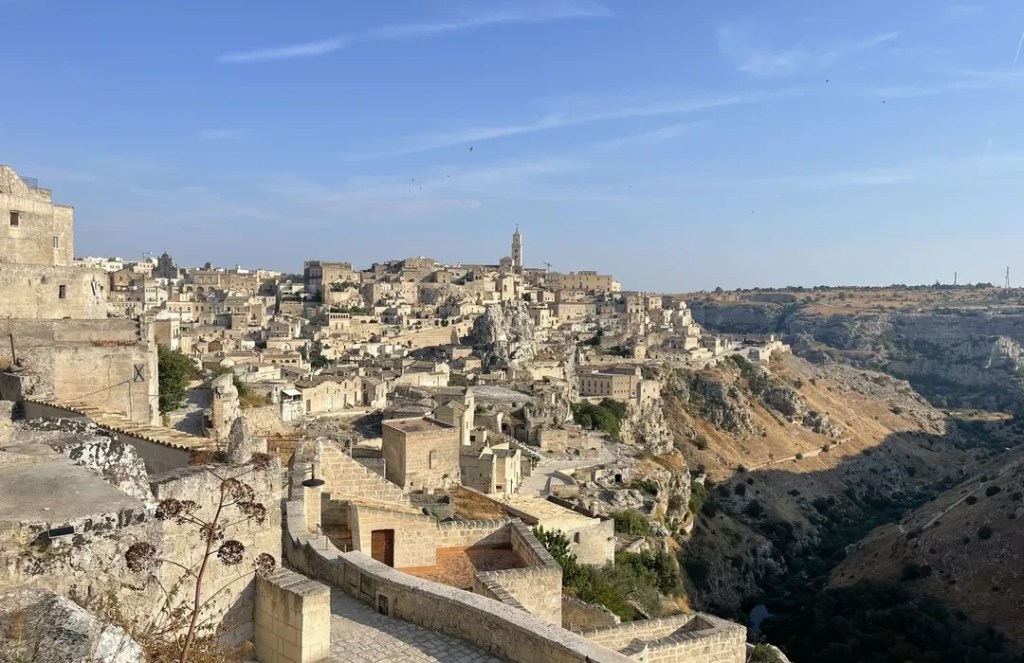
On leaving Montescaglioso… On from Montescaglioso—which I missed the moment I left on the small bus to Matera. I must return. The hilltop town exists in its own world, seemingly remote from the rest of Italy, yet it was warm and welcoming, and somehow managed to revive me.
It was really a minibus, stopping at every opportunity to pick up local women. For them, the journey to Matera felt like a day out—temporarily freed from household chores and feeding their families. They all seemed to know one another, speaking in rapid Italian, their voices rising and falling as they complained about the small details of their everyday lives. And yet, I couldn’t help feeling a quiet jealousy—that they could afford to live such ordinary, mundane lives.
There was only one other man on the journey, and he kept to himself, absorbed in his music. He looked about eighteen, and I imagined he was on his way to meet a girl in Matera. But then his phone rang, and the conversation turned to something entirely different: La Dolce Vita Orient Express, a new train service set to begin in May.
The route sounded almost romantic. It would begin in Rome, travel to Venice, then head down the Adriatic coast to Bari. From there, passengers would be shuttled to Matera—my destination—with its cave churches and underground water cisterns. Back on the train in Bari, the journey would continue towards Taormina in Sicily—which made my ears prick up—before heading on to Palermo and eventually returning to Rome.
It seemed the young man was being offered a job in Matera, one that would benefit from this new train service. He played it cool—neither accepting nor refusing—but you could tell he understood that opportunities like this don’t come around often.
The bus dropped me at Matera Centrale station, where I discovered that my train to Altamura was actually departing from Matera Sud, about two kilometres away. It required a short connecting train journey to get there. It was only once I was on that train that I learned Matera had once been derided as a symbol of poverty, yet had since reinvented itself as a creative hub—full of boutique hotels, buzzing cafés… and, of course, plenty of tourists.
On travelling to Taormina… It was surreal, but we met like lost friends—two people who shared a past, yet barely knew each other. I spotted Severin, with his blond hair and Germanic good looks, as we waited for the ITA Airways flight from Bari–Karol Wojtyła to Catania. The airport name didn’t sound remotely Italian, and I soon discovered why—it was Polish, named after Pope John Paul II.
Severin was from Bremen and had spent the last few years living in Turin. He, too, had been one of Pietro’s “lost” boys, and after Pietro’s sudden death had found himself with a modest sum of money and nowhere to live. I had been more fortunate, receiving a similar amount but allowed to remain in the Verona apartment, thanks to the generosity of Signora Bruschi. But now my home is back in England.
We hadn’t seen each other since that Christmas when Pietro had taken us out for a meal at a restaurant in Milan. It was there we met Elio, who turned out to be Pietro’s favourite—and who had inherited the bulk of his estate, enough to ensure he would never need to work again.
Severin, now in his late twenties, seemed genuinely pleased to see me, and was delighted to discover that we were both bound for Taormina. He looked thinner than I remembered, and had begun to grow a small goatee—something Pietro would never have approved of. Good on him, I thought. I noticed a bruise on his chin, and he explained he had been caught up in Turin’s May Day demonstrations, when protesters tried to break through a police cordon. I hadn’t expected Severin to have become quite such a rebel.
On the aircraft, we talked about old times, each of us offering a quiet, tentative sympathy to the other. Once, we had been adversaries; now, we were something closer to conspirators. Severin had tried to contact Elio after Pietro’s death, but had been met with a swift rebuff. He had also tried to reach me, but hadn’t known where to find me. The chance meeting at the airport had clearly delighted him.
Severin was heading to Taormina to work as a waiter for the summer season. The money Pietro had left him had run out, and now he survived by drifting from one job to the next.
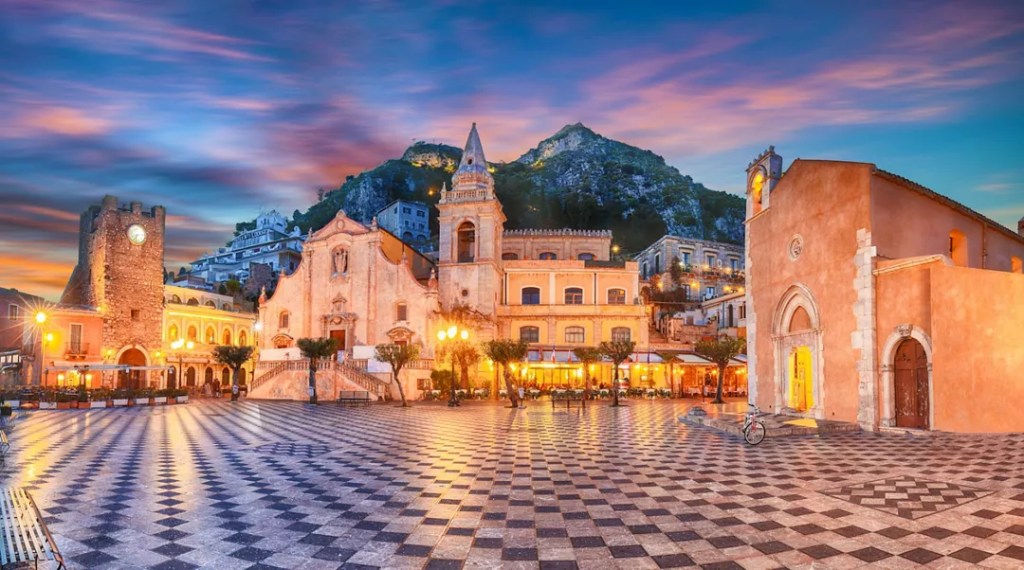
After arriving in Catania, we caught a train to Messina and got off at Taormina–Naxos. From there, we took the bus up into Taormina, where the heavens promptly opened. Inadequately dressed, we wandered through its charming maze of ancient, narrow cobbled alleyways, and along the bustling, elegant—largely pedestrianised—Corso Umberto. We dodged the hundreds of tourists clutching umbrellas, and after the calm of Montescaglioso, I found the crowds slightly overwhelming. Yet it was the smooth, endless stretch of the Mediterranean that held my gaze—and the uneasy thought that Mount Etna lay somewhere close by, hidden in the rainclouds.
It soon became clear that Severin had nowhere to stay. His plan had been to wander the streets of Taormina in search of something cheap. Until his job began—and with it, the promise of a room—the chances of finding affordable accommodation seemed slim. The town may once have existed in a kind of beautiful poverty, but ever since Victorian writers, poets, and artists had discovered it, its fortunes had changed. And soon, the La Dolce Vita Orient Express would be arriving too.
I was staying at a small hotel on Via Don Giovanni Bosco, its balconies overflowing with flowers, and—true to my nature—I offered Severin a bed until he found his footing. At the very least, it meant I wouldn’t be entirely alone as I tried to settle into a strange town.
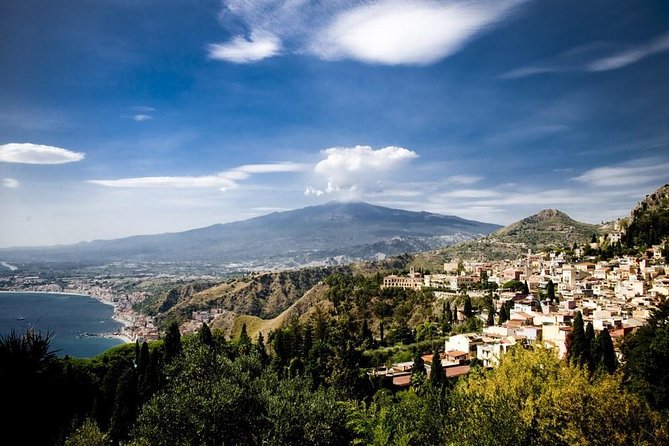
On never trusting Mount Etna… Everybody in Taormina wants you to visit Mount Etna. It is one of the highest volcanoes in Europe, and one of the most active in the world. Alfio, who works on reception at my hotel, suggested that Severin and I take a guided tour. But we both look at Etna and feel quietly relieved by the forty-five kilometres between us and its summit. Never trust an active volcano.
From Taormina, a plume of white smoke drifts from the summit, with no immediate sign of eruption. Yet, according to Alfio, Etna has entered a new eruptive phase that began at Christmas. The crater, he says, is emitting lava, ash, and the occasional flow. He tries to reassure us that Etna poses no real threat to Taormina. Apart from the light dusting of ash that sometimes falls when the wind turns, he tells us to follow the advice of the locals—the Sicilian way is not to worry.
He recalls that, as a small child, he once saw flames suddenly shoot up from the crater, only to subside just as quickly. The same thing happened again the following morning.
Alfio doubts we’ll manage to get up at dawn, but suggests taking us to a hill above the ruined amphitheatre to watch the sunrise. Despite getting to bed at two in the morning, and waking with the lingering effects of strong wine, we let ourselves be dragged through the narrow streets.
The sun rose from the southern edge of Italy and caught the white dome of Etna, tinting it a soft, rose-pink. The colour spread quickly down the snow, deepening until the whole summit glowed like a ruby instead of pale white. Night’s shadows slipped off the slopes, giving way to a rich purple that sank into the valleys and over the orange groves, darkening as it went—until the morning light washed across everything, and the mountains returned to their steady, familiar greens and browns.
That was as near to Mount Etna as I cared to be.
On a poem about Taormina… I found a poem about Taormina on All Poetry which was written by someone referred to only as ecekaradag13, and who appears to have a fondness for Italy.
Taormina Above the Ionian Sea, this teatro of pretense where German tourists photograph Greek ruins through the lens of their prosperity, never seeing the Sicilian boys who sweep their marble steps for coins that disappear into foreign pockets. The ancient theater still echoes with tragedies more honest than the comedy performed daily by boutique owners selling “authentic” Sicily to cruise ship pilgrims seeking enlightenment at duty-free prices. Etna smolders in the distance, that honest mountain which at least admits its capacity for destruction, unlike the hoteliers who smile in four languages while their housekeepers scrub other people’s dreams from Egyptian cotton sheets. In the shadow of San Domenico, where Wilde once walked his particular exile, the local boys still gather at sunset, their beauty a currency more reliable than the lira, their bodies maps of an economy the guidebooks never mention. The bougainvillea blooms in violent purple protest against the limestone walls, while below, the working class of Giardini-Naxos send their children up the mountain to serve aperitivos to those who mistake privilege for culture, consumption for communion with the divine. This is paradise built on the backs of the invisible, where even the gods have learned to speak the international language of tourist euros.