Tag Archives: Montescaglioso

 My Week, For What It Was Worth

On leaving Montescaglioso…
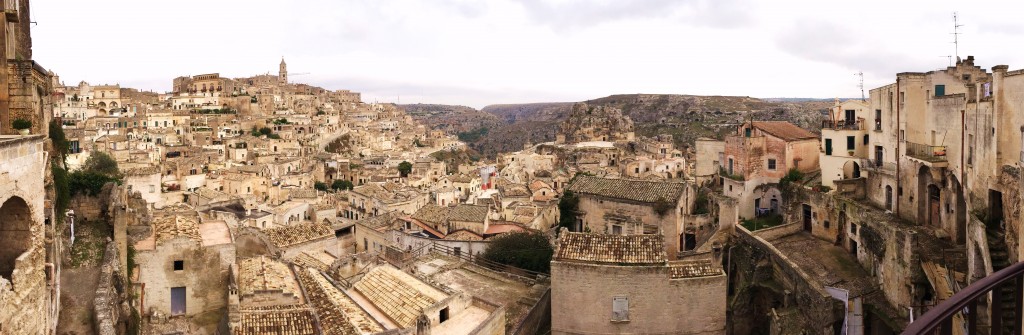
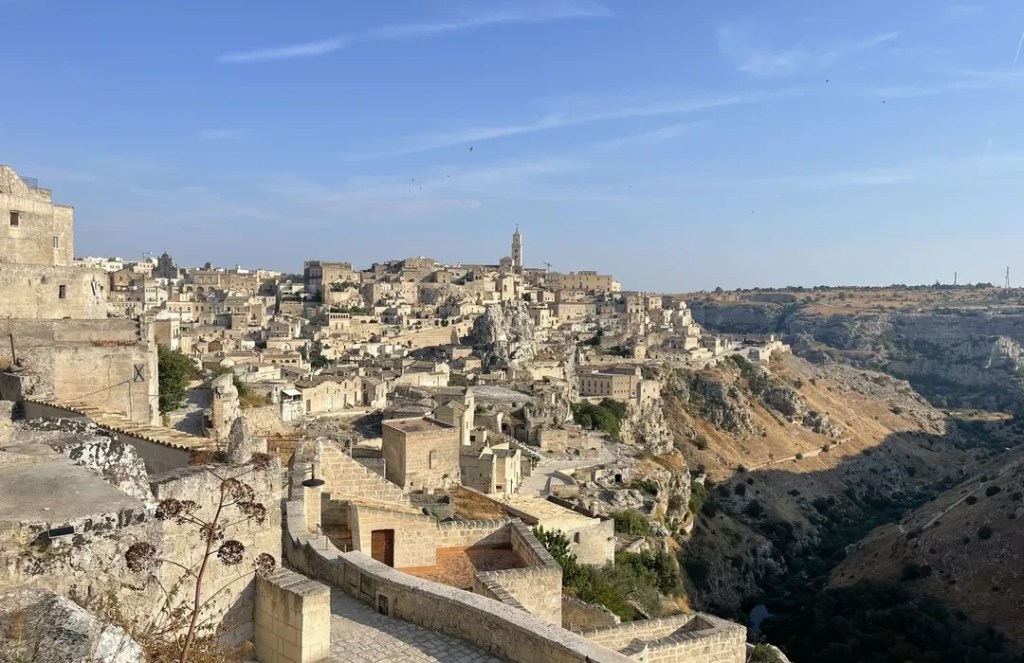
On from Montescaglioso—which I missed the moment I left on the small bus to Matera. I must return. The hilltop town exists in its own world, seemingly remote from the rest of Italy, yet it was warm and welcoming, and somehow managed to revive me.

It was really a minibus, stopping at every opportunity to pick up local women. For them, the journey to Matera felt like a day out—temporarily freed from household chores and feeding their families. They all seemed to know one another, speaking in rapid Italian, their voices rising and falling as they complained about the small details of their everyday lives. And yet, I couldn’t help feeling a quiet jealousy—that they could afford to live such ordinary, mundane lives.

There was only one other man on the journey, and he kept to himself, absorbed in his music. He looked about eighteen, and I imagined he was on his way to meet a girl in Matera. But then his phone rang, and the conversation turned to something entirely different: La Dolce Vita Orient Express, a new train service set to begin in May.

The route sounded almost romantic. It would begin in Rome, travel to Venice, then head down the Adriatic coast to Bari. From there, passengers would be shuttled to Matera—my destination—with its cave churches and underground water cisterns. Back on the train in Bari, the journey would continue towards Taormina in Sicily—which made my ears prick up—before heading on to Palermo and eventually returning to Rome.

It seemed the young man was being offered a job in Matera, one that would benefit from this new train service. He played it cool—neither accepting nor refusing—but you could tell he understood that opportunities like this don’t come around often.

The bus dropped me at Matera Centrale station, where I discovered that my train to Altamura was actually departing from Matera Sud, about two kilometres away. It required a short connecting train journey to get there. It was only once I was on that train that I learned Matera had once been derided as a symbol of poverty, yet had since reinvented itself as a creative hub—full of boutique hotels, buzzing cafés… and, of course, plenty of tourists.
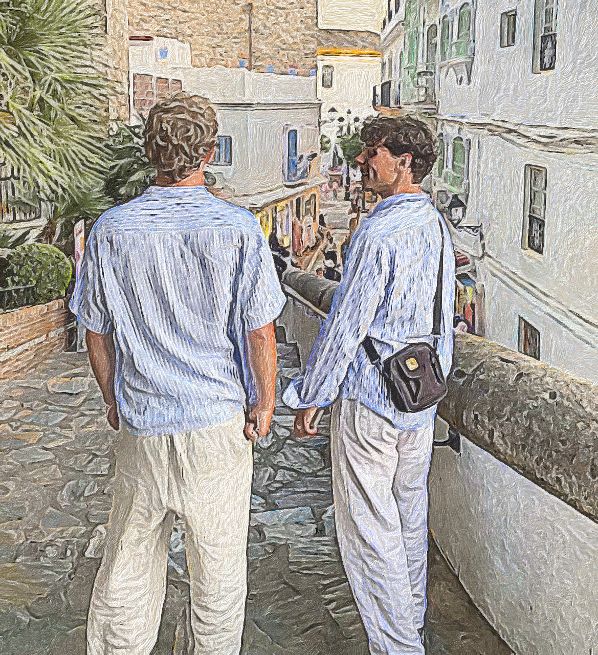
On travelling to Taormina…
It was surreal, but we met like lost friends—two people who shared a past, yet barely knew each other. I spotted Severin, with his blond hair and Germanic good looks, as we waited for the ITA Airways flight from Bari–Karol Wojtyła to Catania. The airport name didn’t sound remotely Italian, and I soon discovered why—it was Polish, named after Pope John Paul II.

Severin was from Bremen and had spent the last few years living in Turin. He, too, had been one of Pietro’s “lost” boys, and after Pietro’s sudden death had found himself with a modest sum of money and nowhere to live. I had been more fortunate, receiving a similar amount but allowed to remain in the Verona apartment, thanks to the generosity of Signora Bruschi. But now my home is back in England.

We hadn’t seen each other since that Christmas when Pietro had taken us out for a meal at a restaurant in Milan. It was there we met Elio, who turned out to be Pietro’s favourite—and who had inherited the bulk of his estate, enough to ensure he would never need to work again.

Severin, now in his late twenties, seemed genuinely pleased to see me, and was delighted to discover that we were both bound for Taormina. He looked thinner than I remembered, and had begun to grow a small goatee—something Pietro would never have approved of. Good on him, I thought. I noticed a bruise on his chin, and he explained he had been caught up in Turin’s May Day demonstrations, when protesters tried to break through a police cordon. I hadn’t expected Severin to have become quite such a rebel.

On the aircraft, we talked about old times, each of us offering a quiet, tentative sympathy to the other. Once, we had been adversaries; now, we were something closer to conspirators. Severin had tried to contact Elio after Pietro’s death, but had been met with a swift rebuff. He had also tried to reach me, but hadn’t known where to find me. The chance meeting at the airport had clearly delighted him.

Severin was heading to Taormina to work as a waiter for the summer season. The money Pietro had left him had run out, and now he survived by drifting from one job to the next.

After arriving in Catania, we caught a train to Messina and got off at Taormina–Naxos. From there, we took the bus up into Taormina, where the heavens promptly opened. Inadequately dressed, we wandered through its charming maze of ancient, narrow cobbled alleyways, and along the bustling, elegant—largely pedestrianised—Corso Umberto. We dodged the hundreds of tourists clutching umbrellas, and after the calm of Montescaglioso, I found the crowds slightly overwhelming. Yet it was the smooth, endless stretch of the Mediterranean that held my gaze—and the uneasy thought that Mount Etna lay somewhere close by, hidden in the rainclouds.

It soon became clear that Severin had nowhere to stay. His plan had been to wander the streets of Taormina in search of something cheap. Until his job began—and with it, the promise of a room—the chances of finding affordable accommodation seemed slim. The town may once have existed in a kind of beautiful poverty, but ever since Victorian writers, poets, and artists had discovered it, its fortunes had changed. And soon, the La Dolce Vita Orient Express would be arriving too.

I was staying at a small hotel on Via Don Giovanni Bosco, its balconies overflowing with flowers, and—true to my nature—I offered Severin a bed until he found his footing. At the very least, it meant I wouldn’t be entirely alone as I tried to settle into a strange town.
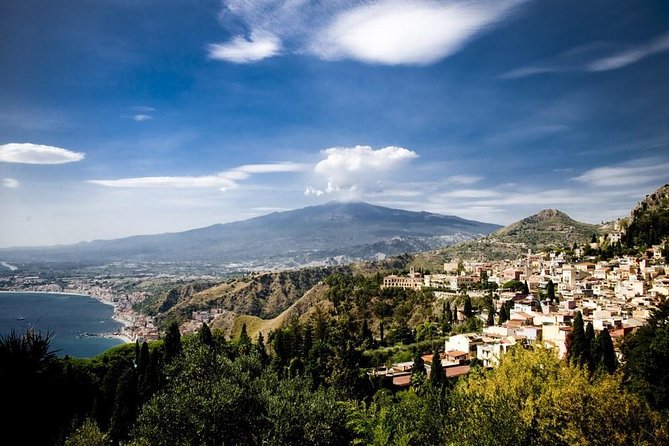
On never trusting Mount Etna…
Everybody in Taormina wants you to visit Mount Etna. It is one of the highest volcanoes in Europe, and one of the most active in the world. Alfio, who works on reception at my hotel, suggested that Severin and I take a guided tour. But we both look at Etna and feel quietly relieved by the forty-five kilometres between us and its summit. Never trust an active volcano.

From Taormina, a plume of white smoke drifts from the summit, with no immediate sign of eruption. Yet, according to Alfio, Etna has entered a new eruptive phase that began at Christmas. The crater, he says, is emitting lava, ash, and the occasional flow. He tries to reassure us that Etna poses no real threat to Taormina. Apart from the light dusting of ash that sometimes falls when the wind turns, he tells us to follow the advice of the locals—the Sicilian way is not to worry.

He recalls that, as a small child, he once saw flames suddenly shoot up from the crater, only to subside just as quickly. The same thing happened again the following morning.

Alfio doubts we’ll manage to get up at dawn, but suggests taking us to a hill above the ruined amphitheatre to watch the sunrise. Despite getting to bed at two in the morning, and waking with the lingering effects of strong wine, we let ourselves be dragged through the narrow streets.

The sun rose from the southern edge of Italy and caught the white dome of Etna, tinting it a soft, rose-pink. The colour spread quickly down the snow, deepening until the whole summit glowed like a ruby instead of pale white. Night’s shadows slipped off the slopes, giving way to a rich purple that sank into the valleys and over the orange groves, darkening as it went—until the morning light washed across everything, and the mountains returned to their steady, familiar greens and browns.

That was as near to Mount Etna as I cared to be.
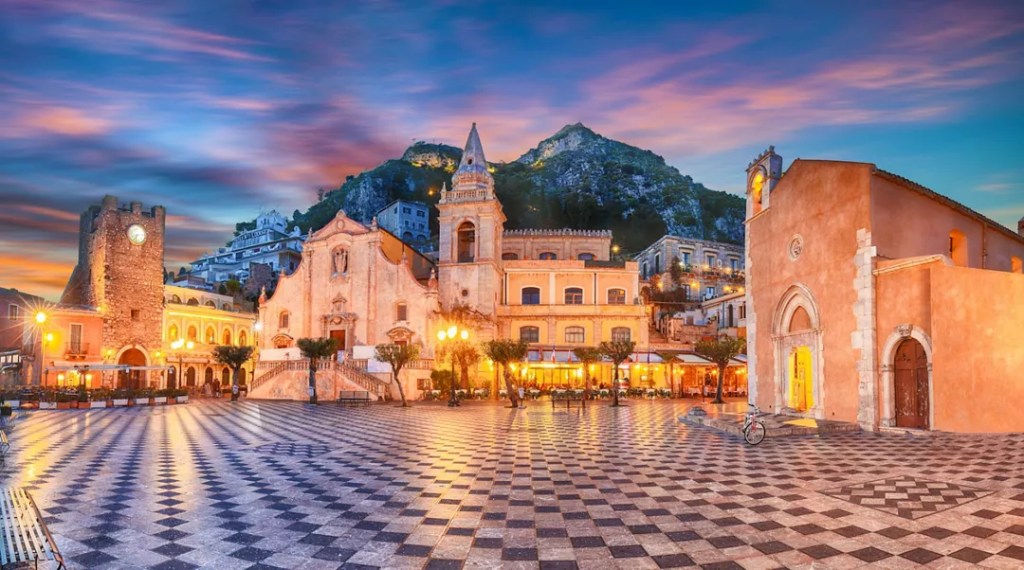
On a poem about Taormina…
I found a poem about Taormina on All Poetry which was written by someone referred to only as ecekaradag13, and who appears to have a fondness for Italy.

Taormina
Above the Ionian Sea,
this teatro of pretense
where German tourists
photograph Greek ruins
through the lens of their prosperity,
never seeing the Sicilian boys
who sweep their marble steps
for coins that disappear
into foreign pockets.
The ancient theater still echoes
with tragedies more honest
than the comedy performed daily
by boutique owners
selling “authentic” Sicily
to cruise ship pilgrims
seeking enlightenment
at duty-free prices.
Etna smolders in the distance,
that honest mountain
which at least admits
its capacity for destruction,
unlike the hoteliers
who smile in four languages
while their housekeepers
scrub other people’s dreams
from Egyptian cotton sheets.
In the shadow of San Domenico,
where Wilde once walked
his particular exile,
the local boys still gather
at sunset, their beauty
a currency more reliable
than the lira,
their bodies maps
of an economy
the guidebooks never mention.
The bougainvillea blooms
in violent purple protest
against the limestone walls,
while below, the working class
of Giardini-Naxos
send their children
up the mountain
to serve aperitivos
to those who mistake
privilege for culture,
consumption for communion
with the divine.
This is paradise
built on the backs
of the invisible,
where even the gods
have learned to speak
the international language
of tourist euros.

On the cute and willing…
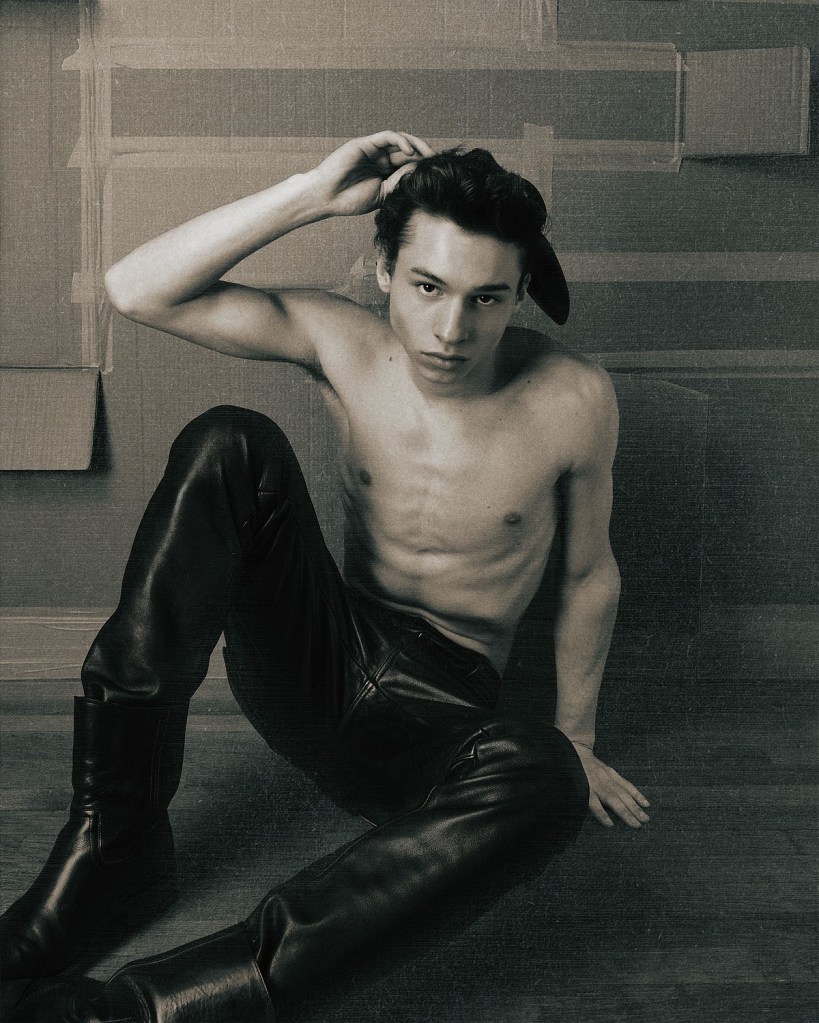
Julien Rondard. Photo by Wanderley Da Costa.

My Week, For What It Was Worth

On chilling out in a Southern Italian town…

Montescaglioso is where a story ends. But I picked a week when the Italian weather was unwelcoming: fine by day, but extremely foggy by night. It is to be expected, because Montescaglioso sits high on a hill.

And then the winds came—strong Sciricco and Maestrale winds that brought heavy rain and quickly sent it away again. For this reason, the locals were happier to stay indoors until conditions improved.

Montescaglioso is where the heart beats a little slower.

Where there are people, I watch them… observing their character and capturing their mannerisms. Most are unaware that this old town was once inhabited by Greeks and Romans.

Some of them will end up in a story.

There is the young boy who is inconspicuous in the corner of a café; he drinks Coke with lemon and reads a paperback copy of Black Run by Antonio Manzini. Every few pages he stops and scrolls through his iPhone. He appears to have friends, but at that moment is bored with his own company.

Then there is the handsome boy, whom I watch with curiosity until it becomes something closer to obsession. He eats pasta with one hand, while the other rests inside his underwear, absent-mindedly playing with himself. He stops when he realises I am watching, and I am immediately disappointed. I want to tell him it is none of my business what he does, but that feels like a perverse thing to say.

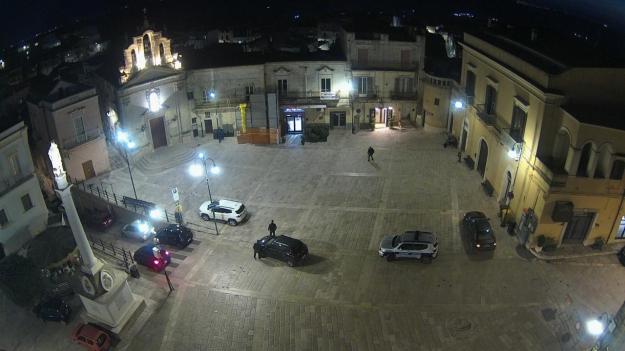
The teenagers who congregate beneath the tall statue of San Rocco, the patron saint of Montescaglioso, in Piazza Roma. They are immaculately dressed in smart jeans, designer puffer jackets, and new trainers, because the nights are chilly. They talk for hours because there is nothing else for them to do. I do not understand what they are saying—they speak too fast—but they seem friendly.

The man who pulls up in a Grande Panda and sees me sitting on a bench outside an old building, its yellow paint faded with time. He speaks remarkably good English and educates me on the history of the town: the stories of local people who left at the beginning of the last century and moved to New York and Toronto. He tells me that Francis Ford Coppola is a second-generation Italian-American, born to parents of southern Italian descent. His paternal grandparents emigrated from Bernalda, which is only a few miles away, and the director now owns a hotel there.

The old man who walks his dog every evening and stops to talk. He points to the Chiesa di San Rocco and tells me it was badly damaged in an earthquake that struck Montescaglioso in 1827, and was later restored with the construction of stone vaults and a new façade. He tells me that ancient Greek tombs were once discovered beneath the piazza, and that the church once stood outside the town—there is the possibility of undiscovered graves beneath the surrounding houses.

I decide that there is much history to be found, but I am only interested in the present, where the young people appear permanently sun-tanned, animated, and possessed of an easy, unstudied allure that feels particular to this part of the world—especially to someone from northern Europe.

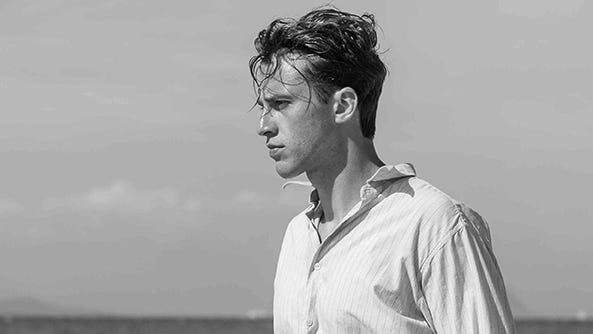
On lusting over Benjamin Voisin in The Stranger…

I know somebody who claims to have met French actor Benjamin Voisin. It may or may not be true because that person has a tendency to tell lies. But the story he tells is a good one because he said that Voisin smoked a lot, wasn’t completely fluent in English, but came across as a nice chap. And he was convinced that he was gay, but that bit has yet to be confirmed.

I first saw Voisin in François Ozon’s Summer of 85 (Été 85), and at the time I thought the director might have chosen a better-looking boy. But then came the trailer for Ozon’s The Stranger (L’Étranger), along with the publicity stills, and I kept finding myself asking, “Who is that good-looking guy?”

It has felt like an age waiting for The Stranger to arrive. Based on Albert Camus’ novella, it was originally shot in colour, though Ozon ultimately chose to release it in black and white—a decision that feels entirely right.

There is a scene in which Meursault (Voisin) kills an Arab boy. He studies the body on the ground—first the armpits, then the lips—before firing… several times. It’s one of Ozon’s familiar devices, turning something ostensibly straightforward into something quietly, disconcertingly homoerotic.

“I wanted to make everything erotic,” Ozon says. “The girls are erotic. The boys are erotic. The nature is erotic. Everything has to be erotic and sensual. That’s what I wanted. And the choice of the black-and-white [cinematography]was a way to show this sensuality in the world.”

If that wasn’t enough we see Voisin’s naked body a few times, a pretty bum that requires squeezing, and even get a glimpse of his manhood.

On coming upon an unwelcome adversary…

The boyfriend of the love of your life stands before you. What are you supposed to do? Granted, he’s good-looking. But he lays claim to someone who should be mine. For that reason, I can’t ignore everything that’s wrong with him. I want lightning to strike him dead. There is a solution to this jealousy—but it’s not one I dare to consider.

On reading an anecdote from Rufus Wainwright…
“What’s the best thing a cabbie has said to you?”

“Well, my handle on Uber is just the letter R, and I went into a cab once and the driver said, “R, what’s that stand for?” And I said, “Rufus.” And he said, “Oh, like Rufus Wainwright? I wonder what happened to him?” I just went along with it…”

As flies to wanton boys are we to the gods…

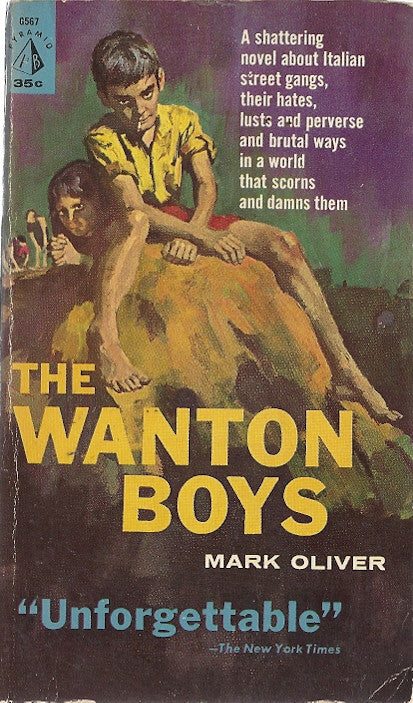
The Wanton Boys, Mark Oliver, 1959.

He was a thin, brown-eyed, sad-looking boy, one of ten children of a poor Italian fisherman who had been drowned at sea. Sometimes he begged a little, and sometimes he stole, but hunger grew in him every day. There was no more salt in the home, only garlic to help the long loaves down. Garlic or one of the half-rotten tomatoes that the wasteful spaghetti-makers threw away, and it was a race in the mornings to get to the garbage cans before the dogs and the other starving scavengers.”

I found a parcel on the doorstep. Tearing it open, I uncover a battered copy of The Wanton Boys. I am beside myself with excitement. It’s an early birthday present from a friend too impatient to wait for the day itself. This ragged mass-market copy, improbably, is worth a small fortune.

The blurb is enticing:

“A shattering novel about Italian street gangs, their hates, lusts and perverse and brutal ways in a world that scorns and damns them.”

I love a book about lust – and perverse and brutal ways.

On the cute and willing…

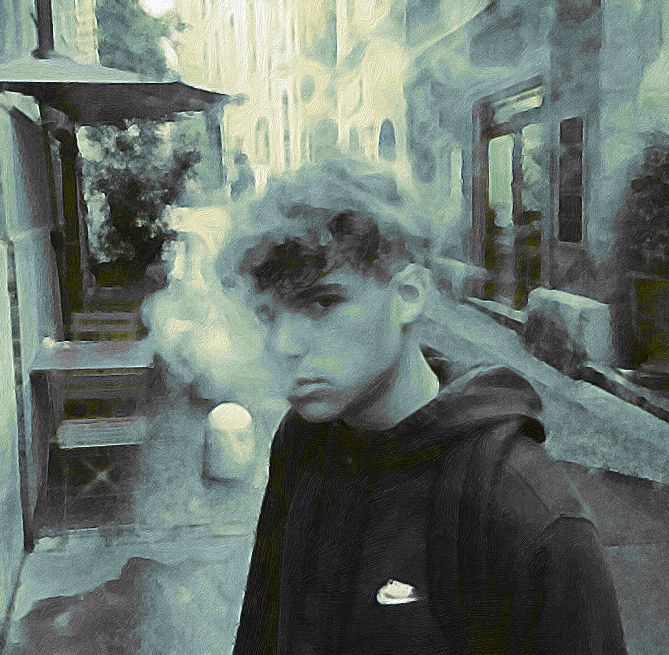
Vimzrut. Photo by Ruslan Pukshyn, 2026

The Distance Between Us Was Never Truly Death

“Paolo went to your country to die, and now, Harry, you have come to his country, where you will also die.” Harry arrives at the small Italian town of Montescaglioso, where it is time to make peace with the person he once loved. The final part of an unlikely story.  (Parts 1 to 24 are available to read in the menu)

Perfectly Hard and Glamorous – Part 25

April 2026

The clock struck twelve at the Chiesa di San Rocco in Piazza Roma. The warmth from the Easter sun was unfamiliar, but as shadows crept from the old buildings and advanced towards the monument, the coolness of the spring afternoon would follow, and remind us that where we came from didn’t matter. One place could be much the same as another.

Piazza Roma was mostly deserted except for a handful of pedestrians who emerged from between these crumbling buildings and went about their business. The peace was only shattered by the noise of a scooter which entered from Corsa della Repubblica. On it, a ragazzo, wearing short sleeves and crash helmet, noticed me standing alone, revved its engine, and circled several times around me. All the time he watched, as there would be other people watching too. 

High above the square, on top of an unlikely building, was a webcam; its five cameras pointing in different directions. Somebody in a cramped New York apartment or a hotel room in Bali, was able to see what was happening in sleepy Montescaglioso. The views were familiar. I looked at them every day, and now, I was also one of the strangers on the screen.

The ragazzo eventually pulled up beside me and cut the engine. He removed his crash helmet and revealed himself to be in his late teens, with black curly hair and neat stubble on his chin. “Sei inglese?” he asked. “Sì, io sono,” I replied. “Then you must be Harry,” he said with broken English. 

He introduced himself as Tino and retrieved a second crash helmet from the sottosella. “Put this on,” he advised, “and get on the back.” I did as I was told and placed my arms around his waist. The engine kicked into life, and he sped off down Via Cavour; through cobblestone lanes that twisted and turned, both sides lined with old houses painted in shades of pink and yellow that the southern sun had slowly faded.

The farther we rode out of town, the wider the roads became, and the houses grew larger and newer. When we reached the petrol station at Strada Provinciale, Tino swung right and came to a stop beneath huge Italian cypresses leading to the gates. We dismounted, and I took in the panoramic views of the surrounding Basilicata. I noticed that the area below the cemetery had been used as a dumping ground for builders’ waste from the construction sites we had passed. Tino opened the sottosella, deposited both helmets, and retrieved a plastic bag. 

“Paolo went to your country to die,” said Tino. “And now, Harry, you have come to his country, where you will also die.” An exchange of the dead. I was the lad from the working classes who had sunk to the bottom before being gifted a chance to rise again. I was about to confront my past again.

Tino took me into the Cimitero Comunale and along corridors of loculi, multi-storey rows of concrete vaults stacked several levels high. The sight was striking; each grave was decorated with vases of fresh flowers. It was a Catholic tradition, an artistic expression, and a practical solution to space limitations. Italian culture maintained a strong, ongoing connection with the dead.

“My family were upset when you asked to visit,” Tino told me as we walked along. “The older ones are still angry and did not want you to come. But it was the younger ones who were able to change their minds.”

“Please thank them for doing so.”

“They call you the ‘English Boy’—the one who came from the projects. Our elders believe that Uncle Paolo did something gravely wrong, and that you were the cause of it. It is the only way they can forgive him. Blame you. Maybe the younger members of the family have more compassion and understanding, and we are more interested in seeing the boy who became the source of such hatred.”

The boy he referred to was no longer a boy. I was now in my sixties and had waited far too long to come here. Tino looked at me, and I could not help noticing his delicate brown eyes, which seemed to be searching for answers.

“I am older than Uncle Paolo was when he died. He will remain a boy forever. In the same way, you have not aged either, Harry. You are still the boy who was responsible for sending him to his tragic death. It is the boy that people will condemn.”

Like Paolo’s family, I had also believed that Paolo had taken his own life. The shame of being arrested and exposed as a homosexual had been too much. But Frank Smith had taken forty years to tell me otherwise: that Andy, my best friend, had blamed Paolo for coming between us—for ruining my life—and had sought revenge by sending him to a horrific death from the top of an abandoned factory.

It had taken me twelve months to process that news. Those last seconds, when Paolo knew that he was going to die. What had been going through his mind? Those intense emotions—fear, love, regret. Had Paolo thought about me in those last moments?

I was about to tell Tino the truth but didn’t get the chance. He had stopped in front of a small, rectangular niche on the bottom row and pointed.

I noticed the flowers first—chrysanthemums, alongside a mix of vibrant and white blooms, carefully arranged in small glass vases. There were also tulips, symbolising the freshness of spring, new beginnings, and hope.

And I saw Paolo again—for the first time in forty-one years.

There was a black-and-white photograph: a headshot of him looking at the camera, that nervous expression, expressive eyes, thick black hair with the same curl that always fell across his forehead, and a half-smile. Paolo was looking at me. A look of surprise. I had finally come to see him. The years of regret washed away, and we were back together again. I saw him smiling. “I loved you, Harry, but I was taken away. The years were long, but you found me again. Ti amo, Harry.”

It was a moment where grief, memory, and love converged.

Tino reached into the plastic bag and handed me a white rose to place in front of the photograph.

“I shall leave you to make your peace,” he said, and slipped away to a bench at the end of the avenue.

I put my hand on the marble slab that had been used to seal the tomb. It felt warm in the afternoon sun. I traced the inscription with my finger—Paolo Antonio Moretti—Amato da tutti coloro che lo conoscevano—beautifully carved in italics by an Italian craftsman. 

“Well… Paolo. Here I am. I never imagined that I would speak to you again. The last time I saw you was at that big house, when we were all arrested. My last recollection is of you looking terrified and shouting my name. I’ve replayed that moment every day for over forty years. Shouting my name because you were scared, and I couldn’t do anything. Do you know how painful that memory has been?

“I tried to speak in the days afterwards, but everyone hated me and wouldn’t let me anywhere near you. They said that I had corrupted you. I suppose your parents were trying to protect you… and they told me that you didn’t want to see me. That hurt, and I’ve tried to come to terms with it ever since, but I never believed it.

“And then you were gone. Forever. Do you know how that felt? The realisation that you love somebody so much, but can never see, touch, or love them… ever again. It was the most painful thing that ever happened to me.”

A tiny sparrow landed on the ground beside me. In Italian folklore, these are seen as a sign from the dead, and it hopped around my feet before flying up onto Paolo’s grave.

“Last year I saw Frank Smith. He told me that you didn’t commit suicide. That was a relief to me—for a while, anyway—but then I found out that it was Andy who killed you. It meant that your parents were right to blame me. My best friend killed you because he was jealous of us. That is something your family needs to know.

“What happened afterwards? I went to pieces. I nicked a car and drove to London, where I stayed for years. I worked as a rent boy and then became a writer. Can you imagine that? A small-time shit from Park Hill who couldn’t string a sentence together. But I’ve written books that proved I could do something with my life. I also met a guy called Scott, who I thought I loved, but now I realise that I probably didn’t.

“I went back to Sheffield—to Park Hill—which had completely changed and wrote about our past. It is the most successful book I’ve written. Everyone thinks it is fiction… but everything in it was true. About growing up, the Geisha Boys, meeting you, loving you, and the things we did.

“But I had to leave again. I didn’t belong there anymore. Many ghosts were laid to rest, but I couldn’t exorcise the memories.

“And now I’m here in Montescaglioso, where I can stay close to you. I’ve brought Tom with me and we’re buying an apartment on Viale Europa, not far from here. It’s modest, but for someone who lived at Park Hill, it will herald a new start.

“Tom is Jack’s youngest son and was a bit of a tearaway—a bit like I was. But he’s attached himself to me and will look after me as I grow older. Growing old is something you won’t know about, but it’s very overrated.

“And I met Jack again. I needed to know that he had forgiven me, but it turned out that he wanted my forgiveness too. The tragedy is that we wasted years feeling guilty. Both of us were afraid to make contact.

“Most importantly, I needed his blessing about Tom, and do you know what he said? When we were teenagers, he thought there was something different about me, but couldn’t pin it down. When it all came out into the open, he expected me to make a move on him. If I had, he said that he wouldn’t have said no. That floored me. He gave me his blessing about Tom because he knew that I’d turned his life around.”

Tino was approaching, and the small sparrow flitted between the flowers with a burst of energy. I stopped talking but couldn’t leave it like that.

“I must go now, but I shall return soon. Ti amo, Paolo.”

“I heard what you were saying to Uncle Paolo,” Tino said. “Did you love him as much as you say you did?”

“I did,” I confessed, “and it was a relationship that should never have happened. Did you know that the first night that I met Paolo, I punched him in the face… and immediately regretted it. He was incredibly sweet and beautiful. I wish you could have met him.”

“And this Tom that you spoke about—he has come to Montescaglioso with you?”

“Another unlikely relationship. Tom is much younger than me, and the story is far too complicated to explain. But he is a link between the past and the present.”

Tom was waiting for me when I returned to Piazza Roma. He smiled—a dazzling grin that showed his face had already tanned under the Italian sun. I explained that Tino had promised to visit us at the new apartment and that he had also asked for a copy of Perfectly Hard and Glamorous.

“But the book is in English,” he replied.

“I know,” I said, “but he wants it because that book is part of his family history.”

And that is the end of this long story.

The journey from a bleak northern city that had little going for it in the 1980s to the present, in a small Italian town that nobody has heard of. Tino was right when he suggested that Paolo had travelled to another country to die, and that I had done the same. And that is what will happen.

We are both happy here and will never leave.

Sometimes, when I stand on the balcony of our new apartment at Viale Europa and look at the house across the street, I imagine that I am seeing Park Hill again. And then the laundry tries to break free with the help of the strong wind that blows from the distant olive groves and wheat fields, and the memories evaporate.

I watch people going about their business—the animated, loud conversations, the frequent gesticulation, and that strong personal style. Both the young and the old, slipping into cafés, shops, and gelaterie. Walking between sun-drenched, ochre-washed buildings and piazzas, with the noise of Vespas weaving through the narrow streets. They are blissfully unaware of that sensory blend of ancient history and modern life; unaware that historic architecture is now adorned with contemporary graffiti.

The Italians are wonderful people.

I also think about everyone who shaped that journey: those who are dead—my parents, my best friend Andy, whom I may never forgive, and Paolo, whom I visit every week. I even think about Frank Smith and Billy Mason. Then there is the living—Jack, who will make regular visits to Italy and remind me that I was once a Geisha Boy, who swore, fought, and offered my body to anyone who wanted it; and Tom, who one day will replace Paolo as the love of my life.