Tag Archives: French movies

My Week, For What It Was Worth

On chilling out in a Southern Italian town…
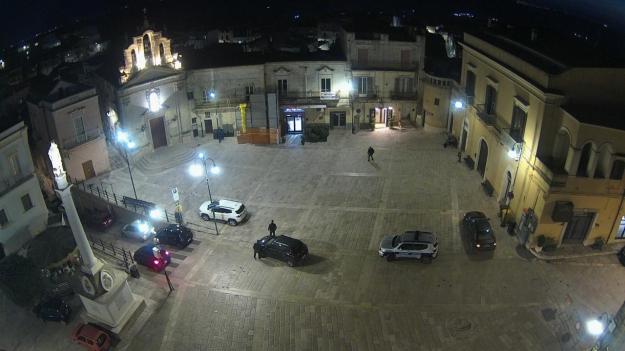
Montescaglioso is where a story ends. But I picked a week when the Italian weather was unwelcoming: fine by day, but extremely foggy by night. It is to be expected, because Montescaglioso sits high on a hill.

And then the winds came—strong Sciricco and Maestrale winds that brought heavy rain and quickly sent it away again. For this reason, the locals were happier to stay indoors until conditions improved.

Montescaglioso is where the heart beats a little slower.

Where there are people, I watch them… observing their character and capturing their mannerisms. Most are unaware that this old town was once inhabited by Greeks and Romans.

Some of them will end up in a story.

There is the young boy who is inconspicuous in the corner of a café; he drinks Coke with lemon and reads a paperback copy of Black Run by Antonio Manzini. Every few pages he stops and scrolls through his iPhone. He appears to have friends, but at that moment is bored with his own company.

Then there is the handsome boy, whom I watch with curiosity until it becomes something closer to obsession. He eats pasta with one hand, while the other rests inside his underwear, absent-mindedly playing with himself. He stops when he realises I am watching, and I am immediately disappointed. I want to tell him it is none of my business what he does, but that feels like a perverse thing to say.

The teenagers who congregate beneath the tall statue of San Rocco, the patron saint of Montescaglioso, in Piazza Roma. They are immaculately dressed in smart jeans, designer puffer jackets, and new trainers, because the nights are chilly. They talk for hours because there is nothing else for them to do. I do not understand what they are saying—they speak too fast—but they seem friendly.

The man who pulls up in a Grande Panda and sees me sitting on a bench outside an old building, its yellow paint faded with time. He speaks remarkably good English and educates me on the history of the town: the stories of local people who left at the beginning of the last century and moved to New York and Toronto. He tells me that Francis Ford Coppola is a second-generation Italian-American, born to parents of southern Italian descent. His paternal grandparents emigrated from Bernalda, which is only a few miles away, and the director now owns a hotel there.

The old man who walks his dog every evening and stops to talk. He points to the Chiesa di San Rocco and tells me it was badly damaged in an earthquake that struck Montescaglioso in 1827, and was later restored with the construction of stone vaults and a new façade. He tells me that ancient Greek tombs were once discovered beneath the piazza, and that the church once stood outside the town—there is the possibility of undiscovered graves beneath the surrounding houses.

I decide that there is much history to be found, but I am only interested in the present, where the young people appear permanently sun-tanned, animated, and possessed of an easy, unstudied allure that feels particular to this part of the world—especially to someone from northern Europe.

On lusting over Benjamin Voisin in The Stranger…
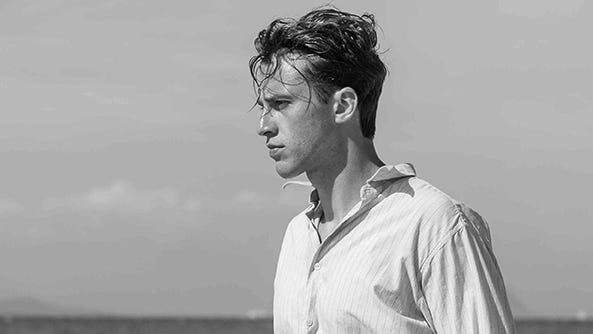
I know somebody who claims to have met French actor Benjamin Voisin. It may or may not be true because that person has a tendency to tell lies. But the story he tells is a good one because he said that Voisin smoked a lot, wasn’t completely fluent in English, but came across as a nice chap. And he was convinced that he was gay, but that bit has yet to be confirmed.

I first saw Voisin in François Ozon’s Summer of 85 (Été 85), and at the time I thought the director might have chosen a better-looking boy. But then came the trailer for Ozon’s The Stranger (L’Étranger), along with the publicity stills, and I kept finding myself asking, “Who is that good-looking guy?”

It has felt like an age waiting for The Stranger to arrive. Based on Albert Camus’ novella, it was originally shot in colour, though Ozon ultimately chose to release it in black and white—a decision that feels entirely right.

There is a scene in which Meursault (Voisin) kills an Arab boy. He studies the body on the ground—first the armpits, then the lips—before firing… several times. It’s one of Ozon’s familiar devices, turning something ostensibly straightforward into something quietly, disconcertingly homoerotic.

“I wanted to make everything erotic,” Ozon says. “The girls are erotic. The boys are erotic. The nature is erotic. Everything has to be erotic and sensual. That’s what I wanted. And the choice of the black-and-white [cinematography]was a way to show this sensuality in the world.”

If that wasn’t enough we see Voisin’s naked body a few times, a pretty bum that requires squeezing, and even get a glimpse of his manhood.

On coming upon an unwelcome adversary…
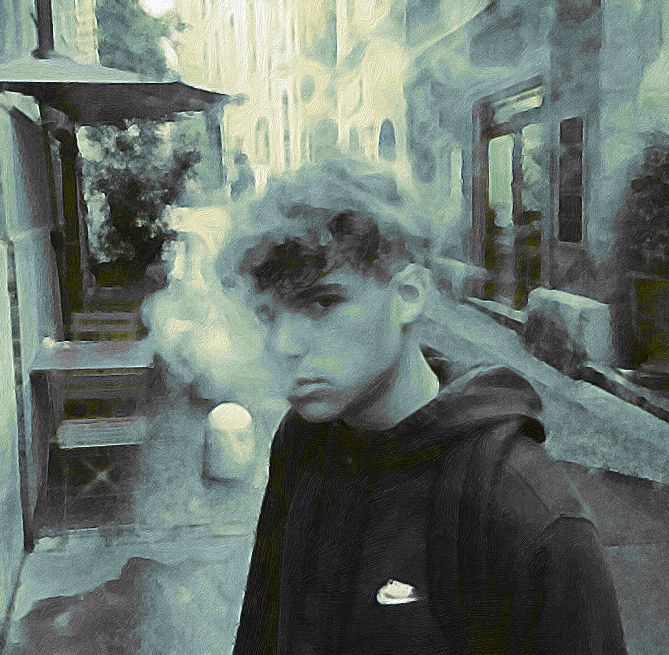
The boyfriend of the love of your life stands before you. What are you supposed to do? Granted, he’s good-looking. But he lays claim to someone who should be mine. For that reason, I can’t ignore everything that’s wrong with him. I want lightning to strike him dead. There is a solution to this jealousy—but it’s not one I dare to consider.

On reading an anecdote from Rufus Wainwright…
“What’s the best thing a cabbie has said to you?”

“Well, my handle on Uber is just the letter R, and I went into a cab once and the driver said, “R, what’s that stand for?” And I said, “Rufus.” And he said, “Oh, like Rufus Wainwright? I wonder what happened to him?” I just went along with it…”

As flies to wanton boys are we to the gods…
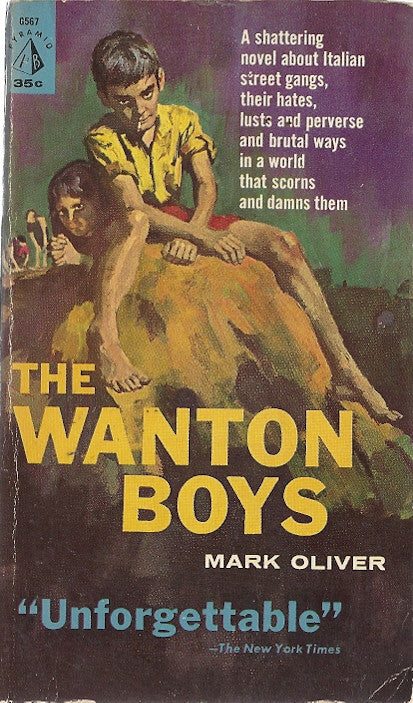
The Wanton Boys, Mark Oliver, 1959.

He was a thin, brown-eyed, sad-looking boy, one of ten children of a poor Italian fisherman who had been drowned at sea. Sometimes he begged a little, and sometimes he stole, but hunger grew in him every day. There was no more salt in the home, only garlic to help the long loaves down. Garlic or one of the half-rotten tomatoes that the wasteful spaghetti-makers threw away, and it was a race in the mornings to get to the garbage cans before the dogs and the other starving scavengers.”

I found a parcel on the doorstep. Tearing it open, I uncover a battered copy of The Wanton Boys. I am beside myself with excitement. It’s an early birthday present from a friend too impatient to wait for the day itself. This ragged mass-market copy, improbably, is worth a small fortune.

The blurb is enticing:

“A shattering novel about Italian street gangs, their hates, lusts and perverse and brutal ways in a world that scorns and damns them.”

I love a book about lust – and perverse and brutal ways.

On the cute and willing…

Vimzrut. Photo by Ruslan Pukshyn, 2026

Un séducteur – Until the day that you died

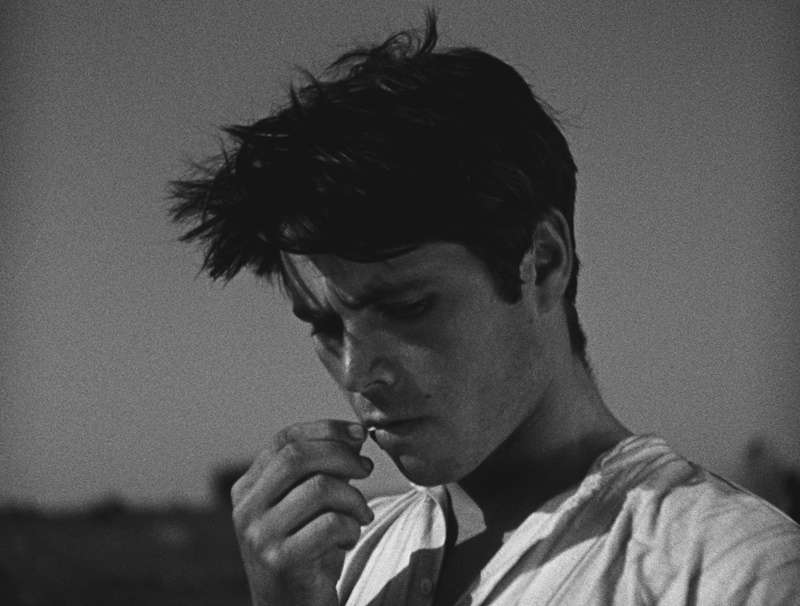
Handsome French boy. The light falls on him like a thought half-formed, catching the edges of his face before retreating into shadow. A quiet defiance in the way he chews on a matchstick. The air feels slow around him, salt and sand mingling with the scent of his skin. His shirt, open at the collar, softens the hardness of his jaw, and the wind seems to pause there – unsure whether to touch him or not. In that hesitation, the moment turns fragile, suspended – beauty caught between innocence and knowing. The image might have been taken yesterday, but this Brittany fisherman is from Finis Terrae, a 1929 French silent film written and directed by Jean Epstein.

Charlie / When boys parted and the broken handshake


“We were brought up as good Catholic boys,” Charlie confided. “But there is no such thing as a good Catholic boy. I am living proof of that.” 

Charlie and his brother went to a Catholic school on the outskirts of Paris. He loved it, whereas Thomas hated it, and was expelled for accidentally setting fire to the priest’s Renault Clio. 

“But Catholic school turned me into a homosexual, and that makes me sad.” He rolled with laughter. “I fooled you! I have such happy memories. I was a prince amongst pigs.” Was this a French expression that was lost in translation?

The conversation happened before we watched Au revoir les enfants (on DVD, no less). The film is set in a French Catholic school in 1944. A boy – Julien – becomes friendly with a new boy – Jean – who turns out to be a Jew in hiding. Throw in the Germans, and you can guess the rest.

Charlie’s school hadn’t been a boarding school, but he probably wished it had been. Living and sleeping amongst dozens of hormonal schoolboys would have suited him wonderfully.

The film’s end scenes were traumatic. Julien, a precocious boy, nervously glances at his friend, tipping off the Gestapo official and, seemingly, causing Jean’s arrest. Later, as he is being led away, he walks over to shake Julien’s hand, but just as their fingers touch, Jean is snatched away. And when the headmaster, Père Jean, also arrested for harbouring Jews, and utters the line – “Au revoir, les enfants!” – the tears rolled down Charlie’s cheeks.  

Louis Malle directed the film and provided the closing voiceover:

“More than forty years have passed, but I will remember every second of that January morning until I die.” (He would depart this world eight years later).

It was based on Malle’s experiences of World War Two when he attended Petit-Collège d’Avon at Fontainebleau. Three Jewish students and a teacher were rounded up and sent to Auschwitz while the school’s headmaster, Père Jacques, would die in the concentration camp at Mauthausen. The memory of his lost friend, and that broken handshake, kept bobbing to the surface, but it took Malle 43 years to make the film.

As the credits rolled, Charlie was in a sombre mood and scanned the back of the empty DVD case. “It was made in 1987, and I cannot believe that I have never seen or heard of this movie before… and it was French too.” He used the fingers of both hands to help him with a calculation. “Do you realise that it has been 38 years since this movie was made? Think about it. Those boy actors will now be old men.”

Charlie / Erastes and the Eromenos

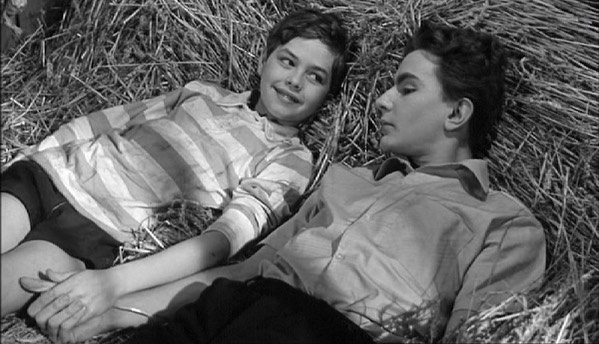
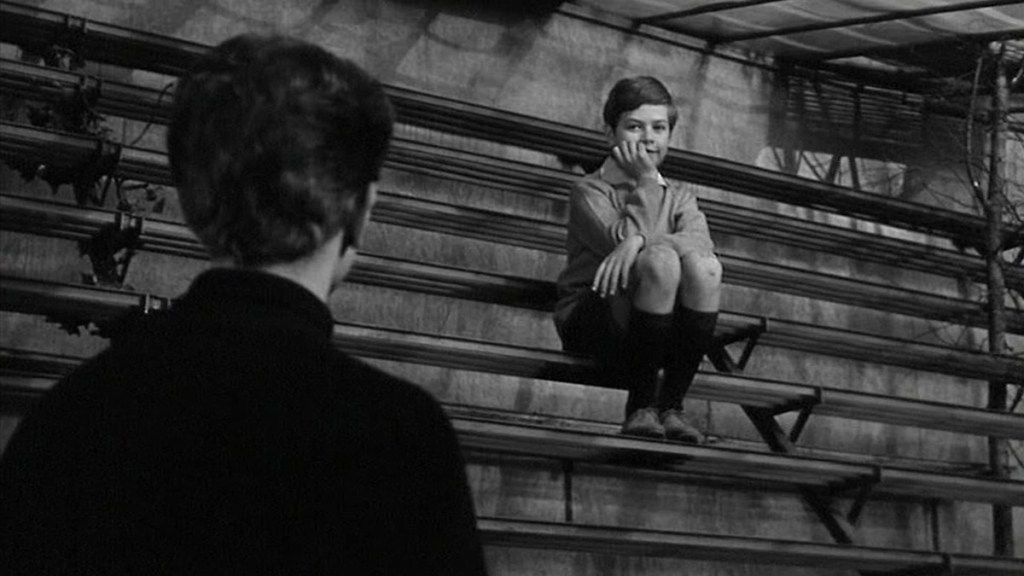
Image: Les amitiés particulières (1964). Directed by Jean Delannoy

It was the last night of our short seaside holiday and Charlie decided that it would be a good idea to stream a movie. He spent well over an hour flicking through Netflix and Prime Video until my patience finally ran out.

“Charlie, we will soon have spent as long looking for a movie than it would to watch one.” He stopped flicking. “Then I shall choose this one, and if you do not like it, I shall not be held responsible,” he said petulantly.

The movie he chose was in black and white and called This Special Friendship. It soon became apparent that it was old (1964), and in French, which delighted Charlie, but the English subtitles would soon annoy him, while I would be annoyed with Charlie for moaning about them.

“It is called Les amitiés particulières, which means ‘special friendships’, but the English cannot translate it correctly,” he told me. “The synopsis is simple. It is set in the rigid atmosphere of a Jesuit boarding school and is a tender relationship between a 14-year-old upperclassman and a 12-year-old boy, who is the object of his desire.” Charlie’s expertise had come after consulting his iPhone.

The movie seemed harmless enough, and because it was made in the 1960s was tame when compared to boy-love movies of today, but after only a few minutes Charlie tutted with disdain. “The character of Georges is supposed to be 14 years old,” he said, “but he looks like he is older than me.” I later found out that the actor, Francis Lacombrade, according to one source, had been 21, but others stated that he had been 17. 

Charlie’s derision intensified when the object of his desire appeared for the first time. He was a small cupid-faced boy carrying a lamb which we presumed was meant to be the symbolism of Jesus Christ as the Lamb of God. “Bordel de merde! Please tell me that this boy isn’t going to be his lover.” His fears proved to be correct, and I agreed that the age difference was disturbing. 

He was called Alexandre, who turned out to be a bit of a cock-tease for Georges, but the romance mainly involved love letters passed between the two of them. The relationship is destroyed by a priest’s will to protect them from homosexuality. “We know why he did that,” said Charlie knowingly. “That priest wanted his wicked way with the little boy.” That wasn’t the case, but there were no happy endings, because heartbroken Alexandre jumped to his death from a moving train.

“The movie was good,” Charlie said afterwards, “but I found it troubling.” I agreed and began my own internet search to see what people thought about it. I was surprised to find that modern-day audiences seem unperturbed by the subject matter but could see that the Catholic Church had tried unsuccessfully to get it banned on its release. 

Charlie disappeared into the kitchen while I fell down a rabbit hole as I dug deeper into the movie’s background. When he returned with two mugs of tea I told him my findings. 

“I’ve found things that  might upset you even more.”

“What do you mean?”

“The movie is based on a book written by a French author called Roger Peyrefitte and is said to be autobiographical because he had a similar romance, and the younger boy committed suicide.” My pronunciation was poor, and it came out as Pay-ri-fit.

Charlie corrected me. “Pey-ri-fee.” He stretched on the leather sofa and mulled over my new-found knowledge.

“But there is more,” I said, scrolling down the page of a French literary site. “Peyrefitte visited the movie set  and fell in love with a 12-year-old boy who played a small part as a choir boy. They had a relationship, and the boy became his personal secretary and was eventually adopted by him.”

“It is Greek love,” Charlie frowned. “Erastes and Eromenos. What happened to them?”

“The boy was called Alain-Philippe Malagnac d’Argens de Villèle.” My English pronunciation left a lot to be desired, but Charlie looked at me as though I had said something significant.

“Alain-Philippe Malagnac?”

“I suppose so.”

“It cannot be the same person,” he cried, “but my father once knew somebody with that name.”

I continued reading. 

“Malagnac became proprietor of Le Club Colony in Paris and briefly managed French singer Sylvie Vertan but it almost bankrupted Peyrefitte and forced him to sell artworks and erotic antiques.”

“The Alaine-Philippe Malagnac that my father knew was married to Amanda Leah, who he believes to really be a man, but a gay icon. He died in a fire near the Alpilles Mountains.”

I saved my pièce de résistance until last.

“Malagnac married Amanda Lear in 1979. She was close friends with Salvador Dali, who disapproved of the marriage.”

Charlie smiled triumphantly. “That is incredible. I cannot wait to tell my father, but what shall I say?” He began fiddling inside his shorts, something he tended to do when he mulled things over. At last, he came to a decision. “I will not say anything because he will become worried that I might also be seduced by an older man.”

I smiled. “I think it is most likely to be the other way around.”

Image: Les amitiés particulières (1964). Directed by Jean Delannoy