On leaving Montescaglioso…
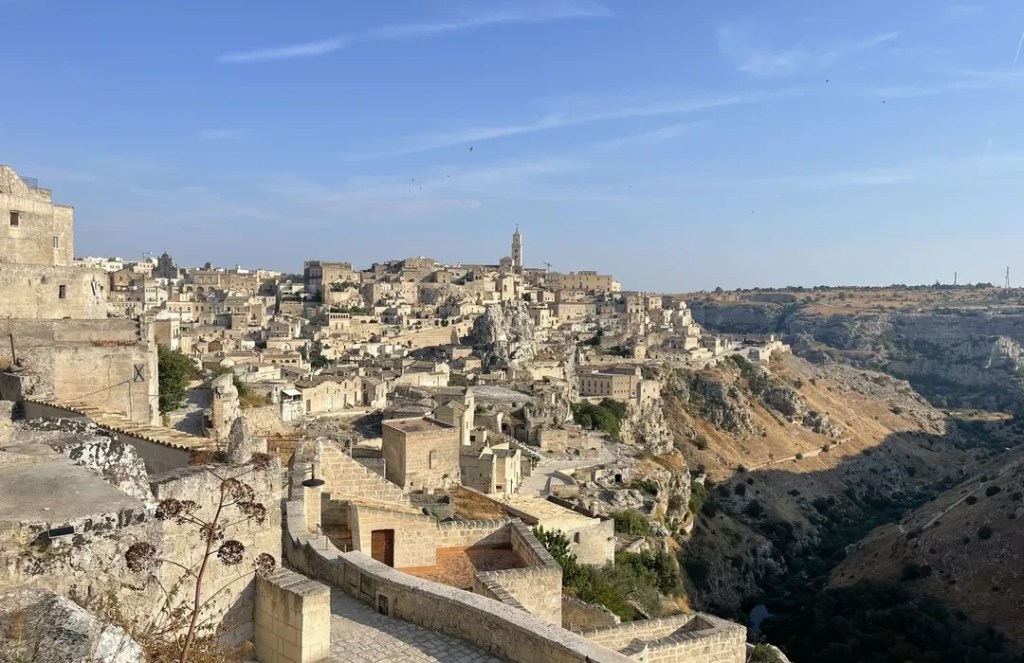
On from Montescaglioso—which I missed the moment I left on the small bus to Matera. I must return. The hilltop town exists in its own world, seemingly remote from the rest of Italy, yet it was warm and welcoming, and somehow managed to revive me.
It was really a minibus, stopping at every opportunity to pick up local women. For them, the journey to Matera felt like a day out—temporarily freed from household chores and feeding their families. They all seemed to know one another, speaking in rapid Italian, their voices rising and falling as they complained about the small details of their everyday lives. And yet, I couldn’t help feeling a quiet jealousy—that they could afford to live such ordinary, mundane lives.
There was only one other man on the journey, and he kept to himself, absorbed in his music. He looked about eighteen, and I imagined he was on his way to meet a girl in Matera. But then his phone rang, and the conversation turned to something entirely different: La Dolce Vita Orient Express, a new train service set to begin in May.
The route sounded almost romantic. It would begin in Rome, travel to Venice, then head down the Adriatic coast to Bari. From there, passengers would be shuttled to Matera—my destination—with its cave churches and underground water cisterns. Back on the train in Bari, the journey would continue towards Taormina in Sicily—which made my ears prick up—before heading on to Palermo and eventually returning to Rome.
It seemed the young man was being offered a job in Matera, one that would benefit from this new train service. He played it cool—neither accepting nor refusing—but you could tell he understood that opportunities like this don’t come around often.
The bus dropped me at Matera Centrale station, where I discovered that my train to Altamura was actually departing from Matera Sud, about two kilometres away. It required a short connecting train journey to get there. It was only once I was on that train that I learned Matera had once been derided as a symbol of poverty, yet had since reinvented itself as a creative hub—full of boutique hotels, buzzing cafés… and, of course, plenty of tourists.
On travelling to Taormina…
It was surreal, but we met like lost friends—two people who shared a past, yet barely knew each other. I spotted Severin, with his blond hair and Germanic good looks, as we waited for the ITA Airways flight from Bari–Karol Wojtyła to Catania. The airport name didn’t sound remotely Italian, and I soon discovered why—it was Polish, named after Pope John Paul II.
Severin was from Bremen and had spent the last few years living in Turin. He, too, had been one of Pietro’s “lost” boys, and after Pietro’s sudden death had found himself with a modest sum of money and nowhere to live. I had been more fortunate, receiving a similar amount but allowed to remain in the Verona apartment, thanks to the generosity of Signora Bruschi. But now my home is back in England.
We hadn’t seen each other since that Christmas when Pietro had taken us out for a meal at a restaurant in Milan. It was there we met Elio, who turned out to be Pietro’s favourite—and who had inherited the bulk of his estate, enough to ensure he would never need to work again.
Severin, now in his late twenties, seemed genuinely pleased to see me, and was delighted to discover that we were both bound for Taormina. He looked thinner than I remembered, and had begun to grow a small goatee—something Pietro would never have approved of. Good on him, I thought. I noticed a bruise on his chin, and he explained he had been caught up in Turin’s May Day demonstrations, when protesters tried to break through a police cordon. I hadn’t expected Severin to have become quite such a rebel.
On the aircraft, we talked about old times, each of us offering a quiet, tentative sympathy to the other. Once, we had been adversaries; now, we were something closer to conspirators. Severin had tried to contact Elio after Pietro’s death, but had been met with a swift rebuff. He had also tried to reach me, but hadn’t known where to find me. The chance meeting at the airport had clearly delighted him.
Severin was heading to Taormina to work as a waiter for the summer season. The money Pietro had left him had run out, and now he survived by drifting from one job to the next.
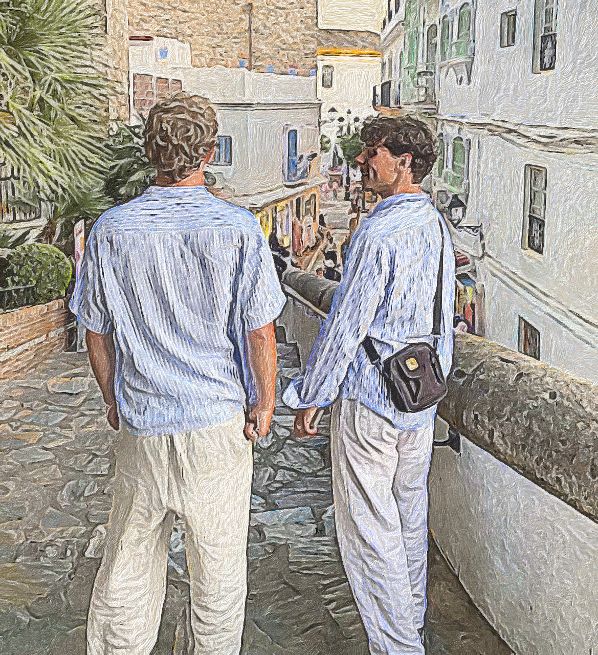
After arriving in Catania, we caught a train to Messina and got off at Taormina–Naxos. From there, we took the bus up into Taormina, where the heavens promptly opened. Inadequately dressed, we wandered through its charming maze of ancient, narrow cobbled alleyways, and along the bustling, elegant—largely pedestrianised—Corso Umberto. We dodged the hundreds of tourists clutching umbrellas, and after the calm of Montescaglioso, I found the crowds slightly overwhelming. Yet it was the smooth, endless stretch of the Mediterranean that held my gaze—and the uneasy thought that Mount Etna lay somewhere close by, hidden in the rainclouds.
It soon became clear that Severin had nowhere to stay. His plan had been to wander the streets of Taormina in search of something cheap. Until his job began—and with it, the promise of a room—the chances of finding affordable accommodation seemed slim. The town may once have existed in a kind of beautiful poverty, but ever since Victorian writers, poets, and artists had discovered it, its fortunes had changed. And soon, the La Dolce Vita Orient Express would be arriving too.
I was staying at a small hotel on Via Don Giovanni Bosco, its balconies overflowing with flowers, and—true to my nature—I offered Severin a bed until he found his footing. At the very least, it meant I wouldn’t be entirely alone as I tried to settle into a strange town.
On never trusting Mount Etna…
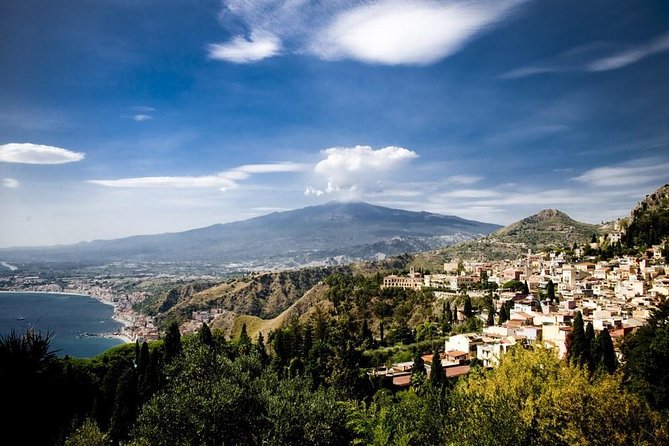
Everybody in Taormina wants you to visit Mount Etna. It is one of the highest volcanoes in Europe, and one of the most active in the world. Alfio, who works on reception at my hotel, suggested that Severin and I take a guided tour. But we both look at Etna and feel quietly relieved by the forty-five kilometres between us and its summit. Never trust an active volcano.
From Taormina, a plume of white smoke drifts from the summit, with no immediate sign of eruption. Yet, according to Alfio, Etna has entered a new eruptive phase that began at Christmas. The crater, he says, is emitting lava, ash, and the occasional flow. He tries to reassure us that Etna poses no real threat to Taormina. Apart from the light dusting of ash that sometimes falls when the wind turns, he tells us to follow the advice of the locals—the Sicilian way is not to worry.
He recalls that, as a small child, he once saw flames suddenly shoot up from the crater, only to subside just as quickly. The same thing happened again the following morning.
Alfio doubts we’ll manage to get up at dawn, but suggests taking us to a hill above the ruined amphitheatre to watch the sunrise. Despite getting to bed at two in the morning, and waking with the lingering effects of strong wine, we let ourselves be dragged through the narrow streets.
The sun rose from the southern edge of Italy and caught the white dome of Etna, tinting it a soft, rose-pink. The colour spread quickly down the snow, deepening until the whole summit glowed like a ruby instead of pale white. Night’s shadows slipped off the slopes, giving way to a rich purple that sank into the valleys and over the orange groves, darkening as it went—until the morning light washed across everything, and the mountains returned to their steady, familiar greens and browns.
That was as near to Mount Etna as I cared to be.
On a poem about Taormina…
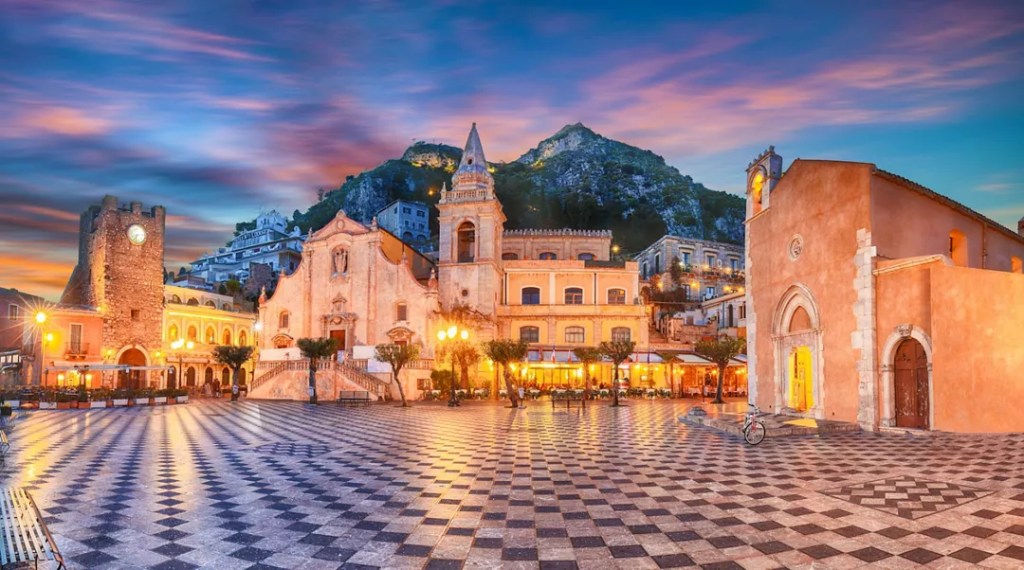
I found a poem about Taormina on All Poetry which was written by someone referred to only as ecekaradag13, and who appears to have a fondness for Italy.
Taormina
Above the Ionian Sea,
this teatro of pretense
where German tourists
photograph Greek ruins
through the lens of their prosperity,
never seeing the Sicilian boys
who sweep their marble steps
for coins that disappear
into foreign pockets.
The ancient theater still echoes
with tragedies more honest
than the comedy performed daily
by boutique owners
selling “authentic” Sicily
to cruise ship pilgrims
seeking enlightenment
at duty-free prices.
Etna smolders in the distance,
that honest mountain
which at least admits
its capacity for destruction,
unlike the hoteliers
who smile in four languages
while their housekeepers
scrub other people’s dreams
from Egyptian cotton sheets.
In the shadow of San Domenico,
where Wilde once walked
his particular exile,
the local boys still gather
at sunset, their beauty
a currency more reliable
than the lira,
their bodies maps
of an economy
the guidebooks never mention.
The bougainvillea blooms
in violent purple protest
against the limestone walls,
while below, the working class
of Giardini-Naxos
send their children
up the mountain
to serve aperitivos
to those who mistake
privilege for culture,
consumption for communion
with the divine.
This is paradise
built on the backs
of the invisible,
where even the gods
have learned to speak
the international language
of tourist euros.
On the cute and willing…