Tag Archives: Queer History

Christian Fox: The Arrogance of Youth

Some of the most beautiful people choose to live the hardest lives

I swear that I once read that there was a home in California for retired gay porn stars from the 1980s and 1990s. The weekly film night looked fun. But I stand to be corrected because I can’t find any evidence of it now.

I once knew a gay porn star. At least, that’s what he called himself. A bit of a fabrication, really. He made one movie and was dropped because of his inability to maintain an erection. The last I heard, he was a shop assistant at Mango Man in Alicante.

A lucky escape, really.

For all of us.

Yes. I’m stuck in a bubble of lube at the moment.

After being star-struck with Joey Stefano (RIP), another challenger surfaces for the ‘I fucked my life up’ award.

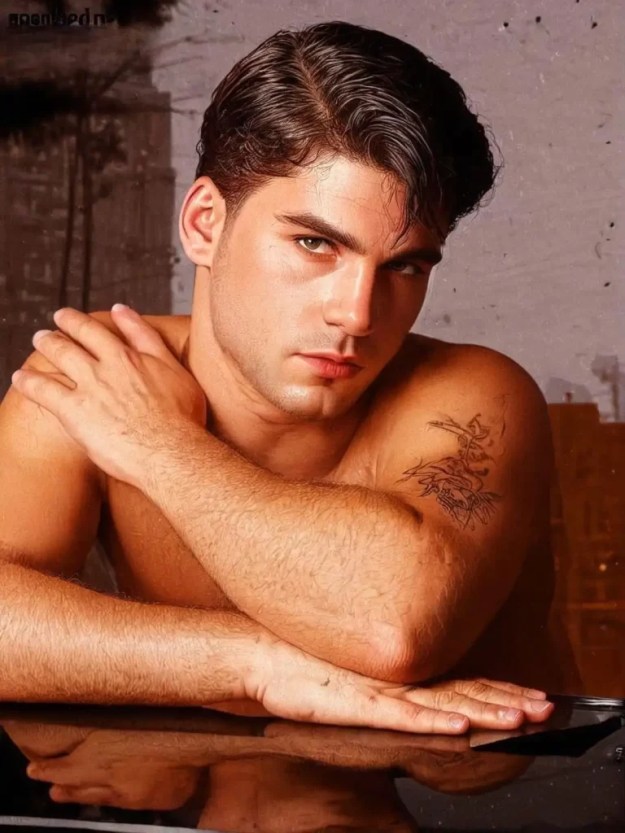
Christian Fox.

By the time you read this, it will be thirty years, almost to the day, since the 22-year-old died from a lethal ketamine overdose at his apartment in New Orleans. His body was discovered three days later. A suicide note was recovered from the scene.

There are a few social media posts that say Fox was ‘a lovely guy’.

But dead guys are always lovely guys.

The same thing happens when a young guy steals a car, evades a police chase and then wraps himself around a tree. Suddenly, he was a ‘lovely lad’.

I don’t know whether Christian Fox—love the name—was a lovely lad or not.

Chi Chi LaRue, patron saint of dead gay porn stars, called him one of the most challenging individuals to work with. He had a reputation for being difficult.

Beyond a shadow of a doubt, I would have liked him.

He ticked every box. And not just because of the athletic physique and ‘honey-blond’ aesthetic.

Born Christopher John McLaughlin in Port Hardy, British Columbia, in 1974, he had an unstable childhood and was placed into foster care at thirteen. He ran away after allegedly being sexually abused and travelled across Canada and the United States using fraudulent identification to conceal his age.

He became an underage dancer at late-night gay venues and adopted the name Christian Fox.

Don’t you admire the spunk of the kid?

He reportedly made his first adult film on his eighteenth birthday and became an exclusive model and actor for Falcon Studios. At the same time, he appeared in gay publications including Manshots, Jock, In Touch and Gay Video Guide.

Like Stefano, he bucked the trend and became known as a ‘premier bottom’ performer.

But Fox developed increasingly serious problems with substance abuse, making him progressively unreliable. By early 1996, his career was effectively over.

Fox had insisted that he would not allow his porn career to become something that wore him down or something of which he would eventually be ashamed.

When his talent agency terminated his contract, the writing was on the wall.

To secure legal residency in the United States, he entered into a marriage of convenience with an American friend and relocated to New Orleans.

But by then, the real problem wasn’t pornography.

It was everything else.

Substance abuse. Depression. Isolation. The inability to imagine what came next.

When Chi Chi LaRue warned him that he might suffer the same fate as Joey Stefano, Fox reportedly replied that he ‘wanted to go’.

LaRue also suggested that Fox was confused about his sexuality.

His neighbours only saw a young man who rode a motorcycle and walked around the French Quarter in a black leather jacket.

Success had come too easily and too young.

Behind the façade was a different world.

Fox was suffering from severe depression.

The porn industry didn’t care if somebody was mentally unstable. And when the cameras stopped rolling, Fox had no obvious way back into the real world.

Shortly before he was due to enter rehab, Fox attempted suicide by throwing himself through a plate-glass window. His injuries prevented him from being admitted.

His wife, Shawn, left him shortly afterwards.

And then, a month later, he was dead.

Twenty-two.

That is the bit I keep coming back to.

Not the body. Not the porn. Not the photographs. Not even the ridiculous mythology that grows around young men who die before they have had the opportunity to become anything else.

Twenty-two.

A whole life still sitting there, unused.

Perhaps that is why I like the idea of the retirement home for old porn stars. I want it to exist.

I want to imagine them at seventy, eighty, sitting around a communal television watching films they made when they were twenty, arguing about who had the best arse, complaining about the heating and asking what happened to everyone else.

Because somebody should get old.

Somebody should get the chance to become boring.

Somebody should survive long enough to look back and think:

Christ. What was I doing?
The Psychologist Says…

I got stuck somewhere between narcissism and the Lego


Somebody will probably be able to correct me, but I cannot find any credible evidence that J. H. Newton was actually a psychologist in the 1940s. Perhaps he was. Perhaps he wasn’t. Perhaps these words came from the pen of a dedicated — albeit rather clever — hack, employed to churn out ‘The Psychologist Says’ every week.

Either way, read on.

What do we mean by the love life of the child? Psychologists usually divide the love-life of a child into three or four stages.

The first stage is known as the auto-erotic stage which appears in infancy. The child is interested in his own body and is exploratory. During this period the child will insert beans and other foreign particles into his nose or ears. During this age the child may also locate the erogenous parts of the body and begin the practice of sexual acts.

Psychologists designate the second period as the narcissistic period, originating from the story of the beautiful youth who fell in love with his own image in a glassy pool. In the very nature of the case the child loves himself first.

The third stage in the child’s love life is known as the homosexual period. It is the gang age of the boy. The boy is more loyal to his gang than his parents. The gang often has more influence over the boy than the home.

Dr. Ruch says from the boys’ club or gang, youth may learn lessons of loyalty, independence, and social-mindedness that may not be distinctly beneficial to the developing boy. Boys’ clubs may need some supervision, but not too much.

Some homosexuals may never recover. If they marry, the outcome is usually very unsatisfactory and unhappy. It is just as important that the homosexuals grow out of this period into the period called the heterosexual stage as it is that the youth learn writing, arithmetic and the rest. Happiness and success in life depends upon it.

The fourth stage of the child’s love-life is commonly called the heterosexual period. It is the period of love between the opposite sexes. It should be encouraged and not discouraged.

The first stage, the auto-erotic period, usually extends to the fifth or sixth year; the stage of childish narcissism, from the sixth to the eleventh year; the homosexual stage extends approximately to sixteenth or seventeenth year; and thereafter the heterosexual period.

From The Paris News, Texas, February 1941.

I might laugh.

Actually, I do laugh.

But it also makes me think.

About being five years old and being taken to hospital after pushing Lego pieces up my bum.

About apparently progressing beautifully through the narcissistic stage, because I was — and remain — completely in love with myself.

About failing to receive the appropriate supervision, thereby discovering that boy gangs were, apparently, incredibly erotic.

And about staying Peter Pan for considerably longer than the good doctor might have considered healthy.

Because, according to this wonderfully alarming piece of 1941 psychology, I should have grown out of all that homosexual gang nonsense and eventually entered the glorious heterosexual period.

I missed the appointment.

Perhaps I was too busy with the Lego.

Joey Stefano Is Dead. Madonna Isn’t

Porn, Madonna, drugs, death – and one red shirt


“At least once a week, I get asked, ‘Whatever happened to that Joey Stefano biopic you were going to do?’

“Every time, I sigh and reply, ‘Still trying to find the financing. Got a million bucks?’

“This for nearly eighteen years.”

Director Chad Darnell wrote those words in 2019.

Things haven’t changed.

It seems that nobody is particularly bothered about Joey Stefano anymore.

Spare me the blushes. It’s unlikely that I’ll be rushing out to find VHS tapes of his work anytime soon.

Joey Stefano — real name Nicholas Anthony Iacona Jr. — was a gay porn actor whose career took off in the 1990s under the guidance of Chi Chi LaRue, the American adult-film director and producer.

I love one particular description of Stefano:

“Stefano was the first bottom to hit big.”

It leaves absolutely nothing to the imagination. And, yes, you’ve guessed correctly.

For a time, Joey — or “Nicky” to those who knew him — was on a high, appearing in more than fifty gay porn films.

High.

Quite literally.

He struggled with drug and alcohol abuse, and in 1994 he died from a drug overdose at a Hollywood motel. The combination was cocaine, morphine, heroin and ketamine.

“His ashen body spread across sweat-soaked sheets.”

There was also the intriguing story of the red shirt he was wearing when he died.

The shirt fascinated Chad Darnell, too. Writing in Queerty, he recalled:

“I was also obsessed with finding the infamous red shirt everyone spoke of in their interviews.”

Nearly eighteen years later, Darnell finally got his hands on it.

“Mike (Skee) called me and said he’d found something he had to show me. He had recently come across a box of Karen Dior’s clothing and each of the pieces had little notes pinned inside them. Dresses. Shirts. Jeans.

“He pulled out a red poplin shirt with a note that read: ‘Nicky died in this’.

“I still have no explanation as to why I felt the need to find this shirt for nearly eighteen years, but here it was. I felt like I had finally caught this ghost I had been chasing for nearly two decades.”

We can all be macabre sometimes.

But Joey Stefano had another claim to fame — and this one took him well beyond the world of gay porn.

Madonna chose Stefano to appear as a featured model in her bestselling and highly controversial coffee-table book, Sex, released in October 1992.

She had noticed him through his growing notoriety and his work as an erotic dancer at New York City’s Gaiety Theatre in the late 1980s and early 1990s. Following the book shoot, Stefano also made a cameo appearance in the music video for Madonna’s single Deeper and Deeper.

The collaboration fitted neatly into Madonna’s wider exploration of transgressive sexuality, underground art and marginalised queer subcultures during her Erotica era.

And then Stefano died.

His death didn’t exactly set the newspapers alight, but I stumbled across an old article in Britain’s Sunday Mirror.

It is fascinating — although perhaps more for its inaccuracies than its accuracy.

“A former boyfriend of Madonna took a chilling secret to the grave — he was HIV positive.”

The article described Stefano as Madonna’s former boyfriend and claimed that he was a 26-year-old bisexual who had been paid just £100 to pose naked with other men in what appeared to be an orgy.

It claimed that, on his deathbed, Stefano had told a friend that Madonna had turned her back on him because he was a junkie. It also claimed that he knew he was HIV positive but had never told Madonna.

According to the article, the two had met after Madonna saw Stefano dancing at a New York theatre. She stayed for two shows, tucked twenty-dollar bills into his G-string and told a friend he was “gorgeous”.

There is, however, a problem.

As far as I can establish, Stefano was never Madonna’s boyfriend. Nor was there, as far as I can establish, any official diagnosis of HIV.

That doesn’t necessarily mean the entire story was invented. It is entirely possible that Madonna distanced herself from Stefano as his drug problems became more severe.

Film editor Mickey Skee certainly believed Stefano had been abandoned by the people who once surrounded him.

“He was abandoned by the rich and famous who once swarmed around him,” Skee said. “And he bad-mouthed Madonna. She had promised to come and see him and help get him jobs. She never did.”

And that, perhaps, is the part of the story that interests me most.

Not the porn.

Not the red shirt.

Not even the Madonna connection.

It’s the strange little gap between the man Joey Stefano became and the people who had briefly found him fascinating.

He was famous enough to be photographed for Sex, famous enough to appear in a Madonna video, famous enough to inspire a biopic that someone spent eighteen years trying to finance.

And yet, when he died, the story almost disappeared.

So I would like to have a word with Madonna.

I have a few questions.

The Hall Mirror (Ο καθρέπτης στην είσοδο)


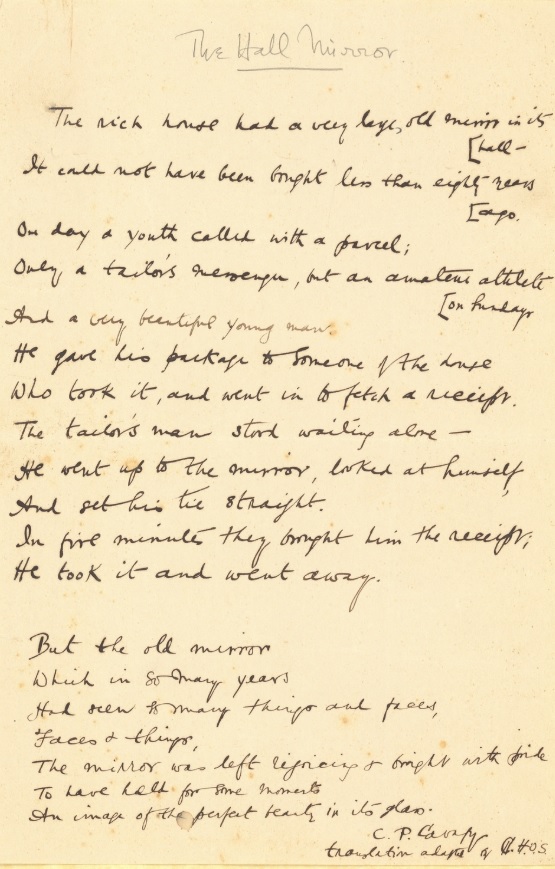
The Hall Mirror

The rich house had a very large, old mirror in its hall.
It could have been bought not less than eighty years ago.
One day a youth called with a parcel;
Only a tailor’s messenger, but an amateur athlete on Sundays
And a very beautiful young man.
He gave his package to someone of the house,
Who took it and went in to fetch a receipt.
The tailor’s man stood waiting alone –
He walked up to the mirror, looked at himself and set his tie straight.
In five minutes they brought him the receipt;
He took it and went away.

But the old mirror
Which in so many years
Had seen so many thousands of things and faces,
The mirror was left rejoicing
And proud to have had hold for some moments
An image of the perfect beauty in its glass.

Translated from Greek by C.H.O. Scaife in collaboration with Constantine P. Cavafy.
Originally published in The Spectator on September 27, 1935.

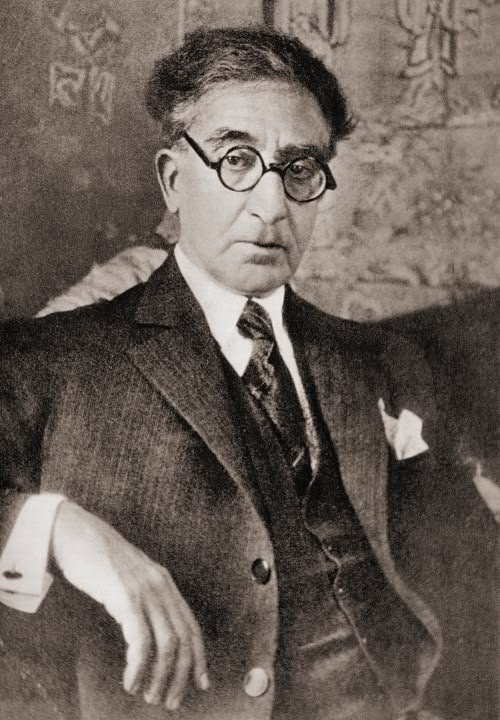
Constantine P. Cavafy (1863–1933) was an extraordinarily influential Egyptian-Greek poet widely considered the most distinguished voice of modern Greek literature and a towering figure of 20th-century Western poetry. Born and based mostly in the cosmopolitan hub of Alexandria, Egypt, his work uniquely blended historical realism, profound skepticism, and deeply personal, intimate expressions of homosexual desire. He spent over thirty years working as a quiet clerk in the Irrigation Service of the Egyptian Ministry of Public Works while writing poetry in his spare hours

C.P. Cavafy

Charles-Henri Ford: A Very Good Looking Penis


The first time I saw Charles-Henri Ford I was immediately drawn to his penis.

I am rather proud of that opening line.

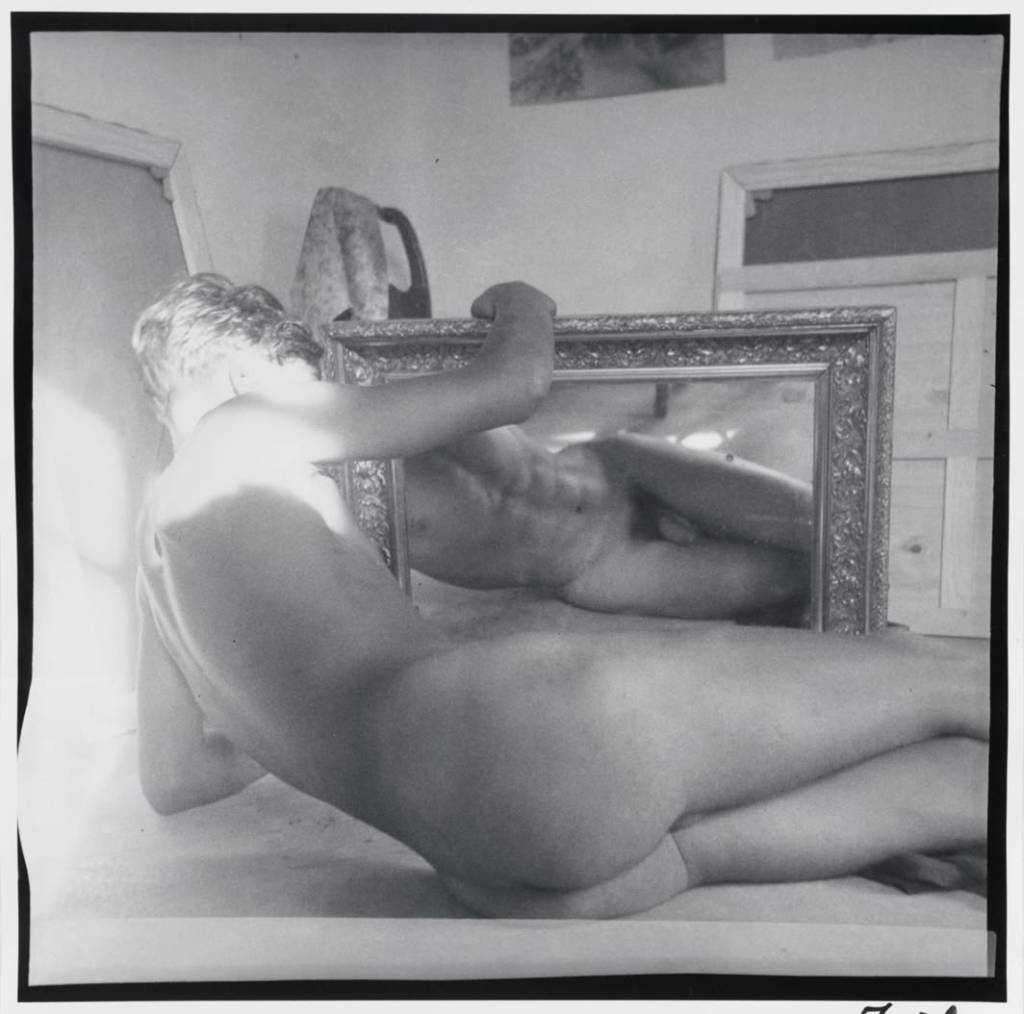
I am referring to Self-Portrait with Mirror, a nude photograph from 1937 in which Ford’s reflection appears in a gilded looking glass. Naked and reclining, he poses in a manner that recalls Velázquez’s Rokeby Venus. That was how I came to notice his penis.

Ford died in 2002, aged ninety-four, by which time that particular penis would presumably have been rather less impressive: shrivelled, fairly useless and probably best left alone.

I have since discovered a great deal about Charles-Henri Ford, including the fact that he was, as a young man, incredibly good-looking.

He also appears to have been blessed with a rather formidable sense of his own destiny. As a teenager, Ford claimed to have had a vision that he would become famous, inspired by Marie Bashkirtseff, the Russian writer and artist who had apparently declared that she would become famous within a year — and did.

“When I read that,” Ford recalled, “I said to myself, Well, if she can do it, I can do it!”

He did.

Ford became a surrealist poet, magazine editor, filmmaker, photographer, collage artist and co-author of what has been described as one of the first openly gay American novels. He was part of Gertrude Stein’s circle in Paris during the 1930s and, three decades later, became an important influence on Andy Warhol.

He had his first poem accepted by The New Yorker and eventually published sixteen books of poetry. In 1933, he co-wrote with Parker Tyler The Young and Evil, a novel based on their adventures in the high-camp homosexual underworld of Greenwich Village.

Edith Sitwell thought very little of it. She described the book as “entirely without soul, like a dead fish stinking in hell” and threw it into her fireplace.

That seems a little harsh, even by the standards of Edith Sitwell.

The book was published in Paris but banned in Britain and America until the 1960s, although smuggled copies circulated through bohemian circles.


In America, Ford was perhaps best known as the editor of two influential magazines.

In 1929, he launched Blues: A Magazine of New Rhythms, an experimental poetry magazine whose subtitle was A Bi-Sexual Bi-Monthly. It lasted only a handful of issues. A decade later came View, a glossy vehicle for the surrealists, particularly the group surrounding André Breton.

Its pages featured young artists and writers alongside established figures: Allen Ginsberg, Pablo Picasso, Henry Miller, Paul Klee, Lawrence Durrell, Georgia O’Keeffe, Joan Miró, Alexander Calder, Marc Chagall and René Magritte. View published the first English translations of Albert Camus and Jean Genet, as well as the first monograph devoted to Marcel Duchamp.

Ford was not, however, entirely reliable when it came to his own biography.

He claimed to have been born in 1913. In fact, he was born in 1908, in Mississippi, in one of his family’s hotels. He later altered the spelling of his middle name because he was tired of being asked whether he was related to Henry Ford.

His family owned a chain of hotels across the southern states, and much of Ford’s childhood was spent moving from one to another with his parents and younger sister, the actress Ruth Ford.

He was sent to a succession of Roman Catholic boarding schools, from most of which he claimed to have been expelled. His editorial career began there. He produced The Brass Monkey, a typewritten gossip sheet with the twin objectives of entertaining his fellow pupils and scandalising the school authorities.

It was, in retrospect, excellent preparation.

Ford moved to Paris in search of a publisher for The Young and Evil, which American publishers had rejected. “Life is short and the jails are uncomfortable,” one apparently explained.

Paris, meanwhile, was offering precisely the sort of life Ford wanted.

“Everything was exciting at the time because you could live on practically nothing and you could meet everyone. They would gather at different cafes: the queers at Le Select, the Surrealists at Les Deux Magots. It was a life that nobody knew in New York.”

Ford travelled to Tangier with his new lover, the exotic and beautiful Djuna Barnes, whose cult novel Nightwood he helped to type.

The romance, like much in Ford’s life, did not last.

The pair returned to Paris after discovering that rats had eaten their clothes.

Back in Paris, Ford abandoned Barnes and embarked on a passionate affair with the Russian artist Pavel Tchelitchew. The relationship contributed to his break with Gertrude Stein, who disliked Tchelitchew after Edith Sitwell had fallen in love with him.

Unfortunately for Sitwell, Tchelitchew did not return her feelings.

Ford and Tchelitchew made no particular effort to conceal their relationship, which merely rubbed salt into Sitwell’s wounds. Years later, the writer Philip Hoare described the pair as a “mercurial” couple. Tchelitchew once complained to Ford, “You’re eating me!” They regarded themselves as “two mad monks” and conducted their affairs with such flamboyant publicity that when Cecil Beaton encountered them in Spain in 1934, their constant altercations apparently drove him to distraction.

Ford eventually returned to New York with Tchelitchew, before going back to Europe and embarking on a new career as a photographer and artist.

His turbulent relationship with Tchelitchew finally ended with the artist’s death in Rome in 1957.

Five years later, Ford returned to America.

He was soon taken up by a new generation of artists, among them Andy Warhol. From the mid-1960s, Ford began producing what he called his Prose Poems: large, colourful collages combining poetry, painting and the visual language of pop art.

He also directed Johnny Minotaur in 1972, a film featuring Allen Ginsberg.

Ford was now an extraordinary survivor from another artistic age, but he continued to reinvent himself.

During the final decade of his life, his companion was Indra Tamang, a Nepalese artist whom Ford had met in Kathmandu.

Philip Hoare later visited Ford in his apartment and found an elegant, slightly fragile survivor of the world he had inhabited so vividly.

Hoare wrote, Ford was “vital but almost painfully thin”, with thick silver hair and immensely graceful hands. He entertained his guests to tea, served by his Nepalese companion, and told stories in a soft Southern drawl, full of self-amusement and a certain modesty.

And so the man whose penis had first caught my attention became, gradually, rather more interesting than his penis.

Although, obviously, it was a very good-looking penis.