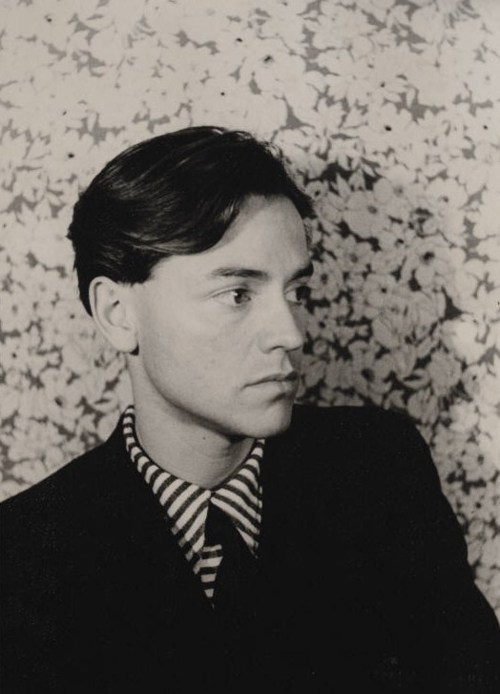
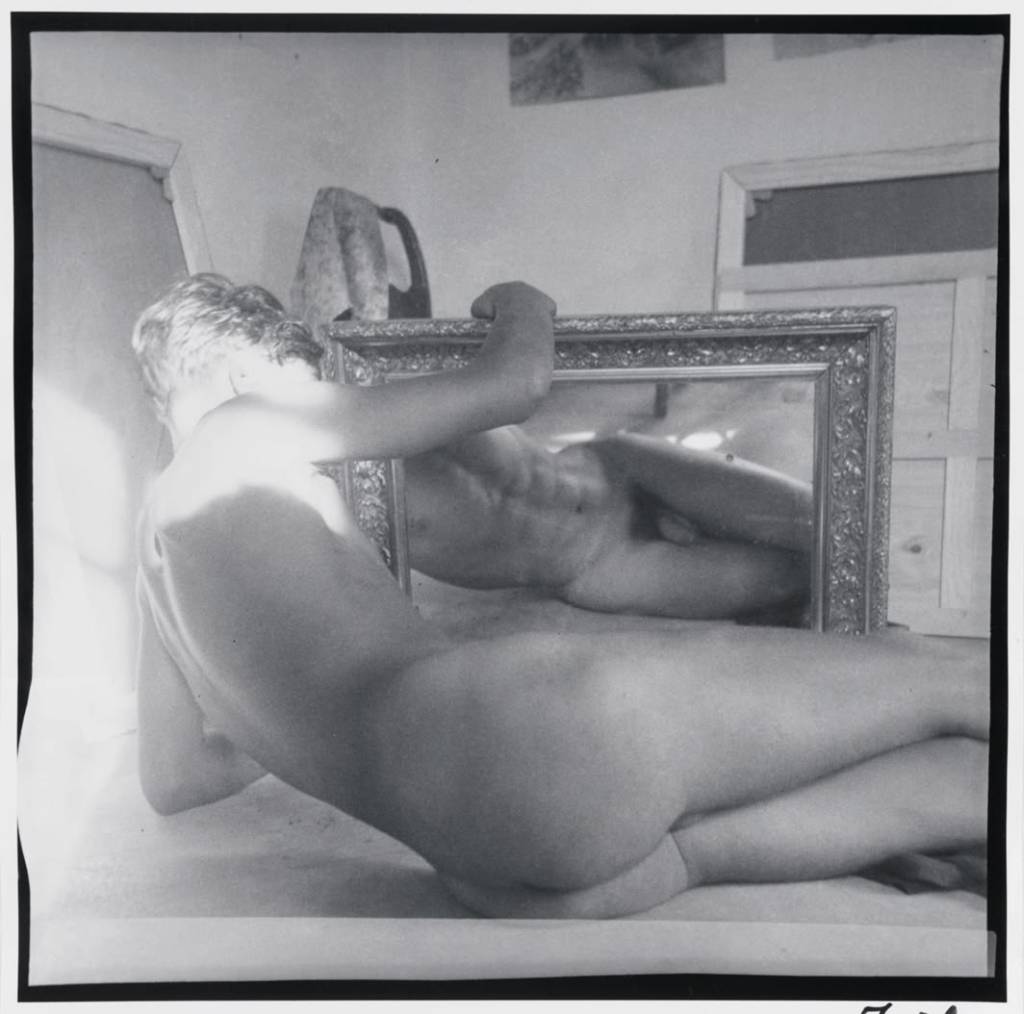
The first time I saw Charles-Henri Ford I was immediately drawn to his penis.
I am rather proud of that opening line.
I am referring to Self-Portrait with Mirror, a nude photograph from 1937 in which Ford’s reflection appears in a gilded looking glass. Naked and reclining, he poses in a manner that recalls Velázquez’s Rokeby Venus. That was how I came to notice his penis.
Ford died in 2002, aged ninety-four, by which time that particular penis would presumably have been rather less impressive: shrivelled, fairly useless and probably best left alone.
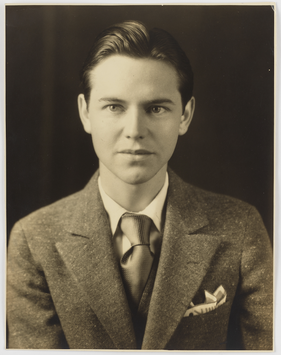
I have since discovered a great deal about Charles-Henri Ford, including the fact that he was, as a young man, incredibly good-looking.
He also appears to have been blessed with a rather formidable sense of his own destiny. As a teenager, Ford claimed to have had a vision that he would become famous, inspired by Marie Bashkirtseff, the Russian writer and artist who had apparently declared that she would become famous within a year — and did.
“When I read that,” Ford recalled, “I said to myself, Well, if she can do it, I can do it!”
He did.
Ford became a surrealist poet, magazine editor, filmmaker, photographer, collage artist and co-author of what has been described as one of the first openly gay American novels. He was part of Gertrude Stein’s circle in Paris during the 1930s and, three decades later, became an important influence on Andy Warhol.
He had his first poem accepted by The New Yorker and eventually published sixteen books of poetry. In 1933, he co-wrote with Parker Tyler The Young and Evil, a novel based on their adventures in the high-camp homosexual underworld of Greenwich Village.
Edith Sitwell thought very little of it. She described the book as “entirely without soul, like a dead fish stinking in hell” and threw it into her fireplace.
That seems a little harsh, even by the standards of Edith Sitwell.
The book was published in Paris but banned in Britain and America until the 1960s, although smuggled copies circulated through bohemian circles.
In America, Ford was perhaps best known as the editor of two influential magazines.
In 1929, he launched Blues: A Magazine of New Rhythms, an experimental poetry magazine whose subtitle was A Bi-Sexual Bi-Monthly. It lasted only a handful of issues. A decade later came View, a glossy vehicle for the surrealists, particularly the group surrounding André Breton.
Its pages featured young artists and writers alongside established figures: Allen Ginsberg, Pablo Picasso, Henry Miller, Paul Klee, Lawrence Durrell, Georgia O’Keeffe, Joan Miró, Alexander Calder, Marc Chagall and René Magritte. View published the first English translations of Albert Camus and Jean Genet, as well as the first monograph devoted to Marcel Duchamp.
Ford was not, however, entirely reliable when it came to his own biography.
He claimed to have been born in 1913. In fact, he was born in 1908, in Mississippi, in one of his family’s hotels. He later altered the spelling of his middle name because he was tired of being asked whether he was related to Henry Ford.
His family owned a chain of hotels across the southern states, and much of Ford’s childhood was spent moving from one to another with his parents and younger sister, the actress Ruth Ford.
He was sent to a succession of Roman Catholic boarding schools, from most of which he claimed to have been expelled. His editorial career began there. He produced The Brass Monkey, a typewritten gossip sheet with the twin objectives of entertaining his fellow pupils and scandalising the school authorities.
It was, in retrospect, excellent preparation.
Ford moved to Paris in search of a publisher for The Young and Evil, which American publishers had rejected. “Life is short and the jails are uncomfortable,” one apparently explained.
Paris, meanwhile, was offering precisely the sort of life Ford wanted.
“Everything was exciting at the time because you could live on practically nothing and you could meet everyone. They would gather at different cafes: the queers at Le Select, the Surrealists at Les Deux Magots. It was a life that nobody knew in New York.”
Ford travelled to Tangier with his new lover, the exotic and beautiful Djuna Barnes, whose cult novel Nightwood he helped to type.
The romance, like much in Ford’s life, did not last.
The pair returned to Paris after discovering that rats had eaten their clothes.
Back in Paris, Ford abandoned Barnes and embarked on a passionate affair with the Russian artist Pavel Tchelitchew. The relationship contributed to his break with Gertrude Stein, who disliked Tchelitchew after Edith Sitwell had fallen in love with him.
Unfortunately for Sitwell, Tchelitchew did not return her feelings.
Ford and Tchelitchew made no particular effort to conceal their relationship, which merely rubbed salt into Sitwell’s wounds. Years later, the writer Philip Hoare described the pair as a “mercurial” couple. Tchelitchew once complained to Ford, “You’re eating me!” They regarded themselves as “two mad monks” and conducted their affairs with such flamboyant publicity that when Cecil Beaton encountered them in Spain in 1934, their constant altercations apparently drove him to distraction.
Ford eventually returned to New York with Tchelitchew, before going back to Europe and embarking on a new career as a photographer and artist.
His turbulent relationship with Tchelitchew finally ended with the artist’s death in Rome in 1957.
Five years later, Ford returned to America.
He was soon taken up by a new generation of artists, among them Andy Warhol. From the mid-1960s, Ford began producing what he called his Prose Poems: large, colourful collages combining poetry, painting and the visual language of pop art.
He also directed Johnny Minotaur in 1972, a film featuring Allen Ginsberg.
Ford was now an extraordinary survivor from another artistic age, but he continued to reinvent himself.
During the final decade of his life, his companion was Indra Tamang, a Nepalese artist whom Ford had met in Kathmandu.
Philip Hoare later visited Ford in his apartment and found an elegant, slightly fragile survivor of the world he had inhabited so vividly.
Hoare wrote, Ford was “vital but almost painfully thin”, with thick silver hair and immensely graceful hands. He entertained his guests to tea, served by his Nepalese companion, and told stories in a soft Southern drawl, full of self-amusement and a certain modesty.
And so the man whose penis had first caught my attention became, gradually, rather more interesting than his penis.
Although, obviously, it was a very good-looking penis.