
Tag Archives: music

Everybody Was Mad About the Boy

How a Noël Coward song survived almost a century—through secret longing, a television commercial, and one unforgettable face whose name has been lost.

A young man, still in his teens, was arranging T-shirts inside a clothes shop on Corso Porta Borsari in Verona. He straightened the rails, turned every hanger so it faced the same direction, then stood back to admire his handiwork.

As he worked, he hummed.

The tune was unmistakable.

Not because it is often heard these days, but because it belongs to another age entirely. Hearing it drift across a fashionable shop on a warm Italian afternoon was quietly disarming. It also hinted, perhaps, at something about the young man himself.

The song was Mad About the Boy.

Nearly a century has passed since Noël Coward wrote it, yet it continues to surface in the most unexpected places. It has survived changing fashions, changing attitudes and changing audiences, acquiring new meanings with each generation that rediscovers it.

For many people, that rediscovery came in 1992.

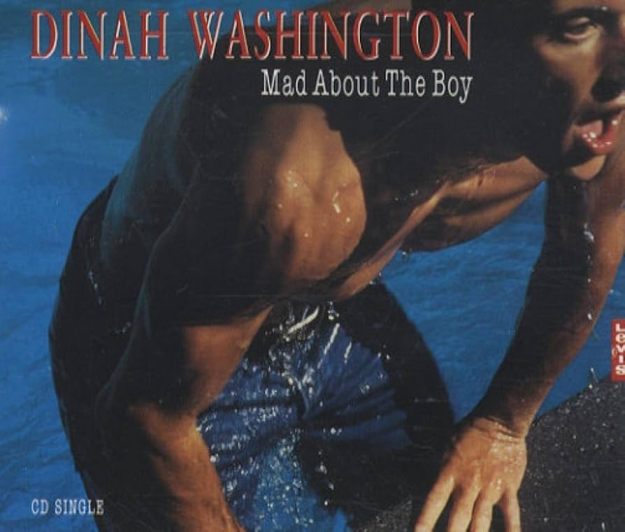
A memorable television advertisement for Levi jeans, directed by Tarsem Singh and inspired by the 1968 Burt Lancaster film The Swimmer, followed a striking young man as he dived from one suburban swimming pool to another. Each dive seemed to carry him into a different decade. There were immaculate post-war families tending barbecues, cocktail parties beneath tiki umbrellas and elegant suburban gardens that belonged to another America altogether. Time became as fluid as water.

Only at the final pool did he stop. A young woman joined him on the diving board before they disappeared together into an Olympic-sized pool.

Playing throughout was Dinah Washington’s recording of Mad About the Boy.

The commercial introduced millions of viewers to a song that was already sixty years old. It also transformed Washington’s 1961 recording into the definitive version, entering the British charts more than thirty years after she had recorded it with Quincy Jones.

Yet the young man who captivated millions simply disappeared from public memory. There’s something rather poignant about that. It echoes the song itself—everyone was “mad about the boy,” yet nobody seems to know who he was. 

The song itself had always been more intriguing than most people realised.

When Coward wrote Mad About the Boy for his 1932 revue Words and Music, it appeared to be a witty lament sung by four very different women—a society hostess, a schoolgirl, a maid and a prostitute—all hopelessly infatuated with the same film star. It quickly became the show’s sensation.

Beneath its polished wit, however, lay something more complicated.

The lyrics speak of embarrassment, secrecy and sleepless nights. They even refer to the boy’s “gay appeal”, a phrase that meant something rather different in 1932, yet has acquired an unmistakable resonance with the passing of time. Long before homosexuality could be openly discussed, the song had become one that many queer listeners instinctively recognised as their own—not because Coward ever declared it so, but because the emotions it expressed were painfully familiar.

Coward himself only deepened the ambiguity.

After the London opening of Words and Music, he entertained Joan Crawford and Douglas Fairbanks Jr., the actor often said to have inspired the song. Fairbanks later laughed off the suggestion.

“I always thought it was Gary Cooper.”

Whether the boy existed at all would remain one of the song’s enduring mysteries.

When Words and Music was revived in New York eight years later under the title Set to Music, Coward wrote an additional verse. This time the singer was not a woman but a respectable businessman whose increasingly desperate attempts to explain his fascination with another man became both comic and surprisingly daring.

It proved too daring.

The verse was cut before audiences ever heard it.

Mad about the boy,
I know it’s silly but I’m mad about the boy,
And even Doctor Freud cannot explain
Those vexing dreams
I’ve had about the boy.
When I told my wife,
She said:
” I’ve never heard such nonsense in my life! “
Her lack of sympathy
Embarrassed me
And made me frankly glad about the boy.
My doctor can’t advise me,
He’d help me if he could;
Three times he’s tried to psychoanalyze me,
But it’s just no good.
People I employ
Have the impertinence
To call me Myrna Loy.
I rise above it,
Frankly love it,
‘Cos I’m absolutely
MAD ABOUT THE BOY!

That Moment: A good rave, on a good night

Surrender – Charlie Marseilles

The music starts, and it feels like heat rising under my skin. I move without thinking — a slow, trembling rhythm that begins in my ribs and spills outward. My shirt clings, half open, heavy with sweat. Each breath feels like it’s carving light through me, and I let it. There’s no audience, just the sound of air, the pulse of my own heartbeat echoing through the floor.

The world shrinks to the movement of my spine, the slip of fabric, the catch of breath. My body feels thin, electric, fragile — like something lit from within. I close my eyes and lean into the rhythm until it blurs the edges of everything. There’s a strange kind of pleasure in it: the way exhaustion burns into something tender, almost holy. I don’t know if I’m dancing or dissolving.

When the music fades, I’m still trembling. The air is warm against my skin, every breath thick and slow. I can taste salt on my lips. For a moment, I stay there — suspended in the quiet — before the world comes back into focus. My body is mine again, but it feels changed, like it’s remembered something it shouldn’t have.

Both sides untouched. Not for listening. Display only

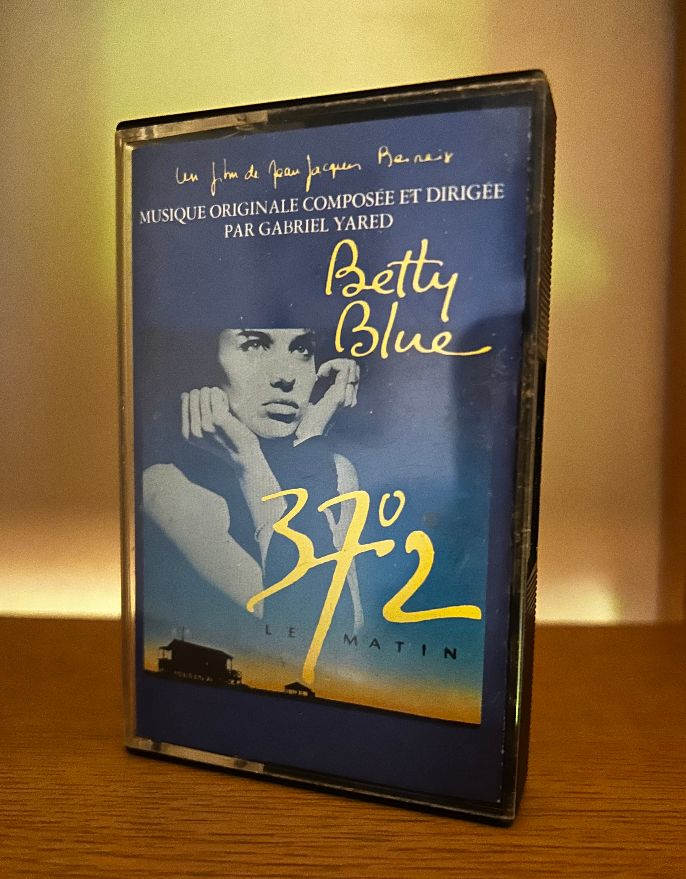
Betty Blue – 37°2 le matin – Gabriel Yared (1986)

A second-hand record store. Old French chansons played over the speakers. “Très bien,” Charlie beamed, because it made him feel at home. But this wasn’t France, it was an English suburb on a quiet Saturday afternoon. I Shazamed a song on my phone. It was Jeanne Moreau singing Les Voyages. 

Charlie rummaged through a cardboard box of old cassette tapes and I pointed out that had he found something interesting, then he wouldn’t be able to listen to it, because we didn’t have anything to play it on. 

And besides, I told him, I was surprised that he even knew what they were because they were obsolete before he’d been born. “That is not the point,” said the Millennium Child. “I have a good reason for looking.”

At last, he found something that pleased him. “This is what I want,” and he held up the soundtrack album to Betty Blue, or 37°2 le matin, if we want to give it the proper title. (I later discovered that it was released in 1986).

“But how are you going to play it?”

“I am not going to listen to it. If I wanted to do that I would listen to the music on Spotify. I have something else in mind.” With that, he borrowed a pound coin with which to buy it. 

The apartment. The office (which used to be Levi’s bedroom). The cassette tape is stood upright on a shelf alongside vintage postcards, pebbles and shells collected from beaches, and a wooden model of the Arc de Triomphe. “It is simply for show,” said Charlie.

Boys, Brass and Billie


He was once a boy who listened to punk rock. Sex Pistols. The Clash. The Damned. That was almost fifty years ago. Back then, if he’d rolled back half a century from the seventies, then he would have landed in the 1930s with a big war to come. Benny Goodman. Glenn Miller. Duke Ellington. The music was as far removed as he could ever have imagined. It brings us to now. The kids of 2025. Billie Eilish. Drake. Taylor Swift. His punk rock is as strange to them as the 1930s were to him.

Where strangers take you by the hand, and welcome you to wonderland


A fat girl in a prom dress sings Club Tropicana on karaoke. She has quite a good voice but looks like an elephant dressed as a ballerina. I think of an oversized Miss Haversham with an unhealthy obsession for Wham.

Stolen Words / I tell you in music the diary of my life between truth and regrets

Image: GionnyScandal, Italian rapper (Vito Delaurentis)

“I don’t like labels. I simply feel like a boy who needs to express himself in the ways and times he feels. Sometimes with a song, sometimes with a book. The label limits you, forces you into a defined space. I want to stay free. Maybe, if I really have to, I would call myself an artist. Period.” – GionnyScandal

*****

“When Gionata opens his eyes, he sees only a bright white tube hanging from the ceiling. He needs a few seconds to focus on everything else – the hospital room, the IV in his arm – to understand why he is there and to realise that he is still alive. Gionata’s story, aka GionnyScandal, starts from here, from the decision to put an end to his pain once and for all, from the extreme and dramatic gesture made when everything seems to have lost meaning and direction. But it also starts from the rush of a friend to save him, from the affection of those around him, from the desire to live that returns to inhabit his thoughts after the drama; from the need to deal with one’s past to move forward and face the future. And so, once out of the hospital, he decides to go through the darkness to understand the origin of his suffering. To do so, he will have to face the ghosts of the past – the death of his adoptive parents, the disappearance of his beloved grandmother – and track down his biological parents who he never knew anything about. And in this journey he will learn to really know himself, perhaps to make peace with his story. To once again put hope and beauty at the centre of his world and his music.”

A cream-filled, drug-hazed memory of a nineties Saturday night

Image: Archer Iñíguez

Saturday slaughter. Pumped up courage. Vodka fuelled Valkyries. Vanilla Valentines. Red Hot Chilli Poppers. Up and down. Cock teasers. Blonde bullshitters. Fag filled fags. Sweaty sex toys. Blue Adonis in Disco Cop. Twink paradise. Twink hell . Be damned by Twinkdom. Boys to men. Romeo, Romeo, Where the fuck are you Romeo? Smooth skinned sluts. Spray tan twiglets. Ba lamb babies. If you could read my mind, love. What a tale my thoughts could tell. Just like an old time movie. A movie that plays every Saturday. The boy shouts louder and louder. What’s he gonna look like with a chimney on him? Up and Down. An ecstasy-stained erotic dream. Screaming queens and disco lights. Screaming queens and fist fights. Shy guys and sly guys. Sugar daddies and fairy cakes. I need you. I want you. I can’t have you. No matter how hard I try, you keep pushing me aside, and I can’t break through. Listen to me. I can’t see through the smoke. There’s no talking to you. The Vengabus is coming. And everybody’s jumping. But you’re not coming. Do you believe in life after love? I can feel something inside me say, I really don’t think you’re strong enough. Robin Hood and his band of boyfriend thieves. Cry babies. Jelly babies. Dolly mixtures. Sun up. Slow down. Come down. Vamos a jugar en el sol. Todos los días son días de fiesta. Vamos a jugar en el sol. Todos los días son días de fiesta. Sex in a Ford Fiesta. Sexy, everything about you so sexy. 

That Moment / Jeff Buckley climbed into bed beside me

Last night, Jeff Buckley visited while I slept and he climbed into bed beside me. I told him that he was dead, and he whispered gently into my ear. “That’s for the best. If I was alive I’d be 57-years-old and you might not like me anymore.”