
How a Noël Coward song survived almost a century—through secret longing, a television commercial, and one unforgettable face whose name has been lost.
A young man, still in his teens, was arranging T-shirts inside a clothes shop on Corso Porta Borsari in Verona. He straightened the rails, turned every hanger so it faced the same direction, then stood back to admire his handiwork.
As he worked, he hummed.
The tune was unmistakable.
Not because it is often heard these days, but because it belongs to another age entirely. Hearing it drift across a fashionable shop on a warm Italian afternoon was quietly disarming. It also hinted, perhaps, at something about the young man himself.
The song was Mad About the Boy.
Nearly a century has passed since Noël Coward wrote it, yet it continues to surface in the most unexpected places. It has survived changing fashions, changing attitudes and changing audiences, acquiring new meanings with each generation that rediscovers it.
For many people, that rediscovery came in 1992.
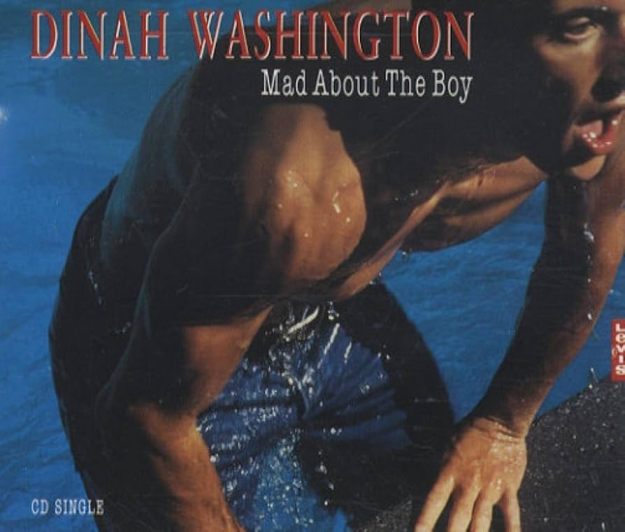
A memorable television advertisement for Levi jeans, directed by Tarsem Singh and inspired by the 1968 Burt Lancaster film The Swimmer, followed a striking young man as he dived from one suburban swimming pool to another. Each dive seemed to carry him into a different decade. There were immaculate post-war families tending barbecues, cocktail parties beneath tiki umbrellas and elegant suburban gardens that belonged to another America altogether. Time became as fluid as water.
Only at the final pool did he stop. A young woman joined him on the diving board before they disappeared together into an Olympic-sized pool.
Playing throughout was Dinah Washington’s recording of Mad About the Boy.
The commercial introduced millions of viewers to a song that was already sixty years old. It also transformed Washington’s 1961 recording into the definitive version, entering the British charts more than thirty years after she had recorded it with Quincy Jones.
Yet the young man who captivated millions simply disappeared from public memory. There’s something rather poignant about that. It echoes the song itself—everyone was “mad about the boy,” yet nobody seems to know who he was.
The song itself had always been more intriguing than most people realised.
When Coward wrote Mad About the Boy for his 1932 revue Words and Music, it appeared to be a witty lament sung by four very different women—a society hostess, a schoolgirl, a maid and a prostitute—all hopelessly infatuated with the same film star. It quickly became the show’s sensation.
Beneath its polished wit, however, lay something more complicated.
The lyrics speak of embarrassment, secrecy and sleepless nights. They even refer to the boy’s “gay appeal”, a phrase that meant something rather different in 1932, yet has acquired an unmistakable resonance with the passing of time. Long before homosexuality could be openly discussed, the song had become one that many queer listeners instinctively recognised as their own—not because Coward ever declared it so, but because the emotions it expressed were painfully familiar.
Coward himself only deepened the ambiguity.
After the London opening of Words and Music, he entertained Joan Crawford and Douglas Fairbanks Jr., the actor often said to have inspired the song. Fairbanks later laughed off the suggestion.
“I always thought it was Gary Cooper.”
Whether the boy existed at all would remain one of the song’s enduring mysteries.
When Words and Music was revived in New York eight years later under the title Set to Music, Coward wrote an additional verse. This time the singer was not a woman but a respectable businessman whose increasingly desperate attempts to explain his fascination with another man became both comic and surprisingly daring.
It proved too daring.
The verse was cut before audiences ever heard it.
Mad about the boy,
I know it’s silly but I’m mad about the boy,
And even Doctor Freud cannot explain
Those vexing dreams
I’ve had about the boy.
When I told my wife,
She said:
” I’ve never heard such nonsense in my life! “
Her lack of sympathy
Embarrassed me
And made me frankly glad about the boy.
My doctor can’t advise me,
He’d help me if he could;
Three times he’s tried to psychoanalyze me,
But it’s just no good.
People I employ
Have the impertinence
To call me Myrna Loy.
I rise above it,
Frankly love it,
‘Cos I’m absolutely
MAD ABOUT THE BOY!

