I confess—I didn’t notice the rabbits at first. But there was something in the photograph that drew me in. It was taken by Izis Bidermanas, the Jewish-Lithuanian photographer, in Whitechapel, London, in 1951.
It’s quite possible that the boy in the image is still alive, but the rabbits, of course, are not.
Bidermanas worked primarily in France and is best remembered for his photographs of French circuses, Parisian streets, and commissions for the iconic Paris Match magazine. He befriended Jacques Prévert, the French poet and screenwriter; both were described as “urban wanderers.” A year after this photograph was taken, they published Charmes de Londres, a book of black-and-white photographs of post-war London by Bidermanas, accompanied by Prévert’s poetic texts—a vivid portrait of the “shabby old capital in its threadbare post-war years.”
There is something both tender and prematurely adult about this image. A loosely tied scarf, a jacket slightly too big. His style seems effortless—almost cool—as if he had stepped out of his own decade and into ours.
He is someone out of sync with his time. The kind of boy you might spot today on the Underground platform, earbuds in, oversized coat slung over his shoulders. Certain types of youth are universal—postures, anxieties, and dreams that repeat across generations. It makes you want to know his story.
There is an angularity to his posture, an aloof tilt of the head. He strokes the rabbit but does not quite look at it. Tenderness in his hands, hardness in his shoulders. Quiet care, resilience, an emotional inheritance that compels him to protect something gentle, even if he has rarely known gentleness himself.
He seems too sharp, too perceptive for the smallness around him—working here because life left him no choice, waiting for the real story to begin. The rabbits were merely a way to earn a few coins.
What if he was drawn to things outside society’s expectations? Art, books, music—worlds not meant for boys like him. Perhaps he dreamed of Soho jazz clubs, photography, fashion—things his home would never have approved of.
He was a boy caught between worlds: childhood and adulthood, duty and desire, the past and the future. A timeless boy, carrying secret longings.
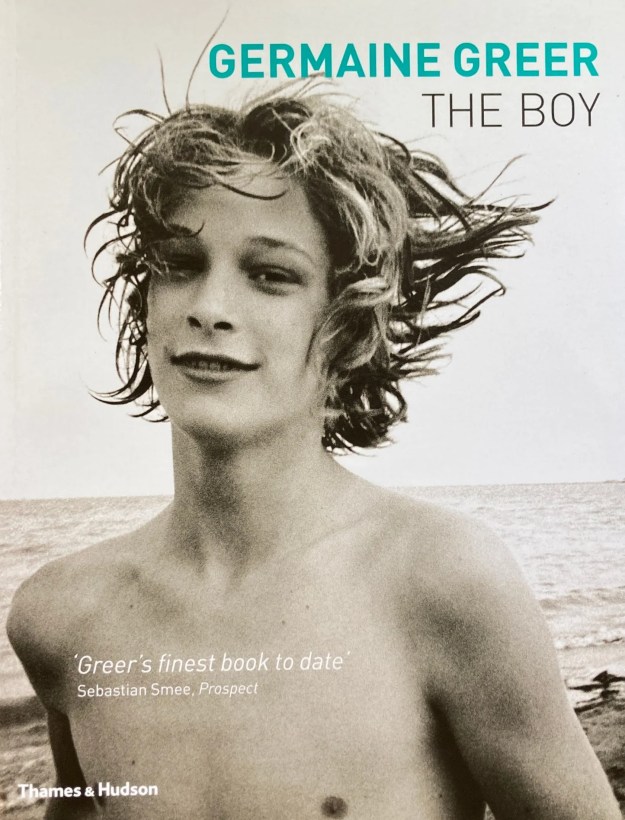
Germaine Greer – The Boy. Published by Thames & Hudson (2007)
Baron Corvo once told me in a dream that I should write something controversial. Terrible advice, obviously. But here we are.
I found a book in a charity shop that Charlie told me not to buy. He said it was distasteful. Which, of course, made me want it more.
The book was Germaine Greer’s The Boy — a 2003 art history study about how young males have been represented in Western art. Greer argued that, for centuries, it was the male body — not the female — that dominated the gaze. Art, she said, used to worship men. Then we decided that kind of looking was shameful.
When it came out, The Boy caused an uproar. Greer said she wanted to help women reclaim their “capacity for visual pleasure,” to look at men the way art has long looked at women. Then she dropped her most infamous line: “A woman of taste is a pederast — boys rather than men.” Predictably, everyone lost their minds.
The book is filled with over 200 images — statues, paintings, portraits — each exploring what Greer called the “evanescent loveliness of boys.” The soldier. The martyr. The angel. The narcissist. The seducer. It’s the sort of book that doesn’t end up on display in Oxfam, which is precisely why I found it there.
The cover shows Björn Andrésen, the Swedish actor who played Tadzio in Death in Venice (1971). The photograph was by David Bailey, but Andrésen said no one asked permission to use it. He was furious — disgusted, even. “I have a feeling of being utilised that is close to distasteful,” he said. And the irony? The week I bought the book, he died, aged seventy.
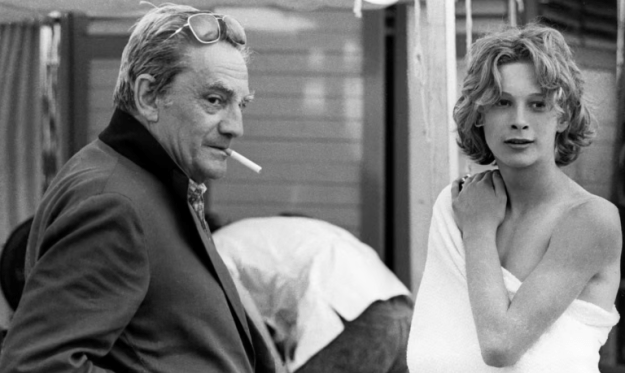
Björn Andrésen with Luchino Visconti on the set of Death in Venice. Photograph: Mario Tursi
Every obituary revisited the same scene: the audition tape from Death in Venice that was included in The Most Beautiful Boy in the World — a documentary about his life. Visconti tells him to smile. Then to undress. He laughs nervously. Strips to his trunks. Shifts under the gaze of men deciding whether he’s beautiful enough.
It’s hard to watch now. Visconti — Count of Lonate Pozzolo, titan of Italian cinema, and apparently, chaos in a cravat — ends up looking less like a mentor and more like a predator. But dead men can’t explain themselves.
When I was fifteen, I’d probably have thought that kind of attention was glamorous. Maybe I’d have handled it. Maybe it would’ve destroyed me. Hard to know. My own encounters with predatory men later on made Visconti look almost saintly by comparison. At least he left art behind. Maybe Andrésen’s story isn’t just one of exploitation, but what happens when fame and beauty collide with someone who’s too young to bear it.
Charlie, meanwhile, can’t stand The Boy. But he loves Death in Venice. He called Tadzio a “beau.” When I asked what that meant, he said: “The boy is beautiful. It’s sensuous, not pederastic. I’m surprised no one’s remade it.”
Which — yes — feels like a double standard. Both the book and the film are about the same thing: beauty. The kind we no longer know how to look at without flinching.
Could Death in Venice ever be remade?
I doubt it. The original is a masterpiece, and also completely unmakeable now. Mann’s 1912 novella was already controversial — a composer obsessed with a boy — and Visconti turned that tension into pure cinema. But in 2025, the moral landscape is different. Post-Me Too, post-Epstein, even looking can feel like a crime. No studio would touch it.
Unless you flipped it.
Make Tadzio older. Make the story less about sex and more about time — the hunger for youth, stillness, lost purity. Desire becomes existential, not erotic. If Visconti made the tragedy of seeing, a modern director — Luca Guadagnino, Todd Haynes, François Ozon, Joanna Hogg, Andrew Haigh — could make the tragedy of knowing you’re looking.
Visconti’s gaze was romantic. Ours would have to be self-conscious.
In their own way, both The Boy and Death in Venice celebrate the same thing — male beauty, youth, the brief perfection of being looked at before it fades. Once upon a time, that was sacred. Now it’s scandalous. Somewhere along the line, admiration turned into suspicion.
So yes, Baron Corvo told me to write something controversial. Bad idea from a worse man. But maybe he was right about one thing: sometimes, it’s worth writing about what we’re not supposed to look at.
Dirk Bogarde in Death in Venice (Morte a Venezia). Photograph: Ronald Grant Archive
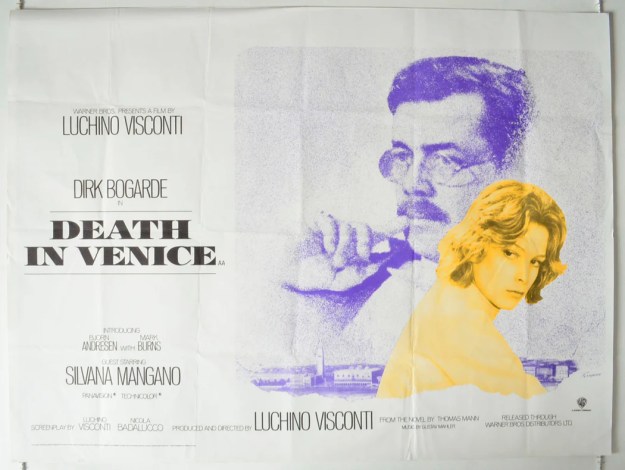
Death In Venice (a.k.a. Morte a Venezia). Original British quad movie poster
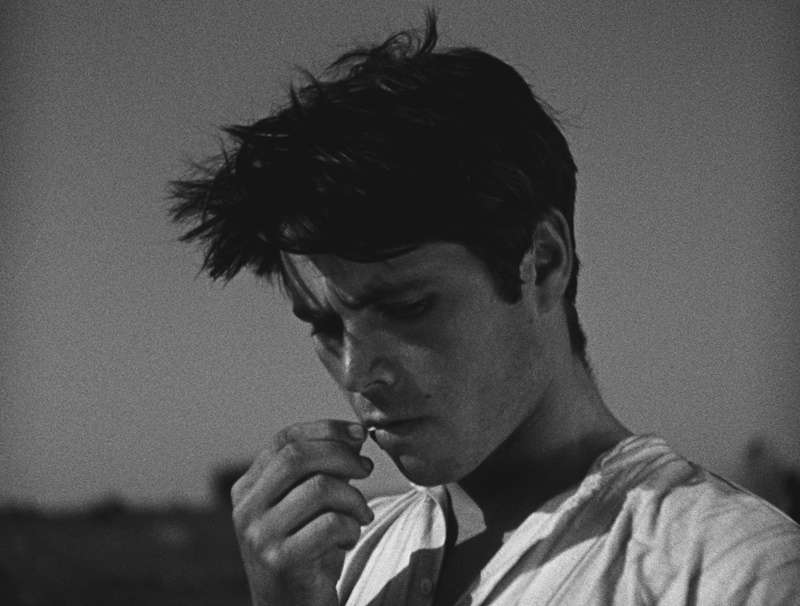
Handsome French boy. The light falls on him like a thought half-formed, catching the edges of his face before retreating into shadow. A quiet defiance in the way he chews on a matchstick. The air feels slow around him, salt and sand mingling with the scent of his skin. His shirt, open at the collar, softens the hardness of his jaw, and the wind seems to pause there – unsure whether to touch him or not. In that hesitation, the moment turns fragile, suspended – beauty caught between innocence and knowing. The image might have been taken yesterday, but this Brittany fisherman is from Finis Terrae, a 1929 French silent film written and directed by Jean Epstein.
Johnny and Vinny (second and fourth from left) – Danny Fitzgerald (1963). According to, Loncar and Kempster, Fitzgerald never printed this image. It was found in a short, four-frame strip of images of the brothers smoking between two cars with friends, on a street in Carroll Gardens, Brooklyn.
The noisy summer of 1963. Shouts, laughter, transistor radios blasting crooners and rock ’n’ roll. Danny Fitzgerald walked the streets of Carroll Gardens—sixty square blocks of brownstone row houses stretching from DeGraw Street to Hamilton Avenue, and from Court Street to Hicks. The neighbourhood bore the name of Charles Carroll, the only Roman Catholic to sign the Declaration of Independence, and as if on cue, the bell towers of St. Mary Star of the Sea and Sacred Hearts & St. Stephens rang out, reminding Fitzgerald that faith was still the glue holding this community together.
Everybody knew everybody here. Reputations mattered, gossip travelled faster than the summer heat, and though Fitzgerald wasn’t an outsider, he knew that by the time he reached Carroll Park, word of his presence would already have spread. He checked that the roll of ten-dollar bills was still safe in his pocket.
On one corner stood a family deli; opposite it, the bakery, its doorway spilling the smells of fresh bread, sfogliatelle, and espresso, along with the little paper cups of ice that kids clutched in the sun. A neon sign buzzed over the grocery, where a framed portrait of John F. Kennedy hung proudly behind the counter.
Sicilian and Neapolitan voices floated from stoops where old women in black dresses swept steps, aired laundry, and fanned themselves as they traded gossip. Below them, men smoked cigars and talked dockside work while listening to baseball on portable radios. Children darted about—stickball, stoop ball, bicycles weaving down Union Street, dodging cars, or shrieking as they ran through the spray of a fire hydrant on President Street.
Fitzgerald found what he was looking for on Columbia Street: teenage boys in leather jackets and rolled-up jeans, striking poses, trying hard to look older as they flirted with girls.
Johnny leaned against an iron railing, a toothpick lodged in the corner of his mouth, hair slicked so smooth it gleamed in the afternoon sun.
“Johnny! Vai a prendere il pane!” his mother called from the window, tossing him a crumpled dollar bill. Go get the bread.
He caught it with ease, sighed, and stuffed it into his pocket. His buddies leaned against a parked Buick, passing around a cigarette. Johnny joined them, hesitated briefly—his mother waiting for bread—then shrugged. She could wait.
Fitzgerald stepped forward, cautious but deliberate. “Hi Johnny. I’ve got a proposition for you—and your brother.”
In 1963, Danny Fitzgerald was forty-two. A first-generation Irish-Italian, he had only taken up photography in his thirties. He trained at Abraham Goldberg’s gym on Clinton Street, where he gained the trust of the young men who boxed and lifted there. For a few dollars, he persuaded them to pose for what he called “standard beefcake”—half-naked in pouches or bikini trunks. These images sold covertly to private collectors and to Joe Weider, who used them for magazine covers: Young Physique, Muscles a Go-Go, Demi-Gods.
Health-and-fitness publications doubled as discreet erotica for America’s homosexuals, offering a socially acceptable way to admire the male form. For Fitzgerald, the work was both a business and a means of feeding his own desires. He was said to have fallen hopelessly in love with one of his muses, a blonde youth named Orest—“unrequited love is a ridiculous state, and it makes those in it behave ridiculously.”
In the early sixties, Fitzgerald met the striking bodybuilder Richard Bennett, who became his primary model and collaborator. Together they founded Les Demi Dieux—“the demigods”—a venture that presented “sublime, muscled beauties from the streets of Brooklyn, the beaches of New Jersey, and the woods of Pennsylvania.” Bennett often acted as bait, coaxing young men into Fitzgerald’s lens for tastefully erotic photographs.
By 1963, when Fitzgerald approached Johnny and his brother Vinny, his focus had shifted back to the gritty realism of South Brooklyn street life. A ten-dollar bill was enough to persuade a boy to pose; a little more, and one might strip to the waist.
It was a handsome life, but a quiet one. The photographs were rarely seen beyond private circles, and after 1968 Fitzgerald stopped shooting altogether.
He died in 1990, destined for obscurity, until Robert Loncar and James Kempster acquired his archive the following year. They catalogued his life’s work, publishing Brooklyn Boys: Danny Fitzgerald and Les Demi Dieux (1993) and mounting an exhibition. Though the book is now out of print, coveted by collectors, his photographs survive online at a dedicated website. https://lesdemidieux.com
The rediscovery sparked excitement. Critics praised the work for its intimacy, its blend of realism and myth, its ability to capture both the spirit of its era and something hauntingly timeless. For a while, Fitzgerald’s name flickered in the wider cultural conversation. Yet as the years passed, interest faded again. Today, the collection drifts in a liminal space—remembered vaguely, rarely exhibited, and maybe a danger vanishing once more. Its half-life raises a lingering question: how easily can art be lost, even when once found?
Muscle Boy. Photograph from the early 1960s by Danny Fitzgerald and his studio Les Demi Dieux
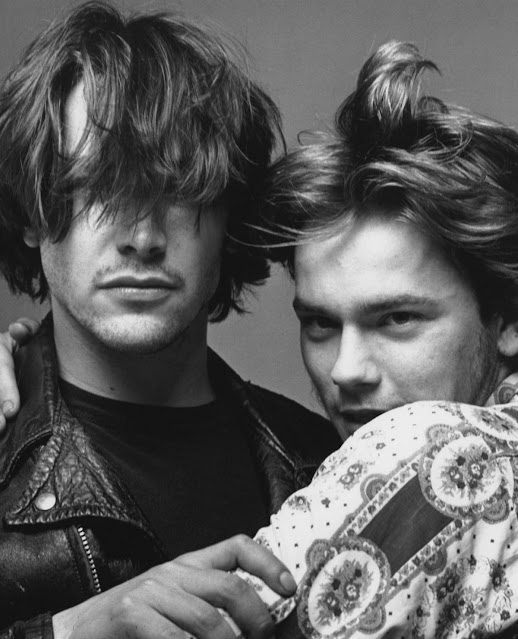
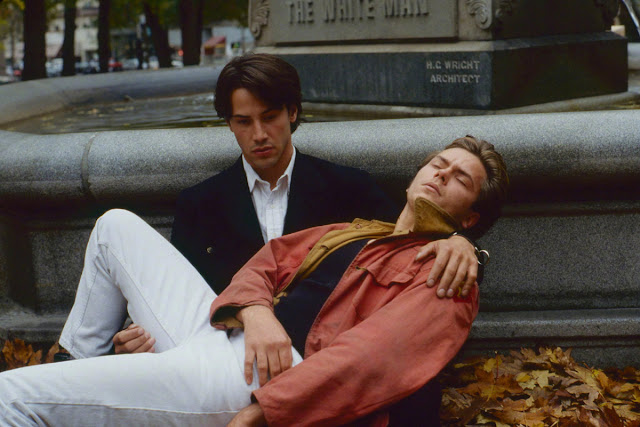
My Own Private Idaho. Keanu Reeves and River Phoenix. Promotional still (1991)
Scott: I only have sex with a guy for money.
Mike: Yeah, I know.
Scott: And two guys can’t love each other.
Mike: Yeah.
Mike: Well, I don’t know. I mean… I mean, for me, I could love someone even if I, you know, wasn’t paid for it… I love you, and… you don’t pay me.
Scott: Mike…
Mike: I really wanna kiss you, man… Well goodnight, man… I love you though… You know that… I do love you.
***
Watched ‘My Own Private Idaho’ for the first time. Charlie asked me if I’d seen Keanu Reeves recently because he looked old. But he was 61-years-old. River Phoenix still looks exactly the same… but that was how he left things. I remembered that I’d mentioned Phoenix before… but in one of my stories, he had appeared as a ghost.
It wasn’t going to be called ‘My Own Private Idaho’… better than ‘Blue Funk’ or ‘Minions of the Moon’… and named after a B-52s song. Inspired by Shakespeare’s Henry IV plays… Prince Hal and Hotspur and Falstaff… but here it was Scott Favor, privileged bisexual, Mike Waters, narcoleptic gay hustler searching for his mother, and Bob Pigeon, coke-dealing chickenhawk. Gus Van Sant: “My films are usually about relationships. I think you make films about things you lack.”
I can’t stop thinking about River Phoenix because, I guess, I’m in love with yet another dead man.
1987… “Run to the rescue with love and peace will follow.” – River Phoenix.
1989… Star burning bright. Beautiful. Lightness. Creative. Camera object.
1991… Indie moment. ‘My Own Private Idaho’. Realism to fantasy. Challenging the norm. Self-destructive attitudes. Dark themes. Cool culture. Downbeat hustlers. Wanderers. A chance to become an adult actor. Gus Van Sant simply being Gus Van Sant.
Keanu Reeves laying in bed playing with his nipple. What River Phoenix needed after making this movie – a bath, a shave, an exfoliating facial scrub.
“How do you see yourself fitting in with younger Hollywood acting?” (A sweet voice). “I don’t see any of them in the perspective or in the limelight of Hollywood. I really don’t ever want to get that objective or self-consciousness of my place in this world of showbusiness.”
1993… LA nightclub. Halloween. Music blasting. Sitting on a couch. Tired. Intoxicated. Skinny. Bad skin. Ticking time bombs. Heroine. Cocaine. Morphine. Marajuana. Valium. Cold remedies. Addiction is an open secret here. And then the star exploded all over the pavement. Never did anyone move from casual drug use to death so quickly. The night that Fellini died – ‘A director’s sweet life. An actor’s brief life.’
Retrospective.
2025… ‘My Own Private Idaho’. Turning point. A troubling effect. Midnight rock sessions. Alcohol. Uncontrollable drug use. Crystal meth. Hooked. No chance of going back now. Progressive and fatal. Like ‘The Little Shop of Horrors’…if you go too near to the plant it will eat you. The best performance… but from now on he didn’t care enough about himself to look after himself. What about those he left behind? Nobody did anything to help him when he was alive… guilt… and lasting sadness.
Have a nice day!
My Own Private Idaho. Keanu Reeves and River Phoenix. Promotional still (1991)
My Own Private Idaho. Keanu Reeves and River Phoenix. Movie poster (1991)
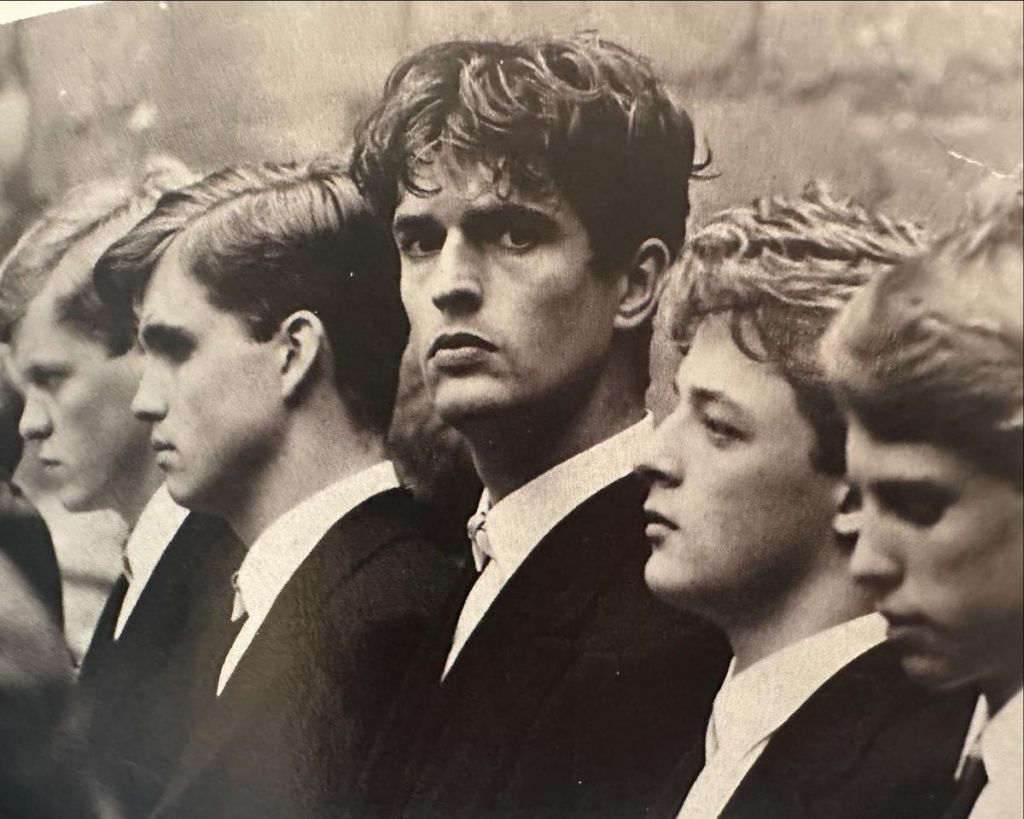
Rupert Everett and Colin Firth in Another Country. Directed by Marek Kanievska (1984)
It’s taken me a long time to watch Marek Kanievska’s Another Country because the thought of Soviet spies didn’t exactly fill me with excitement. It turned out to be a red herring. The film opens with Rupert Everett as Guy Bennett (think Guy Burgess), a wheelchair user in his drab Moscow apartment, who reflects on his schooldays at a 1930s English public school.
“It was delightful, utterly despicable.”
I’d forgotten how incredibly handsome Everett, Colin Firth and Cary Elwes as young chickens were. Well, it’s a gay movie and gloom pervades throughout. The agonies of homosexual love and the even greater agonies of being played with by the power structure.
Afterwards, Everett, flushed with anarchy, and a former public schoolboy himself, looks to have blurred his character with real life. A bit of a nightmare then, but I admire him for it. (I think that Everett is a brilliant memoirist – read his books).
When the film was released in 1984, an American newspaper queried why the biggest question hadn’t been answered. How did the lanky, dishevelled Bennett move from a witty and irreverent schoolboy to become a Soviet spy? We never did find out.
A good film, beautifully shot, if not a bit pedestrian at times.
And so, to the sad story of Frederick Alexander (aged 22), a close friend of Everett, who played Jim Menzies, but was really called Piers Flint-Shipman.
He and Everett were the only members of the original stage cast to appear in the film. “A much subtler and better actor that people at first gave him credit for. Wonderfully arrogant. Great dash and élan. One of the few people who could keep Rupert in order,” said its writer, Julian Mitchell.
In June 1984, while travelling back from France to attend the preview-cum-premiere of Another Country he was killed when a suicidal driver turned into his oncoming car. He would never grow old like Everett, Firth and Elwes.
And a recent anecdote.
Charles Spencer, 9th Earl Spencer, brother of Diana, Princess of Wales, was a young extra when it was filmed in Oxford, Northamptonshire and London in 1983.
“I bumped into Colin Firth – whose first film this also was – when he was promoting The King’s Speech, and said: ‘Colin, you won’t remember me – but we took a shower together in Another Country’.
“Of course I remember!”, he laughed: “You have fantastic buttocks!”
“Had, I’m afraid”, I replied: “not have…”
Rupert Everett (centre) and Charles Spencer (far left) in a scene from Another Country
Ludwig II (Ludwig Otto Friedrich Wilhelm; 25 August 1845 – 13 June 1886)
Bavaria’s favourite monarch ‘Mad’ King Ludwig, who liked to build fancy castles, and whose body was found in a lake in June 1886, along with that of Dr Bernhard von Gudden of the Munich Asylum.
His death was declared suicide by drowning but as the story slides further into history, the conspiracy theories grow – murdered by whom and for what purpose?
The composer Richard Wagner appears to have played Ludwig like an orchestra violin, and there were rumours of sexual relationships with Paul Maximillian Lamoral, Prince of Thurn and Taxis, chief equerry Richard Hornig, the Hungarian theatre actor Josef Kainz, and courtier Alfons Weber.
And then there was Karl Hesselschwerdt, quartermaster of the Royal Stables, who allegedly procured young cavalrymen for Ludwig’s pleasure.
Alas, Ludwig Otto Friedrich Wilhelm, King of Bavaria, also known as Count Palatine of the Rhine, Duke of Bavaria, Duke of Franconia and Duke in Swabia, was probably no madder than the rest of us. His extravagance used against him to declare his insanity.








 Perfectly Hard and Glamorous