
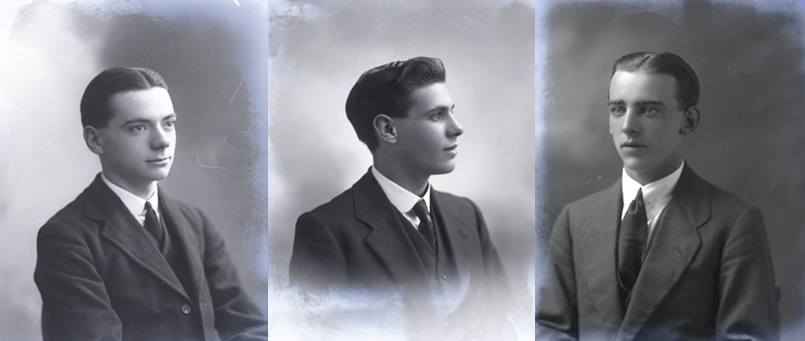
“You know I like Archie Pennybet very much indeed. In fact, I think I like him better than anyone else in the world, ‘septing of course my relations.” – Edgar Doe.
One of my recurring frustrations with old books is this.
Every so often, I pick up a novel now regarded as homoerotic and wonder how on earth its first readers failed to notice what was sitting in plain sight.
A second dose from Ernest Raymond’s 1922 First World War novel, Tell England: A Study in a Generation, a book that goes to extraordinary lengths to beat around the bush.
When it was published, the poor dears read it as a patriotic, high-church Anglican tribute to the tragic “lost generation” of British public schoolboys sent to Gallipoli. The lingering focus on male beauty and passionate friendships seems to have passed them by.
You may recall from an earlier post that Raymond himself later openly acknowledged the novel’s homosexual subplot.
The first half of the novel, Five Gay Years of School, introduces the narrator, Rupert Ray, and his classmates as young men who are acutely aware of their own attractiveness, opening one school chapter with Archie Pennybet’s boast: “I’m the best-looking person in this room.” Time and again, they are presented as magnificent, almost perfect creations of God.
At the heart of the story is Rupert’s deeply emotional attachment to his classmate Edgar Doe, who is quite unmistakably homosexual. Their relationship is marked by jealousy, devotion, and emotional intensity that often resembles a love affair far more than ordinary friendship.
“I say, why does Doe avoid us now?”
“The Gray Doe,” sneered Penny. “Oh he – She’s in love, I suppose. With Radley.”
“Don’t drivel,” I commanded. “Why does he hang about with that awful Freedham?”
“When you’re my age, Rupert,” began Penny, in kind and accommodating explanation, “you’ll know that there are such things as degenerates and decadents. Freedom is one. And very soon Doe will be another.”
“Well, hang it,” I said, “if you think that, how can you joke about it, and leave him to go his way?”
“Oh, the young fellow must learn wisdom. And he’s not in any danger of being copped. I’m the only one that suspects, and I guessed because I’m exceptionally brilliant. Besides, if he wants to go to the devil for a bit, you can’t take his arm and go with him.”
“No,” I said, “but you can take his arm and bring him back.”
The schoolmaster, Radley, is described as regarding the boys with a “strong, active love.” Rupert comments: “We were his hobby. I have met many such lovers of youth.”
In the second half of the novel, the boys are sent to Gallipoli. The emotional and physical admiration established during their schooldays evolves into a romanticised martyrdom, where dying beautifully for England becomes the ultimate fulfilment of their youth.
By Jove, Ernest Raymond was clever.
He wrote about male intimacy with remarkable emotional and physical closeness without provoking the censors of the 1920s. Wrapped in high-church religiosity and fervent patriotism, it was accepted by the general public as nothing more than an innocent, heart-rending tribute to fallen soldiers.

