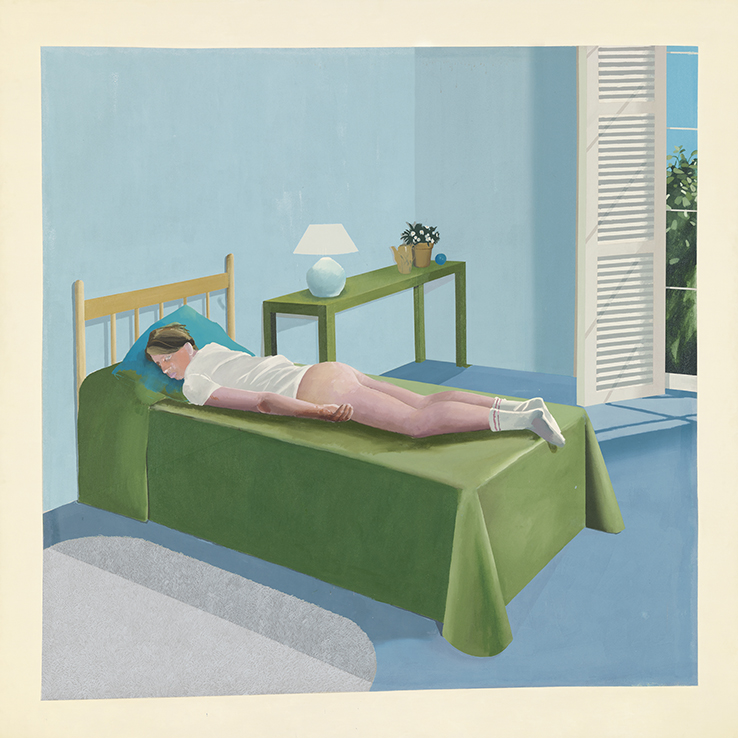
I think I may have fallen in love with someone.
A twenty-something with soft, youthful features and a quiet demeanour. He is highly desirable; his image has become an indelible symbol of Californian beauty and desire.
There is a problem.
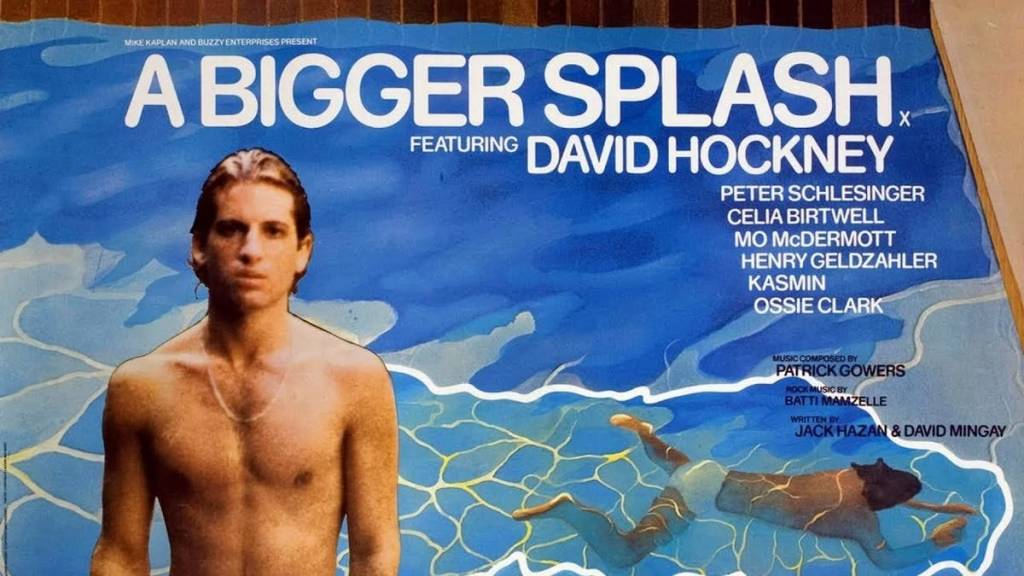
A Bigger Splash, directed by Jack Hazan, was a groundbreaking film that merged documentary with scripted drama to explore a poignant period in David Hockney’s life between 1971 and 1973.
Released in 1974, A Bigger Splash chronicles the emotional fallout and creative struggle that followed Hockney’s devastating break-up with his young partner and muse, Peter Schlesinger. It received mixed reviews, with Private Eye dismissively referring to it as A Bugger’s Pash.
And yes, I have fallen in love with Schlesinger as he was more than fifty years ago.
In the film we see Schlesinger, clad only in white briefs, dancing with himself before an easel. He gets it on with a friend, the actor Eddie Kalinsky, skinny-dips with a pool full of twinks, and later swims alone, completely naked, before climbing out and revealing everything we wanted to know.
He was a handsome fellow with long, floppy hair, and Hockney was understandably devastated to lose him. In retrospect, A Bigger Splash is a remarkable piece of filmmaking, freezing Schlesinger in time.

He was in his mid-twenties and was rumoured to have agreed to appear only during the final months of production, and only if he was paid.
Hockney was said to have been “utterly shattered” by A Bigger Splash and allegedly offered Hazan $20,000 to destroy it.
These old films play tricks on us. They invite us into an imagined one-to-one connection, creating the illusion that we know the subject’s true personality. We fill the historical gaps with our own desires, values and fantasies. In effect, we create the perfect partner.
But it is a one-sided, unreciprocated affair. It gives us the experience of romantic love and emotional attachment without the risk of rejection or conflict. He can never disappoint me, change his mind, or break the spell of his visual perfection.
Schlesinger became the myth of the eternal muse.
There is another problem.
Our minds struggle to comprehend the ageing process, and the fact that Schlesinger is alive and well, now approaching eighty, threatens to shatter that myth.

Schlesinger was born in 1948 in Encino, in California’s sun-drenched San Fernando Valley, the son of an insurance agent and a social worker. He studied drawing at UCLA and, in 1966, aged eighteen, met Hockney, who was teaching a summer class. He soon became the subject of one of Hockney’s best-known paintings, Peter Getting Out of Nick’s Pool.
He had stepped into an unfamiliar world, and who could have blamed him? Suddenly he was socialising with museum curator Henry Geldzahler and art dealers Nicholas Wilder and John Kasmin, while also befriending novelist Christopher Isherwood and artist Don Bachardy.
After graduating, Schlesinger moved to London with Hockney and enrolled at the Slade School of Fine Art. There he was introduced to Hockney’s bohemian circle, including the designer duo Ossie Clark and Celia Birtwell.
Hockney and Schlesinger were together for three years, and it was fortunate that Hazan chose the period of their separation as the backdrop for his documentary.
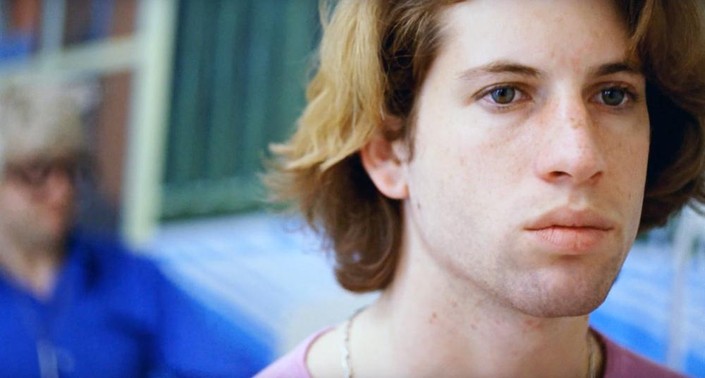
The question I kept asking myself was simple: why did the relationship end?
By then Hockney was in his thirties, and the imbalance in both age and influence inevitably played its part. Schlesinger struggled to establish an identity of his own while living within Hockney’s enormous social and professional orbit.
There was also the suggestion that Hockney became consumed by his work, leaving Schlesinger isolated, waiting for an artist who often seemed to prioritise the canvas over the relationship.
The cracks had already appeared.
The most convincing explanation, however, is that Schlesinger had fallen in love with someone closer to his own age—someone equally beautiful.
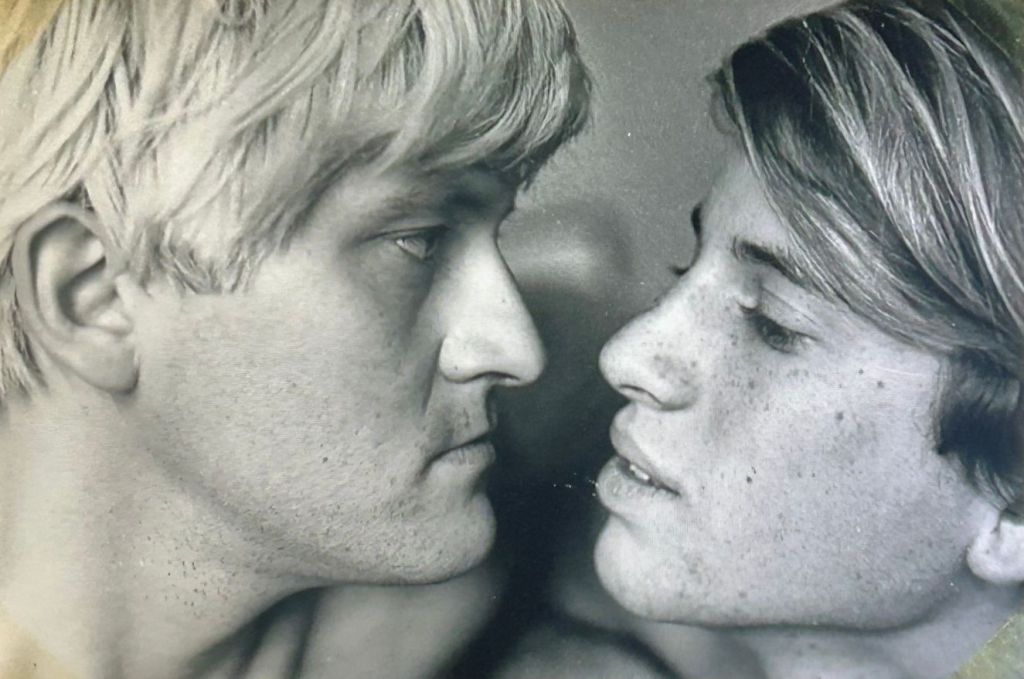
Schlesinger met the Swedish-born design student Eric Boman in March 1971 at Mr Chow’s restaurant in Knightsbridge. Following the London premiere of Visconti’s Death in Venice, Paloma Picasso invited Boman, Manolo Blahnik and Andy Warhol’s business partner Fred Hughes to dinner with Hockney and Schlesinger.
Hockney later regretted deciding not to attend.
“David was not interested,” recalled Boman, “so this adorable boy turned up at our table in a camel hair Ossie Clark coat.”
Schlesinger said it was love at first sight.
The final straw came a few months later during a group holiday in Cadaqués, Spain, where Schlesinger and Boman met again. Fatigued by constant drama, emotional claustrophobia and the pressure of being Hockney’s primary visual obsession, Schlesinger found himself drawn ever closer to Boman.
“Peter came with David Hockney and notoriously stayed on, causing their real dramatic and public break up. It was considered best that Peter and I go home, and we left at the crack of dawn in Ossie Clark’s Bentley, hoping to spend a night at Tony Richardson’s on the way, but he’d have none of it out of solidarity to DH. So we ended up at Mick and Bianca’s (Jagger). The next morning, Ossie put us on a train at Sainte-Anne, and since we had no reservations, the conductor let us stand in the corridor all the way to Paris in our swimsuits – the beginning of our new life.”
Hockney sank into depression and responded with bitterness and jealousy. In A Bigger Splash, he remarked that he might consider destroying the ‘Peter’ works. But, in fairness to Hockney, and all others who had lost their first love, who could have blamed him.
It took Schlesinger a long time to escape Hockney’s emotional pull. Jack Hazan later recalled in a Vice interview that Hockney would entice Schlesinger back under the pretence of painting him, simply so he could be near him. Schlesinger reportedly found this both “petulant” and “suffocating”, and longed to escape Hockney’s web.
One of the most important paintings from this period—and one that features in A Bigger Splash—is Portrait of an Artist (Pool with Two Figures). In 2018 it sold at auction for a record-breaking $90 million.

“I don’t even think it’s a portrait of me, really,” Schlesinger said. “The figure standing beside the pool was a solution to a ‘conceptual’ problem, regarding composition and light, rather than an outpouring of romantic longing.”
After the break-up, Schlesinger moved into his own studio around the corner from Hockney. His relationship with Boman involved a lengthy commute between Notting Hill and Battersea by bus and bicycle.
Alongside painting, Schlesinger had always been interested in photography, but it was Boman who made a career from it. After borrowing Schlesinger’s Pentax camera, he became highly sought after for his art, fashion and society photography.
“Eric is very methodical and likes setups. I just snap pictures and he doesn’t understand that,” Schlesinger once said.

During the 1980s Schlesinger also became disenchanted with painting and turned instead to ceramics, an art form he continues to pursue.
The couple moved to New York in 1978 and, a year later, settled in a tenth-floor loft where the Flatiron District meets Chelsea, in a building that had once housed a girdle factory. Four years later they bought a mid-nineteenth-century Greek Revival house near Bellport on Long Island, where they spent their summers.
Schlesinger and Boman remained together for fifty-one years, with Hockney once referring to them as a “couple of old maids.”
Eric Boman died of pancreatic cancer in 2022.
In recent years Schlesinger said he had no contact with Hockney and, referring to A Bigger Splash, reflected: “It’s not about me. It’s so long ago, it’s like a different person.”
But Schlesinger is like a painting in a museum.
Perhaps the only way to live forever is inside a work of art, and Schlesinger’s life remains preserved in Hockney’s paintings and, to some extent, in A Bigger Splash.
It is vintage media: a pre-digital art world, a lost world of effortless style, leisure and raw creativity.
And I am still in love with the young Peter Schlesinger.