Tag Archives: Gay Art

Hot Boys, Great Art

A Cellist Elevated by His Bath: Philip Gladstone (2007)
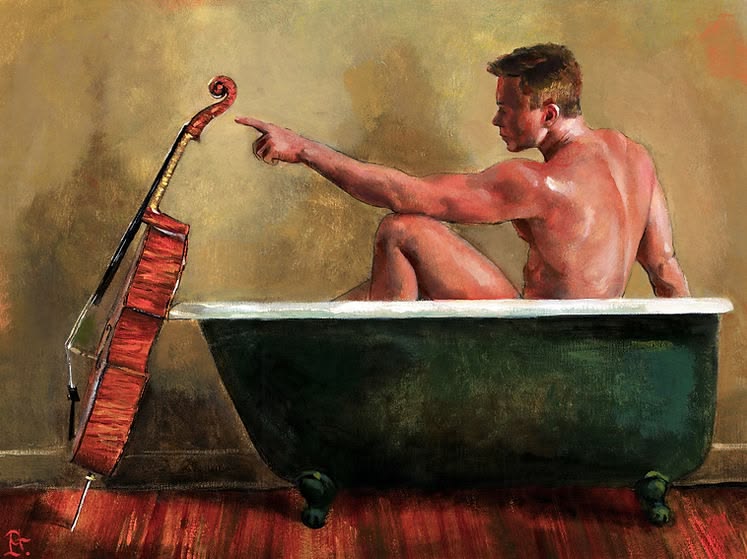

He had been in there for nearly an hour. Long enough for the water to cool, for the steam to disappear from the mirror, for the afternoon to slip into something approaching evening. He ought to have got out. There were things to do, people who might be waiting. But he had never been particularly good at doing what was expected of him.

Instead, he pointed at the cello.

There is nothing quite so exciting as a young guy in a bath. Especially one who brings his cello.

A Cellist Elevated by His Bath was painted in 2007 by American artist Philip Gladstone, whose work I’m beginning to think deserves considerably more attention.

Born in Philadelphia, Gladstone is known for his evocative figurative paintings, often featuring the male nude as protagonist, muse and general cause of distraction. He now paints full-time in a renovated barn studio at his antique farmhouse in rural Maine. Not a bad setting for an artist with such a particular eye for the male form.

This painting belongs to his long-running Tubs Series, in which bathers, animals and assorted objects find themselves in antique tubs that feel less like bathroom fixtures and more like protective, womb-like spaces. The results are surreal, dreamlike and just a little absurd.

And then there is the cello. The pose. The pointing finger.

I have questions. But I’m not sure I want answers.
Hot Boys, Great Art

Night in the Desert: George Quaintance (1951)


George Quaintance (1902–1957) was an American artist famous for his “idealised, strongly homoerotic” depictions of men in mid-century physique magazines. He often used historical settings to justify nudity, or to remove his subjects from the constraints of modern society. Muscular, semi-nude or completely nude men dominate his paintings, with the Wild West becoming one of his favourite settings. He would later influence artists such as Tom of Finland.

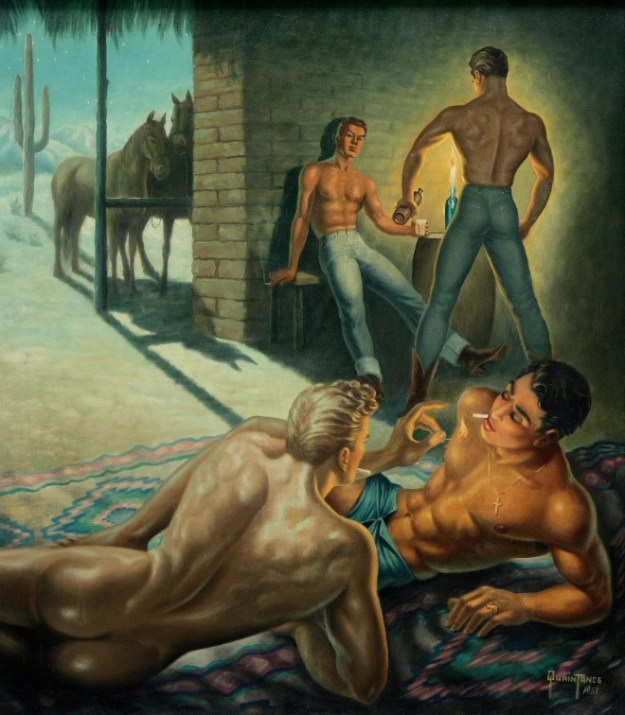
One of his iconic masterpieces was Night in the Desert (1951)

John D. Wainbright, on the LGBTQ encyclopedia, wrote:

“It portrays a reclining nude cowboy, well-honed musculature gleaming in the moonlight and blond hair perfectly coiffed. He is proffering a lighted match to a cigarette in the mouth of the dark handsome youth lying next to him, suggesting a shared post-coital moment. In the background, two equally hyper-masculine cowboys face each other clad only in Levis, legs provocatively spread.”

In this and several other paintings in the series, the blond cowboy bears a striking resemblance to Quaintance himself. He was something of an egotist, but he also kept himself in remarkable physical shape. Perhaps he understood better than most artists the appeal of the body he was painting.

On November 8, 1957, Quaintance suffered a heart attack. He was just 55.

In reporting his death, Bob Mizer described Quaintance as “a perfectionist” who “drove himself unmercifully”, working days and nights to finish a painting or sculpture, sometimes taking Benzedrine to keep himself awake.

His legacy is more than sixty signature oil paintings, now scattered among private collections and a handful of gay-oriented museums around the world. More importantly, he helped create an image of male beauty that could be unmistakably homoerotic while still hiding behind the conventions of the American frontier. Cowboys, muscles, moonlight. It was a pretty effective disguise.