
The Boy and the Dolphin: Ernest Myers (1904)
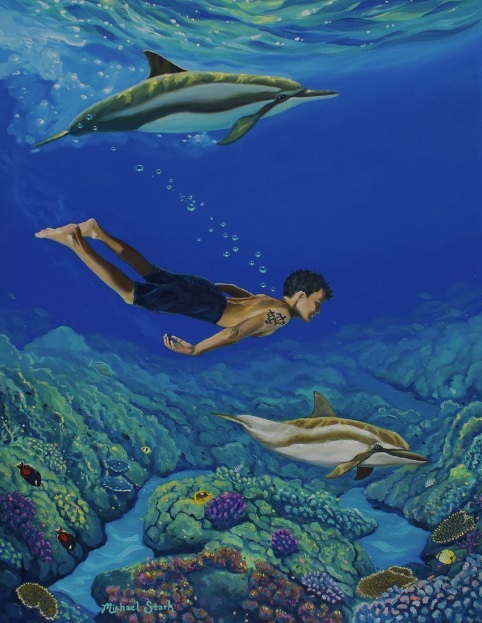
A band of boys went bathing to the sea
All fair, but one the first in youthful bloom,
Him marked a Dolphin, tenderest of his kind,
Far off and joined his gambols in the wave.
And a great love grew up between the twain.
For day by day, the boy came to the shore
And day by day his faithful friend was there,
And on his back would bear him merrily
Amid the dashing waves, a burden dear.
But on an unblest morn, what time their mirth
Was happiest and the boy in trustful glee
Upon his playmate stretched his limbs at length,
And backward leaned, and shouted to his steed,
Ah, me! the sharp spear of the Dolphin’s fin
Pierced his fair side and spilt his tender life,
So there was no more play between the twain.
But that poor friend, perceiving how the foam
Was crimsoned all with blood about his track,
And that sweet voice, which was his music, hushed,
Knew that all joy was slain and agony
Seized him and he desired to die.
So to the beach he bore him mournfully
Amid the dashing waves a burden dear;
And on the sands he softly laid him down
And by his side gave up his grieving soul.
But the boy’s comrades, sorrowing for their mate,
Took up the corpse and washed it of the blood,
And laid it in a grave beside the sea,
Beside the sea, above the wave-washed sand.
And by his side they laid the Dolphin dead
Ernest Myers (1844–1921) was an English classicist and poet. This particular poem, apparently his only one exploring Greek love, was inspired by an account in Aelian of a boy from Iasos who formed a close attachment to a dolphin. It appeared in the Hellenica section of his Gathered Poems, published by Macmillan in London in 1904.
Interestingly, Myers is sometimes mistakenly credited as “Meyers”. Today, he is remembered, if at all, more for his translations of Pindar and Homer than for his own poetry.
The Boy and the Dolphin tells a rather beautiful, if ultimately heartbreaking, story of a young boy who forms an unusually close friendship with a dolphin.
What begins as innocent play in the sea develops into something much deeper. The dolphin comes to recognise the boy, seeks him out each day and carries him on its back through the waves. Myers describes their relationship as a great love, and there is something rather lovely about the simplicity with which he presents it. Neither seems to need anything more than the other’s company.
Of course, the story takes a tragic turn. During one of their playful encounters, the boy is accidentally pierced by the dolphin’s fin and dies. It is particularly poignant that the dolphin has no intention of harming him. The very creature that has become his closest companion is responsible for his death, quite by accident.
But perhaps the most affecting part of the poem comes afterwards. The dolphin sees the blood in the water and realises that something terrible has happened. The boy’s familiar voice is gone, their games are over, and the dolphin seems unable to bear the loss. It carries the boy back to shore, lays him gently on the sand and then dies beside him.
There is something deeply moving about that final image. The boy’s companions bury them together, as though recognising that what existed between them was something worth honouring.
For me, the poem is about more than friendship between a child and an animal. It is about affection, innocence and a devotion that seems to transcend the boundaries between species. The dolphin’s grief is presented as every bit as real and profound as that of the boy’s human companions.
And there is another dimension to it. Although presented as an animal fable, the poem has a distinctly classical sensibility, with its emphasis on youthful beauty, tenderness and the intensity of attachment. There is something almost like a little Greek love story here, albeit one told through the unlikely pairing of a boy and a dolphin.
It is, in essence, a rather touching little story about love, loss and the extraordinary bonds that can form between two very different creatures.

