
A Room of One’s Own
A memorable hot summer on mainland Europe has given way to a funereal London autumn, with its low, monolithic sky the colour of dirty dishwater. Everything appears dark and hopeless, made worse by the city’s unhealthy obsession with Christmas.
This isn’t Verona. It isn’t Taormina. It isn’t Paris or Venice either.
But, for now, it is a place to call home, even if it doesn’t particularly feel like one.
I’ve settled into Deej’s place in Brixton, and he’s generously offered me the use of one of the attic rooms as an office. I prefer to call it a study. It’s reached by a twisting flight of stairs and probably once belonged to some poverty-stricken servant. I keep imagining a ghostly figure standing behind me, looking over my shoulder and reading everything I write. A few blasts of Nubiyan Twist soon manage to rid the room of any lingering spiritual presence.
It’s also a good place to die.
As rooms go, it isn’t bad, provided you overlook the 1960s ‘flower power’ wallpaper decorating the back wall. It’s a room that appears to have been ignored by successive owners, largely because it has no heating and is absolutely freezing. It won’t be somewhere I’ll be working in just my boxer shorts. Fortunately, an old electric fire has been purloined from the basement and is now working overtime to make the place habitable.
The pièce de résistance, however, is an enormous mahogany desk with a leather inlay. We’ve managed to manoeuvre it into position in front of a dirty dormer window, offering views over a collection of rather overgrown back gardens. Deej tells me it’s Edwardian Revival, having had it valued with a view to selling it on the quiet. It turns out to be extremely valuable, although its monetary worth is somewhat academic. Nobody can work out how anyone managed to get the bloody thing up those twisting stairs, and the only way it will ever leave is in pieces.
The desk also contains a couple of unexpected treasures hidden away in its drawers. Two old magazines, separated by entirely different eras but somehow brought together in this unlikely resting place.
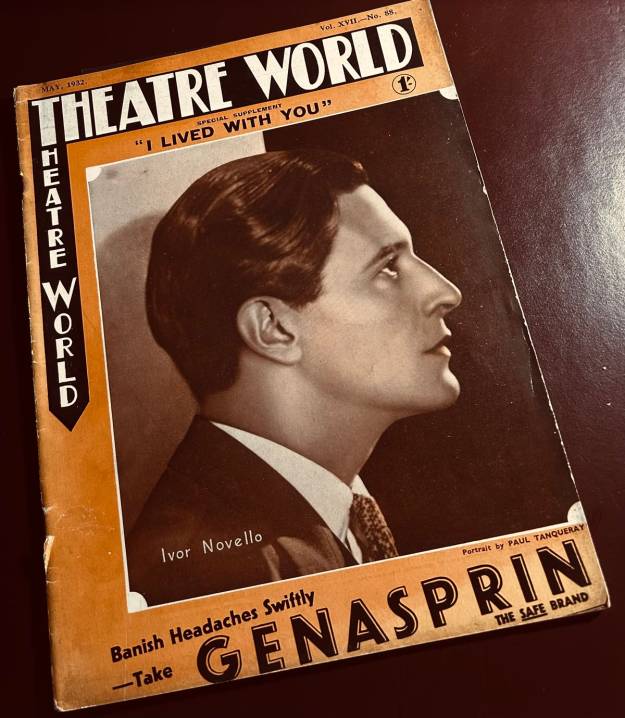
The first is a May 1932 copy of Theatre World, featuring a quite stunning photograph of Ivor Novello on the cover. The second is an April 1987 copy of i-D, with Grace Jones staring back at me from its cover.
For a ‘young chronicler’, discovering such things is comparable to an orgasm.
Perhaps the room and I are going to get along rather well after all.
Still Looking at Timothée
I’ve just finished reading Don Bachardy: An Artist’s Life by Michael Schreiber, published in late 2025.
The 92-year-old ‘twink’ offers a fascinating collection of memories, recalling his encounters with Golden Age Hollywood stars, literary icons and lifelong friends. Among the notable subjects are Bette Davis, Joan Crawford, Marilyn Monroe, Tennessee Williams, Truman Capote and, of course, his partner, Christopher Isherwood.
Isherwood and Bachardy famously met on a beach in Santa Monica, California, in late 1952. Bachardy was 18; Isherwood was 48.
It gives the rest of us a little hope that growing old needn’t necessarily mean becoming any less sexually charged.
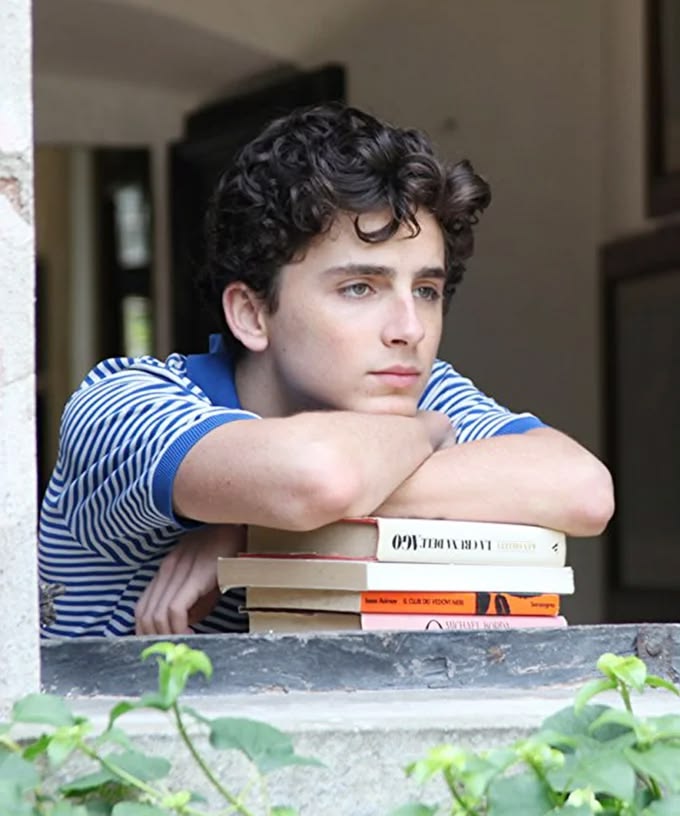
Filmmaker James Ivory, who wrote the Oscar-winning screenplay for Call Me by Your Name, contributes a foreword to the book. Bachardy also makes an interesting observation about the film, which proved to be the breakout role for Timothée Chalamet:
“I just wish I liked that young man, Timothée Chalamet, more. I thought it was an intelligent performance; I think he had real presence and he’s photogenic, but there’s something about him that I resist. I don’t know what it is. It’s something to do with his personality: he just doesn’t appeal to me. He’s the wrong kind of beautiful young man.”
Is there anybody in the world who would agree with this?
I certainly don’t.
I thought Chalamet captured the messy duality of youth rather brilliantly. His Elio combines intellectual arrogance and youthful cockiness with deep insecurity, physical awkwardness and a rather touching naivety. He is simultaneously self-assured and painfully unsure of himself.
And much of Chalamet’s storytelling happens in silence.
The camera lingers on his face while other characters speak, allowing us to glimpse the inner dialogue and emotional shifts taking place beneath the surface. He doesn’t need to explain everything. A look, a hesitation or the slightest change in expression often tells us more than dialogue could.
And then there is that extraordinary seven-minute emotional passage during the closing credits, as Elio sits staring into the fireplace, processing the heartbreak of his first great love. It’s a remarkable piece of screen acting, and one that stays with you long after the film has ended.
I showed Bachardy’s observation to Deej.
“Call Me by Your Name is a classic,” he said. “I thought he was brilliant. But it is such a long time ago now. Now Chalamet is just another Hollywood nobhead!”
I’m a Sucker for a Bad Boy
Arthur Rimbaud was never particularly famous among the general public during his lifetime, although he was a well-known and rather scandalous figure within a small, distinctly bohemian literary circle in Paris.
His writing career was remarkably brief, spanning roughly 1870 to 1875, with most of his work written before he reached the age of 21. Apart from self-publishing A Season in Hell in 1873 (most copies of which went undistributed) and having some of his poetry published with the assistance of Paul Verlaine, his work attracted little attention beyond the literary circles in which he moved.
It was not so much literary fame that made the young Rimbaud notorious, but his behaviour. He acquired a reputation for wildness, drug and absinthe use, and, perhaps most famously, his passionate, volatile and ultimately destructive relationship with fellow poet Paul Verlaine, who shot him in 1873.
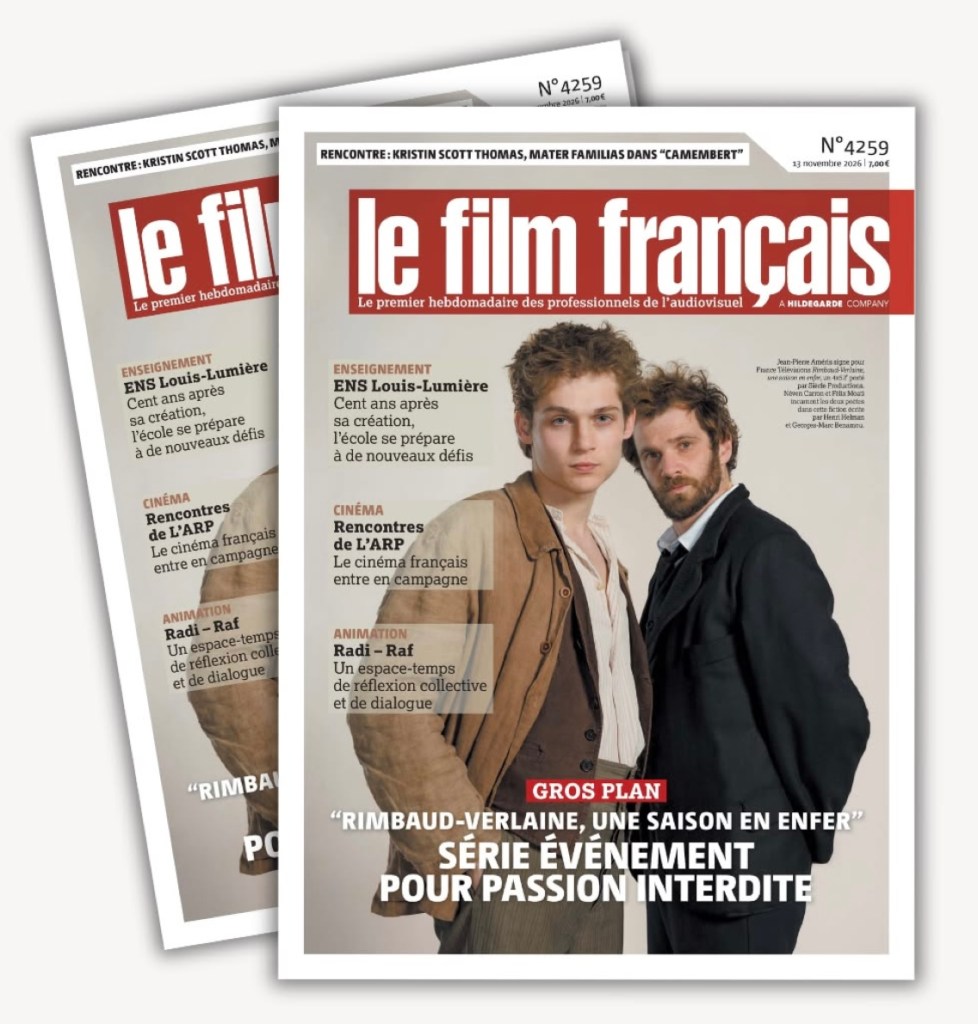
And it is this rather intoxicating combination of poetry, passion and self-destruction that forms the basis of a forthcoming four-part French television mini-series. Rimbaud-Verlaine, une saison en enfer will be directed by Jean-Pierre Améris, written by Henri Helman, and focus on the period between 1871 and 1873, when the relationship between the two poets was at its most intense.
Filming took place between September 7 and October 29, 2026, at locations in France and Belgium, including Rimbaud’s hometown of Charleville-Mézières, as well as settings recreating nineteenth-century London.
Néven Carron takes the lead role of the young Arthur Rimbaud, opposite Félix Moati as Paul Verlaine. Carron first came to prominence as a semi-finalist on The Voice and subsequently appeared alongside Augustin de Winter in Benoît Duvette’s medium-length drama Éden & Charlie (2024).
I have to confess that the prospect of seeing Rimbaud brought to the screen is rather appealing. A young poet, spectacularly talented, wilfully difficult, romantically reckless and seemingly determined to make a complete mess of his life. One can hardly accuse him of being dull.
Imagine My Room
I did that ChatGPT thing.
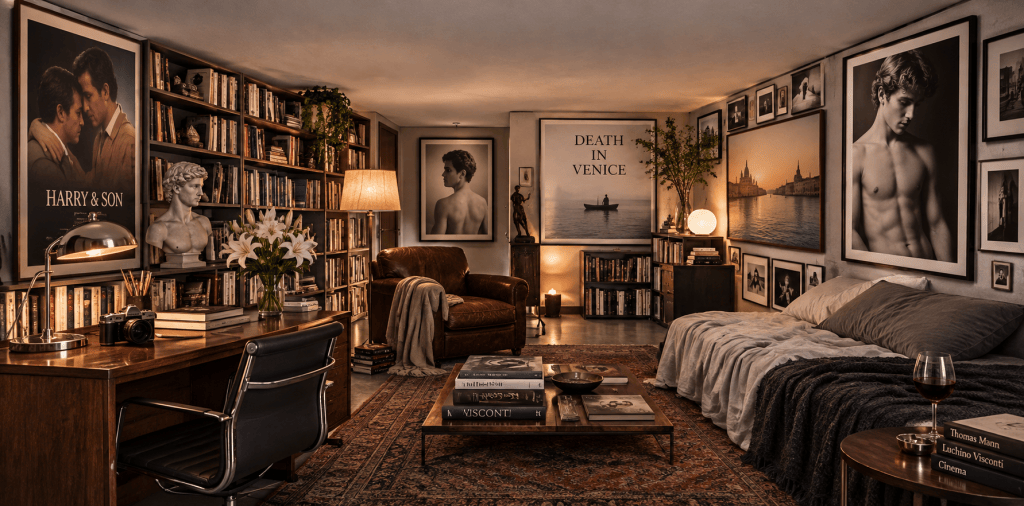
You know the one. You show it a photograph of an empty room and ask it to recreate the space in your style, drawing on what it knows about you.
It did a fantastic job.
A private world of art, literature, cinema and photography. Somewhere between a Venetian writer’s retreat and an intimate film-lover’s study. A room filled with Thomas Mann and Luchino Visconti, the lingering shadow of Death in Venice, the curious ambiguities of Harry & Son, and the beginnings of Stillness.
And then there are the photographs celebrating male beauty, the camera, the books, the classical sculpture, the Venetian light and the quiet suggestion of The Art of Him. A room for someone fascinated by beauty, desire, artistic vision and the stories that lie beneath the surface.
It’s rather wonderful, actually. A little self-indulgent, perhaps, but I can live with that.
There is just one small problem.
It looks absolutely nothing like the attic room at the top of Deej’s house.
On the Cute and the Willing: Kirill

There is something rather unfair about eyes like Kirill’s. They’re impossible to ignore. A little inquisitive, perhaps, but with just enough mischief to make you wonder what might be going through his mind.
He looks directly at the camera, apparently quite comfortable with the attention, while the slightly parted lips and casually open white shirt do little to discourage further admiration.
It’s the eyes, though, that hold me. There’s an intriguing mixture of innocence and knowingness about them. The sort of gaze that makes you wonder whether you’re looking at someone who hasn’t quite realised the effect he’s having, or someone who has realised it perfectly well.
I’m inclined to suspect the latter.
Either way, Kirill has my attention.
Kirill at Michael Model Management, Kaliningrad. Photo by Drummmonkey and Kostanyans (2026)

