
The Parting: Edwin Emmanuel Bradford (1910)
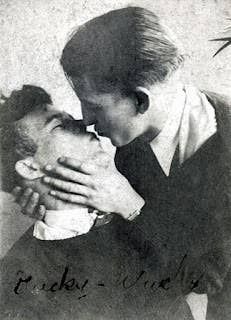
Two boys had met to bid “goodbye,”
One was my friend, the other 1;
He was going home—going home to die.
I know for long he talked to me,
But I think I only heard the sea—
It moaned and moaned incessantly,
I dared not look at him—I saw
The wind play with a wisp of straw:
‘Twas early Spring and cold and raw.
But when the station came in sight
Through parted clouds the sun shone bright.
Flooding the world with warmth and light.
A moment later in the train
I glanced at, with a stab of pain,
The face I never saw again.
The train went out: dark grew the sky
And all at once tempestuously
A storm of hail swept far and night.
But darkness could not blot or kill
That sunlit face—it never will:
By night and day I see it still.
Edwin Emmanuel Bradford’s The Parting first appeared in The Romance of Youth and Other Poems in 1910, with later editions appearing around 1920. It is tempting to read it as a wartime farewell between two young men, particularly because of its language of death and separation.
But the date matters.
This is 1910.
The First World War is still four years away.
So who, exactly, are these two boys?
Bradford gives us almost nothing. Just the meeting. The silence. The cold. The train. And that extraordinary final image of the boy’s face surviving everything — even darkness.
The poem belongs to the strange, fascinating world of early twentieth-century Uranian literature: writing that openly explored romantic and homoerotic relationships between men and adolescent boys.
Bradford himself lived an extraordinary double life. He was an Anglican vicar, respectable enough to be reviewed seriously and, remarkably, often favourably. At the same time, he was publishing poetry about male beauty, youth and desire.
That tension is part of what makes The Parting so haunting.
It never says what these boys are to each other.
Perhaps that was precisely the point.
Two boys meet.
One leaves.
And one face remains.

