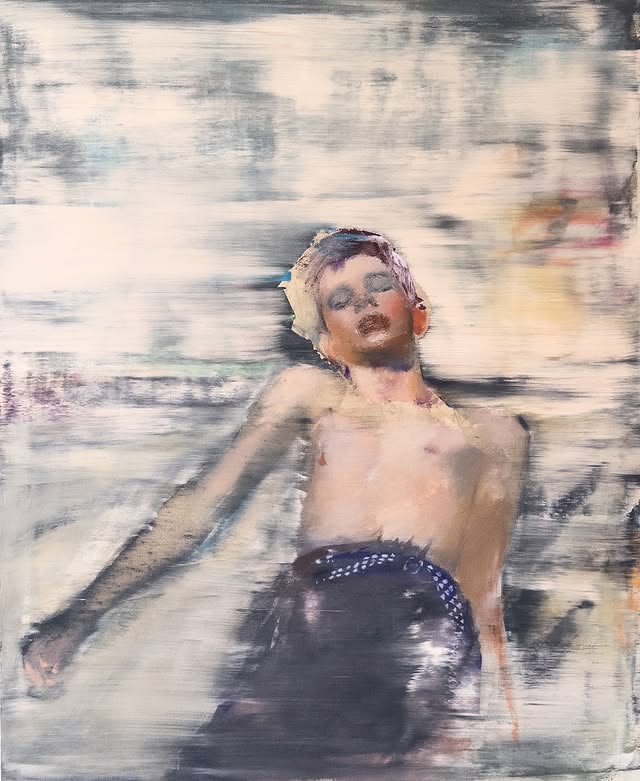
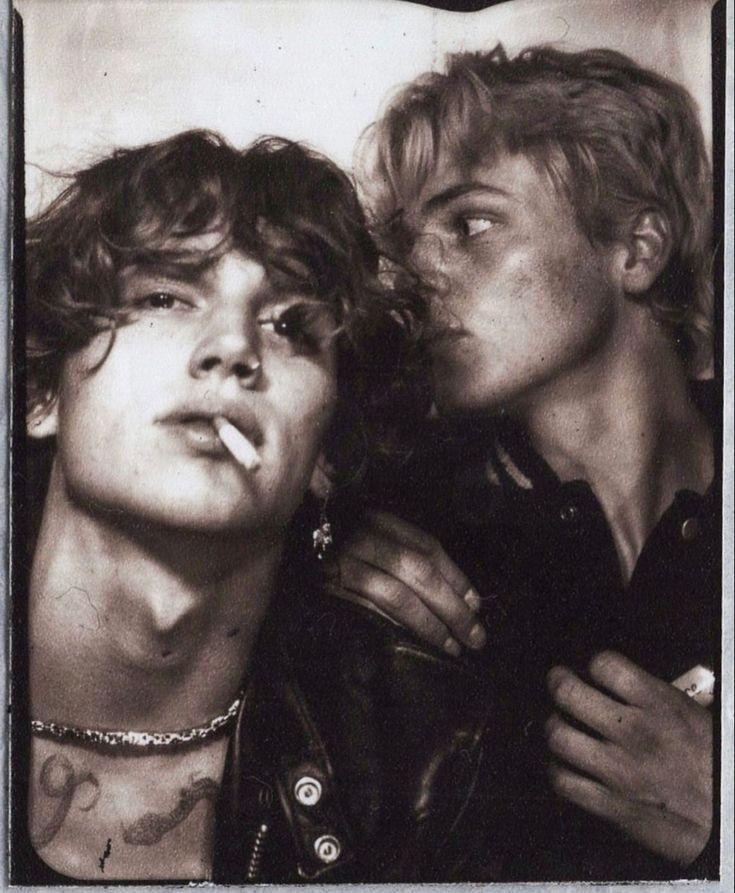
Mark Morrisroe, Self-Portrait with Broken Finger, Christmas 1984
I would have fallen in love with him. No doubt about that. And he would have ruined my life.
But that never happened.
A bullet rolled out of his ashes. Shot in the back at seventeen. That was all that remained.
Myles Vale
Mark Morrisroe (1959-1989) was an influential American photographer, performance artist, and filmmaker who served as a central figure in the Boston punk scene of the 1970s and the New York art boom of the 1980s. When he was 17 years old, he was shot in the back, leaving him with a bullet lodged next to his spine for the rest of his life. He died of AIDS complications. His last words to his friends were “take my photo”. On the second click of the shutter he was gone.
Fabian Strachan Woodley (1888–1957) was a Bristol-born teacher, journalist, and poet whose wartime writing evolved from youthful patriotism to profound melancholy after a devastating personal loss.
In June 1916, his lover, twenty-year-old Lieutenant Myles O’Donovan of the Royal Munster Fusiliers, a native of County Cork, was killed by shellfire. In response, Woodley wrote To Lieut O’D (1916), a deeply personal elegy in his memory.
The poem marked a turning point in Woodley’s work. Gone were the optimistic patriotic verses of his early war years, replaced by a poignant meditation on grief and the waste of young life. He evokes O’Donovan’s vitality and laughter before the brutal interruption of a screaming shell brings his life to an abrupt end in the trenches.
To Lieut O’D was later included in Woodley’s 1921 collection, A Crown of Friendship.
To Lieut. O’D (1916)
See him standing at the corner, Cynosure of friendly eyes, Challenging their kindly sallies, Combatting with swift replies.
Eyes alight with Life and Laughter, Brown eyes full of mirth and fun; Fresh face tanned by months of warfare, Lithe limbs browned by summer sun.
Suddenly a shell comes screaming, Through the blue vault overheard, Strikes – His laughing lips are silent, All his splendid youth lies dead.
Death! whose arrow countless thousands And unerring aim have proved, Could you not have aimed untruly, Spared for me the boy I loved?
David decided to spend the afternoon on his own. Moments like this had become rare.
He had spent the morning writing, but his concentration had deserted him. Leaving Joshua creating something unidentifiable in the studio, he wandered towards Little Portugal and ended up nursing a cappuccino outside Starbucks.
Portuguese families had first settled around Notting Hill and Ladbroke Grove before rising rents gradually pushed many south of the Thames. The neighbourhood around South Lambeth Road eventually became known as Little Portugal, although, today, there seemed remarkably few Portuguese about.
Places like this had always fed David’s imagination.
He would settle into his chair and watch the procession of strangers pass by; ordinary people following lives known only to themselves. He would invent those lives as they walked.
His attention always drifted towards solitary young men moving with effortless confidence. Summer had finally arrived and they appeared in shorts, T-shirts and trainers, a backpack slung casually over one shoulder. David had never quite lost his fascination with male legs.
Not long ago he had stumbled across an idea for a book.
It would require an entirely different kind of research.
He imagined choosing a young man at random. There was only one rule: he had to be someone David found beautiful enough to want to sleep with. Realistically, he thought, the feeling would almost certainly not be mutual. Most would be straight, but that hardly mattered. David would give each one a name, follow discreetly behind and see where life carried him. Every journey would become a chapter. Every stranger, a story.
So far, the idea had remained just that.
When he mentioned it to Joshua, he had received a look of genuine concern.
“You do realise you’re describing stalking?”
David had laughed, but the accusation lingered.
Even so, the idea continued to delight him.
When a handsome young man with thick dark curls appeared at the end of the street, David briefly wondered whether today might finally be the day.
Instead, his attention shifted to the table beside him.
An older man and a much younger one had just sat down together.
A couple? Father and son?
Before David could decide, a woman appeared carrying coffees.
Mother.
The younger man was exceptionally handsome. Tallish, blond, wearing a designer top, blue shorts and unexpectedly bright pink socks. The socks made David smile. Stretching his legs in front of him, the young man absent-mindedly stroked the smooth skin of one shin before rubbing the back of his knee as though it had begun to ache.
David found himself listening.
Only the boy’s voice carried.
It was unmistakably Home Counties.
“She’s strange,” he said. “And she walks funny too.”
His parents laughed. His mother replied too quietly for David to catch.
“I know what you’re saying,” the boy answered, “but I don’t think that’s going to happen.”
David suspected she was trying to engineer a romance.
The father smiled with quiet satisfaction.
David recognised the expression immediately.
It was the face of a man who knew exactly how handsome his son was.
The longer David looked at him, the more he could imagine the father at the same age. Once equally beautiful. Once perhaps exactly the kind of man David might have taken home without a second thought.
The mother passed over a muffin.
The boy demolished it without the slightest concern for calories. Crumbs scattered down the front of his T-shirt before he brushed them away.
“We obviously flirt with each other,” he said, “but what’s the point of flirting with someone who doesn’t want you?”
My God.
How could anybody not want you?
He was exactly the kind of boy David loved to be seen beside. Someone impossibly attractive who might patiently sit in a garden listening to his stories while pretending to prune roses.
Then again, David suspected the illusion would disappear the moment he started talking about girlfriends.
Once upon a time, David had been that boy.
Only now did he realise how fortunate he had been.
At the time, he never knew.
His mother resumed talking while the boy scrolled through his phone, somehow managing to follow both conversations at once.
“It’ll take a month or so to grow,” he said, barely looking up.
Life would be much easier if parents never got in the way.
The father, who had spoken hardly at all, glanced towards David.
David instinctively lowered his eyes to his own phone.
The screen was still open on an interview with a twenty-something influencer from New York.
“The guys I fuck outside my relationship don’t look anything like my boyfriend. They’re all, like, fifty-five with massive tits. Why would I eat what I can get at home?”
David smiled despite himself.
Why don’t I ever meet people like that?
The thought faded almost as quickly as it arrived.
Another, quieter one took its place.
He was growing old.
Not suddenly.
Not dramatically.
Simply, unmistakably.
He imagined himself in ten years time.
An old man sitting alone on a bench. Shoulders rounded beneath the weight of time. Hands resting on his knees, or wrapped around the handle of a walking stick. A faded wool jacket buttoned to the neck. A flat cap pulled low across his brow. Scuffed trainers tied with thick laces.
Watching the world continue without ever asking him to join in.
A forgotten actor, a lost Hitchcock film, the lifelong companion of Beverley Nichols, and a pioneer of British television. The remarkable life of Cyril Butcher deserves to be remembered.
Cyril Butcher
Metaphorically speaking, I spent two days and one long night sitting opposite Cyril Butcher at Signora Bruschi’s kitchen table. I questioned him, shared my frustrations and searched for answers that never came. The only response was the occasional concerned glance from Signora Bruschi, who had begun to suspect that I was talking to myself.
I assured her it was research. Anyone who has spent hours buried in old newspapers, forgotten magazines and fading archive material will know how easily the outside world disappears.
The trail began with a copy of Film Weekly from 1930. There, among its yellowing pages, was a photograph of a dreamy-looking young man named Cyril Butcher. He was twenty years old and had just become one of two winners of a nationwide competition offering a six-month scholarship at Elstree Studios, worth £250 together with a weekly salary of £10.
There had been 6,783 entrants, although Film Weekly never revealed precisely what they had been asked to do. One winner was always a young man and the other a young woman. Butcher entered through the Picture House in Ipswich; his fellow winner, Aileen Despard, represented the Rialto Cinema in Raynes Park, south-west London.
Standing six feet tall, weighing eleven and a half stone, with brown hair and brown eyes, Butcher evidently impressed a formidable judging panel. Among them were some of British cinema’s most promising directors, including Alfred Hitchcock, Ewald André Dupont, Norman Walker and Walter Summers.
The prize was more than a scholarship. British International Pictures quickly placed the two winners in a ten-minute comedy short entitled An Elastic Affair, directed by Hitchcock himself. The film premiered at the London Palladium, where Butcher and Despard were presented with contracts by the studio’s founder, John Maxwell.
Ironically, An Elastic Affair was a talking picture shown in a theatre that had yet to install sound equipment. Audiences watched the performances in silence.
Butcher appeared simply as ‘The Boy’; Despard as ‘The Girl’. One contemporary reviewer described his performance as “amateurish”, before generously conceding that he had never acted before. After a further screening in Ipswich, the film disappeared from circulation. Today it is regarded as one of Alfred Hitchcock’s lost films.
Later that same year Butcher appeared as ‘Dancer’ Johnny in Richard Eichberg’s crime melodrama Night Birds. It proved to be his final screen role.
I showed his photograph to Signora Bruschi.
“Bel ragazzo,” she murmured thoughtfully.
Then, after another glance:
“Omosessuale?”
She had guessed correctly.
Two years after his brief flirtation with cinema, Butcher came to the attention of Beverley Nichols, already one of Britain’s best-known writers. Novelist, journalist, playwright, broadcaster, composer and public speaker, Nichols embodied the glittering world of the Bright Young Things while carefully concealing his homosexuality from public view.
The two met during auditions for a theatrical adaptation of Nichols’ bestselling novel Evensong, itself inspired by the celebrated Australian soprano Dame Nellie Melba, whom Nichols had known personally during her later years.
Nichols was thirty-four. Butcher was twenty-two.
Their meeting would shape the rest of Butcher’s life.
He moved into Nichols’ cottage, Allways, at Glatton in Cambridgeshire, a picturesque Tudor thatched house whose gardens later inspired Nichols’ celebrated gardening trilogy beginning with Down the Garden Path.
Whether Fleet Street suspected the true nature of their relationship is difficult to judge. If rumours circulated, editors exercised remarkable discretion. Newspapers invariably described Butcher as a friend, visitor or business associate, never anything more intimate.
For more than half a century they remained together.
When Beverley Nichols died in 1984, after fifty-three years of companionship, Butcher inherited the largest share of his estate, valued at £131,750.
The public knew Beverley Nichols.
Very few remembered Cyril Butcher.
The obvious question is what Butcher himself made of it all.
The archives, frustratingly, have little to say.
His own voice is almost entirely absent. He left no memoir, no revealing interviews and no collection of personal letters that might explain the man behind the carefully posed publicity photographs. Almost everything we know comes from newspapers, theatre programmes and the lives of other people. It is enough to reconstruct his career, but rarely enough to understand his character.
Cyril Butcher
His family background was rather more remarkable than his modest film career might suggest.
Henry Ernest Butcher, Cyril’s father, was born in Ipswich and trained at the Royal Academy of Music before leaving England to pursue a career in German opera. For twelve years he sang across Germany, Austria, Switzerland and Poland, establishing himself on the Continental stage. In Cologne, in 1907, he married Gertrud Maria Maassen. Two years later, while the couple were living in St Gallen, Switzerland, their only son, Cyril, was born.
The First World War abruptly transformed the family’s fortunes.
As an Englishman working in the Austro-Hungarian Empire, Henry Butcher found his contracts cancelled almost overnight. Effectively stranded in Vienna, he reinvented himself under the Germanised name Heinrich Butscher and spent three years playing imposing villains and heavy dramatic roles for Viennese film companies.
Meanwhile, young Cyril was sent to the relative safety of Switzerland, where he spent the war at boarding school. Although born abroad, he was brought up as unmistakably English, eventually returning with his parents when they settled once again in Ipswich in 1919.
The stage fascinated him from an early age.
Before that dream could become reality he spent a brief period as a cadet in the Merchant Navy, only to discover that life at sea held little appeal. He abandoned it for work in a gasworks while nurturing rather more glamorous ambitions. He hoped to become a dancer in musical revues and, failing that, imagined a career as a writer.
Then came the Film Weekly competition.
Winning transformed an unknown twenty-year-old into a national curiosity almost overnight. Newspapers delighted in reporting the details that today seem wonderfully quaint. He stood six feet tall, weighed eleven and a half stone, had brown eyes and brown hair, and apparently possessed exactly the sort of wholesome good looks that British International Pictures believed audiences wanted to see.
Yet the promise proved fleeting.
After An Elastic Affair and Night Birds, film producers looked elsewhere. The great cinematic career that had seemed so certain never materialised.
The theatre, however, proved more welcoming.
When his screen career faltered, Butcher found steady work in the musical revues he had always loved. In October 1931 he appeared as Captain Donegal in a revival of Florodora, followed by performances in This World of Ours, Fanfare and Noël Coward’s Words and Music. He was never a leading man, but he worked consistently, quietly building a respectable theatrical career.
It was during this period that Beverley Nichols entered his life.
Beverley Nichols
Whether Butcher genuinely fell in love with Nichols or recognised the opportunities that accompanied the relationship can never be known. The two possibilities are not mutually exclusive. Affection and ambition have often travelled together, particularly in professions where introductions and patronage mattered.
What is beyond dispute is that Butcher’s horizons widened dramatically.
Between 1932 and 1935 he wrote the stage and screen pages for Nora Shackleton Heald, editor of The Queen, the weekly magazine read by Britain’s aristocracy and fashionable society. When Heald moved to The Lady the following year, Nichols also became one of its occasional contributors.
Butcher was increasingly making his living not simply as an actor, but as a journalist.
He also wrote for The Sketch, contributing a series entitled The Worst Moments of My Life, in which well-known public figures recalled their most embarrassing or uncomfortable experiences. The articles were later collected in In Extremis: Worst Moments in the Lives of the Famous, published in 1934.
Then there was the matter of Brighton.
That year the town council published a promotional booklet about the seaside resort under Beverley Nichols’ name. It later emerged that the work had in fact been ghost-written by Butcher, with Nichols content to accept the credit.
It raises an intriguing possibility.
If Butcher could disappear so completely behind Nichols’ public persona once, might he have done so on other occasions?
The evidence simply isn’t there.
But it is difficult not to wonder.
The theatre remained Butcher’s natural home throughout the 1930s.
Between 1936 and the outbreak of the Second World War he appeared in a succession of musical revues and stage productions. He rarely enjoyed star billing, but there was satisfaction in regular work, and he increasingly found opportunities beyond acting.
Together with the pianist, composer and playwright Albert Arlen, he wrote and directed Counterfeit, a comedy thriller in twenty scenes. After previewing in Richmond it transferred to London’s Duke of York’s Theatre, where it featured a young Charles Hawtrey, years before the Carry On films would make him a household name.
The reviews, unfortunately, were lukewarm.
Around the same time, Beverley Nichols found himself under growing financial and personal pressure. In 1937 he sold Allways, the idyllic Cambridgeshire cottage that had inspired his famous gardening books. Publicly, the sale was attributed to the need to finance his latest West End production, Floodlight, itself destined to disappoint at the box office.
There may, however, have been another reason.
Village gossip had become increasingly hostile. Nichols’ frequent male visitors attracted attention, while rumours of moonlit skinny-dipping parties and young local men invited to the house circulated far beyond Glatton. Whether exaggerated or not, such stories carried genuine danger. Homosexuality remained a criminal offence, and a whispering campaign could destroy both careers and reputations.
War interrupted everything.
In 1940 Butcher joined the Royal Navy. Little has emerged about his wartime service, but once peace returned he resumed the theatrical life that had been placed on hold for six long years.
Nichols and Butcher settled at Merry Hall in Ashtead, Surrey, in 1946. The elegant Georgian house, surrounded by extensive gardens, would become famous through Nichols’ gardening books, although behind the scenes Butcher was contributing far more than readers realised.
In 1949 he wrote Dear Heart!, a comedy staged by the Playwrights’ Theatre Group at London’s Chepstow Theatre Club. By then, however, another medium was beginning to eclipse the stage.
Television.
Beverely Nichols and Cyril Butcher
When Butcher began writing a television column for The Sketch in 1950, the medium was still finding its feet. His weekly articles charted life inside the BBC’s Alexandra Palace studios and later recorded the birth of commercial television with the curiosity of someone who recognised he was witnessing history in the making.
Five and a half years later he crossed the divide himself.
Associated-Rediffusion, Britain’s first Independent Television contractor, recruited Butcher to write and direct drama. It proved to be the defining chapter of his professional life.
Today, when scenes can be filmed repeatedly until perfection is achieved, it is easy to forget how television drama was once created.
In the 1950s almost everything went out live.
A forgotten line, a jammed door, a misplaced prop or a camera appearing in shot became part of the broadcast forever. If a programme needed repeating, there was no videotape waiting on a shelf. The entire cast and crew returned to the studio and performed the production all over again from the beginning.
It demanded absolute concentration.
Between 1955 and 1960 Butcher directed episodes of The Granville Melodramas, ITV Play of the Week, ITV Television Playhouse and Murder Bag. Week after week he helped establish the grammar of British television drama at a time when the rules were still being invented.
His achievements have largely been forgotten.
Yet millions of viewers watched programmes that passed through his hands.
In 1953, while rehearsing Nichols’ little-known play La Plume de ma Tante at Bromley Theatre, Butcher left midway through production after being called away to direct a television adaptation of Evensong—the very work that had first brought the two men together more than twenty years earlier.
Life has a curious habit of closing circles.
In 1958 Nichols and Butcher moved for the last time, settling at Sudbrook Cottage in Richmond, where they would remain together for the rest of their lives.
By the end of the 1950s, Butcher’s career had begun to change direction.
For two years he served as Senior Director of Schools Programmes before returning briefly to drama. By now, however, the industry’s priorities were shifting. The man who had once directed ambitious live productions increasingly found himself overseeing factual programmes with decidedly less glamour. Titles such as Shopping For You, Shop on the Corner, election coverage and broadcasts from the Ideal Home Exhibition reflected the changing demands of commercial television rather than any decline in his ability.
His final appointment at Associated-Rediffusion was as Head of its newly established Commercial Production Department.
Then came an altogether unexpected opportunity.
Television in Ethiopia was in its infancy. The Ethiopian Television Service had only recently begun broadcasting when Butcher accepted the post of Director-General, moving to Addis Ababa in 1965. For two years he helped shape a national broadcaster from the ground up, an experience unlike anything he had previously encountered.
His contribution did not go unnoticed. Emperor Haile Selassie awarded him the Order of the Ethiopian Empire in recognition of his work.
By the time Butcher returned to Britain, the pace of his life had slowed considerably.
In 1967 and 1968 he and Beverley Nichols embarked on an extended journey through South Africa, Singapore and the Far East while researching The Sun in My Eyes. Nichols wrote the text; Butcher supplied the photographs.
The arrangement had become familiar.
One man occupied the public stage.
The other often worked quietly behind the scenes.
Retirement, when it finally came, was only partial. Butcher continued to review television for The Stage, lent his support to plans for a fringe theatre in Wimbledon and, in 1984, became the subject of Old Stagers, a BBC Radio 2 programme celebrating veterans of British theatre and entertainment.
It was a rare moment in which the spotlight fell, however briefly, upon him.
When Beverley Nichols died in 1984, Butcher inherited the greater part of an estate valued at £131,750. He continued living at Sudbrook Cottage, despite suggestions that the house might have to be sold to meet taxes and other liabilities.
It never was.
Four years later, in 1988, Cyril Butcher died at the age of seventy-nine.
The handsome young man from Film Weekly had long since disappeared.
There are still people who remember Beverley Nichols and who knew of his lifelong relationship with Butcher. Most biographies suggest that, by their later years, companionship had replaced passion. Nichols’ attraction to younger men is well documented, as are his discreet encounters with the “rough trade” of London, while Butcher appears to have accepted those indiscretions with quiet resignation.
What passed between them in private is known only to history.
It is tempting to wonder whether Butcher’s contribution to Nichols’ success extended beyond the few acknowledged examples. We know that he ghost-wrote at least one published work and spent decades living alongside one of Britain’s most prolific authors. Did other manuscripts pass beneath his pen? Did other ideas become Nichols’ bylines?
The evidence is silent.
Perhaps it always will be.
After two days and one long night sitting opposite Cyril Butcher at Signora Bruschi’s kitchen table, I know a great deal more about his life than I did when I began.
I know that he was the young man who caught Alfred Hitchcock’s eye and starred in one of the director’s lost films. I know that he spent more than fifty years beside one of Britain’s most celebrated writers, helped shape the earliest years of commercial television, accepted an imperial decoration from Haile Selassie and quietly contributed to British theatre, journalism and broadcasting.
Yet, in another sense, I know almost nothing about him.
The archives reveal the milestones of his life, but not the life itself.
They tell us where he worked, whom he loved and what he achieved, yet remain stubbornly silent on the questions that matter most: what kind of man was he, what made him happy, what made him laugh and, when the lights finally went out, whether he believed he had lived the life he wanted.
Perhaps that is the fate of those who spend their lives just beyond the spotlight.
History remembers the stars.
It is less kind to those who helped them shine.
As I left Signora Bruschi’s kitchen, I glanced once more at the photograph of the twenty-year-old Cyril Butcher.
For a fleeting moment, it felt as though he was looking back.
Signora Bruschi received a visit from an old neighbour, Signor Luigi Bevilacqua, an elegant man who owns a second-hand bookshop filled with volumes I cannot read because they are all in Italian. They sat together over coffee, exchanging news of people they had known for years. Signora Bruschi is not usually one for gossip, but she seemed happy to make an exception on this occasion.
Signor Bevilacqua belongs to the historic Bevilacqua-Lazise family, whose legacy includes Paolo Veronese’s magnificent Bevilacqua-Lazise Altarpiece, which I admired in the Museo di Castelvecchio.
Like Signora Scala next door, however, these old aristocratic families survive largely in name alone. Signor Bevilacqua is a man of modest means who shops at Eurospin and watches Un posto al sole on television. There was something rather pleasing about that contrast.
Curiosity sent me down the inevitable rabbit hole. The history of the Bevilacqua-Lazise dynasty is so extensive that it is easy to wander from one fascinating detail to the next until you realise you have strayed a very long way from where you began.
I suspect that Conte Alberto Bevilacqua may have been one of Luigi’s forebears. A member of the Bevilacqua-Lazise family, Alberto is best remembered as the youthful subject of an 1899 terracotta portrait bust by the sculptor Hendrik Christian Andersen. The bust was acquired by Henry James, who displayed it on the chimneypiece at Lamb House in Rye.
James wrote:
“I’ve struck up a tremendous intimacy with dear little Conte Alberto, & we literally can’t live without each other. He is the first object my eyes greet in the morning & the last at night.”
The sculpture captures Alberto as a boy with an eager, inquisitive expression—not unlike Bianchi—and it remains at Lamb House today as part of the National Trust collection.
My favourite quote …
“I think that there’s something very, very severely neurologically deficient about the generation right under me. I think screenagers, as they call them now, are fucked. God go with them. Good luck.” – Katya Zamolodchikova
Coffee Before Country …
Lautaro bought me a coffee. It was a peace offering, as if to say, I might be from Argentina, but please don’t judge me. I turned my back on him and laughed, which, in truth, was rather childish.
Everything Sounds Better in Italian …
Sitting on the steps of an old Catholic church, I listened to a young man speaking with his mentor. He worked his way through a list of places where they might hold a meeting. He had clearly done his homework, arriving with notes and a carefully considered list of options. His mentor questioned each suggestion, and the young man answered thoughtfully.
They spoke in Italian that I could follow—slowly, passionately—and somehow this entirely mundane conversation sounded impossibly romantic.
The Church, the Ball, the Boys …
Late afternoon. I sat on an old bench, a memorial to Concetta Rossini, who died in 1996.
Teenage boys played football—World Cup heroes, though none of them Italian. Echoing thuds. The hollow knock of a plastic ball rebounding off weathered travertine steps and ancient wooden doors. Worn backpacks and abandoned electric scooters became goalposts against a sacred backdrop that had witnessed centuries of community life.
Sharp, rhythmic cries of “Lascia! Batti! Tira!” ricocheted off the high stone walls, mingling with the peal of the church bells. Apart from me, the only spectators were weathered marble saints, rose windows and towering columns, silently watching the fleeting, restless energy of youth.
The sharp, geometric shadows cast by the church’s Baroque façade slowly crept across the piazza, offering a cool sanctuary from the heavy afternoon heat. Just a few feet away, sunlight blazed across the cobblestones, drawing a glowing boundary as the game flowed in and out of the light.
To those boys, this might just as easily have been the San Siro or the Stadio Olimpico.
Great Freedom, Small Mercies …
I watched Great Freedom—Große Freiheit in German—with Bianchi. Franz Rogowski plays Hans Hoffmann, a man repeatedly imprisoned under Paragraph 175, the law that criminalised homosexuality.
Halfway through the film, Bianchi asked why Rogowski “spoke funny”. Irritatingly, he had a point. I later discovered that Rogowski’s distinctive speech is the result of surgery to repair a cleft palate and lip during childhood. I told Bianchi not to be so cruel, whereupon he kicked me hard with his bare foot, managing only to hurt himself in the process.
One character, Oskar, played by Thomas Prenn, immediately caught my eye. Unfortunately, my newfound admiration was short-lived, as he promptly fell to his death from a rooftop.
Bianchi noticed my disappointment and, in his own uniquely compassionate way, consoled me by kicking me with his other foot.
Given that Prenn’s character is German, I was surprised to discover that the actor was born in Innichen, Italy, before studying at the Ernst Busch Academy of Dramatic Arts in Berlin. Fluent in both Italian and German, he would be the ideal person to translate between Bianchi, Severin and me—assuming he was available and prepared to tolerate us.
“I loved everything in this world. And all I had was my blank notebook under the sun.”
Sandro Penna, the Italian poet, believed his finest work consisted of only a handful of lines.
Why write a long poem when four lines will do?
A man after my own heart.
I leave my job filled With dry words. But at the gate The gods have set down for my joy A boy playing with boredom.
Penna also loved to walk—through fields and parks, but above all through the working-class districts of Rome, usually after dark.
We are left in little doubt as to what drew him there.
His friend, Pier Paolo Pasolini, knew that Penna was captivated by the same ragazzi who wandered the city’s outskirts.
The evening kidnapped My quarreling boys Their angel voices Warring. Now they stand In the mothering shelter of new lights In houses across the street.
Engraved in the bright sky The silent smudge Of a hero on a horse
Under the first star.
Penna’s way of life, however, also caused concern.
In 1956, he brought a 14-year-old street boy, Raffaele Cedrino, to the home he shared with his mother. The boy remained part of Penna’s life, on and off, until 1970.
I saw my dark haired boy Seated in the audience Smoking a cigarette He has the brightest eyes.
Penna died alone in the same house on Via della Mola dei Fiorentini in 1977.
In brief: Born in Perugia in 1906, Sandro Penna spent most of his life in Rome. Although he trained as an accountant, he never settled into regular employment, instead earning a living through newspaper work, proofreading, and dealing in art.
In 2014, Peter Valente described Penna’s verse as “candid, uncluttered, minimalist, and of profound lyrical intensity.” It is difficult to think of a finer summary.
Cola returned from Torricelle with important news. Signora Valenti had asked him for my mobile number. Why she wanted it, he had no idea, but he had seen no reason not to give it to her.
I could think of several.
“She will contact you,” Cola said before tucking into the meatballs his mother had prepared. As far as he was concerned, that was the end of the matter.
Bianchi sat opposite, his bare foot brushing against my knee beneath the table. He hadn’t quite followed the conversation and raised an eyebrow, waiting for someone to explain.
Signora Bruschi stood at the hob, stirring a pan with her back to us. Even so, I knew she was listening to every word.
She was a wily woman.
When Cinzia had pleaded for Bianchi to stay with me because Lorenzo was making life difficult for him at home, Signora Bruschi had seen straight through the lie. She allowed him to remain, but not with me. While I had been banished to Cola’s room, Bianchi had temporary use of mine. Now she was clearing out a room in the attic that would soon become his.
Signora Valenti wasted no time.
Later that evening a message arrived asking whether I was free to meet her for coffee the following day.
I read it aloud and was about to reply that I wasn’t available when Signora Bruschi wiped her hands on her apron and joined us at the table.
“It would be rude to refuse,” she said. “After all, you have no reason not to go.”
Signora Bruschi invariably had the final word.
“But,” she added after a pause, “I think it would be better if Bianchi came with you.”
Bianchi’s face lit up.
Cola grinned.
“She wants your body,” he said.
At eleven the following morning we arrived at Liston 12 on Piazza Bra, its terrace overlooking the Roman Arena. It was crowded with tourists, most of whom had no idea they could have paid half the price simply by walking a few streets farther.
I scanned the tables until I spotted Signora Valenti sitting in the shade. She raised a hand to attract our attention.
She wasn’t alone.
Edoardo sat beside her.
Valentina Valenti looked effortlessly glamorous. Her long blonde hair was tied back and oversized designer sunglasses concealed much of her face. She wore a pale pink summer dress and white Jimmy Choo heels.
She rose to greet us, kissing each of us lightly on the cheek. Bianchi’s appearance seemed not to concern her in the slightest as she motioned for us to sit before signalling a waiter for four espressos.
Edoardo remained where he was, idly turning the pages of a menu. He looked profoundly bored by the ritual of introductions.
After I introduced Bianchi, Signora Valenti inclined her head politely.
“I had expected you to send me samples of your work,” she said. “When you didn’t, I was forced to find it online. It wasn’t easy.”
“I’m sorry,” I replied. “I write under a pen name.”
“I know,” she said with a faint smile. “But I am well connected. I know people who are very good at finding whatever I need.”
She reached into an expensive handbag and produced a leather notebook filled with beautifully handwritten notes.
“I know you’re a travel writer. I’ve read several of your articles. They’re well written…” She looked up. “If a little dull.”
Across the table Edoardo gave a quiet snort of amusement.
His dark hair was slicked back as though he had only just stepped out of the shower. A faint scar ran across one cheek. The moment he realised I had noticed it, he covered it with his hand. It was his eyes that lingered with me, however—cold, watchful and instinctively unfriendly.
“I’d like to offer you a job,” Signora Valenti continued.
“A job?”
“My husband’s business has become extremely successful and is expanding internationally. I want you to write the history of the estate—from its modest beginnings to what it has become today.”
“Why me?”
The waiter arrived balancing our coffees with exaggerated care, placing each cup before us as though performing on stage. Signora Valenti dismissed him with an impatient flick of her hand.
“Why not?”
I searched for a polite way to decline without giving offence.
“Everything you need will be available to you,” she continued. “There are boxes of historical records at Torricelli that must be sorted through. Edoardo has agreed to help.”
Judging by the expression on his face, Edoardo had agreed to nothing. He was here because his mother had decided he would be.
The project held little appeal. Neither did the prospect of spending weeks in Edoardo’s company.
“I’m delighted that’s settled,” she said brightly. “I should have been very disappointed had you refused.”
She waited, knowing perfectly well no objection was coming.
“Excellent,” she concluded. “Then it’s agreed.”
A cigarette appeared from nowhere. She lit it with practised elegance and leaned back looking entirely satisfied with herself.
Bianchi looked equally pleased.
“This means you’ll stay in Verona longer.”
“Which creates one problem,” I said. “The rules say I have to leave Italy soon. I’m only here as a tourist.”
“Problems like that don’t exist in our world.”
It was the first time Edoardo had spoken. His voice was flat, almost bored.
“Exactly,” said his mother. “Now, let’s discuss your fee.”
The offer was generous.
Three thousand euros was considerably more than I had ever been paid for a commission, and although the project would take time, it would still leave me free to accept other work.
An Alfa Romeo belonging to the Carabinieri was parked outside Signora Bruschi’s house when we returned.
“Che ci fanno qui?” Bianchi asked.
Two uniformed officers were just leaving. The younger of the pair held the front door open as we approached, taking a moment longer than necessary to look us up and down.
He seemed vaguely familiar.
Tall. Handsome. Short-cropped hair.
Our eyes met for several seconds, as though each of us felt we ought to recognise the other.
E.M. Forster spent much of his life hiding a part of himself.
In a diary entry from 1964 he wrote:
‘I should have been a more famous writer if I had written or rather published more, but sex has prevented the latter’.
Between 1905 and 1910 he published four novels—Where Angels Fear to Tread, The Longest Journey, A Room with a View and Howards End. By the time A Passage to India appeared in 1924, Forster had grown weary of writing about marriage and the relationships between men and women. It would be the last novel published during his lifetime.
Instead, his imagination increasingly turned towards relationships between men. He wrote stories that explored same-sex desire but refused to publish them, convinced that the world in which he lived was not ready for them.
His novel Maurice finally appeared in 1971, a year after his death. It tells the story of Maurice Hall, whose love affair with his Cambridge friend Clive Durham ultimately gives way to a deeper relationship with the young gamekeeper Alec Scudder. Defying class prejudice, social convention and the threat of blackmail, the novel ends not in tragedy but in hope.
Forster wrote Maurice in 1913–14, yet he could never quite let it go. He revised the manuscript in 1932 and again between 1952 and 1960, repeatedly reworking the ending while remaining determined that the lovers should find happiness.
It is difficult not to wonder whether Maurice became the life that Forster wished he might have lived himself.
While at Cambridge he was infatuated with Hugh Owen Meredith, who is widely believed to have inspired the character of Clive. He was also drawn to working-class men and, in 1930, began a relationship with the London policeman Bob Buckingham that lasted for forty years. During his travels abroad he formed other relationships, reportedly experiencing sex for the first time with a soldier on an Egyptian beach when he was thirty-eight.
In 1970, the biographer P. N. Furbank observed:
“He achieved physical sex very late, and found it easier with people outside his own social class; and it remained a kind of private magic for him – an almost unattainable blessing, for which another person was mainly a pretext.”
The executor of Forster’s estate was Professor W. J. H. Sprott of Nottingham University, best known for translating Sigmund Freud’s New Introductory Lectures on Psycho-Analysis. Among Forster’s papers he discovered the manuscript of Maurice, together with the unfinished novel Arctic Summer, largely written in 1911, which also explored homosexual themes.
There were also a number of short stories written between 1903 and 1958. Published posthumously in 1972, only two had appeared during Forster’s lifetime; the remainder were either overtly homoerotic or explicitly gay stories that would almost certainly have been considered indecent by contemporary standards.
Within his closest circle, Forster made little attempt to conceal his sexuality. He shared successive drafts of Maurice with trusted friends including Siegfried Sassoon, Lytton Strachey, Edward Carpenter, Christopher Isherwood, Xiao Qian and Forrest Reid.
Beyond that circle, however, he was intensely guarded.
In 1962, John Bayley wrote in The Guardian that “the homosexual themes underlie all his novels.”
Forster replied:
“Are you aware that homosexuality is still a criminal offence, and any public implication of it therefore objectionable.”
As Kate Symondson notes on the British Library website, Forster was only sixteen when Oscar Wilde was sentenced in 1895 to two years’ hard labour—the maximum penalty—for homosexual acts. It was a warning that stayed with him for the rest of his life.
The dangers faced by Maurice and Alec were not merely fictional. They reflected the laws, prejudices and fears that shaped Forster’s own existence.
Only in 1967, with the passing of the Sexual Offences Act, were private homosexual acts between men over the age of twenty-one decriminalised in England and Wales. By then Forster was eighty-eight years old, and the novel that had meant so much to him still remained unpublished.
There had been a thunderstorm warning across the Veneto, but nobody believed it. They complained about the relentless heat and the pitiless sun, longing instead for shorter days, cold mornings, and snow.
Even so, the wind hinted that relief might finally be on its way. It rattled the café awnings, scraped chairs across pavements, and sent menus tumbling into the next street. In Signora Bruschi’s courtyard the washing twisted itself tightly around the line, while the terracotta pots overflowing with pelargoniums, lavender, salvias, petunias and Mexican fleabane bore the worst of it. One of the smaller pots toppled from the kitchen step and shattered. Even the tiny finches that usually flitted between the potted citrus trees abandoned the branches for the shelter of a shaded corner, where they sang with frantic urgency. Signora Bruschi rushed outside clutching a broom and shouted for us to rescue the washing before it blew away.
It was Cola who first noticed the bruised-purple cloud creeping across the sky. Others followed behind it, darker still, advancing with slow deliberation as though reluctant to commit themselves. They lingered above the city, steadily subduing the sun. With every passing minute the light faded, the heat loosened its grip, and the stale air trapped inside the old stone walls for weeks was finally released. When the wind eased, Signora Bruschi scolded us for throwing the clean washing into the basket instead of folding it properly.
An uneasy stillness settled over Verona. The city seemed to pause in expectation. Even the finches fell silent.
Bianchi stepped into the doorway and sniffed the air. It carried that strange sweetness that always arrives before heavy rain, reminding us of freshly cut grass. He pointed towards the sky, where the clouds had taken on an unsettling greenish hue, their tops spreading into broad, flat anvils. For a fleeting moment the sun broke through, casting dramatic shafts of light that sharpened every corner of Signora Bruschi’s courtyard.
Then came the first distant growl of thunder from somewhere beyond Lake Garda.
A blinding flash of lightning sent Bianchi darting back inside. From neighbouring houses came cheers, laughter and exaggerated cries of alarm. Only a handful of raindrops struck the marble flagstones before Signora Bruschi ushered everyone indoors.
Moments later the wind returned with renewed force, and the rain followed.
It swept across the city from the west in solid sheets, lashing the parched streets and hammering rooftops. The sheer weight of water became a roaring wall of sound that swallowed everything else. Gutters overflowed, torrents cascaded from the roofs, and water surged across the courtyard until it pooled outside the kitchen door. Drains that had lain dry for weeks surrendered almost immediately. Through the window we watched the neighbouring buildings dissolve behind a curtain of rain until they became little more than grey silhouettes.
“The heavens are teeming,” Signora Bruschi cried.
Brilliant forks of lightning split the sky, vanishing almost as soon as they appeared. Each flash was followed by a violent crack and then a rolling explosion of thunder that rattled the windowpanes and shook the house to its foundations.
Again.
And again.
“I hope it stops soon,” Bianchi whispered.
Cola, however, seemed delighted.
He dashed into the courtyard, pulling off his T-shirt as he ran, and stood ankle-deep in the rising water, lifting his face towards the sky as the rain drenched him within seconds. By the time he wandered back inside, his jeans clung to his legs and streams of water spread across Signora Bruschi’s kitchen floor. Without missing a beat, she clipped him around the back of the head, snatched a towel from the washing basket, and thrust it into his hands.
“My son is stupido,” she sighed, with equal measures of exasperation and affection.
Pietro’s Books, Bianchi’s Curiosity …
College has broken up for the summer and, when he is not working, Bianchi is usually either trailing me around Signora Bruschi’s house or reading in my apartment. Since my return, our hostess has been content for him to stay, but she has made it abundantly clear that no relationship of any kind is to develop between us. Consequently, Bianchi has taken up residence in my rooms while I have been relegated to sharing Cola’s bed.
My stay in Verona is only temporary, and I have no illusions that, once I return to the UK, Bianchi will have any claim on my Italian life.
For now, however, he has been quietly investigating my possessions in an earnest attempt to learn everything he can about me. He has also been working his way through Pietro’s boxes, which Signora Bruschi finally carried down from the attic for me to sort.
That is how Bianchi came to be sitting on my sofa with one of Pietro’s hardback novels from the 1990s.
Scuola di nudo is an intimidating thing: six hundred pages of uninterrupted Italian, which effectively rules out any possibility of my reading it.
“It is about a university professor in Pisa,” Bianchi explained, “who explores his obsession with male beauty and desire, and who is very critical of his colleagues.”
“Would I like it?” I asked.
“Probably not. I think you like magazines instead.”
The remark was aimed squarely at the infamous French copy of Le Pénis lying beside my bed, a publication that, until then, he had politely pretended not to notice.
“There is no plot,” he continued. “But it is interesting. And there are many scandals.”
I suspect Bianchi has already grown bored with the novel, despite his insistence to the contrary, and is persevering with it largely because he thinks it will impress me.
I looked up the author, Walter Siti, and discovered that he taught at several Italian universities, wrote screenplays, and has also been a reviewer for La Stampa.
As for Scuola di nudo, I remain none the wiser. Bianchi’s fractured English synopsis is, I suspect, as close to understanding the novel as I am ever likely to get.
Not my Taormina …
Severin wishes I were back in Taormina. I’m not so sure.
Dolce & Gabbana recently unveiled its new Alta Sartoria collection at the Teatro Antico, with the Ionian Sea below and Mount Etna rising behind it. The guest list was suitably glamorous: Erling Haaland and Isabel Haugseng Johansen, Theo James and Ruth Kearney, Christian Bale, Monica Bellucci, Jennifer Lopez and Michele Morrone.
I wasn’t invited.
That, in a way, is the point.
Taormina isn’t really for north European wastrels like Severin and me. It’s for people willing to spend the equivalent of a monthly mortgage on a single night’s stay, pay limousine prices for taxis and happily buy things marked up tenfold simply because they can.
It is the most expensive destination in Sicily.
We visited out of season and enjoyed it, although even then the White Lotus pilgrims were beginning to get on my tits. According to Severin, they’ve since become unbearable.
I left after a few weeks. He stayed.
He now spends sixteen hours a day working in a restaurant, and even the flat that came with the job has lost its appeal. The owners have suggested he share it with three other young waiters, each expected to pay an exorbitant rent. Rooms are scarce in Taormina, they say.
Watching from afar, I realise the place isn’t really for me.
Give me the Taormina where writers, poets, artists and photographers arrived on the backs of flea-bitten donkeys and drank cheap wine in tiny houses with compacted earth floors.
Give me Alfio, paid peanuts to work in a hotel whose rooms now cost five times what I paid only weeks ago. The same Alfio who took us where the locals ate, introduced us to the Taormina hidden behind the postcards, and preferred the company of ordinary people to wealthy tourists.
Give me the sweaty boys chasing a football across a dusty patch of wasteland, before somebody decides it would make the perfect site for another luxury boutique hotel.
Severin won’t last the summer.
Sooner or later, he’ll leave Sicily in search of something better.
I’m tempted to invite him to Verona. But that would test Signora Bruschi’s generosity.
The First Twink …
“Adam, as in Adam and Eve. I think he was the first twink and he was definitely a power bottom. The snake of it all in the garden is sus to me.” – Grant Gibbs
Adam in Paradise. Kristian Zahrtmann (2020)
On the cute and willing…
Ruslan Danilchenko. Photographed by Kiana Beijleveld
“Thus began a friendship entirely different from any Gordon had known before. He did not know what his real sentiments were; he did not even attempt to analyse them. He only knew that when he was with Morcombe he was indescribably happy. There was something in him so natural, so unaffected, so sensitive to beauty. After this Morcombe came up to Gordon’s study nearly every evening, and usually Foster left them alone together, and went off in search of Collins.
“Indeed this friendship, coupled with his admiration for Ferrers, was all that kept Gordon from wild excesses during the dark December days and the drear opening weeks of the Easter term. During the long morning hours, when Gordon was supposed to be reading history, more than once there came over him a wish to plunge himself into the feverish waters of pleasure, and forget for a while the doubts and disappointments that overhung everything in his life. At times he would sit in the big window-seat, when the school was changing class-rooms, and as he saw the sea of faces, some big, some small, who had drifted with the stream, and had soon forgotten early resolutions and principles in the conveniently broadminded atmosphere of a certain side of Public School Life, he realised how easily he could slip into that life and be engulfed. No one would mind; his position would be the same, no one would think worse of him. Unless, of course, he was caught. Then probably everyone would turn round upon him; that was the only unforgivable sin – to be found out. But it was rarely that anyone was caught; and the descent was so easy. In his excitement he might perhaps forget a little.”
I have never quite understood what all the fuss was about.
When The Loom of Youth by Alec Waugh was published in 1917, it provoked a minor literary scandal.
Written when Waugh was just seventeen and a half, the novel is both a realistic and romantic portrait of the early twentieth-century British public school system. Through its protagonist, Gordon Caruthers, he explores the complex social hierarchies, academic pressures and personal relationships that shape life at the fictional Fernhurst School.
The novel broke long-standing Victorian taboos by acknowledging the romantic and homosexual attachments that could develop between schoolboys, although by modern standards its treatment is remarkably restrained.
Indeed, the two passages reproduced above are about the only real indication that Gordon Caruthers and his fellow pupil, Morcombe, shared anything approaching a romantic attachment.
Contemporary reviews were, for the most part, favourable, though many cautiously skirted around the subject, resorting to euphemisms such as “immorality”, “decadence”, “sentimental relations” and “unhealthy” adolescent behaviour.
The fiercest opposition came not from the literary press but from conservative periodicals, educational journals and coordinated letter-writing campaigns organised by public school authorities, who regarded the novel as a damaging attack on their institutions.
Waugh depicted a world in which schoolboys cheated, schoolmasters were often out of touch, and both could become easy targets for the casual cruelties of adolescence.
He also challenged the Victorian conviction that team sports—particularly rugby and cricket—instilled the moral character and leadership required to govern the British Empire.
Then there was the schoolboy slang, which horrified many critics and parents, who dismissed the dialogue as vulgar, ungentlemanly and symptomatic of cultural decline.
As Waugh had himself been educated at Sherborne School in Dorset, the school quickly recognised itself as the model for Fernhurst and regarded the novel as a profound betrayal. By exposing the realities of life inside one of England’s elite public schools, Waugh opened institutions that had long been shielded from public scrutiny and, in the process, stirred anxiety among parents and former pupils alike.
Sherborne believed it had little choice but to expel him from its old boys’ association, the Old Shirburnian Society.
Reading it today, it is difficult to see what so alarmed its detractors. What once seemed a shocking exposé now reads as an unusually perceptive, and surprisingly tender, account of adolescence.