“Dare I suggest that we are both infatuated with the same beautiful young man?” said John Singer Sargent.
“I fear that this is the case,” replied Baron Adolph de Meyer.
“Then it is true that we will both do our best to win his affections?”
“Yes,” said de Meyer. “You will teach him the skills required of an artist. I shall dazzle him from behind the camera.”
“May the best man capture his heart,” Sargent laughed.
The conversation is entirely fabricated.
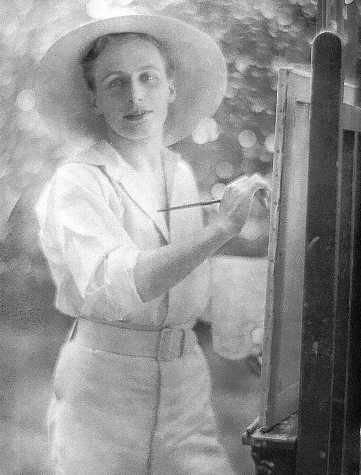
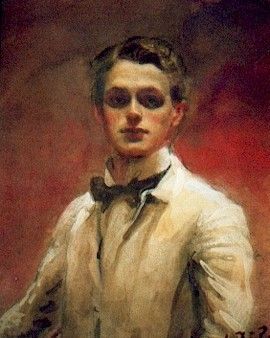
We shall never know whether John Singer Sargent, the American portraitist, or the pioneering French photographer Baron Adolph de Meyer, was tempted to seduce William Bruce Ellis Ranken, the extraordinarily handsome young artist who had studied at the Slade School of Art.
But it is an irresistible possibility.
The two older men had witnessed the disgrace of Oscar Wilde, and if such thoughts existed, they would have had to remain unspoken. Desire was one thing; admitting to it was quite another.
But suppose, for a moment, that they were both captivated by Ranken. Might he have replied, in that soft Scottish accent:
“I am flattered by your attention. I am happy to be seduced by either of you. If it advances my career, I shall willingly sacrifice my innocence. But you must understand that I already belong to someone else.”
That someone was Ernest Thesiger, Ranken’s fellow student at the Slade, who would go on to become an actor.
Perhaps Thesiger, with his taste for theatricality and his instinct for the deliciously ambiguous, might even have prophesied what I am suggesting here. The title of his 1927 autobiography seems almost to wink at us from across the decades:
Practically Correct.
“I knew that one day somebody would understand,” Thesiger might have said. “That we had to hide our forbidden passion.”
“But there were wicked tongues,” Ranken might have added. “The spiteful and the jealous, always watching, always waiting to discover something that was never meant to be discovered.”
According to the story, Ernest and Ranken’s sister, Janette, devised a solution. They would become brothers-in-law as well as lovers.
“I did not like the idea,” Ranken might have confessed. “But there was no choice. I shaved off my hair — an act of protest, shock and grief. And yet the three of us lived together in harmony, protected, at least for a while, from the prying eyes and insinuations of others.”
Whether any of this is true is another matter.
Perhaps that is precisely the problem with Ranken. There is so much about him that sounds invented even when it is not.
William Bruce Ellis Ranken was an extraordinarily handsome Edwardian aesthete: flamboyant, charming, fiercely dramatic and devoted to beauty. He inhabited a world of visual splendour, yet apparently possessed a warmth that made him unusually free of the snobbery one might expect from his surroundings.
He seems, in retrospect, almost too perfectly cast for the role.
And perhaps that is why the temptation to invent a little around him is so difficult to resist.