
The Countess, the Living, and the Dead
There was a video featuring Adam Rickitt, who had been big in Coronation Street, in which he appeared naked. The song had been around when David had been clinging to the frayed edges of his youth. He hadn’t pulled it off. Everything went downhill afterwards. Adam Rickitt went to New Zealand to appear in a soap and was accused of stealing a block of cheese, a bottle of HP Sauce and a jar of coffee from a supermarket. David had moved out of the family home because the banks were knocking at the door.
On Sunday night, they had called at a gay bar, and David saw Adam Rickitt on the screen again. “I would gladly have sniffed his bollocks,” he told Joshua, who turned his nose up. “What the fuck is this shite?”
David recalled dancing to Adam Rickitt at Cruz 101 in Manchester. He was high on ecstasy at the time. But he’d gone to a friend’s flat afterwards and written the best chapter of a book he had never written—longhand, too. Then he had left it behind, where it ended up in a black wheelie bin.
Mancunian days. Every weekend in the North West. But he remembered little. The only memory he retained was of a cute little chicken who had taken his shirt off and started singing, “Sexy… everything about you, so sexy.”
David went home with him. The biggest shithole in Longsight, with every room knee-deep in empty Coke bottles. The bed was hidden behind a mountain of takeaway boxes. It had taught him that all that glittered was definitely not gold.
He related the story to Joshua while walking home in the rain.
“You’re too posh,” Joshua warned him. “Too many frills and high expectations.”
“But I ended up with you,” David replied.
“Your problem is that you look too much at the past, and forget about the future.”
“But there isn’t much of that left, is there?”
David was feeling down.
March had been a bad month. April looked bleaker.
“There are too many deaths, Joshua. Once, I went to weddings all the time. Now I go to funerals. I suppose we’re all in the same boat, because everybody dies.”
But Joshua was too young to understand and nudged him on the arm.
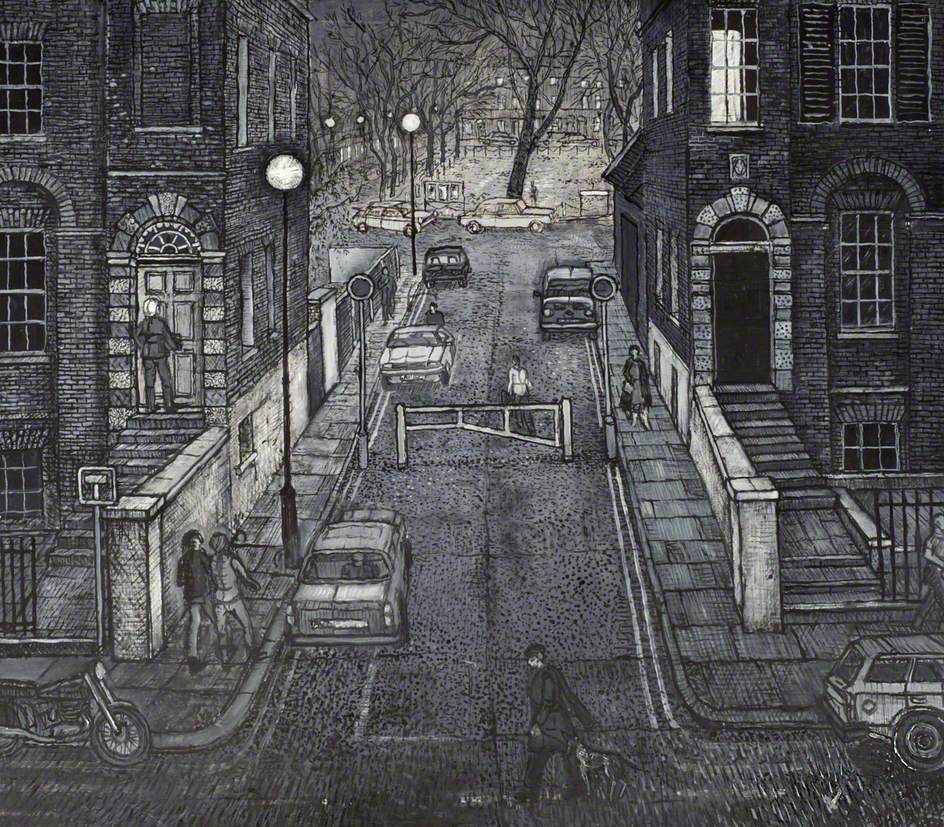
David was referring specifically to their next-door neighbour, who had surrendered to the inevitable. In the square, Dorothy Jerman had been known as the ‘Countess’ and lived alone. Not many had known why she was called the Countess, but there was a suggestion that it was a nickname given to her by a former landlord at the Prince of Wales opposite.
“That’s right,” she once told David. “He was the Brixton Bomber, a former boxer, who took over in the 1960s and upset residents by installing a juke box. It attracted teenagers and the lawyers and solicitors who lived nearby wanted a quiet pub and drove him away. But he was a good chap, and called me the Countess because he wanted to get into my knickers. Little did he know that I never wore any.”
The Countess, a portrait painter, had moved here in the early sixties when Cleaver Square had been different to what it became. She shared it with her kids after a messy divorce and remained after they had grown up and left. By all accounts, she was a ‘rebel’ who famously held wild parties that spilled out into the street.
David inherited the house next door and on most fine days, the Countess could be found sitting on the front steps, a glass of wine at hand, either reading a paperback or making conversation with anyone who passed.
And the Countess had loved Joshua from the moment David invited him to move in with him. Two fucking artists, David had mused. Joshua would sit on the steps as she stroked his blond hair and told him stories about her life.
She claimed to have chosen Cleaver Square on the recommendation of a friend, Innes Fripp, a landscape painter and portrait artist who had taught at the nearby City and Guilds of London Art School and once had a studio in the square.
David had looked up the connection and found that it might have been true. He also discovered that the area had once been called Prince’s Square, named after two houses flanking the entrance, built for Joseph Prince by Michael Searles in the 1760s. The name was changed in 1937, a throwback to Mary Cleaver, who had owned the land in the eighteenth century.
“This is where sea captains lived,” the Countess once boasted, “but the square fell on hard times by the end of the nineteenth century and attracted old music-hall stars instead. It fell on evil days—crumbling brick façades hiding three families across three floors. During the war, the council requisitioned many of the houses for bombed-out families. The trees died, and the gardens were razed.
“South of the river was one vast slum when I arrived. When I fled Chelsea’s superficiality, the square was dilapidated, with shabby red-brick houses—homes for dockers and clerks—but every door stood open. Everybody knew everybody else. Materially, they had little, but they shared it when needed. Then the developers came, and with them came the barristers, judges, and MPs. That was when the doors shut. The young people drifted away, saying the square was not worth living in—it was dead. That is how we ended up with John Major.”
The houses went for millions now, but the Countess had not been tempted to sell. She could have died a millionaire, but preferred to live with her memories and pry into the lives of people she did not know… and who might have looked down on her, had it not been for her cheek and charisma.
When David arrived in the square, the Countess welcomed him as somebody who lived on her level. Shortly before he died, David’s uncle, William, had kicked out the previous tenants with a view to selling it. It was vacant when David discovered that the property now belonged to him.
But now the old woman had died.
It was good fortune that the Countess had resolutely refused to lock her front door. Joshua had gone looking for her and found the body slumped in a fireside armchair: a flute of flat champagne beside her and a dog-eared copy of Valley of the Dolls in her lap. He had panicked and gone running round to David, with no idea what to do.
Only the day before, David had made an unnerving discovery. The Countess had told him that he was not an Aries after all, but a Taurus. It had taken sixty-two years to learn the truth. But David, who normally paid little heed to astrology, realised that he preferred being a ram to a bull—it was better for a gay man, he suggested.
“A cusp baby,” the Countess commiserated, “and if it helps, you have adopted elements from each star sign.
“You do love a grand romance—you throw yourself into it, heart first, and breathe your partner in as though they were oxygen. But you bruise easily in love, my dear, and you’re far too quick to feel taken for granted. You’ve a weakness for strays as well—people from all walks, the straighter the better.”
“I do have a weakness for working-class boys,” David agreed. “And Joshua comes from a relatively poor family in Thamesmead.”
“Really?” said the Countess. “I had no idea. He speaks with such charm and dignity—and is incredibly handsome. And Thamesmead is perfectly lovely in the summer.”
“I met him when he was only twenty-one and working at Morrisons. For some reason, I was walking around the lake and came across him standing there, looking at the birds on the water. I found out later that he didn’t know one bird from another—except when we were talking about cocks. He had been cruising for a shag, which he didn’t get, but we talked. I pointed out that Thamesmead had been the setting for A Beautiful Thing, which turned out to be his favourite film. Eighteen years later, here we are.”
The Countess had not finished.
“You may have secret love affairs or fall in love with someone who is quite unavailable to you.”
“That’s not true.” David had been a bit too quick to reply, and the Countess raised her eyes, because she had not, for one minute, believed him.
David was thinking about Miles, his provincial friend, whom he had first met when the boy was eighteen. Putting Joshua aside, he had spent the last eight years trying to seduce Miles, but had failed at every attempt. Unknown to Joshua, David had once fallen in love with Miles. It was never reciprocated, but that feeling never changed. Miles was only interested if you happened to be a good-looking French or Italian boy—certainly not somebody like David.
“Are we referring to Freddie, dear?” the Countess asked.
Freddie lived in Hammersmith and was the same age as Miles, but his eccentricities annoyed David—not least his tendency to point out dead people whom he claimed to see at the most inappropriate times. Once, David had slept with him, and Freddie had told him that there was an old woman sitting knitting at the bottom of the bed. He had also ingratiated himself with the Countess because he claimed that a family friend had used his name for a character in The Archers. That had gone down extremely well, because she listened to the programme without fail.
“The last time that I saw Freddie,” she laughed, “he suggested that there was the presence of two dead women—Christine and Hannah—who once ran a brothel here. I talk to them all the time now, and suggest that far worse things have happened in my time.”
“It is definitely not Freddie,” said David, “and I would appreciate it if you did not repeat that to Joshua.”
“Because Venus represents attraction, and the twelfth house is associated with the feet,” she said, “your feet may be especially attractive—and have erogenous zones!”
He had turned his nose up.
David and Joshua headed home and passed the Countess’s house, which stood in darkness.
“I wonder what will happen to the house,” Joshua speculated.
“Well,” said David, “she must have had a will, and I suppose everything will go to her family.”
They were both aware that the Countess had fallen out with her three children, and only one of her grandsons, Owen, ever visited her. The two of them had known him as a young teenager and knew that he did much of the maintenance work around the house, though there were difficulties the Countess had often fretted over.
“If Owen gets everything,” Joshua mused, “it could prove interesting.”
David thought that Owen had grown into a striking young man, but conveniently overlooked that he suffered from a severe case of ADHD, which made him prone to violent bouts of temper.
“He would most likely sell it and become fabulously wealthy,” he suggested.
David knew that the Countess was of sound mind and that she had deliberately led her family to believe that she suffered from delusions—among them that she saw thousands of long-tailed birds clinging to a tree in her back garden, that the other trees were covered in hundreds of cats, and that dead dogs with fiery eyes lived beneath the bushes.
“At least it stops them visiting a crazy woman,” she had laughed.
“Whoever it is left to will find it contested,” David added, “because they will say that the Countess was of unsound mind when she made it.”
“Maybe she was deranged,” Joshua decided. “She often claimed that all sorts of famous people visited her at one time or another. She once told me a magnificent story about Vivienne Westwood, David Bowie, and Marc Bolan coming to tea—and that they ended up bouncing along the street on great big orange balls.”
Space hoppers,” David implied. “I had one when I was a small child in the 1970s. Did you know that Russell Harty was also a personal friend of the Countess?”
David knew that Joshua would not know who Russell Harty was.
“What was he famous for?”
“Sexual escapades with much younger men,” David replied, “and for hosting chat shows on television.”
David had met him once, when he had still been young enough to turn heads in the street. Harty had just returned from Paris, where he had lunched with Nureyev and Charlotte Rampling at the British Embassy. He made small talk, and David was disappointed that this brief encounter on Greek Street had not led to anything more. Still, it had been enough for him to brag about at Comptons.
A few months later, Harty was dead, having suffered liver failure—a result of hepatitis.
“The Countess knew everyone, or said she did. And now there’s no one left to confirm it.”
“That’s the problem,” said Joshua. “Did these encounters actually happen? Was she connected, or just a brilliant bullshitter? I often wonder the same about some of your stories.”
That last comment hurt David.
“Everything I tell you is true.”
“But nothing ever seems to happen to me. The Countess knew famous people. And you’ve done things—wild things—that make my existence seem ordinary.”
“The older you get, what once seemed ordinary suddenly becomes fascinating. We all look back and realise that we did something special.”
The funeral was due to take place the following Friday. The cortège would leave Cleaver Square at lunchtime and travel to Lambeth Crematorium, where a short service would take place before she was handed over to the devil.
Joshua unlocked the door and turned to David. “Do you think we’ll see anybody famous at the funeral?”
“Probably not,” David replied.




 Perfectly Hard and Glamorous