Tag Archives: Fiction

The Shadowed Hand Behind the Letter


Being the transcript of a letter unearthed in the long-sealed vaults of the Royal Bank of Scotland, November 2025

George Walker Wood
66 Cavendish Street,
Marylebone
London

29 November, 1881

My dear Reader,

If by curious chance you hold this manuscript in your hands, I entreat you to read its contents with the utmost seriousness. Only by such attentive perusal shall you perceive that the pages which follow are both an explanation and a justification for their long concealment.

Should it prove that I still draw breath when these lines meet your eye, then I beg of you—burn them without delay, and disclaim all knowledge of ever having encountered them. The shame that would ensue from their divulgence is of so dreadful a nature that I scarcely dare commit the thought to paper.

I shall therefore begin at the point where first I made the acquaintance of one Johane—an Irish youth of some four-and-twenty years, of humble condition, and with every outward appearance of one who might easily draw misfortune to my door. He was, however, most commonly called Jack, and by that familiar name I shall refer to him henceforth. Dear Jack belonged to a loose fraternity of young loafers and street-bred rascals—variously known as the “London Boys”—a wild and merry set whose manners were as questionable as their morals, yet whose very recklessness possessed, for me, an unaccountable fascination.

In time I grew most attached to Jack, and he attended me frequently at my lodgings in Marylebone. There, behind doors safely bolted, we indulged in certain intimacies which, though common enough within that unseen sphere of which London pretends ignorance, would cause polite society to feign horror. Jack’s person was slight, his garments threadbare and ill-assorted, and he bore all the marks of those who are forced to wrest their sustenance from the streets; yet beneath that rough exterior there was a warmth and vigour not easily described. When fortune smiled and I had a few coins to spare, he would remain with me until morning, and those nights—cold, anxious, sweet as they were—remain fixed in my memory.

I suspect that my landlady, Mrs. Chivers, a stout matron of no small curiosity, had taken something of a liking to Jack as well; for once I discovered him seated at her kitchen table devouring a modest breakfast of bread and scrape. The glint of mischief in his eye, as he looked up at me over the crust, told me all I needed to know. She had chosen to see nothing of the nature of my rooms above.

My days were spent at the old desk overlooking Cavendish Street, where I composed articles for The London Figaro and The Dark Blue. Yet I had long nourished the ambition to attempt a novel—something that might echo, however faintly, the triumph of A Tale of Two Cities. My parents, never slow to remind me of my deficiencies, assured me that I lacked both imagination and creative faculty, that I was fit only to set down facts and order them neatly upon a page.

Still, I could not forget the tales Jack whispered to me during those winter nights—tales of gentlemen of rank who sought his company at a high price; of drawing-room adventures veiled beneath the richest draperies; of temptations and behaviours of which the world speaks only in scandalised murmurs. Spurred by these accounts, I sought the acquaintance of a certain printer known to an associate of Henry Ashbee—a man whose livelihood depended upon the discreet production of pamphlets of a decidedly provocative character.

Mr. William Lazenby, a sharp-eyed fellow, showed interest in my idea and agreed to an initial impression of two hundred and fifty copies. He offered me a share of the profits, subtracting his considerable costs, should I but write with candour. The sums he mentioned far exceeded any I had yet earned, and the promise of so easy a reward was exceedingly tempting. He informed me that the book should be sold exclusively by mail-order through an address in Paris, and insisted that I adopt a nom de plume, lest I bring inevitable ruin upon myself.

When I conveyed the scheme to Jack, he immediately demanded—nor without justice—a share of the proceeds, and further insisted that his own name be affixed to the work. I warned him that the police might take a dim view of such recklessness, but he merely laughed and declared that the “mutton-shunters”, knowing full well he could neither read nor write, would never suppose him connected to any printed matter. With that he tumbled himself upon the bed in his usual impudent fashion and suggested that we commence our “research” without delay.

By June the manuscript was completed, and I had settled upon what I deemed a most fitting title—The Sins of the Cities of the Plain. Though Mr. Lazenby scoffed at it, he conceded that the biblical suggestion would doubtless catch the eye of those gentlemen who take an interest in such hidden matters. I confess I feared that certain passages, dealing as they did with the concealed customs of our clandestine fraternity, might prove too recognisable to those acquainted with that shadowed realm.

Lazenby nevertheless published the work in two parts, and it found immediate favour among readers eager to feast upon the covert indulgences of the great and respectable.

Though I tremble at the thought of its reception, I take comfort that my own name has thus far escaped suspicion. I offer here my apologies to Mr. Simeon Solomon and Mr. James Campbell Reddie—both of whom have been unjustly whispered about in connection with this deception. Jack, meanwhile, basks in the admiration of his companions and seems persuaded that a century hence his name will still be spoken among certain circles of “inverts”, as he jests.

This very day I have deposited my first earnings at the Lombard Street branch of Messrs. Glyn, Mills, Currie & Co., alongside this confession, sealed and hidden, to remain in the vault until such time as Providence ordains its discovery. Should that day come, I trust that The Sins of the Cities of the Plain shall be regarded as a truthful and unvarnished portrait of those whose society I have come to cherish.

Ever, dear Reader, your faithful servant,

𝒢. 𝒲𝒶𝓁𝓀𝑒𝓇 𝒲𝑜𝑜𝒹
⌣⌣⌣⌣⌣⌣⌣⌣⌣
George Walker Wood

*****

Now read on to separate fact from fiction.

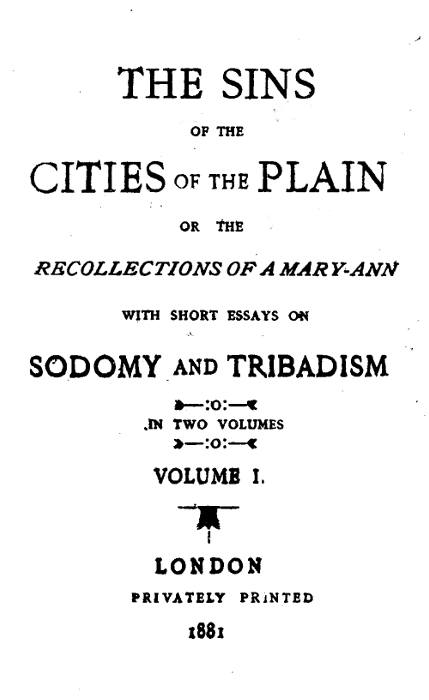
This edition contains the unabridged text of the first edition housed at the British Library, together with a new introduction by Wolfram Setz and a facsimile reproduction of the original volumes’ title pages.

The Sins of the Cities of the Plain is an influential Victorian erotic novel, originally published anonymously in 1881 and widely considered one of the first works of exclusively gay pornography in English. It is a fictionalized memoir attributed to real-life Irish prostitute Jack Saul.

The book is a narrative, presented as the “recollections” or “memoirs” of Jack Saul, detailing his experiences as a young male prostitute (a “Mary-Ann” or “rentboy”) in the clandestine gay underworld of Victorian London. It traces his escapades from boarding school into young adulthood, describing his sexual encounters with various men, from schoolboys and guardsmen to wealthy aristocrats and members of high society.

While attributed to Jack Saul, the actual author is debated by scholars, with some suggesting a ghostwriter or figures like the painter Simeon Solomon or James Campbell Reddie were involved. The book was privately printed in two volumes in 1881 by William Lazenby to avoid obscenity laws and sold for a high price.

The original printings are unobtainable today, but modern editions are widely available from various publishers, such as Valancourt Books and Mint Editions.

What remains for Harry Oldham when the glow fades?

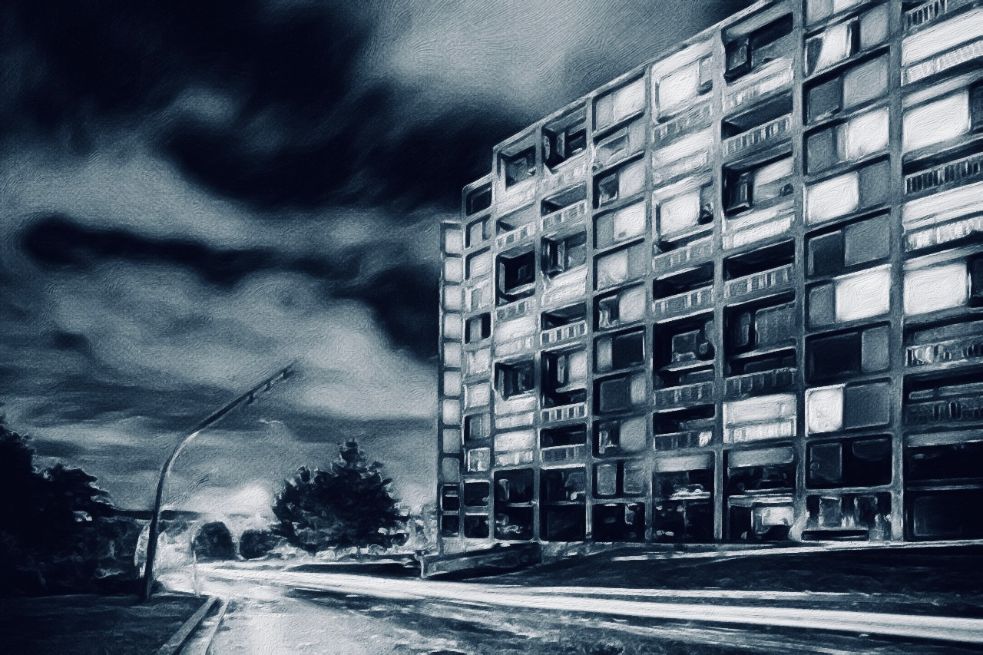
Harry Oldham is writing a novel based on his criminal and sordid past. To do so, he has returned to live at Park Hill, where he grew up, and the place that he once left behind. That was then and this is now, in which the old world collides with the new. (Parts 1 to 17 are available to read in the menu)

Perfectly Hard and Glamorous – Part 18

October 2025
There was a paperback of Saturday Night Fever published in 1977 by H. B. Gilmour. I read it when I was twelve. If I remember right, the novel said that Tony Manero looked like a young Al Pacino. In the film that came first, a girl he kissed on the dance floor gasped, “Ohh, I just kissed Al Pacino!”

I hadn’t a clue who Pacino was, only that he must’ve been something to look at. “Pacino! Attica! Attica! Attica!”

Decades later, Pacino published his autobiography at eighty-four. Everyone knows who he is now. It’s a decent book—above average—and I doubt he wrote it himself, but I’ll gladly be proved wrong. He writes beautifully about the part of life most people avoid thinking about: the last act, when the runway ahead is shorter than the one behind, as David Foster once put it.

Compared to Pacino, I’m still young. But sixty looms, and yes—I care a fuck. Quite a lot, actually.

I looked in the bathroom mirror and flinched. The face staring back didn’t belong to me. Wrinkles, dull skin, cheeks softening with age. Not the face of an eighteen-year-old; the face of an old man.

That night I dreamt of Andy, Jack, and me—partying by the Cholera Monument. Summer, though the skies were leaden. We were drunk, a boom box blaring New Musik. Rain began to fall, but we didn’t care. We danced, the drops sliding down our fresh, young faces. “It’s raining so hard now / Can’t seem to find a shore…”

We stripped to our boxers, soaked and clinging, leaping like fools. Paolo watched from under a tree, the outsider at the edge of a brotherhood. I wanted him to join us, but he stayed still, afraid.

When the song ended, our clothes were a sodden heap. We grinned, knowing this moment could never happen again. Paolo walked over, still fully dressed, and looked me up and down. Do you like what you see, Paolo?

He shook his head. When he finally spoke, I wished he hadn’t. “Harry, what are you doing? What happened to your body? Old men don’t behave like this.”

I woke to a shadow in the doorway. “Harry, you okay?”

Tom. He came and sat on the edge of the bed. “I think you were dreaming. You started shouting.”

“What did I say?”

“I don’t know, but you woke me up.”

“Fuck.”

“What were you dreaming about?”

I’d read that dreams fade fast because they live in the same part of the brain that controls movement—crowded out the moment we start to stir. But I remembered this one. And I blamed Al Pacino.

“What time is it?” I asked. “When did you get here?”

“Four a.m. After midnight, maybe. You didn’t hear me come in.”

“At least you haven’t lost your key yet. I take it you’ve finished your drug dealing for the night.”

He rolled his eyes. “Harry, I told you—what you don’t know won’t hurt you.”

Tom had mellowed since I met him two years ago. Back then he’d have clenched his fists and spat, “What the fuck’s it got to do with you?” Now twenty, he was as much a part of the flat as I was. He drifted in and out, sometimes gone for days, then suddenly asleep on the sofa when I woke.

Why I let him into my life, I’ve asked myself a hundred times. Just not tonight. Tonight, I was glad of him.

He lay back, staring at the ceiling. I went to piss. When I came back, he’d slid up beside me, hands behind his head.

“What are you doing?”

“I’ve never really been in your bedroom before.”

“Liar.” I’d made it clear it was off-limits, but I knew he’d snooped when I wasn’t around.

“Why did you become a writer?”

“Ah, the loneliest job in the world.” I hesitated, then answered.

“One night—a year before I left school—my parents came home from an open evening. Same story every year: teachers saying how useless I was. But that night, my mum came into my room looking excited. She said, ‘Mr Green, your English teacher, thinks you’ve got imagination if you put your mind to it. He said if you used better, longer words, you might pull through.’ My dad, standing behind her, added, ‘I told Mr Green he needs to speak properly first… but it’s a start.’ That was the only bit of hope they brought home.”

“Is that when you started writing?”

“Didn’t mean anything then. But in the early nineties, when I was broke, I had this client—older guy, fat—wanted me to piss on him. Easy money. We were lying on a wet plastic sheet in a hotel bed, talking. He worked for a publisher. Said I could make money writing about life as a London rent boy. I didn’t, of course—it sounded like work—but he told me to keep notes. Can you imagine?”

“And did you?”

“Not at first. Then one day I nicked a pack of exercise books from WH Smith and started jotting things down. Faces, nights, bits of talk. Eventually I began adding fiction, and that’s probably when I realised I could be a writer.”

My first book came out when I was in my forties. Nothing to do with rent boys. I’d drafted that novel, but no one wanted it—too sordid, too shallow, they said. One editor told me to try something else. So I wrote a formulaic thriller about a teacher investigating a missing student. I hated every minute of it, but it sold.

Tom turned toward me, and I braced for a jab. Instead, he said, “Maybe it’s time to revisit that old story. Nothing you write could shock anyone now. Might even fit with the book you’re working on.”

He hadn’t read any of my new work, not since that first night. My return to Sheffield and Park Hill had been interesting, if not productive. The book was two years late, my agent losing patience. Still—Tom had a point. I hadn’t thought about including the London years.

“There was a book published in the nineteenth century,” I said. “The Sins of the Cities of the Plain. No one knows who wrote it—some say a young rent boy named Jack Saul. It’s pretty explicit. I lived a life that echoed its pages once, long ago, when I was young… and now I’m not.”

Charlie / I will make him appear extremely homoerotic

Levi in the Bath – Charlie Marseilles

“Shameless. He floats naked in the water, the light rippling over chest and stomach. His lips, as if caught between a breath and a moan, his hand loose at his side like he’s waiting to be grabbed. There’s nothing soft about it – just flesh, need, and the unspoken dare in his stillness. Every line built for touch, for heat, waiting to be claimed. The invitation to take what you want. The sight is blunt, undeniable: he wants to be used.”

Charlie had taken his art in a new direction. He was bored, disillusioned with paintings of landscapes, objects and street scenes. A flirtation with what he called ‘art contemporain’ had ended in frustration. “Circles, squares, solid colours, lines, zig-zags … they mean nothing to me!”

The first that I knew about this new path was when I returned home to find Levi, our former lodger, sprawled on the sofa in just his underwear. “It isn’t what it looks like,” he flushed. ”I’m only doing it as a favour.”

Charlie shouted from the bathroom. “I am ready now. The bathtub is full and my camera is ready.” I was bemused to say the least.

Charlie wandered into the room. “Ah, you are home, mon ami. I need the bathroom for thirty minutes while I photograph Levi.”

The Polish boy with the Yorkshire accent followed him along the corridor and into the brightly lit bathroom. With a certain amount of embarrassment he stepped into the bath. “Lay down, Levi, and put your head underwater. I am going to stand on both sides of the bath and take photos from above.”

I watched from the doorway and listened while Levi was told to take deep breaths and submerge himself. Then he had to raise his right arm, then his left, and then both of them together. All the time, Charlie was precariously balancing, taking shot after shot. 

When they had finished, Levi stood up, looking satisfyingly toned, and dripping from head to toe. Charlie looked him up and down. “As I suspected, you have a little dick, but we cannot all be lucky. You can get dry now.” 

“I feel stupid,” Levi told him, “and I haven’t brought any dry boxer shorts.” Charlie flicked through the images and appeared not to have heard him, so I went to a bedroom drawer and gave him a pair of mine to change into.

That night Charlie spent hours searching for the right photo. The next morning he visited a local print shop and had it blown up to the size of a small poster. He placed it on an artist’s easel and studied it. “I am going to use this photo to create my next painting,” he announced. “If it is successful then I am going to start painting beautiful men from now onwards.”

I reminded him that there had been a time when he would have considered Levi anything but beautiful. “That was the case,” he replied, “but I needed somebody that I knew who was willing to model for me, and when I have finished, I will make him appear extremely homoerotic which is something he is definitely not.”

Somewhere he hasn’t yet imagined


He crouched at the platform’s edge, elbows balanced on his knees, his bare arms lit starkly by the fluorescent tubes above. The train had not yet arrived, but the rails sang faintly, a low vibration that climbed through the soles of his shoes. He leant forward, alert, as if he could will it closer with the sharpness of his gaze.

The station smelt of metal and damp stone, a place most would find tired and ordinary. But for him it felt alive – charged. His youth made everything sharper: the hum of electricity, the echo of footsteps along the tiled walls, even the restless air that slipped through the tunnel ahead. He sniffed his armpits and detected the sweet aroma of innocent sweat that he rather liked.

And then the lights appeared, two pale orbs cutting through the dark, and his breath caught. It was only a train—one of a thousand that came before and would come after. Yet in that moment it felt like something else entirely, a promise or a dare. The train held his past, and once he had boarded, it would move him towards a future. He didn’t know where it would go, only that he was ready to be carried.

He grinned to himself, a private smile that nobody else saw. His whole body hummed with the knowledge that he was young, and that youth meant possibilities. 

The Bathwater


Maria was tired of life. Tired of the flat that they lived in. Tired of not having enough money. Tired of being a mother to a four year old. Tired of not being able to take a bath on her own. That was it. She was tired of Joe most of all. They sat opposite each other in silence. She kept still, but he  fidgeted, unable to get comfortable and put his feet against the wall behind her and trapped her head between his legs. She noticed the scar on his left knee that had turned pink in the hot water. She also saw how white the bubbles on his legs seemed against the dirty bathroom tiles. Joe lit a cigarette and offered it to her, but she declined, and he simply shrugged. All the time he flicked ash into the bathwater, but she no longer cared. At least he wasn’t wearing sunglasses like he normally did in the bath. ‘I used to love him,’ she thought, ‘but now I hate him more than anything.

And then to bed, where half in doze, I seemed to float about a glimmering night of Uranians

Image – Charlie Marseilles

I was dancing with ghosts. Men who lived from the reign of Queen Victoria, through Edward VII, to King George V. A few lived beyond. They were spectral figures circling me, wavering, and waiting for a response. Watchful. Whispering. Lingering. For the most part, they were happy that I was there, but a few eyed me with caution. They lived in a time when it was wiser to trust nobody.

More and more joined the dance. Coming out of doors that had long closed, from dark corners, and miserable places to where they were banished.

Each told me their name, some I knew, but most were unfamiliar, and frowned at my ignorance. There were those whose names I recognised, but not the men they belonged to. But there were so many that I would not remember everyone, and I resorted to recording names in a notebook. I wrote frantically, eager to please, careful not to miss anyone.

A long list of dead people, some of whom were friends, acquaintances, and some who were strangers to one another. They danced because they were connected – names intrinsically linked – but they might not have known it. They had gone into my notebook because they shared something in common.

When they lived I did not exist. I came much later, born into a kinder world. 

The passage of time puts me at an advantage. A century later,  it is easy for me to see how they lived, what achievements came their way, if at all, and how they were remembered, for better or worse. The links are  in the chain –  who was attached to who?

The Boy with the Black Dog

Image: The Boy with the Black Dog – Charlie Marseilles

Ten o’clock in the morning and I hoped that I wasn’t too late. I stood on the terrace and looked upon the narrow street, the wait tense, every figure a possibility, every person making my pulse leap, until I remembered the black dog, and the disappointment set in.

I was in my hiding place, and he wouldn’t know that I was there, the anticipation laced with secrecy, maybe even guilt. I was invisible, while he was exposed for everyone to see. What would happen if he looked up? Would he even notice me? What if I wasn’t the only watcher?

The minutes ticked by and I hoped that he would appear, and when he did, it would seem like the world was holding its breath. I waited for the boy with the black dog.

Charlie / The mystery of the black Calvin Klein briefs


The day started with a mystery that caused a problem. Charlie had done the laundry and I had been angry. It doesn’t matter how many times that you tell him to separate whites and colours, he refuses to do so. The result was that my white t-shirts came out pink yet again. When I challenged him about it, he sulked, and put the rest of the clothes away in silence.

And then we came to the black Calvin Klein briefs. 

Charlie was putting them in my drawer and I pointed out that they didn’t belong to me. He held them between his fingers and examined them. “They are not mine either,” he decided. “They must be yours,” I replied. “They are definitely not mine.”

We stared at the underwear and waited for the other person to admit to owning them. But neither of us coughed up.

Charlie tossed them onto the bed. 

“This poses a significant problem,” I decided. “If they don’t belong to either one of us, then whom do they belong to?”

“That is a very good question. Do they belong to someone who you have been sleeping with?”

“In your dreams,” I responded, but there was hesitancy in my voice. Charlie had the ability of making you feel guilty even when you were innocent, and this was one of those occasions. He pounced upon my uncertainty and decided that I had been sleeping with someone who had forgotten to take their underwear home with them. 

“I can assure you that I haven’t slept with anyone. The only person that I’ve slept with is you, but even that’s debatable.”

“What do you mean?”

“Nothing. I’m just a bit upset because I know that they are not mine, nor are they anybody else’s that I know of, so the finger of suspicion points squarely at you. Have you been sleeping with somebody behind my back?”

Charlie rubbed his hands through his hair in desperation. “Do not be disgusting. I have not been sleeping with anybody.”

“Was it one of those American Mormon boys who came knocking at the door? Did one of them come back when I was out?” It was a cheap shot. But a few days before, they had come bright-eyed and eager to save our souls. I’d politely turned them down and said to Charlie that it was inconceivable that every Mormon boy appeared to be cute. 

When Charlie was hurt, his French accent became more pronounced. “I believe it when you say that you know nothing about them, but you must also understand that I have nothing to do with them either.”

“But whose are they?”

“I have no idea. But maybe they belonged to Levi who left them behind when he moved out.”

“But that was weeks ago,” I said.

“I guess that there is no other explanation.”

And that was where we left it. Black Calvin Klein underwear unclaimed.

I’m on a beach with nothing to do except write shit on my phone

Image: Readymoney Cove / PHG / 2025

Sometimes, you have nothing to do except watch and think. It’s Tuesday afternoon, it’s overcast, and I’m sitting on a beach… I tap random thoughts into my phone… and later, it reads like a diary, but also conjures up memories of being a child when we had ‘news books’ in which we wrote any drivel that might have happened.

This is my drivel…

Megan tells me a story about Peran of Polruan, with his salty brown legs, who lives alone in an old fisherman’s cottage called The Buoy. Never a visitor. Not a word to anyone. The girls think he’s a Cornish Saint and want to have sex with him. Every morning he catches the river ferry and returns at teatime. Where does he go? What does he do? On summer evenings he reads on the doorstep. I’m intrigued, but I want to know more about the books that he reads.

***

I’m looking for a bit of phwoar on the beach. I want a handsome young guy who strips to his shorts and goes swimming. But on this cloudy Tuesday afternoon I’m blessed with old ladies in one-piece costumes who do sedate breast-strokes to the pontoon and back. Shortly after four o’clock, a blonde schoolboy appears and parks himself close by. His shirt is untucked and the school tie hangs loose around his neck. From his bag, he pulls out a copy of William Golding’s Lord of the Flies and starts reading. He seems happy being with Ralph and Jack, and I wonder which one of them he’s sympathetic to.

***

It’s been a month since I had a cigarette. I realise this whilst standing on the quayside. Instead, I’ve been using my Pro Max Double Apple – 10K puffs. What might you get up to with ten thousand puffs? Behind me, a sour-faced woman moans to her husband that I’m vaping. I turn around and give her a deadly look and she tuts. There wouldn’t have been any remorse if I’d pushed her into the sea.

***

“The Tesco delivery is coming tomorrow morning,” says Megan. She makes it sound like this is the highlight of the week. It might well be. She’s changed a lot since moving down here. Where is the Megan I once knew? The girl who drank Aperol Spritz by the dozen and got her tits out afterwards. “That’s exciting, I look forward to it,” I reply. She gives me a wicked look. “I was hoping that you might stay in and wait for him. I think that you’ll be less sarcastic after you’ve seen the Tesco guy.”

***

I write at the kitchen table with the door open and ignore the wasps that fly in and buzz above my head. I’ve realised that they soon get bored and leave the same way that they came. Megan appreciates my eclectic music tastes and has recommended an album called Senza Estate by My Friend Dario. It plays on my laptop while the wasps gather around the Corn Flakes. One of the tracks is called Keep on Cruising which is calming and innocent, and far removed from the cruising that I’m used to.