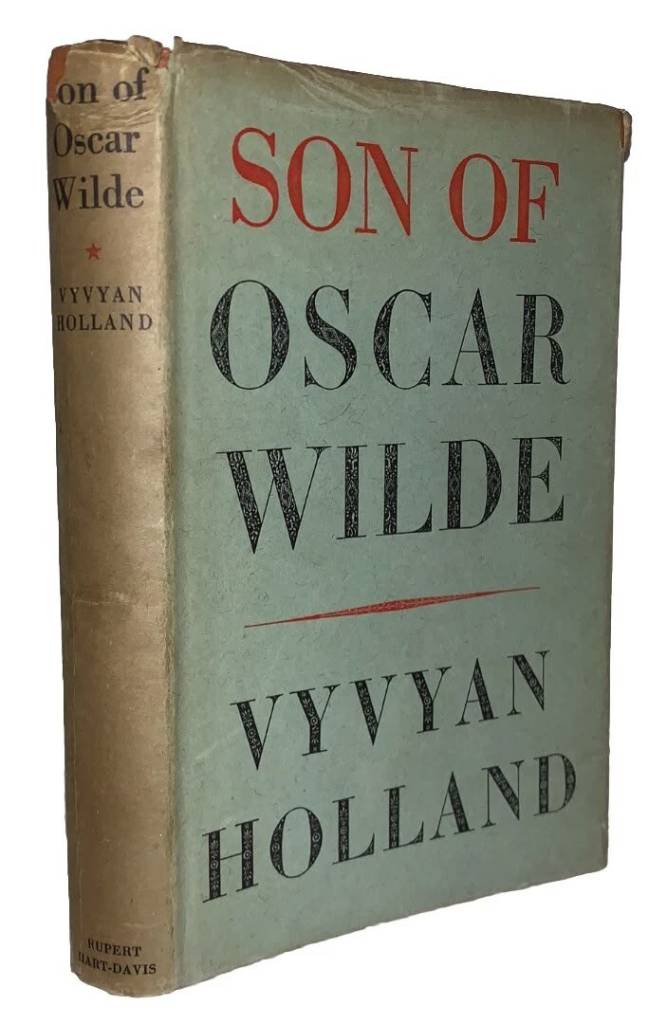
“The self-righteousness of that age was really camouflage to disguise its own hypocrisy, and the people who were loudest in their condemnation of my father were often those whose own lives could least bear investigation.”
– Vyvyan Holland writing in Son of Oscar Wilde. Published by Rupert Hart-Davis (1954)
And I can’t help thinking that the same still applies…
– Being the transcript of a letter unearthed in the long-sealed vaults of the Royal Bank of Scotland, November 2025
George Walker Wood 66 Cavendish Street, Marylebone London
29 November, 1881
My dear Reader,
If by curious chance you hold this manuscript in your hands, I entreat you to read its contents with the utmost seriousness. Only by such attentive perusal shall you perceive that the pages which follow are both an explanation and a justification for their long concealment.
Should it prove that I still draw breath when these lines meet your eye, then I beg of you—burn them without delay, and disclaim all knowledge of ever having encountered them. The shame that would ensue from their divulgence is of so dreadful a nature that I scarcely dare commit the thought to paper.
I shall therefore begin at the point where first I made the acquaintance of one Johane—an Irish youth of some four-and-twenty years, of humble condition, and with every outward appearance of one who might easily draw misfortune to my door. He was, however, most commonly called Jack, and by that familiar name I shall refer to him henceforth. Dear Jack belonged to a loose fraternity of young loafers and street-bred rascals—variously known as the “London Boys”—a wild and merry set whose manners were as questionable as their morals, yet whose very recklessness possessed, for me, an unaccountable fascination.
In time I grew most attached to Jack, and he attended me frequently at my lodgings in Marylebone. There, behind doors safely bolted, we indulged in certain intimacies which, though common enough within that unseen sphere of which London pretends ignorance, would cause polite society to feign horror. Jack’s person was slight, his garments threadbare and ill-assorted, and he bore all the marks of those who are forced to wrest their sustenance from the streets; yet beneath that rough exterior there was a warmth and vigour not easily described. When fortune smiled and I had a few coins to spare, he would remain with me until morning, and those nights—cold, anxious, sweet as they were—remain fixed in my memory.
I suspect that my landlady, Mrs. Chivers, a stout matron of no small curiosity, had taken something of a liking to Jack as well; for once I discovered him seated at her kitchen table devouring a modest breakfast of bread and scrape. The glint of mischief in his eye, as he looked up at me over the crust, told me all I needed to know. She had chosen to see nothing of the nature of my rooms above.
My days were spent at the old desk overlooking Cavendish Street, where I composed articles for The London Figaro and The Dark Blue. Yet I had long nourished the ambition to attempt a novel—something that might echo, however faintly, the triumph of A Tale of Two Cities. My parents, never slow to remind me of my deficiencies, assured me that I lacked both imagination and creative faculty, that I was fit only to set down facts and order them neatly upon a page.
Still, I could not forget the tales Jack whispered to me during those winter nights—tales of gentlemen of rank who sought his company at a high price; of drawing-room adventures veiled beneath the richest draperies; of temptations and behaviours of which the world speaks only in scandalised murmurs. Spurred by these accounts, I sought the acquaintance of a certain printer known to an associate of Henry Ashbee—a man whose livelihood depended upon the discreet production of pamphlets of a decidedly provocative character.
Mr. William Lazenby, a sharp-eyed fellow, showed interest in my idea and agreed to an initial impression of two hundred and fifty copies. He offered me a share of the profits, subtracting his considerable costs, should I but write with candour. The sums he mentioned far exceeded any I had yet earned, and the promise of so easy a reward was exceedingly tempting. He informed me that the book should be sold exclusively by mail-order through an address in Paris, and insisted that I adopt a nom de plume, lest I bring inevitable ruin upon myself.
When I conveyed the scheme to Jack, he immediately demanded—nor without justice—a share of the proceeds, and further insisted that his own name be affixed to the work. I warned him that the police might take a dim view of such recklessness, but he merely laughed and declared that the “mutton-shunters”, knowing full well he could neither read nor write, would never suppose him connected to any printed matter. With that he tumbled himself upon the bed in his usual impudent fashion and suggested that we commence our “research” without delay.
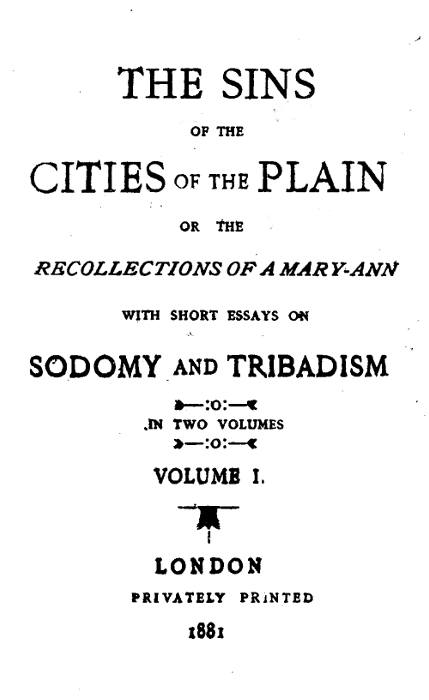
By June the manuscript was completed, and I had settled upon what I deemed a most fitting title—The Sins of the Cities of the Plain. Though Mr. Lazenby scoffed at it, he conceded that the biblical suggestion would doubtless catch the eye of those gentlemen who take an interest in such hidden matters. I confess I feared that certain passages, dealing as they did with the concealed customs of our clandestine fraternity, might prove too recognisable to those acquainted with that shadowed realm.
Lazenby nevertheless published the work in two parts, and it found immediate favour among readers eager to feast upon the covert indulgences of the great and respectable.
Though I tremble at the thought of its reception, I take comfort that my own name has thus far escaped suspicion. I offer here my apologies to Mr. Simeon Solomon and Mr. James Campbell Reddie—both of whom have been unjustly whispered about in connection with this deception. Jack, meanwhile, basks in the admiration of his companions and seems persuaded that a century hence his name will still be spoken among certain circles of “inverts”, as he jests.
This very day I have deposited my first earnings at the Lombard Street branch of Messrs. Glyn, Mills, Currie & Co., alongside this confession, sealed and hidden, to remain in the vault until such time as Providence ordains its discovery. Should that day come, I trust that The Sins of the Cities of the Plain shall be regarded as a truthful and unvarnished portrait of those whose society I have come to cherish.
Ever, dear Reader, your faithful servant,
𝒢. 𝒲𝒶𝓁𝓀𝑒𝓇 𝒲𝑜𝑜𝒹 ⌣⌣⌣⌣⌣⌣⌣⌣⌣ George Walker Wood
*****
Now read on to separate fact from fiction.
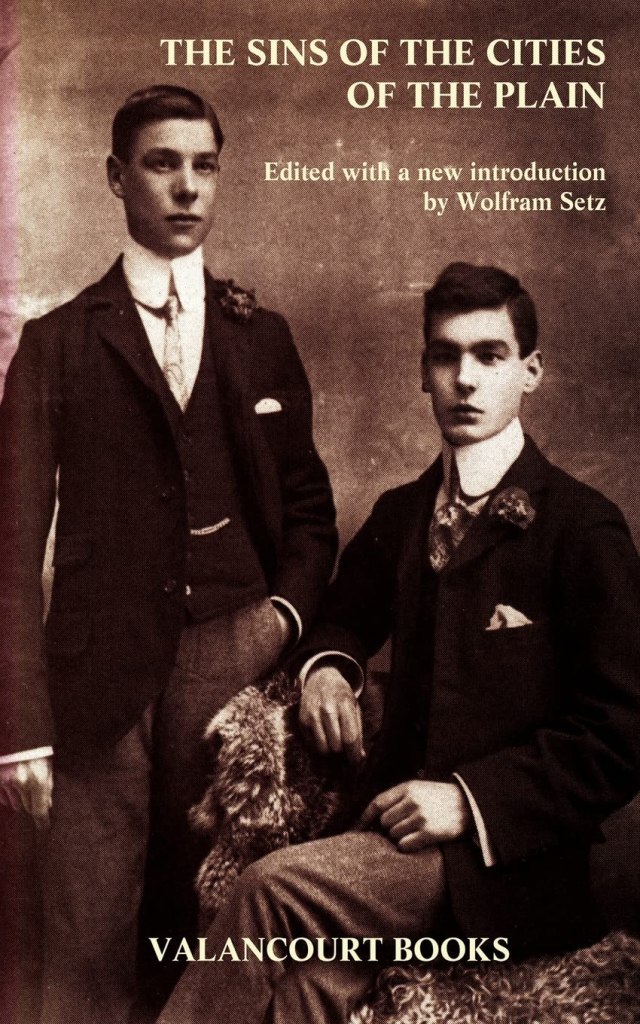
This edition contains the unabridged text of the first edition housed at the British Library, together with a new introduction by Wolfram Setz and a facsimile reproduction of the original volumes’ title pages.
The Sins of the Cities of the Plain is an influential Victorian erotic novel, originally published anonymously in 1881 and widely considered one of the first works of exclusively gay pornography in English. It is a fictionalized memoir attributed to real-life Irish prostitute Jack Saul.
The book is a narrative, presented as the “recollections” or “memoirs” of Jack Saul, detailing his experiences as a young male prostitute (a “Mary-Ann” or “rentboy”) in the clandestine gay underworld of Victorian London. It traces his escapades from boarding school into young adulthood, describing his sexual encounters with various men, from schoolboys and guardsmen to wealthy aristocrats and members of high society.
While attributed to Jack Saul, the actual author is debated by scholars, with some suggesting a ghostwriter or figures like the painter Simeon Solomon or James Campbell Reddie were involved. The book was privately printed in two volumes in 1881 by William Lazenby to avoid obscenity laws and sold for a high price.
The original printings are unobtainable today, but modern editions are widely available from various publishers, such as Valancourt Books and Mint Editions.
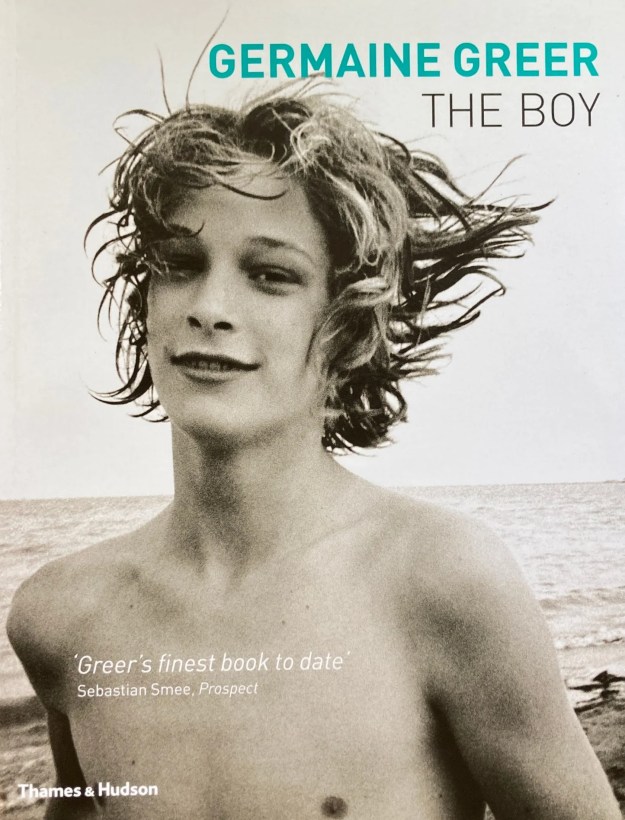
Germaine Greer – The Boy. Published by Thames & Hudson (2007)
Baron Corvo once told me in a dream that I should write something controversial. Terrible advice, obviously. But here we are.
I found a book in a charity shop that Charlie told me not to buy. He said it was distasteful. Which, of course, made me want it more.
The book was Germaine Greer’s The Boy — a 2003 art history study about how young males have been represented in Western art. Greer argued that, for centuries, it was the male body — not the female — that dominated the gaze. Art, she said, used to worship men. Then we decided that kind of looking was shameful.
When it came out, The Boy caused an uproar. Greer said she wanted to help women reclaim their “capacity for visual pleasure,” to look at men the way art has long looked at women. Then she dropped her most infamous line: “A woman of taste is a pederast — boys rather than men.” Predictably, everyone lost their minds.
The book is filled with over 200 images — statues, paintings, portraits — each exploring what Greer called the “evanescent loveliness of boys.” The soldier. The martyr. The angel. The narcissist. The seducer. It’s the sort of book that doesn’t end up on display in Oxfam, which is precisely why I found it there.
The cover shows Björn Andrésen, the Swedish actor who played Tadzio in Death in Venice (1971). The photograph was by David Bailey, but Andrésen said no one asked permission to use it. He was furious — disgusted, even. “I have a feeling of being utilised that is close to distasteful,” he said. And the irony? The week I bought the book, he died, aged seventy.
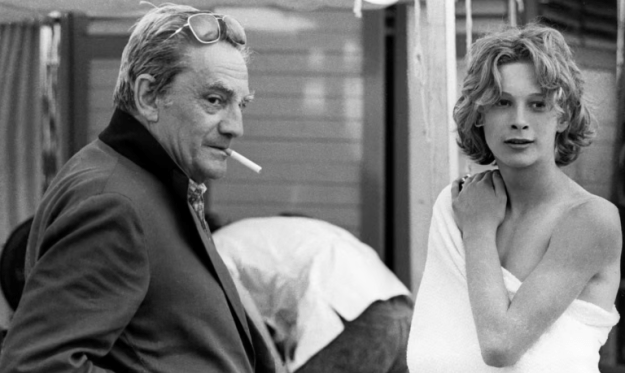
Björn Andrésen with Luchino Visconti on the set of Death in Venice. Photograph: Mario Tursi
Every obituary revisited the same scene: the audition tape from Death in Venice that was included in The Most Beautiful Boy in the World — a documentary about his life. Visconti tells him to smile. Then to undress. He laughs nervously. Strips to his trunks. Shifts under the gaze of men deciding whether he’s beautiful enough.
It’s hard to watch now. Visconti — Count of Lonate Pozzolo, titan of Italian cinema, and apparently, chaos in a cravat — ends up looking less like a mentor and more like a predator. But dead men can’t explain themselves.
When I was fifteen, I’d probably have thought that kind of attention was glamorous. Maybe I’d have handled it. Maybe it would’ve destroyed me. Hard to know. My own encounters with predatory men later on made Visconti look almost saintly by comparison. At least he left art behind. Maybe Andrésen’s story isn’t just one of exploitation, but what happens when fame and beauty collide with someone who’s too young to bear it.
Charlie, meanwhile, can’t stand The Boy. But he loves Death in Venice. He called Tadzio a “beau.” When I asked what that meant, he said: “The boy is beautiful. It’s sensuous, not pederastic. I’m surprised no one’s remade it.”
Which — yes — feels like a double standard. Both the book and the film are about the same thing: beauty. The kind we no longer know how to look at without flinching.
Could Death in Venice ever be remade?
I doubt it. The original is a masterpiece, and also completely unmakeable now. Mann’s 1912 novella was already controversial — a composer obsessed with a boy — and Visconti turned that tension into pure cinema. But in 2025, the moral landscape is different. Post-Me Too, post-Epstein, even looking can feel like a crime. No studio would touch it.
Unless you flipped it.
Make Tadzio older. Make the story less about sex and more about time — the hunger for youth, stillness, lost purity. Desire becomes existential, not erotic. If Visconti made the tragedy of seeing, a modern director — Luca Guadagnino, Todd Haynes, François Ozon, Joanna Hogg, Andrew Haigh — could make the tragedy of knowing you’re looking.
Visconti’s gaze was romantic. Ours would have to be self-conscious.
In their own way, both The Boy and Death in Venice celebrate the same thing — male beauty, youth, the brief perfection of being looked at before it fades. Once upon a time, that was sacred. Now it’s scandalous. Somewhere along the line, admiration turned into suspicion.
So yes, Baron Corvo told me to write something controversial. Bad idea from a worse man. But maybe he was right about one thing: sometimes, it’s worth writing about what we’re not supposed to look at.
Dirk Bogarde in Death in Venice (Morte a Venezia). Photograph: Ronald Grant Archive
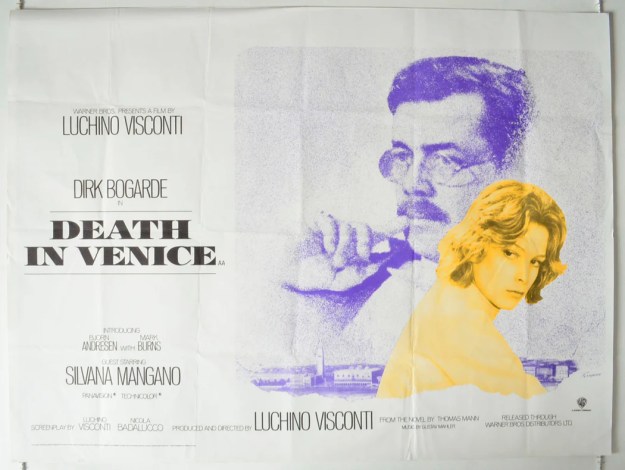
Death In Venice (a.k.a. Morte a Venezia). Original British quad movie poster
A schoolboy dropped onto the bench beside me. Grey blazer, black trousers, loosened tie, scuffed shoes. I noticed everything that didn’t matter. A rough diamond, I thought – though his sparkle wouldn’t cut much around here.
The riverside benches stretched empty, yet he chose mine. I should’ve told him to shove off. His presence made me feel exposed, grimy. How old was he? Fourteen? Fifteen? Sixteen? I couldn’t pin it.
He glanced at my book. “What’s it about?” The cover stared up at me like a mute witness. Say something. Anything.
Instead, he dug in his bag and handed over his own. HappyHead. Yellow jacket. Boy in a green hoodie. Like Hunger Games, but better.
A woman passed with a rat-sized dog that barked like it deserved drowning. She glanced at us — too long, too sharp. The boy grinned. “He’s my dad.” I was far too young to be. Her cheeks flared; she looked away.
I slid him The Outsiders. Black cover, five combs — four white, one yellow, streaked with red. The misfit.
He read the first lines aloud –
“When I stepped out into the bright sunlight from the darkness of the movie house, I had only two things on my mind: Paul Newman and a ride home. I was wishing I looked like Paul Newman – he looks tough and I don’t – but I guess my own looks aren’t so bad.”
A smirk tugged his lips, then he handed it back. Game recognised game.
Sometimes, you have nothing to do except watch and think. It’s Tuesday afternoon, it’s overcast, and I’m sitting on a beach… I tap random thoughts into my phone… and later, it reads like a diary, but also conjures up memories of being a child when we had ‘news books’ in which we wrote any drivel that might have happened.
This is my drivel…
Megan tells me a story about Peran of Polruan, with his salty brown legs, who lives alone in an old fisherman’s cottage called The Buoy. Never a visitor. Not a word to anyone. The girls think he’s a Cornish Saint and want to have sex with him. Every morning he catches the river ferry and returns at teatime. Where does he go? What does he do? On summer evenings he reads on the doorstep. I’m intrigued, but I want to know more about the books that he reads.
***
I’m looking for a bit of phwoar on the beach. I want a handsome young guy who strips to his shorts and goes swimming. But on this cloudy Tuesday afternoon I’m blessed with old ladies in one-piece costumes who do sedate breast-strokes to the pontoon and back. Shortly after four o’clock, a blonde schoolboy appears and parks himself close by. His shirt is untucked and the school tie hangs loose around his neck. From his bag, he pulls out a copy of William Golding’s Lord of the Flies and starts reading. He seems happy being with Ralph and Jack, and I wonder which one of them he’s sympathetic to.
***
It’s been a month since I had a cigarette. I realise this whilst standing on the quayside. Instead, I’ve been using my Pro Max Double Apple – 10K puffs. What might you get up to with ten thousand puffs? Behind me, a sour-faced woman moans to her husband that I’m vaping. I turn around and give her a deadly look and she tuts. There wouldn’t have been any remorse if I’d pushed her into the sea.
***
“The Tesco delivery is coming tomorrow morning,” says Megan. She makes it sound like this is the highlight of the week. It might well be. She’s changed a lot since moving down here. Where is the Megan I once knew? The girl who drank Aperol Spritz by the dozen and got her tits out afterwards. “That’s exciting, I look forward to it,” I reply. She gives me a wicked look. “I was hoping that you might stay in and wait for him. I think that you’ll be less sarcastic after you’ve seen the Tesco guy.”
***
I write at the kitchen table with the door open and ignore the wasps that fly in and buzz above my head. I’ve realised that they soon get bored and leave the same way that they came. Megan appreciates my eclectic music tastes and has recommended an album called Senza Estate by My Friend Dario. It plays on my laptop while the wasps gather around the Corn Flakes. One of the tracks is called Keep on Cruising which is calming and innocent, and far removed from the cruising that I’m used to.
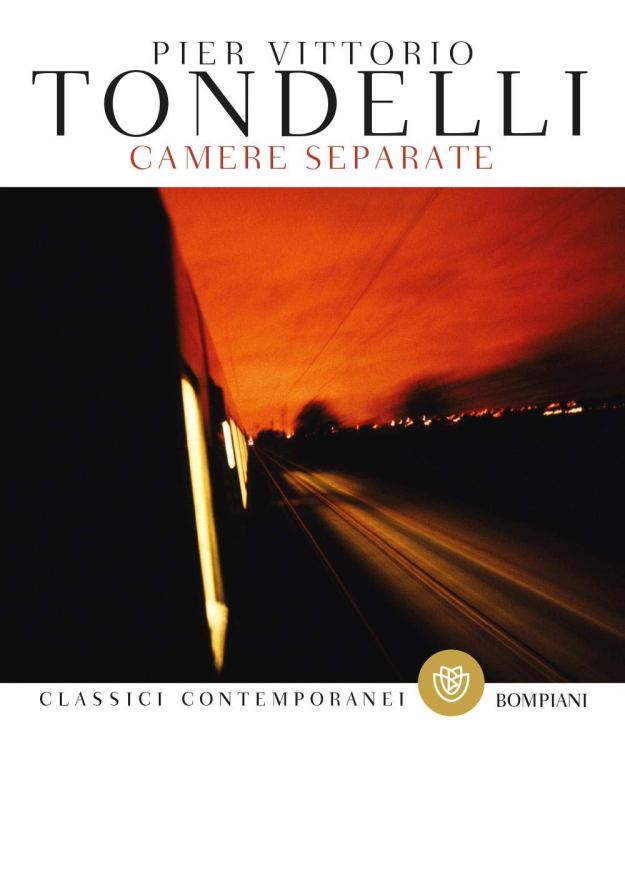
“Now he feels like some ageing pin-up finding a pimply kid masturbating over photos of him as a boy, and peeping lecherously in on those carnal couplings of his youth.” – Separate Rooms – Pier Vittorio Tondelli – Italy – 1989
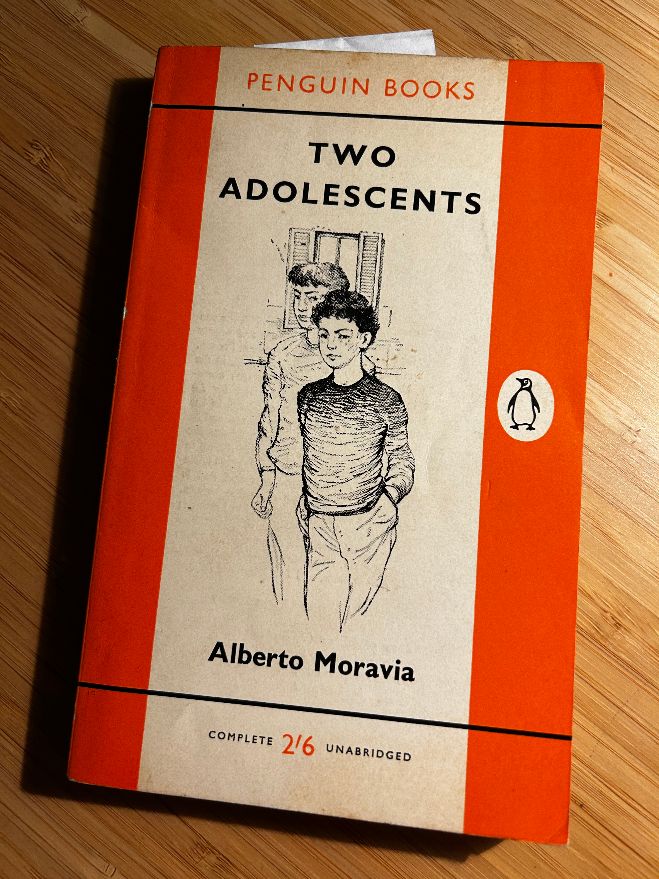
Two stories. Two boys. “The realisation came to him that a difficult and miserable age had begun for him, and he couldn’t imagine when it would end.” In 1945, Alberto Moravia was writing about puberty, moral dilemmas and sexual awakening. Agostino, the story of a 13-year-old boy’s adolescence and an obsession with bad boys on sunny beaches. I think back to that age, and, almost certainly, I might have been Agostino himself. And then there is Luka, a troubled boy, who appears in 1948’s Disobedience, who resists societal norms and expectations, and acts strangely. Only later did I read that this was supposed to be allegorical, and meant to highlight his refusal to serve in the Italian army during World WarTwo. I didn’t like Luca much, but there again, I had completely missed the point. I’m a dumbass!
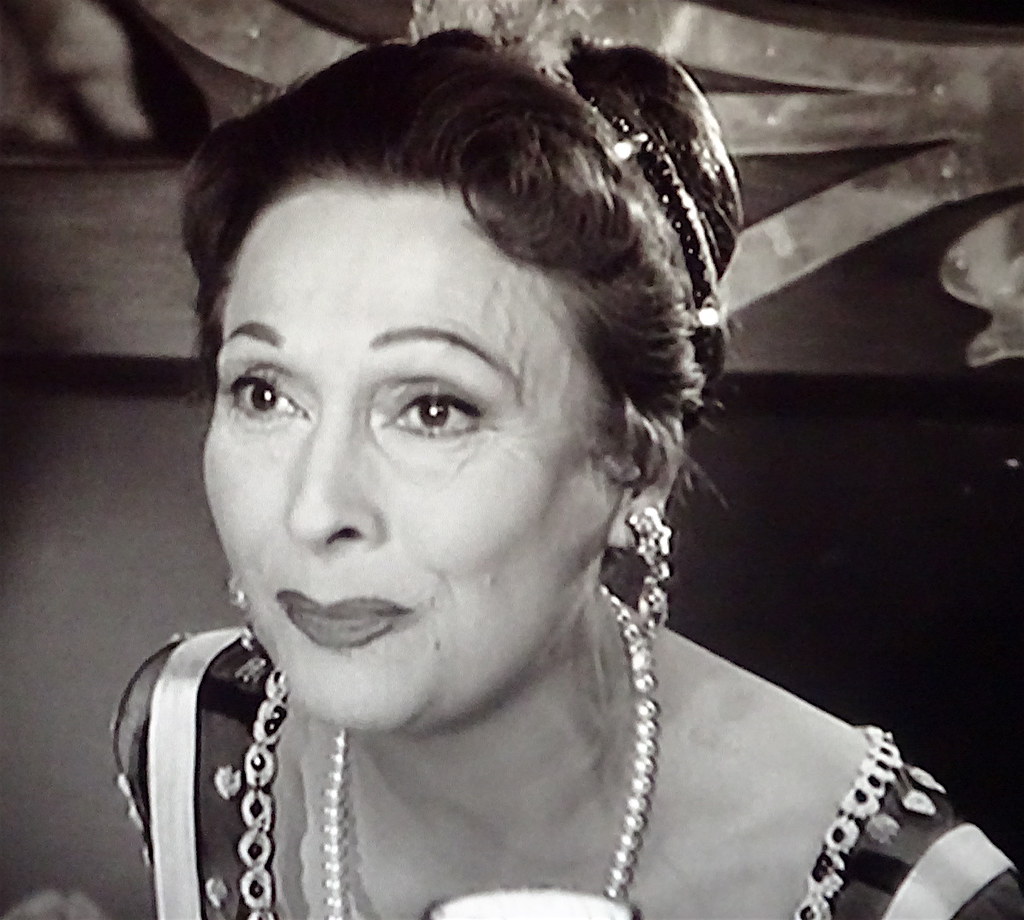
Charlie is reading an old book about an old French actress called Arletty. It was face down on the floor while he painted something that looked like mashed-up graffiti. He noticed me looking at it. “The book is called Je Suis Comme Je Suis – which means I Am As I Am,” he said.
“I’ve never heard of her,” I replied, flicking through its yellowing pages. Lots of tired text and black and white photographs. Charlie stopped painting and looked at me. “A madame after my own heart. Mon cœur est français, mais mon cul est international.”
I asked him to translate because he speaks too fast for me to understand. “It is quite simple,” he smirked. “It means that my heart is French, but my arse is international.”
He was provoking me, a crude attempt to make me jealous, that had succeeded.
I googled the name Arletty and discovered that she was accused of treason and imprisoned in 1945 for her wartime liaison with a German Luftwaffe officer, during the occupation of France.
Charlie’s face became sad. “Did you know that by the nineteen sixties she was almost blind?” He sat up on his knees and began fiddling inside his underwear. This was something he tended to do a lot. “She was blind in one eye but put the wrong eye drops in her good eye and destroyed that one too.”
“What happened to her?”
“She was a recluse, blind, and living alone in a dark Parisian apartment, which is how I will end up.” He peered at me with mournful eyes and waited for me to respond. It was a ploy that he used when he wanted attention.
“I’m sure that you’ll manage to find somebody who will be dumb enough to take you in.”
His face brightened. “That is correct. I will always be okay.” He jumped up and studied his unfinished canvas on the floor. “By the time I am old, I will be a famous artist, and there will be a long line of people wanting to take me in.” He waved his hand in front of my nose. “Would you like to smell my fingers?”
I once read André Aciman’s Homo Irrealis: Essays, and to be honest, it was a difficult read, partly because I didn’t understand what the hell he was talking about. Aciman’s approach to fiction is different, and I bought The Gentleman from Peru for Charlie, the French boy who once met the author, and wanted it because it was a signed copy. He keeps reminding me that I once had an original copy of Call Me By Your Name that I inexplicably threw away. I read The Gentleman from Peru because Charlie never will. His attention wanders after a few chapters, and that is why we are left with shelves of half-read books with slips of paper showing how far he got. But after finishing this book, I realise that this is more of a novella, and if Charlie is ever going to finish a book, this might be the one.
“We have too many books,” I told Charlie. It was true, the apartment was being taken over by books that had been bought at second-hand bookshops and charity stores. They filled the shelves and were now stacked in corners. ”It’s time to get rid of some of them.”
He looked at me with disgust. “They are collectible,” he cried. “These books will increase in value.”
We had a routine, like an old married couple. We would go to affluent parts of the city looking for rare books that people had no use for anymore. Intellectuals lived here, and there was a chance that we might stumble upon old art and photography books. “You will not find a Katie Price autobiography in these shops,” Charlie explained. “These places are full of lost treasures. Remember that book you bought for ten pounds and is now worth a fortune?”
Charlie was referring to Germaine Greer’s The Boy that we’d later seen in an antiquarian bookshop for one hundred pounds. “A very controversial book,” he’d said. “It is almost paedophilic.” Except that Charlie’s French had difficulty translating it and made me smile, and this allowed him to think that I was confirming his opinion.
I secretly admit to enjoying these days out, and then retiring to a favourite cafe – the one that sold fish finger filled croissants – and examining what we’d bought. Charlie would carefully display the books on a table alongside cups of coffee with flowery patterns in the froth and take a photo that he posted on Instagram.
“I think that you have become a bibliomaniac,” I told him.
“That word sounds French,” he replied, “but I do not understand it.”
It means that you are an addict, and one day the floor of our apartment will collapse under the weight of the books.”
There was another point I wanted to make, but chose not to, because it would end in an argument. Charlie had a habit of starting novels and never finishing them, and I repeatedly found bookmarks after thirty pages or so. He denied this, but I had yet to see him read a book from beginning to end.
Charlie believed I had more books than him. This might have been true once, but I had learned to thin them out. I’d started putting them in the recycling, because it was a quick fix, but this always felt unacceptable. And then I chose charity shops to dispose of them, the same ones that we visited now. The drawback was that my friends shopped in them as well, and often gave the same books back to me. But no, I’d decided, Charlie had more books than me.
“We need to categorise the books,” Charlie explained, as if this was a compromise. “We can put art books together, likewise photography books, and so on. Then our visitors will realise how sophisticated we are.”
“There might be a short term solution,” I joked. “Levi is moving out soon, and we could turn his bedroom into a library.”
Charlie looked doubtful. “I had thought that we might rent the room out again.”
“I didn’t think that you liked anybody else living here, and I remember the fuss that you made when Levi moved in.”
“That was different,” he replied, “I didn’t know him, but now I will miss him when he is gone. And besides, the extra money is useful.”
This was a point of contention because somewhere along the way, Levi’s rent money had found its way into Charlie’s bank account, and had yet to confront him about it.






 Perfectly Hard and Glamorous