
Category Archives: Life Story

David: A Good Story, Apparently

“A swell so big and strong it will wipe clean everything before it.”

I got a message from David. The first I’d heard from him since our falling out in December. I hadn’t been expecting an apology and didn’t get one. I wasn’t even sure one was required. Some days I thought I might be the one who owed it. Still, the silence had broken, and that felt like something.

‘My boy turned forty this week and wanted to see where he was born. I took him to the Kapiʻolani Medical Center, where his mother gave birth to him. It wasn’t what he had in mind. But he stood straight, like the military taught him, and was too polite to tell me to go to hell. He was a Kamaʻāina — child of the land — but this wasn’t where he grew up.’

“What???” I replied.

David rang immediately.

I paused Heated Rivalry, which had literally just started. I hadn’t even got past the opening credits. Everyone had been talking about it, which was precisely why I’d been avoiding it. The same thing had happened with Adolescence. The louder the praise, the more stubbornly uninterested I became. But Heated Rivalry had the added incentive of steamy gay sex scenes — and I liked the idea that large audiences wanted that and were openly enjoying it. So fine. I’d given in. And then David called.

“It’s a paragraph I’ve just written,” he said. “I found a draft of something I wrote about Hawaii in the eighties. A good story’s been hiding in a drawer for forty years. It’s time to rewrite it. Update it.”

“Hawaii?”

“If memory serves, I based it on a Rolling Stone article about a teen suicide. But I think that was Kansas. Or somewhere like it. No idea why I chose Hawaii.”

“Suicide?”

“That only comes at the end.”

“Well,” I said, buying time, “I suppose there has to be a happy ending.”

“A suicide and a birth,” he said, as if that clarified things. “You get the opening now?”

I didn’t. Except that David was a successful writer, and it clearly made sense to him. Which, apparently, was enough.

“I think I know why I chose Hawaii,” he continued. “There was a film I saw. Big Wednesday. Surfing. Jan-Michael Vincent, Gary Busey. Semi-naked most of the time. Very young. Very hot.”

“Who?” My patience was thinning.

“Ah. Before your time. Though now that I think of it, that film was set in California.”

“Get to the point, David. The longer we talk, the longer I’m delayed from steamy gay sex. What’s the story actually about?”

“Whoa,” he laughed. “So you’ve sorted things out with Charlie. What did I tell you? You can’t keep a good man down.”

I froze. Had I really discussed my prolonged sexual drought with David?

“I’ll be brief,” he said. “It’s about jealousy. At least on one side. When three people are involved, somebody always loses.”

This was unexpected territory for him. David could spin a tight crime plot or disappear happily into a historical setting, but relationships were something he normally sidestepped entirely.

“It feels a bit left-field,” I said. “And why go back to something written that long ago?”

“It was shite,” he said cheerfully. “I never read past the first page after I shoved it in a drawer. My first novel came out ten years later — my style had changed completely by then. But time’s counting down. It feels like unfinished business. I want to turn it into something wonderful.”

“How old were you when you wrote it?”

“Let’s see… I started it in 1984, so I’d have been twenty. Finished it the year after. That’s why the characters were that age.” He paused. “It’ll read like I’m reliving myself.” Then, suddenly: “Goddammit. I remember now. I’d just read Michener’s Hawaii. That’s why. Oahu, specifically. And Magnum P.I. was on television.”

I thought about my own life. Whether anything I’d written would still exist in forty years. Whether I’d ever be considered established, in any meaningful sense. I’d been carrying an idea for a book for years, but inertia kept winning. Instead, I scraped a living writing about country houses and cities. It all felt increasingly dull. Stranger still, it occurred to me that David must have written that early draft on a typewriter — a genuinely painful way to work, as far as I was concerned.

He said he had to go.

“By the way,” he added, “I’ve finished the Isherwood biography on Kindle. It ended rather abruptly. One moment he was alive, the next he was gone. Dead. But I won’t mention it again. You seem sensitive about that.”

I restarted Heated Rivalry. Two seconds later, my phone buzzed.

‘Forgot to say. I’m going for a drink with a young man — a student — only nineteen. Just out of nappies, really. Don’t tell Josh, but of all people, I thought you’d like to know. 😏’

That Moment: Boy in the Black Hoodie

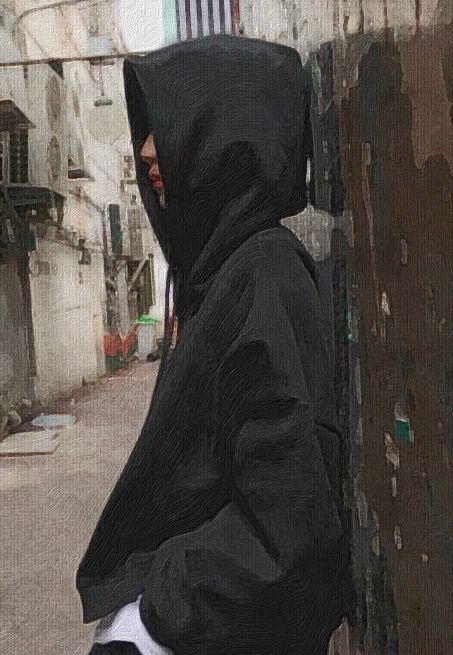
Scally Boy – Charlie Marseille (2026)

Four guys are waiting for a haircut. One hides inside a black hoodie so that all I can see is the tip of his nose. I call him a ‘scally boy’ – someone with edge, rawness, no inhibition; danger; lower social class. People only see what they must see: confidence, arrogance, hardness. They fail to see his vulnerability, his ignorance of those who might exploit him, and his lack of ambition.

When it is his turn, he stands and takes his hoodie off—but he gets it wrong. As he pulls it over his head, his T-shirt comes with it and he is left half-naked. He corrects things quickly, but it is too late. I have already processed every inch of him: the pale skin, the smoothness, the flat stomach, the black hairs showing above his waistband, the tattoo on his arm that says Adam.

Such a shame, I think, because he is primed for one thing only—a girl. His masculinity, the expectation, the understanding that anything else will not do. The girl will fall in love with Adam, but what he feels about her will not matter. He will have done what is expected and will display her like a trophy before discarding her for another.

Adam catches my eye and snarls, “Do you like what you see, faggot?”

Where the Tide Still Knows Us


I placed the flowers in Robbie’s memory on the sand, arranging them slowly, as if touch still mattered. The tide crept in, cool around my ankles, withdrawing and returning with a rhythm that felt almost deliberate. This was a special place—not because it was beautiful, but because it had once borne the weight of our closeness, and even now seemed to breathe with it.

The Isherwood Problem: Youth, Age and the Right to Desire

Don Bachardy and Christopher Isherwood. Early 1950s. Photograph by Zeitgeist Films / Everett Collection.

My friend David is reading a biography of the writer Christopher Isherwood on his Kindle. It has taken him a long time to get through—not because the book is difficult, but because it is extremely long. He joked that his Kindle had travelled with him from London to Munich and Paris, and back again, and he had only reached the fifty-percent mark.

“That’s the problem with an e-book,” he said. “We don’t talk about pages anymore. We obsess over percentages.”

I suggested that perhaps he was in too much of a hurry to finish it.

“That’s true,” he reflected, “but don’t you always have one eye on what you’re going to read next?”

David is a lot older than me, and I’m not entirely sure where we first met. He is educated, though—one of those men whose words are almost always guaranteed to entertain. We were walking beside the canal from Paddington Station towards Little Venice. It was dark, lonely, and faintly threatening. I half-expected a knife-wielding mugger to emerge from the shadows at any moment.

For someone like me, who comes from the provinces, London can feel dangerous. David had no such concerns. He regarded nighttime as the best time to wander its quieter streets, harvesting inspiration for his novels, though on this occasion he had also had to tolerate my repeated complaints.

He tried to change the subject.

“The other day I went into Daunt Books on Marylebone High Street,” he said, “and overheard two older women talking. One of them said, There are so many books to read, and so little time left to do it. That made me think about my own mortality. It’s probably why I’m in such a hurry to finish the Isherwood biography.”

It was the first time I’d heard him refer to his age in that way. I’d never really considered that it might trouble him.

It was my turn to change the subject.

“To be honest, I’ve never read Isherwood,” I said. “I find him a bit of a privileged bore.”

He seemed not to hear me.

“There are several comparisons between Isherwood and myself,” he continued. “I’ve been struggling to come up with new ideas recently, and while reading the biography I came across a quote from his diaries: A lack of creative inclination to cope with a constructed, invented plot—the feeling, why not write what one experiences from day to day? Why invent, when life is so prodigious?”

He paused, as if letting the words settle.

“That resonated with me. I’ve decided that my future writing will only be based on real life experiences. That will be far more satisfying.”

David’s work had always relied on a radiant imagination—several bestsellers proved that—but this declaration unsettled me. As if anticipating my concern, he smiled.

“I have a lifetime of fascinating stories involving my closest friends,” he said. “Some of them might raise a few eyebrows.”

“Did Isherwood do as he suggested?” I asked.

“Absolutely. He created characters based on people he knew. Sometimes he even wrote about himself in the third person, omniscient. I plan to do the same. I’ll call my character David—and absolve myself of any blame.”

Little Venice. Where the canals whisper secrets under the London stars

We passed moored canal barges. Most were dark, but a few glowed from within: a man cooking over a tiny stove, a woman bent over her laptop, someone stretched out watching television. Their lives were visible through brightly lit portholes, as if privacy were optional.

“There are other similarities between Isherwood and me,” David went on. “When he was forty-eight he met his long-term partner, who was only eighteen. Does that sound familiar? Joshua was twenty-one when I met him. I was forty-four. Seventeen years later, we’re still together.”

“To be honest,” I said, “I’m surprised your relationship has lasted this long.”

I thought of the times he had propositioned me, and of the occasions I had refused him. I would have been eight when he met Joshua, who was now approaching forty. I had been in my early twenties when I first met David.

“The secret,” he said, “is not to make a relationship exclusive. Not my words—Isherwood’s. He and Don Bachardy both had sex with other people.”

It sounded close to a confession.

“Young men enjoy the benefits of being with an older man,” he continued. “Even if they get their sex elsewhere. Boys can take on the identity of their mentor. Bachardy picked up Isherwood’s accent within a year. Joshua is still his own person, but he always comes home. He values stability.”

Above us, traffic thundered along the Westway flyover. Sirens cut through the night. London had become a city of constant alarm. We were nearing Little Venice—named, supposedly, by Lord Byron, who compared its rubbish-filled waters to the Italian city he had once lived in. In the darkness we could just make out Browning’s Island.

“This is where Paddington Bear was once carried by a swan,” David joked. “Though I suppose that means nothing to you.”

My mind was elsewhere.

“I know times were different,” I said, “but Isherwood might today be accused of grooming a young boy.”

“I knew you’d say that,” David replied. “And yes—you’re right. An established literary figure and a college freshman. There were even unkind rumours in New York that he was with a twelve-year-old. His friends disliked Bachardy. But they turned a moral weakness into a long-term relationship. Rather like Joshua and me.”

He paused.

“Back then, people were blissfully unaware. Today everything is played out before a global audience. If the same thing happened now, Isherwood would be cancelled—even if nothing illegal had occurred. We used to call it boy-love. An appreciation of male beauty going back to the Greeks and Romans. Now it’s considered dirty. That’s something I struggle with.”

A person with limited education is at a disadvantage when arguing with David. He always has the clever words ready. My clumsiness betrayed me.

“Can’t you see that there’s something disgusting about the age difference?”

He frowned—not so much at my disapproval, but at my inelegance.

“When I was young,” he said, “homosexuality wasn’t acceptable. Many of us missed out on young love. Then the AIDS crisis came. Now we grow old resentful, because there’s a void. Is it so terrible that we try to recover something we lost? You’re the generation without constraint. You don’t understand our predicament.”

He stopped walking.

“No matter how old you are,” he said, “there will always be something exquisite about youth.”

“Why?” I asked. “Isherwood came from an even older generation. And what you’re saying sounds pederastic to people my age.”

“When Isherwood was young in the 1920s, he was driven out of Germany by the Nazis. Berlin became dangerous. By the time Bachardy appeared, Isherwood was already considered ancient. Some say the boy did the chasing. The relationship later became non-sexual. Bachardy had other lovers.”

A group of students approached—three boys, two girls—laughing loudly before falling into an awkward silence as they passed us. I recognised the look. Suspicion. Not for the first time, I’d been mistaken for a male hooker. I resisted the urge to run after them and explain myself.

David smirked.

“I think I know why you struggle with age disparity,” he said. “That look on your face—it wasn’t moral outrage. It was embarrassment. Shame. You’re ashamed to be seen with someone older.”

He shook his head.

“That’s not a virtue I admire. One day you’ll find yourself old without warning. And the object of your desire will be much younger. I hope that boy doesn’t think the way you do now.”

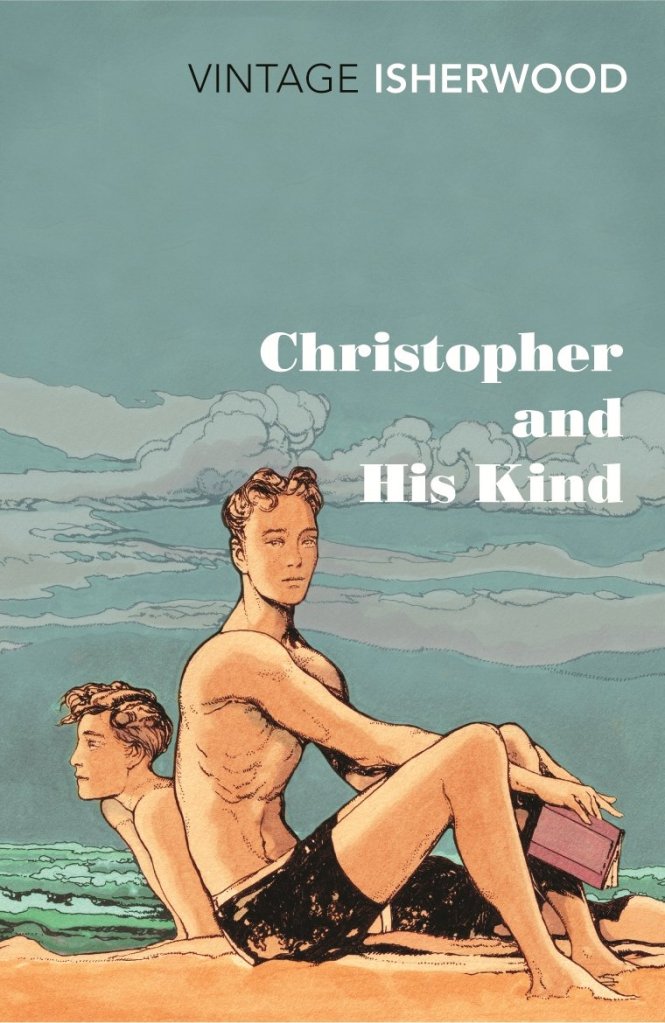
Christopher and His Kind is a 1976 memoir by Christopher Isherwood first printed in a 130-copy edition

Life Story: The Linger of What Was

New Romantic. Colin Cox. Photographed by David Suárez (December 2025)

The thrill of the forbidden, the surge of emotion and thought. That quiet, hollow space inviting reflection on the fleeting nature of our own lives and whatever traces we leave behind. A wavering line between appreciating beauty and surrendering to objectifying desire—an involuntary pull shaped by masculine sensitivity, itself carved by the bittersweet passage of time and the ephemerality of experience. The soft focus, the restrained emotion: a vivid instant once sharp and certain now blurring into a subtle, almost spectral echo of what once felt wholly present. The intensity drains away, leaving only a neutral, distant recollection, until all that survives are scattered fragments of sensation.

A Mildly Unhinged Seasonal Update

Every man has his secret sorrows which the world knows not; and often times we call a man cold when he is only sad

The days are getting shorter and, honestly, more depressing. The final stretch of this yearly slog is only weeks away, yet I’m already wondering whether I’ll make it to the finish line in one piece. Autumn seemed to appear out of nowhere this year. Now the winter solstice looms on 21 December — an already dismal day made even bleaker by falling on a Sunday.

“Solstice” means “sun stands still”: the Sun’s path appears to pause for a few days before inching north again, marking the peak of winter. It sounds poetic, almost serene, but for someone like me it can feel anything but. This year has been one of the bad wobbles.

I belong to that unlucky club of people living with Seasonal Affective Disorder (SAD), a form of depression that follows a seasonal rhythm — often called “winter blues” because the symptoms intensify as the light dwindles. At least I’m in decent company: Adele, Ryan Reynolds, Jim Carrey, and Emma Thompson have all spoken openly about dealing with it.

The symptoms? A greatest-hits list of misery: persistent low mood, loss of interest, low energy, oversleeping, carb cravings, weight gain, fuzzy concentration, irritability, social withdrawal, and those heavy feelings of guilt or worthlessness. Over the past few weeks, I’ve ticked every single box.

Worst of all are the irrational thoughts that hitch a ride. These fixations burrow in and make themselves at home. In previous years, I’ve spiralled over a long-ago one-night stand, convinced I needed to confess it to my partner to find peace — thankfully a friend talked me down. Another winter I became obsessed with the idea that I had too much money and would have to explain myself to the taxman, despite everything being perfectly legitimate. This year, despite feeling physically fine, I can’t shake the fear that I’m harbouring a terminal illness. Seeing it written out looks absurd, but that’s the reality of it.

SAD likely stems from disruptions to the body’s internal clock and imbalances in serotonin and melatonin triggered by the lack of sunlight. It was formally named in 1984 by Dr. Norman Rosenthal and his team at the National Institute of Mental Health.

There’s no magic cure. You grit your teeth and get through it. It’s less “mind over matter” and more “matter over mind” — odd phrasing, but surprisingly accurate. What helps me most is staying occupied: researching, writing, watching TV, cleaning… anything that absorbs me. Eventually, after a few hours, I’ll notice I feel almost normal again. I recently read that building Lego can help too — its structure and focus promote mindfulness, which can ease anxiety and depressive symptoms.

The fear that you’re “cracking up” can be overwhelming the first time, especially if you don’t yet know what’s happening. But when it returns, you at least recognise the shape of it. You learn its rhythm. You remember it passes. And that alone is sometimes enough to help you hold on until the light returns.

Life Story: The Third Drop

I noticed him but he chose not to notice me. After he had dropped his mobile phone on the floor for the third time, he realised that he had to say something.

Hot Tap Hustle for the Horny

Image – Darkness Drops

Pablo thrusts his hands beneath the hot tap. He rubs them together in a frantic, almost self-destructive rhythm as the water climbs from warm to blistering. Anyone else would flinch, recoil — but he holds himself there, jaw locked, letting the scalding cascade engulf him in a cloud of bitter, furious steam.

The faces and bodies of the men he aches for seem to drift through that fog, circling him, pressing close. You can tell when the moment is nearing: the tightening of his calves, the subtle clench of his arse, the way he grinds himself against the cold lip of the sink. It is sharp, electric — his own strange ritual, the pink-hands-and-hot-water orgasm — that edge where pain dissolves into an ecstatic, trembling pleasure.

But the release he chases always slips from him. It teases, then vanishes.

When the heat becomes unbearable, he finally twists the tap off. His head drops. He turns, shoulders hunched, his shorts soaked and clinging to him. He won’t meet my eye; shame clouds the air between us. This little masochistic kitchen-sink drama — he believes it reveals too much.

That Moment: A good rave, on a good night

Surrender – Charlie Marseilles

The music starts, and it feels like heat rising under my skin. I move without thinking — a slow, trembling rhythm that begins in my ribs and spills outward. My shirt clings, half open, heavy with sweat. Each breath feels like it’s carving light through me, and I let it. There’s no audience, just the sound of air, the pulse of my own heartbeat echoing through the floor.

The world shrinks to the movement of my spine, the slip of fabric, the catch of breath. My body feels thin, electric, fragile — like something lit from within. I close my eyes and lean into the rhythm until it blurs the edges of everything. There’s a strange kind of pleasure in it: the way exhaustion burns into something tender, almost holy. I don’t know if I’m dancing or dissolving.

When the music fades, I’m still trembling. The air is warm against my skin, every breath thick and slow. I can taste salt on my lips. For a moment, I stay there — suspended in the quiet — before the world comes back into focus. My body is mine again, but it feels changed, like it’s remembered something it shouldn’t have.

Concerning the Boy from Ruislip


Mr and Mrs Jones of Ruislip,

I find it rather interesting that you spent thousands of pounds to send your son to this university city. Did he have a choice in the matter? Perhaps not — but in any case, thank you for your thoughtful consideration. He is, as you surely already knew, something of a handful. But did you also know that he grinds his teeth in his sleep?