Tag Archives: youth

Last night I dreamt I was eighteen again

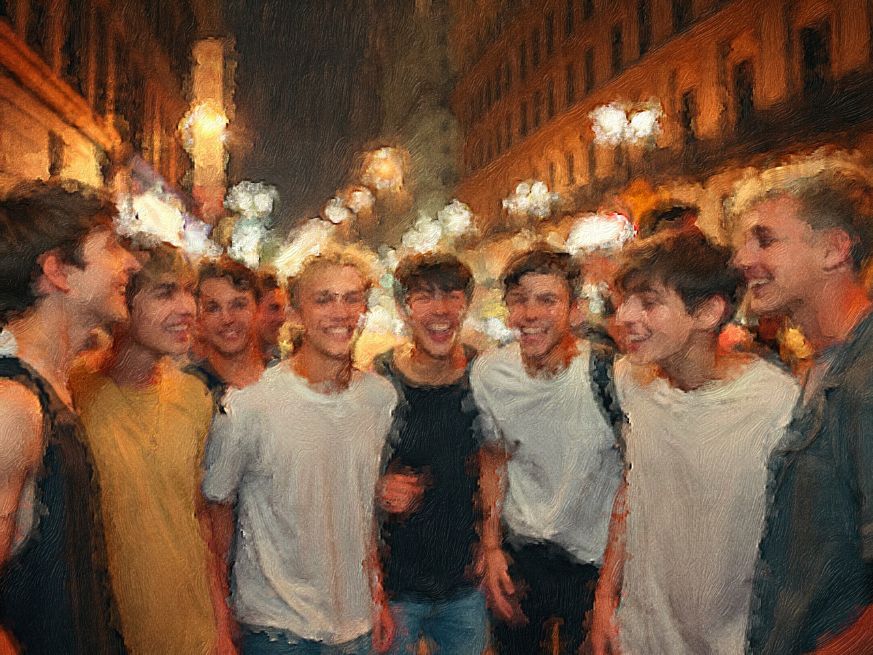
The Boys- Charlie Marseille (2026)

Hormonal Surge: Increased testosterone, fuelling restlessness and the need to discharge energy, sometimes through risky or boisterous play, mock fighting, and testing boundaries.

I wake and can hear music playing in the other room. It is an eighties song – Calling All the Heroes – and it is perfect. My first waking moments are defined by a song made before I was born. It will become a favourite. Whenever I hear it, I will recall the dream.

I’m eighteen. Like I always am. There are twenty boys of a similar age. We don’t know each other, but we have bonded; something connects us, though I don’t know what it is. And now we are friends. Brothers who drink too much, laugh, and joke. We move from bar to bar until the group becomes fragmented, but still we keep bumping into one another — in different bars, on street corners, in dark streets – and each time we greet each other with high fives. I keep losing my coat that contains my mobile phone, but somebody in the group always finds it and saves it for me.”

What am I dreaming about?

Eighteen. Delayed or suspended adolescence. The moment just before categorisation -before ‘out’ or ‘not out’, before relationships are legible, before desire is policed or explained. A moment of pure potential, when attraction, friendship, and self-recognition have not yet been sorted into boxes. A group of boys I don’t know, where intimacy doesn’t have to announce itself as erotic to be real. Touch exists: high fives, a coded language, bodies moving together through night-time space, alcohol loosening edges, and the bond is felt rather than named.

These boys don’t posture. They don’t test me. They don’t ask who I was. They simply accept me. A world that perhaps never fully existed, but felt briefly possible.

The group breaks apart, but there is no need to cling because the bond reasserts itself naturally. “I still know you. You still know me.” I repeatedly lose my coat and my phone – yet I am never punished. I am held by others even when I am careless, distracted, or drifting. I don’t have to hold myself together perfectly. I’m not abandoned for losing my way. A fantasy of uncomplicated male belonging – one where youth, desire, friendship, and identity coexist without fracture or explanation.

The next part of the dream is important.

“There are ten of us staying in a hotel room. It is the only one available. We snack on almonds and slices of apple covered in salted caramel and maple sugar. Two double beds and a single mattress on the floor. When it comes to sleep, we must find space in one of the beds. I choose a double bed where four of us will squeeze together. I’m thrilled that the most handsome boy will sleep next to me. But at the last moment, he is taken. Another boy wants him to share the mattress on the floor, and I am devastated. The dream is never consummated.”

The hotel room matters. It is temporary, improvised, and not designed for this many bodies. I share a bed with four boys. The choice is telling. I don’t choose privacy, pairing, or exclusivity. I choose crowded intimacy – warmth, bodies, breath, limbs overlapping. Proximity without the exposure of being singled out. I am about to be close to the handsome boy without declaring him an object of desire, but he isn’t a person yet – he is a figure onto which desire might safely attach itself. 

The handsome boy doesn’t reject me; he is summoned – pulled away by another boy. Desire is displaced, not denied. My devastation isn’t only about losing him. It is about losing the fantasy of being quietly chosen within the group. But the group has ruptured because somebody else’s desire has rearranged the night. My loss is intimate, quiet, internal – no one else even notices it happening – and so I do not follow. I do not compete. I do not protest. I absorb the loss silently. 

I woke up.
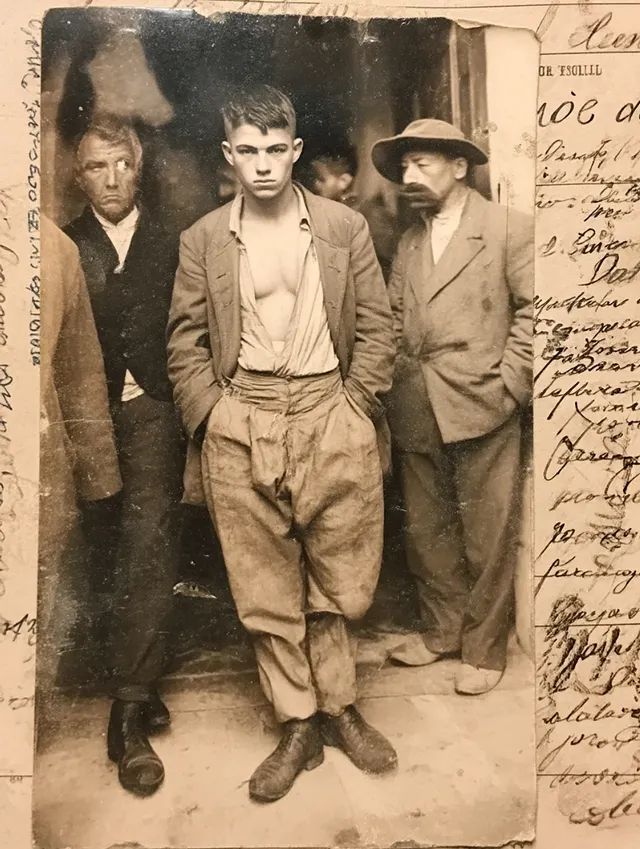
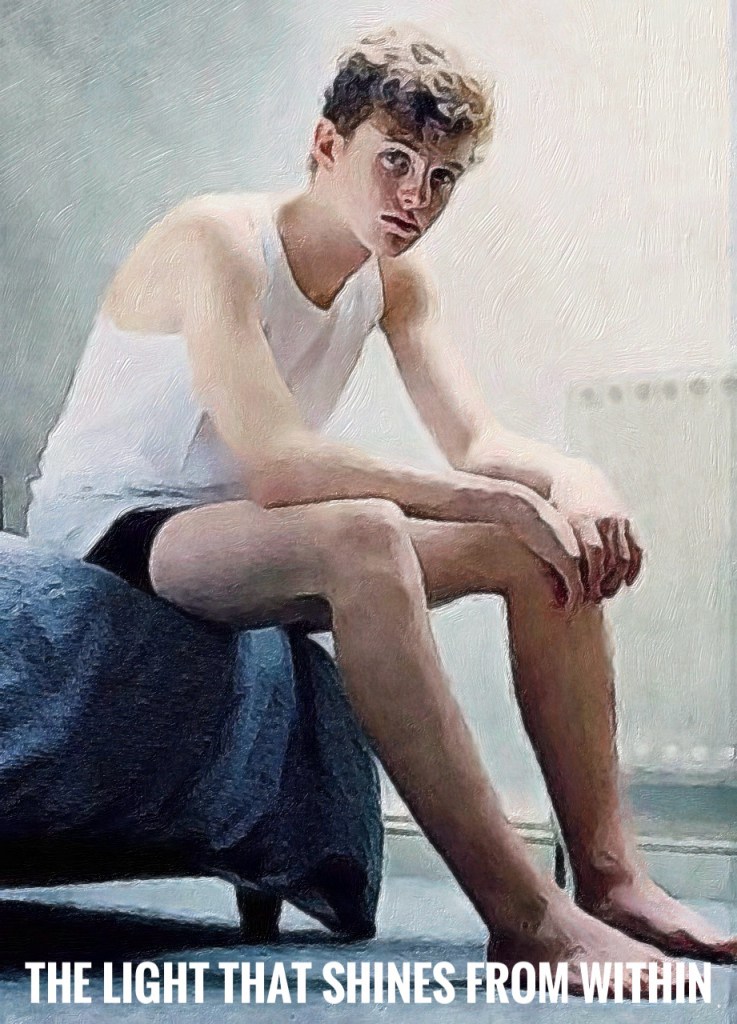
Stolen Words: “In our youth we are all beautiful.”


“When I see this image, the first thing that comes to mind is my theory that in our youth we are all beautiful! Is it because in our twenties very few things scare us, or because life has barely run us over yet? It is not my intention to make you think that this is the best period of our lives, I absolutely don’t think that! But there is something there, perhaps the little life one still has behind them, that gives this stage a bright patina. Later, that shine doesn’t disappear, it just changes its nature. It becomes deeper, more complex, sometimes harder to see at first glance, but no less real.” – Nuria Velasco

Old Photos Cabinet

Life Story: The Third Drop

I noticed him but he chose not to notice me. After he had dropped his mobile phone on the floor for the third time, he realised that he had to say something.

Whitechapel Boy and the Threadbare Years

I confess—I didn’t notice the rabbits at first. But there was something in the photograph that drew me in. It was taken by Izis Bidermanas, the Jewish-Lithuanian photographer, in Whitechapel, London, in 1951.

It’s quite possible that the boy in the image is still alive, but the rabbits, of course, are not.

Bidermanas worked primarily in France and is best remembered for his photographs of French circuses, Parisian streets, and commissions for the iconic Paris Match magazine. He befriended Jacques Prévert, the French poet and screenwriter; both were described as “urban wanderers.” A year after this photograph was taken, they published Charmes de Londres, a book of black-and-white photographs of post-war London by Bidermanas, accompanied by Prévert’s poetic texts—a vivid portrait of the “shabby old capital in its threadbare post-war years.”

There is something both tender and prematurely adult about this image. A loosely tied scarf, a jacket slightly too big. His style seems effortless—almost cool—as if he had stepped out of his own decade and into ours.

He is someone out of sync with his time. The kind of boy you might spot today on the Underground platform, earbuds in, oversized coat slung over his shoulders. Certain types of youth are universal—postures, anxieties, and dreams that repeat across generations. It makes you want to know his story.

There is an angularity to his posture, an aloof tilt of the head. He strokes the rabbit but does not quite look at it. Tenderness in his hands, hardness in his shoulders. Quiet care, resilience, an emotional inheritance that compels him to protect something gentle, even if he has rarely known gentleness himself.

He seems too sharp, too perceptive for the smallness around him—working here because life left him no choice, waiting for the real story to begin. The rabbits were merely a way to earn a few coins.

What if he was drawn to things outside society’s expectations? Art, books, music—worlds not meant for boys like him. Perhaps he dreamed of Soho jazz clubs, photography, fashion—things his home would never have approved of.

He was a boy caught between worlds: childhood and adulthood, duty and desire, the past and the future. A timeless boy, carrying secret longings.

Twink on Trial

Twink – Charlie Marseilles (2025)

Johnny had Sabrina Carpenter in his ears again, looping ‘Feather’ from Russell Square all the way to Wood Green. She didn’t know she was basically the narrator of his life, but one day he’d tell her. That’s what twinks do: dream big, unrealistic, sparkly dreams and somehow convince themselves it’ll all work out. Johnny didn’t care. He usually jumped head-first into the unknown anyway.

The day had been a slog. Instead of listening to his tutor, he’d spent two hours doodling in his notebook — the one with the Eric Ravilious cover he pretended made him look cultured. The tutor finally snapped and kept him back. “How would you describe your life?” he’d asked, like Johnny had personally offended academia.

Johnny had smiled. “Fed, pampered, and impatient. Honestly? My life is one long, sexy, pouty battle.”

The tutor hadn’t expected honesty. Or attitude. “In my day,” he’d muttered, “you would have been called a prostitute.”

Harsh, sure. But Sabrina would’ve had his back. She’d remind him he was eighteen, hot, and fully allowed to be desired — and if someone wanted to bankroll his glitter-coated lifestyle, that was on them. She’d conveniently skip the part about him being high twink maintenance: fine dining, special diets, beach holidays, designer clothes, and accommodation that didn’t smell like student desperation.

Alexander funded the whole thing, because Johnny lived for an Instagram-ready existence and the universe had not, so far, given him the bank account to match.

Twinks are vulnerable, Johnny decided, and love could never be found in a discount store.

When he got home, Alexander was already there, drinking wine and listening to Vivaldi — the soundtrack of men who’d survived ‘twink death’ and were now coasting through their late thirties in cashmere.

“We need to talk,” Alexander said. Serious voice. Terrible sign. Johnny tossed his Reiss puffer on the floor anyway. He was a trophy boy, and trophies didn’t hang themselves up.

Alexander cleared his throat. “The thing is… sugar babies aren’t really financially viable anymore. I need to do a quarterly business evaluation.”

Johnny froze. Thank God he’d kept all the receipts — he’d at least prove he’d been properly maintained. And he was not going down quietly.

“Look,” Johnny said, already shifting into survival mode, “you’re old enough to be fluent in PowerPoint and so I’m going to prepare a presentation of all my key deliverables. I think you’ll find them very compelling. Being adorable. Emotional availability. Pretending to like oysters. And really? That’s just the intro slide.”

Something Worth Remembering

Dominik Datko and Maciej Poplonyk. Photographed by Arthur Iskandarov

Dominic chose fourteen stone steps to sit on. They hadn’t been cleaned in a century; weathered and frost-damaged, they had taken on a patina — the greyness broken by lichens and mosses, ivy-leaved toadflax, and ryegrass. He rested his head against the iron railings and sighed.

Arthur sat thinking below him, his legs sprawled across the pavement. 

 “Once upon a time, a horse and carriage pulled up, and a well-dressed man — wearing a top hat and fine coat — disembarked and climbed these steps. He rang the bell and waited while an old butler answered the door, then handed over the hat and coat before being shown into a reception room.”

“How do you know that?” said Dominic, who lit a cigarette and looked towards the front door. There was no grandeur anymore. A glass door stood behind a padlocked gate; dirty net curtains protected the inside from prying eyes. The house was empty and unloved.

 “You only say it because you are describing something that you have seen or read. You don’t know what happened, because you weren’t here.”

Arthur picked up a piece of stone that had crumbled from one of the two pillars at the foot of the steps. He examined it before putting it inside a trouser pocket. This was something else to add to his ‘shelf of memories’. One day, when they were old men, he would pick up the piece of stone and show it to Dominic and say, “Do you remember the day we sat on those stone steps?” But he doubted that Dominic would grow old.

“My dear boy, despite your charm and privilege, you sadly lack imagination and prefer to live that shallow existence on TikTok and Instagram. Such a waste of an upbringing.”

Dominic laughed.

“And besides,” Arthur continued, “you will never become famous if you don’t contribute anything worthwhile that you can be remembered for.”

“That, my love, sounds too much like hard work,” Dominic replied. “But I envy you, Arthur, because you believe that writing those shitty little posts will turn you into a brilliant writer.”

There was a note of sarcasm in his voice, and Arthur knew that Dominic didn’t mean to be unkind.

“It is true. There are millions of tadpoles swimming in this huge pond. Why should anybody take notice of this one ordinary tadpole? But, Dominic, it’s not about being a brilliant writer. It’s about learning from mistakes — because I look back at some of the things I’ve written and cringe. But I remind myself that writing is about me, and I write for my own enjoyment.”

Youth is a gift of nature, but age is a work of art


Suspicion — the cynic — grows tiresome after a while. He toys with a silver St. Christopher medal, the patron saint of twinks slipping through his fingers.

He’s doe-eyed, all innocence, and says, “I like older men.” I smile, let him think he’s got me hooked — but he’s no match for experience.

Still, he’s waiting for a response, so I play along.

“Why do you like older men?” My voice can’t quite hide the boredom.

“Because,” he says, “older men are more experienced.” An off-the-peg answer.

I lean forward. He flinches, thinks I might kiss him.

“Here’s how this goes,” I tell him. “You’ll want me to fall for you — to believe I can’t live without someone barely out of nappies. You’ll lead me on until you work out what you can get: a place to stay? Money? A holiday? A stop-gap? And then you’ll move on, find someone else.”

He’s shocked — hand over mouth, as if such despicable thoughts had never crossed his mind. But he knows it isn’t going well.

“I might be older,” I say, “but I once sat where you are now.”

He sinks into his seat.

“I played them all, never realising I’d grow old too. We all do — it’s the one thing we can’t control. But don’t worry. I’ve swapped seats, yes, but I’ve kept yours warm for you.”

A love letter to youth

Youth – Charlie Marseilles

A time of potential, energy, and opportunity, and joy and personal maturation. It’s about vitality and growth. A reward and a source of joy. It is strength and vigour, seen as a time of great potential and opportunity.

A time for learning, maturing, and developing one’s sense of self before the responsibilities of adulthood.

Make the most of it.

It is a foundational period for developing wisdom and forming good habits. Appreciate and make positive choices during this fleeting time because personal fulfillment can still be achieved.

That Moment: “I have no idea who you are talking about.”

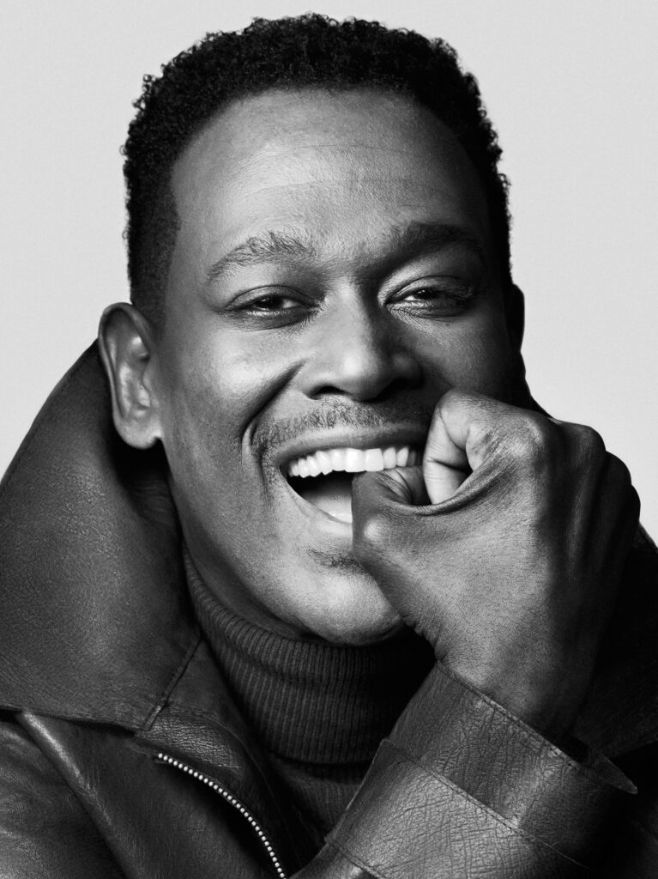
Luther Vandross (1951-2005)

The young man asked me to describe something that I had done during the week. “Something unusual that nobody else had done.”

I pondered too long and dismissed everything that came into my head. But then I had it.

“Well, it’s been a Luther Vandross week. I watched a movie-length documentary about him and listened to six of his albums.”

He absorbed what I had said. “That was pretty cool,” he replied, nodding with approval. “But I have one question to ask. Who the fuck is Luther Vandross?”

Stolen Words / The Beautiful Boy has been absent from our field of vision

Klein Youth – Charlie Marseilles

“We speak of the body of the young man at his fullest development, just on the brink of maturity, a young man who has retained some of his original innocence. The model for the classic Greek was the young athlete, from an aristocratic family, who competed in the nude in the original Olympic Games. It is not until later that the natural male form was used as a medium for the expression of godliness, an idea that later became the basis for a popular religious sect. A look back through the twentieth century will demonstrate just how long the Beautiful Boy has been absent from our field of vision. Examine the popular male images of the past 60 years. How many of them have been both young and beautiful?”

Helen Ziou – Valley Advocate Amherst – April 1984