
I had assumed that French people’s reputation for being sexually daring and uninhibited was overstated. My relationship with Charlie confirmed it. An observer could have thought that I was more typical of the French than he was. Charlie avoided sexual gratification: my desire for sex could be insatiable.
My reason for going to Paris was not, as I had told Charlie, to review an exhibition at an art gallery, but simply to find Thomas, his older brother, who had urged me to go. Charlie had every reason to suspect that this had been my intention all along. He had watched my contrived journey around the city with scepticism. Every message, each question, was an effort to catch me out.
Charlie knew much more about his unlikely brother than he cared to mention. “Make sure you do not go to see Thomas.” It was a warning that implied something unthinkable might happen if I did. That was the allure. I hoped that something might happen.
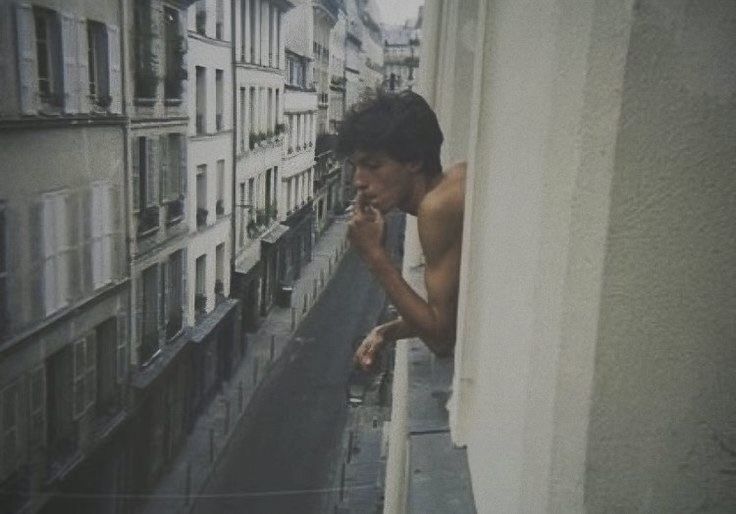
My arrival had stirred a buzz of excitement. Thomas had greeted me like a returning lover. But there was still ambivalence. He had rooms above Bar Dieudonné and I had noticed the only bed which suggested that I was going to share it with him.
The arrival of Ambre was the first time I realised that he had a girlfriend, and I confess that I initially regarded her as unwelcome competition. His friend, Léo, added to the uncertainty. After that, I resigned myself to sleeping on the brown leather sofa.
While Thomas worked at the bar, Ambre and Léo took me into Le Marais and we ended up at Joe Le Sexy, a gay sex boutique, where I had discovered naked photos of Charlie in the glossy magazine Le Pénis.
Ambre consulted Thomas and took it upon herself to make me drunk. After drinking too many Vodka-Apples I began telling them everything that was wrong with Charlie. They comforted me in a way I had never known. Ambre kept kissing me and brushing her cheek against mine. Léo insisted on nibbling my ear and letting his lips trail down my neck. I found that I was enjoying the attention.
We encountered Thomas as he was shutting down Bar Dieudonné for the night. He slipped his arm around me. “My brother is an idiot,” he whispered. “But we shall make your stay memorable, and then you might not wish to go back.” He insisted that we go to a late-night café on Rue de Seine where bar staff gathered after work.
It was a small place; tables with candles squeezed into every available space; the walls covered in black and white prints of Paris in the 1960s; chart music turned low. “Brigitte Bardot, Françoise Hardy and Serge Gainsbourg used to come here,” said Ambre.
There was a vacant table in a dark corner.
“Come,” Thomas gestured. “Sit beside me and we can lust over Ambre and Léo together.” His hand rested lightly on my knee.
A young man brought bottles of red wine and fussed attentively over us.
“The waiter who was in charge of that part of the room was a young, handsome fellow, about 23 years of age,” said Ambre, smiling. Her eyes followed the blushing boy and then settled upon Léo.
“Civil, good-natured, and obliging,” Léo interjected. “He was a favourite with both master and son, the latter of whom, black-eyed beauty as he was, seemed to regard him with even affection.”
He signalled for Ambre to continue.
“But he was only a waiter: he was an heir,” she sighed and shook her head in quiet sadness. “Mutual affection is, in civilised parts of the world, a mere folly.”
Everyone laughed.
“The French are crazy people,” the waiter said to me with a shrug.
When he had gone, Thomas restored a sense of order around the table.
“I must see the incriminating photographs that have caused such remue-ménage.”
Ambre pulled out Le Pénis and handed it to him.
Thomas slowly flicked through the magazine, carefully studying each page, raising his eyebrows once or twice. We, the jury, waited until he finally reached the images of Charlie. Léo kicked me under the table while Thomas spent a long time examining the photographs.
“Thomas!” Ambre shrieked. “If you spend any more time looking at them, I shall think that you are becoming aroused by your own brother. What do you think?”
“I think it is a tragedy and a regeneration,” he replied. “Good pictures. Unusual themes—beautiful, dramatic, romantic—exquisitely thrilling and appealing. What more can I say.”
So far, I had been allowed to wallow in my misery; the quiet spectator who was content to let the others remain the focus of attention. But Ambre and Léo were waiting for me to say something.
“Your critique is interesting, it is almost an art form,” I managed to say, “but, sadly, that is not the way I see it.”
Thomas gave a great sigh and stroked my hand.
“I understand that you are hurting. I understand that you are embarrassed and angry. But we are not talking about war, suffering, or death. We are talking about photographs.”
“Only photographs,” I agreed, “but naked photographs of Charlie with an erection. It was a shock because I had no idea that he had agreed to be photographed in this way. Charlie usually tells me everything. In this case, he didn’t because he knew that I would disapprove.”
“And why would you have done so?” asked Ambre.
“Because,” I stammered, “I fail to see why the world should see him like this when I have not. Why has he allowed this to happen? I feel like a fool.”
My phone pinged again as it had done dozens of times. I looked at my messages, some accusatory, and some, I might add, showing concern. But I had no desire to reply. Among them, I saw that Bianchi had also messaged, and, for once, I did not feel guilty.
“Give me your phone,” Thomas demanded.
I resisted. It was said that a boy and his dog were inseparable, and the same might have applied to a boy and his phone. Especially when you knew that Thomas was about to do something that I might regret.
Thomas held his hand out and waited until I reluctantly handed it to him.
He laid the copy of Le Pénis on the table and took a photograph of it. Then he opened WhatsApp and sent it to Charlie.
It was as simple as that. No need to make excuses for not replying to messages. Make him see that I was angry without saying anything.
Almost immediately, the phone pinged.
“No, monsieur,” Thomas warned. “You are not permitted to look at it and certainly not allowed to answer it… at least not for three years.”
Charlie maintained that Thomas was stupid but, from what I saw and heard, I began to understand that the opposite was true. Thomas was like Charlie in some ways, and, as the older of the two brothers, had been able to refine his instincts in a way that made Charlie seem less complete.
Thomas turned and kissed me. His lips were warm and soft, and I felt the brush of stubble against my chin. When he pressed his tongue into my mouth I yielded, accepting that this had been the moment I had waited for. There was a soft, melodic hum—Ambre’s way of showing that she found this display of affection ‘cute’ and ‘heartwarming’. Léo gripped my inner thigh. “Nous prendrons soin de toi, ami,” he said soothingly.
We were interrupted by the waiter who, satisfied that the occupants of this corner table were unlikely to cause any trouble, had brought more red wine.
We talked for ages: nothing of any consequence.
“Thomas tells us that you are an established travel writer. That must be very exciting.”
“Well,” I volunteered, “Thomas is only partly correct. I am a travel writer who does not go anywhere.”
“And that you are also living in Italy.”
“Again, Thomas is being creative with the truth. I can stay in a room that Signora Bruschi keeps for me. It is not mine, and when I go, which is not often, I am allowed to stay rent free.”
“But you are able to make a living?”
I decided that the truth could wait for another day and nodded. My head spun slightly as I did so.
“Miles must earn money to keep Charlie,” Thomas interjected. “My brother is known for not paying his own way. But I think that they are in love most of the time.”
I pulled a face.
“I am a student at Paris Diderot University,” Léo said. “I study history and one day I shall win a Nobel Prize for my genius.”
Ambre howled with laughter.
“And that means you are always spending your time with friends, visiting cafés, and enjoying the nightlife. Studying is only a small part.”
“And do not underestimate the importance of sleep,” he said “Ambre does nothing worthwhile. She works in a fashion store at Canal Saint-Martin and spends her days complaining about loathsome Parisians with too much money and no manners.”
We talked for ages: nothing of any consequence.
“Where did you all meet?” I asked.
“We do not know when or how we met,” said Thomas. “A French thing. It is usually through a friend, or a friend of a friend, and after we have been introduced, they disappear and we are left with each other. It is a union of those people who are not wanted.”
“Non,” Ambre decided, “it was about sex.”
“What?”
“The French prioritise the art of seduction, and our appetites are natural and normal rather than shameful. We were certainly attracted to each other sexually.”
If that were true, then I had been unfortunate enough to have become involved with the only French person who did not follow such principles. But Charlie had allowed strangers to see him in a way that I, his lover, had never been permitted to. I thought back to the times when I had tried to be affectionate and the refusals that followed. And now there was the realisation that, if this relationship was to survive, it might have to be shared through the pages of magazines like Le Pénis.
I slipped away to the toilet, and, with Thomas not there to admonish me, I could not resist the urge to look at my phone. The last message from Charlie had been an hour ago and read: I love you. Really, I do. I had always understood the meaning of a Queen’s silence, or what might now be a King’s silence, and I was not drunk enough to forget it. I did not reply.
When I returned, Ambre was lip-synching to Melodrama. Léo was nowhere to be seen. Thomas had that ecstatic look on his face which suggested that he had taken something. But then I noticed that Léo had slipped beneath the table and was giving him a blow job. When somebody came over to say hello, Thomas shook their hand as he came in Léo’s mouth.

 Perfectly Hard and Glamorous