Tag Archives: lifestory

The David Problem: Notes from a Life

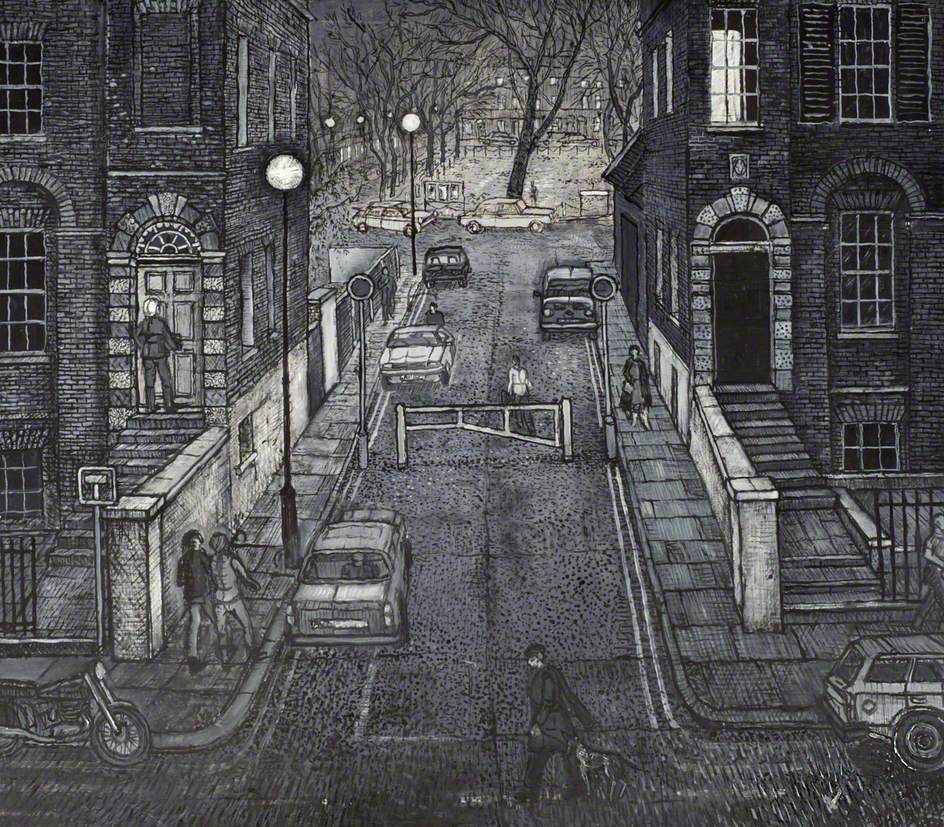
Peter Snow – Cleaver Square from Kennington Park Road (1988). From the Southwark Art Collection.

The Countess, the Living, and the Dead

There was a video featuring Adam Rickitt, who had been big in Coronation Street, in which he appeared naked. The song had been around when David had been clinging to the frayed edges of his youth. He hadn’t pulled it off. Everything went downhill afterwards. Adam Rickitt went to New Zealand to appear in a soap and was accused of stealing a block of cheese, a bottle of HP Sauce and a jar of coffee from a supermarket. David had moved out of the family home because the banks were knocking at the door.

On Sunday night, they had called at a gay bar, and David saw Adam Rickitt on the screen again. “I would gladly have sniffed his bollocks,” he told Joshua, who turned his nose up. “What the fuck is this shite?”

David recalled dancing to Adam Rickitt at Cruz 101 in Manchester. He was high on ecstasy at the time. But he’d gone to a friend’s flat afterwards and written the best chapter of a book he had never written—longhand, too. Then he had left it behind, where it ended up in a black wheelie bin.

Mancunian days. Every weekend in the North West. But he remembered little. The only memory he retained was of a cute little chicken who had taken his shirt off and started singing, “Sexy… everything about you, so sexy.”

David went home with him. The biggest shithole in Longsight, with every room knee-deep in empty Coke bottles. The bed was hidden behind a mountain of takeaway boxes. It had taught him that all that glittered was definitely not gold.

He related the story to Joshua while walking home in the rain.

“You’re too posh,” Joshua warned him. “Too many frills and high expectations.”

“But I ended up with you,” David replied.

 “Your problem is that you look too much at the past, and forget about the future.”

“But there isn’t much of that left, is there?” 

David was feeling down.

March had been a bad month. April looked bleaker.

“There are too many deaths, Joshua. Once, I went to weddings all the time. Now I go to funerals. I suppose we’re all in the same boat, because everybody dies.”

But Joshua was too young to understand and nudged him on the arm. 

David was referring specifically to their next-door neighbour, who had surrendered to the inevitable. In the square, Dorothy Jerman had been known as the ‘Countess’ and lived alone. Not many had known why she was called the Countess, but there was a suggestion that it was a nickname given to her by a former landlord at the Prince of Wales opposite.

“That’s right,” she once told David. “He was the Brixton Bomber, a former boxer, who took over in the 1960s and upset residents by installing a juke box. It attracted teenagers and the lawyers and solicitors who lived nearby wanted a quiet pub and drove him away. But he was a good chap, and called me the Countess because he wanted to get into my knickers. Little did he know that I never wore any.”

The Countess, a portrait painter, had moved here in the early sixties when Cleaver Square had been different to what it became. She shared it with her kids after a messy divorce and remained after they had grown up and left. By all accounts, she was a ‘rebel’ who famously held wild parties that spilled out into the street. 

David inherited the house next door and on most fine days, the Countess could be found sitting on the front steps, a glass of wine at hand, either reading a paperback or making conversation with anyone who passed. 

And the Countess had loved Joshua from the moment David invited him to move in with him. Two fucking artists, David had mused. Joshua would sit on the steps as she stroked his blond hair and told him stories about her life.

She claimed to have chosen Cleaver Square on the recommendation of a friend, Innes Fripp, a landscape painter and portrait artist who had taught at the nearby City and Guilds of London Art School and once had a studio in the square.

David had looked up the connection and found that it might have been true. He also discovered that the area had once been called Prince’s Square, named after two houses flanking the entrance, built for Joseph Prince by Michael Searles in the 1760s. The name was changed in 1937, a throwback to Mary Cleaver, who had owned the land in the eighteenth century.

“This is where sea captains lived,” the Countess once boasted, “but the square fell on hard times by the end of the nineteenth century and attracted old music-hall stars instead. It fell on evil days—crumbling brick façades hiding three families across three floors. During the war, the council requisitioned many of the houses for bombed-out families. The trees died, and the gardens were razed.

“South of the river was one vast slum when I arrived. When I fled Chelsea’s superficiality, the square was dilapidated, with shabby red-brick houses—homes for dockers and clerks—but every door stood open. Everybody knew everybody else. Materially, they had little, but they shared it when needed. Then the developers came, and with them came the barristers, judges, and MPs. That was when the doors shut. The young people drifted away, saying the square was not worth living in—it was dead. That is how we ended up with John Major.”

The houses went for millions now, but the Countess had not been tempted to sell. She could have died a millionaire, but preferred to live with her memories and pry into the lives of people she did not know… and who might have looked down on her, had it not been for her cheek and charisma.

When David arrived in the square, the Countess welcomed him as somebody who lived on her level. Shortly before he died, David’s uncle, William, had kicked out the previous tenants with a view to selling it. It was vacant when David discovered that the property now belonged to him.

But now the old woman had died.

It was good fortune that the Countess had resolutely refused to lock her front door. Joshua had gone looking for her and found the body slumped in a fireside armchair: a flute of flat champagne beside her and a dog-eared copy of Valley of the Dolls in her lap. He had panicked and gone running round to David, with no idea what to do.

Only the day before, David had made an unnerving discovery. The Countess had told him that he was not an Aries after all, but a Taurus. It had taken sixty-two years to learn the truth. But David, who normally paid little heed to astrology, realised that he preferred being a ram to a bull—it was better for a gay man, he suggested.

“A cusp baby,” the Countess commiserated, “and if it helps, you have adopted elements from each star sign.

“You do love a grand romance—you throw yourself into it, heart first, and breathe your partner in as though they were oxygen. But you bruise easily in love, my dear, and you’re far too quick to feel taken for granted. You’ve a weakness for strays as well—people from all walks, the straighter the better.”

“I do have a weakness for working-class boys,” David agreed. “And Joshua comes from a relatively poor family in Thamesmead.”

“Really?” said the Countess. “I had no idea. He speaks with such charm and dignity—and is incredibly handsome. And Thamesmead is perfectly lovely in the summer.”

“I met him when he was only twenty-one and working at Morrisons. For some reason, I was walking around the lake and came across him standing there, looking at the birds on the water. I found out later that he didn’t know one bird from another—except when we were talking about cocks. He had been cruising for a shag, which he didn’t get, but we talked. I pointed out that Thamesmead had been the setting for A Beautiful Thing, which turned out to be his favourite film. Eighteen years later, here we are.”

The Countess had not finished.

“You may have secret love affairs or fall in love with someone who is quite unavailable to you.”

“That’s not true.” David had been a bit too quick to reply, and the Countess raised her eyes, because she had not, for one minute, believed him.

David was thinking about Miles, his provincial friend, whom he had first met when the boy was eighteen. Putting Joshua aside, he had spent the last eight years trying to seduce Miles, but had failed at every attempt. Unknown to Joshua, David had once fallen in love with Miles. It was never reciprocated, but that feeling never changed. Miles was only interested if you happened to be a good-looking French or Italian boy—certainly not somebody like David.

“Are we referring to Freddie, dear?” the Countess asked.

Freddie lived in Hammersmith and was the same age as Miles, but his eccentricities annoyed David—not least his tendency to point out dead people whom he claimed to see at the most inappropriate times. Once, David had slept with him, and Freddie had told him that there was an old woman sitting knitting at the bottom of the bed. He had also ingratiated himself with the Countess because he claimed that a family friend had used his name for a character in The Archers. That had gone down extremely well, because she listened to the programme without fail.

“The last time that I saw Freddie,” she laughed, “he suggested that there was the presence of two dead women—Christine and Hannah—who once ran a brothel here. I talk to them all the time now, and suggest that far worse things have happened in my time.”

“It is definitely not Freddie,” said David, “and I would appreciate it if you did not repeat that to Joshua.”

“Because Venus represents attraction, and the twelfth house is associated with the feet,” she said, “your feet may be especially attractive—and have erogenous zones!”

He had turned his nose up.

David and Joshua headed home and passed the Countess’s house, which stood in darkness.

“I wonder what will happen to the house,” Joshua speculated.

“Well,” said David, “she must have had a will, and I suppose everything will go to her family.”

They were both aware that the Countess had fallen out with her three children, and only one of her grandsons, Owen, ever visited her. The two of them had known him as a young teenager and knew that he did much of the maintenance work around the house, though there were difficulties the Countess had often fretted over.

“If Owen gets everything,” Joshua mused, “it could prove interesting.”

David thought that Owen had grown into a striking young man, but conveniently overlooked that he suffered from a severe case of ADHD, which made him prone to violent bouts of temper.

“He would most likely sell it and become fabulously wealthy,” he suggested.

David knew that the Countess was of sound mind and that she had deliberately led her family to believe that she suffered from delusions—among them that she saw thousands of long-tailed birds clinging to a tree in her back garden, that the other trees were covered in hundreds of cats, and that dead dogs with fiery eyes lived beneath the bushes.

“At least it stops them visiting a crazy woman,” she had laughed.

“Whoever it is left to will find it contested,” David added, “because they will say that the Countess was of unsound mind when she made it.”

“Maybe she was deranged,” Joshua decided. “She often claimed that all sorts of famous people visited her at one time or another. She once told me a magnificent story about Vivienne Westwood, David Bowie, and Marc Bolan coming to tea—and that they ended up bouncing along the street on great big orange balls.”

Space hoppers,” David implied. “I had one when I was a small child in the 1970s. Did you know that Russell Harty was also a personal friend of the Countess?”

David knew that Joshua would not know who Russell Harty was.

“What was he famous for?”

“Sexual escapades with much younger men,” David replied, “and for hosting chat shows on television.”

David had met him once, when he had still been young enough to turn heads in the street. Harty had just returned from Paris, where he had lunched with Nureyev and Charlotte Rampling at the British Embassy. He made small talk, and David was disappointed that this brief encounter on Greek Street had not led to anything more. Still, it had been enough for him to brag about at Comptons.

A few months later, Harty was dead, having suffered liver failure—a result of hepatitis.

“The Countess knew everyone, or said she did. And now there’s no one left to confirm it.”

“That’s the problem,” said Joshua. “Did these encounters actually happen? Was she connected, or just a brilliant bullshitter? I often wonder the same about some of your stories.”

That last comment hurt David.

“Everything I tell you is true.”

“But nothing ever seems to happen to me. The Countess knew famous people. And you’ve done things—wild things—that make my existence seem ordinary.”

“The older you get, what once seemed ordinary suddenly becomes fascinating. We all look back and realise that we did something special.”

The funeral was due to take place the following Friday. The cortège would leave Cleaver Square at lunchtime and travel to Lambeth Crematorium, where a short service would take place before she was handed over to the devil.

Joshua unlocked the door and turned to David. “Do you think we’ll see anybody famous at the funeral?”

“Probably not,” David replied.
My Week, For What It Was Worth

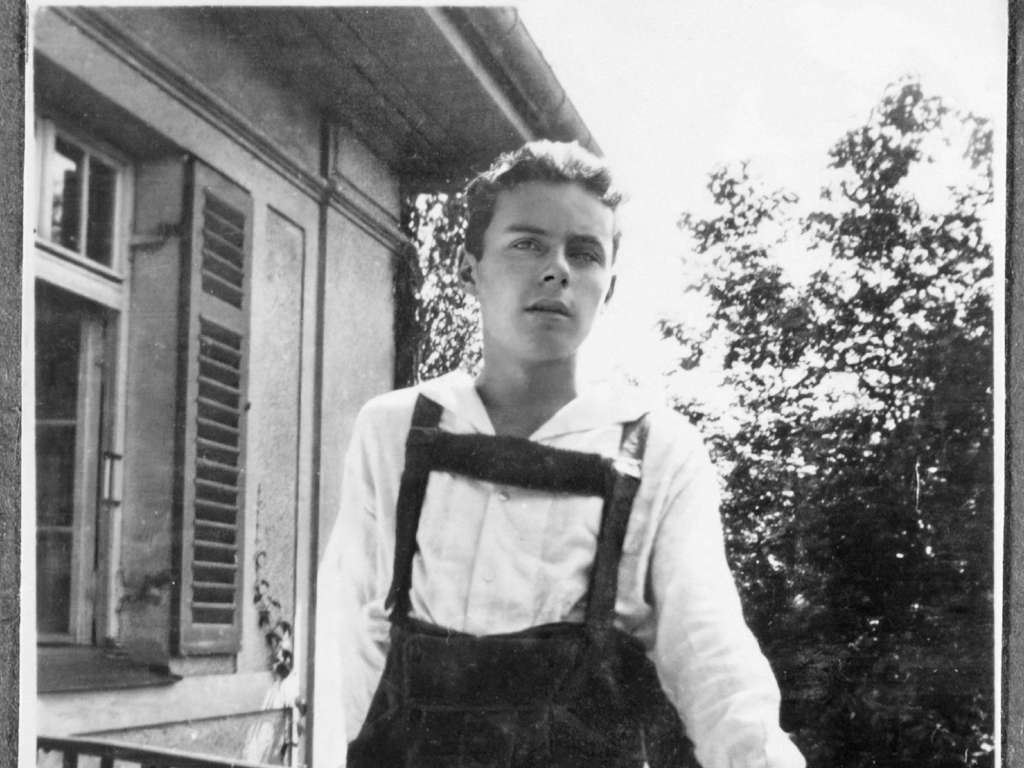
Klaus Mann (1906 – 1949)

On finding a photo of 16-year-old Klaus Mann…

Klaus Mann. Cute twink. What did you become? A chaotic mix: part mongrel, openly queer, a junkie, and premature anti-Fascist. The eldest son of German literary giant Thomas Mann. Born with a permanent side-eye for the world and zero patience.

Every book he published before 1933 got tossed straight into the flames during the Nazi book burnings.

His 1942 autobiography, The Turning Point, reads like a roll call of lost friends; an unsettling number of the people in it had died by suicide, more than feels believable in one life.

Seven years later, in Cannes, he followed the same tragic path.

“Memories are made of peculiar stuff, elusive and yet compelling, powerful and fleet. You cannot trust your reminiscences, and yet there is no reality except the one we remember.” – Klaus Mann (The Turning Point)

On being famous in a hundred years…

I will die and in a hundred years people will decide that I was iconic. Maybe I was just too avant-garde for my era, and everyone needed a lot of time to catch up. Or maybe… I was just a shit writer and in a hundred years time people won’t be writing at all. And when they rediscover my work, it will make my shit writing seem like that of an intellectual. 

On hearing about an intriguing snack…

“He said that he would fix me a snack, but that it might take a little time. I read while he disappeared into the kitchen. When he returned fifteen minutes later, he handed me a plate containing three salted crackers and an unknown delicacy that had been thinly spread over each one. I asked what it was, but he shushed me and said that they were best eaten straight away. I ate them and afterwards he told me that the crackers had been covered with his sperm.”

On the urge to write gay porn…

I write gay sex scenes in which nothing really happens. So why not write gay porn where everything does? The thought crosses my mind, but embarrassment stops me. I have no wish to shock anyone, or to offend.

People tell me there is money in it. In that world you can have sex with anyone you like on the page—the most beautiful man, the ugliest. No limits, no refusals. Anything can happen because you decide it does.

The urge to write it grows stronger.

But then my unhealthy fascination with Baron Corvo returns, as it often does, and he appears in my dreams again. He reminds me—rather coldly—that, like him, I am already sufficiently depraved, bordering on the disgusting, and that there is really no need to write about it.

On realising what I look at each morning…

I’ve started following a French blog called Gay Cultes—my daily hit of a beautiful male body, a little lust, and a sprinkle of homo culture. And it makes me a little jealous because it is simple and never misses. 

On loving these lines in a book…

“He spat and beat his donkey, which farted, kicking one leg. I followed his advice, as the commotion I seemed to be causing was making me a little uncomfortable.”

On observing three guys in a band…

Three guys are standing there with guitar cases on their backs, talking among themselves. From what I catch, they’re starting a band.

For a second I feel this urge to tell them they’re absolutely doomed. Not because of the music—who knows, they might be good. But visually? It’s a disaster. Two chubby guys and one tall, spotty skeleton. 

On finding a good poem…

Together
Sleeping together … how tired you were …
How warm our room … how the firelight spread
On wall and ceiling and great white bed!
We spoke in whispers, as boys will do,
And now it was l—and then it was you
Slept a moment, to wake-time fled;—
“I’m not a bit sleepy,” one of us said.
I woke in your arms,—you were sound asleep.
So close together we had tried to creep,—
Clinging fast in the darkness, we lay
Sleeping together,—that yesterday!

C. Mansfeld

On hearing a man say to his small son…

“Gi’ it a look. It’s reyt callin’ out, innit? All sat there beggin’ for it—everythin’ tha needs t’ knock up a proper bit o’ slopdosh, if tha’s not soft.” 

*****

Did I believe in life after love? In love after love? In life after life? I was unsure at that time.

But we were happy.

My Head is Full of Random Shit

*****

“Video Angelus internehilium et imortalis Even as we speak our hearts entwine. Senex et angelus video venestus caelum. Equiden lavare in meus vita empeteus Ah eeh ah eeh ah.”

*****

The boy who likes the excitement of fear.

“I worry about being thrown off the carousel in later life.” 

A skinny body and dirty pants.

*****

“He’s got it. Yeah, baby, he’s got it. I’m your Penis, I’m your fire. At your desire. Well, I’m your Penis, I’m your fire. At your desire.”

*****

Be careful who you choose because it can go wrong.

Is it that Bailey is still a virgin?

A shelter on a beach full of books.

A lake in an abandoned quarry.

Is it love that never quite reaches an orgasm?

A boy who turns up late is always popular.

Pasticcio.

The Organ of Lorenzini.

Life Story: The Third Drop

I noticed him but he chose not to notice me. After he had dropped his mobile phone on the floor for the third time, he realised that he had to say something.

My Own Private Idaho – River Phoenix doesn’t just act – he drifts, aches, and unravels… and now we know that it was real

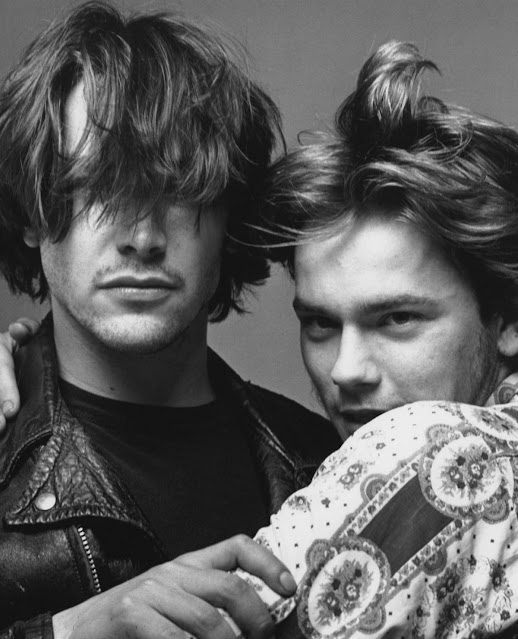
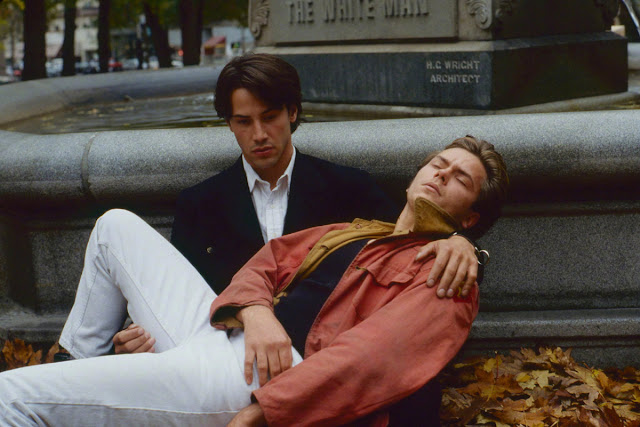
My Own Private Idaho. Keanu Reeves and River Phoenix. Promotional still (1991)

Scott: I only have sex with a guy for money.

Mike: Yeah, I know.

Scott: And two guys can’t love each other.

Mike: Yeah.

Mike: Well, I don’t know. I mean… I mean, for me, I could love someone even if I, you know, wasn’t paid for it… I love you, and… you don’t pay me.

Scott: Mike…

Mike: I really wanna kiss you, man… Well goodnight, man… I love you though… You know that… I do love you.

***

Watched ‘My Own Private Idaho’ for the first time. Charlie asked me if I’d seen Keanu Reeves recently because he looked old. But he was 61-years-old. River Phoenix still looks exactly the same… but that was how he left things. I remembered that I’d mentioned Phoenix before… but in one of my stories, he had appeared as a ghost. 

It wasn’t going to be called ‘My Own Private Idaho’… better than ‘Blue Funk’ or ‘Minions of the Moon’… and named after a B-52s song. Inspired by Shakespeare’s Henry IV plays… Prince Hal and Hotspur and Falstaff… but here it was Scott Favor, privileged bisexual, Mike Waters, narcoleptic gay hustler searching for his mother, and Bob Pigeon, coke-dealing chickenhawk. Gus Van Sant: “My films are usually about relationships. I think you make films about things you lack.”

I can’t stop thinking about River Phoenix because, I guess, I’m in love with yet another dead man.

1987… “Run to the rescue with love and peace will follow.” – River Phoenix.

1989… Star burning bright. Beautiful. Lightness. Creative. Camera object.

1991… Indie moment. ‘My Own Private Idaho’. Realism to fantasy. Challenging the norm. Self-destructive attitudes. Dark themes. Cool culture. Downbeat hustlers. Wanderers. A chance to become an adult actor. Gus Van Sant simply being Gus Van Sant. 

Keanu Reeves laying in bed playing with his nipple. What River Phoenix needed after making this movie – a bath, a shave, an exfoliating facial scrub.

“How do you see yourself fitting in with younger Hollywood acting?” (A sweet voice). “I don’t see any of them in the perspective or in the limelight of Hollywood. I really don’t ever want to get that objective or self-consciousness of my place in this world of showbusiness.”

1993… LA nightclub. Halloween. Music blasting. Sitting on a couch. Tired. Intoxicated. Skinny. Bad skin. Ticking time bombs. Heroine. Cocaine. Morphine. Marajuana. Valium. Cold remedies. Addiction is an open secret here. And then the star exploded all over the pavement. Never did anyone move from casual drug use to death so quickly. The night that Fellini died – ‘A director’s sweet life. An actor’s brief life.’

Retrospective.

2025… ‘My Own Private Idaho’. Turning point. A troubling effect. Midnight rock sessions. Alcohol. Uncontrollable drug use. Crystal meth. Hooked. No chance of going back now. Progressive and fatal. Like ‘The Little Shop of Horrors’…if you go too near to the plant it will eat you. The best performance… but from now on he didn’t care enough about himself to look after himself. What about those he left behind? Nobody did anything to help him when he was alive… guilt… and lasting sadness.

Have a nice day!

My Own Private Idaho. Keanu Reeves and River Phoenix. Promotional still (1991)
My Own Private Idaho. Keanu Reeves and River Phoenix. Movie poster (1991)

Back off – I’m not that person now

The soul of a good time. But something changed. I’m not a social person anymore, but everybody wants me to be. They talk shit all night. I want to say, “Please go away, I prefer my own company now.”

When I’m not in the mood. Sad scenes from a gay bar

Image: Charlie Marseilles

Matchstick Man stretched and showed his slender stomach. Lean, flat and toned. It was for my benefit, and he knew that I would be distracted by the neat wave of wispy hair that headed south of his Calvin Klein waistband. But he still claimed to be straight, and when I suggested otherwise, he simply laughed.

The tall handsome guy, maybe in his twenties, looked fine from a distance. When he came over, I found that he’d had lots of botox and talked about Donald Trump in a squeaky voice. 

An older man chatted me up, and said that I had a lovely smile. But I wasn’t in the mood, and played hard to get, and so I made an effort not to smile anymore. He called me an arrogant prick and left me alone. 

A group of guys stood next to me. One of them, who appeared to be wearing aluminium foil, thought he was the patron saint for confused gays. He pontificated that he knew more than anybody else and his friends agreed with him. I wanted to make a noise like a sheep but somebody beat me to it.

Two guys told a friend that when they got together they were both tops, and so they tossed a coin to decide who would be the bottom. 

Somebody behind me said something like, “Oh, poor love, poor heart, I played with your pain, I trampled on you with indifference!” – or words to that effect. I hoped that they were quoting from something, and this wasn’t part of their normal conversation, but somebody said, “I agree.”

The Angel grabbed me from behind and gave me a hug which I thought was sweet. He sat beside me and gave me a tour of his body tattoos. The last time I saw him, he insisted I speak to his grandmother on his mobile phone. It was an awkward conversation with somebody I didn’t know. She told me that he was ‘ a little shit’ because he forgets to take his ADHD medication and then he’s like a rabbit. My interpretation of a rabbit had been different to hers. Later… he ate pizza with his eyes closed and looked so tired that he may have drifted off at any moment.

That Moment – Familiarity is Dangerous


A night of drunken defiance, the air outside warm and sticky, carrying the sour breath of alcohol from the open doors. My head feels heavy, my stomach lined with white rum, and the thought of going home to curl up with a Jacques Tati biography feels more attractive than another drink. Still, I order another one – habit, not desire.

Ben messages to see if I’m out, and I can feel the eagerness in his words, the barely disguised hunger. Last week we sat in a corner booth until five in the morning, the world narrowing to the scrape of glasses and the whisper of confidences. But I put him off tonight. Familiarity is dangerous.

I once fell for him and, in a moment of reckless honesty, suggested we sleep together. He brushed it off with a laugh, not knowing that I never give anyone a second chance.

Charlie / Un après-midi en sous-vêtements


A hillside in the remote countryside. Serge Gainsbourg sang Black Trombone on the iPhone. Charlie danced in his underwear.  His hair formed a question mark on his head. He looked cute. I grabbed him from behind and he reached over and patted me on the head like a dog. Then he pissed into the wind and I got covered from behind.

Charlie / The mystery of the black Calvin Klein briefs


The day started with a mystery that caused a problem. Charlie had done the laundry and I had been angry. It doesn’t matter how many times that you tell him to separate whites and colours, he refuses to do so. The result was that my white t-shirts came out pink yet again. When I challenged him about it, he sulked, and put the rest of the clothes away in silence.

And then we came to the black Calvin Klein briefs. 

Charlie was putting them in my drawer and I pointed out that they didn’t belong to me. He held them between his fingers and examined them. “They are not mine either,” he decided. “They must be yours,” I replied. “They are definitely not mine.”

We stared at the underwear and waited for the other person to admit to owning them. But neither of us coughed up.

Charlie tossed them onto the bed. 

“This poses a significant problem,” I decided. “If they don’t belong to either one of us, then whom do they belong to?”

“That is a very good question. Do they belong to someone who you have been sleeping with?”

“In your dreams,” I responded, but there was hesitancy in my voice. Charlie had the ability of making you feel guilty even when you were innocent, and this was one of those occasions. He pounced upon my uncertainty and decided that I had been sleeping with someone who had forgotten to take their underwear home with them. 

“I can assure you that I haven’t slept with anyone. The only person that I’ve slept with is you, but even that’s debatable.”

“What do you mean?”

“Nothing. I’m just a bit upset because I know that they are not mine, nor are they anybody else’s that I know of, so the finger of suspicion points squarely at you. Have you been sleeping with somebody behind my back?”

Charlie rubbed his hands through his hair in desperation. “Do not be disgusting. I have not been sleeping with anybody.”

“Was it one of those American Mormon boys who came knocking at the door? Did one of them come back when I was out?” It was a cheap shot. But a few days before, they had come bright-eyed and eager to save our souls. I’d politely turned them down and said to Charlie that it was inconceivable that every Mormon boy appeared to be cute. 

When Charlie was hurt, his French accent became more pronounced. “I believe it when you say that you know nothing about them, but you must also understand that I have nothing to do with them either.”

“But whose are they?”

“I have no idea. But maybe they belonged to Levi who left them behind when he moved out.”

“But that was weeks ago,” I said.

“I guess that there is no other explanation.”

And that was where we left it. Black Calvin Klein underwear unclaimed.