Tag Archives: gay

The Isherwood Problem: Youth, Age and the Right to Desire

Don Bachardy and Christopher Isherwood. Early 1950s. Photograph by Zeitgeist Films / Everett Collection.

My friend David is reading a biography of the writer Christopher Isherwood on his Kindle. It has taken him a long time to get through—not because the book is difficult, but because it is extremely long. He joked that his Kindle had travelled with him from London to Munich and Paris, and back again, and he had only reached the fifty-percent mark.

“That’s the problem with an e-book,” he said. “We don’t talk about pages anymore. We obsess over percentages.”

I suggested that perhaps he was in too much of a hurry to finish it.

“That’s true,” he reflected, “but don’t you always have one eye on what you’re going to read next?”

David is a lot older than me, and I’m not entirely sure where we first met. He is educated, though—one of those men whose words are almost always guaranteed to entertain. We were walking beside the canal from Paddington Station towards Little Venice. It was dark, lonely, and faintly threatening. I half-expected a knife-wielding mugger to emerge from the shadows at any moment.

For someone like me, who comes from the provinces, London can feel dangerous. David had no such concerns. He regarded nighttime as the best time to wander its quieter streets, harvesting inspiration for his novels, though on this occasion he had also had to tolerate my repeated complaints.

He tried to change the subject.

“The other day I went into Daunt Books on Marylebone High Street,” he said, “and overheard two older women talking. One of them said, There are so many books to read, and so little time left to do it. That made me think about my own mortality. It’s probably why I’m in such a hurry to finish the Isherwood biography.”

It was the first time I’d heard him refer to his age in that way. I’d never really considered that it might trouble him.

It was my turn to change the subject.

“To be honest, I’ve never read Isherwood,” I said. “I find him a bit of a privileged bore.”

He seemed not to hear me.

“There are several comparisons between Isherwood and myself,” he continued. “I’ve been struggling to come up with new ideas recently, and while reading the biography I came across a quote from his diaries: A lack of creative inclination to cope with a constructed, invented plot—the feeling, why not write what one experiences from day to day? Why invent, when life is so prodigious?”

He paused, as if letting the words settle.

“That resonated with me. I’ve decided that my future writing will only be based on real life experiences. That will be far more satisfying.”

David’s work had always relied on a radiant imagination—several bestsellers proved that—but this declaration unsettled me. As if anticipating my concern, he smiled.

“I have a lifetime of fascinating stories involving my closest friends,” he said. “Some of them might raise a few eyebrows.”

“Did Isherwood do as he suggested?” I asked.

“Absolutely. He created characters based on people he knew. Sometimes he even wrote about himself in the third person, omniscient. I plan to do the same. I’ll call my character David—and absolve myself of any blame.”
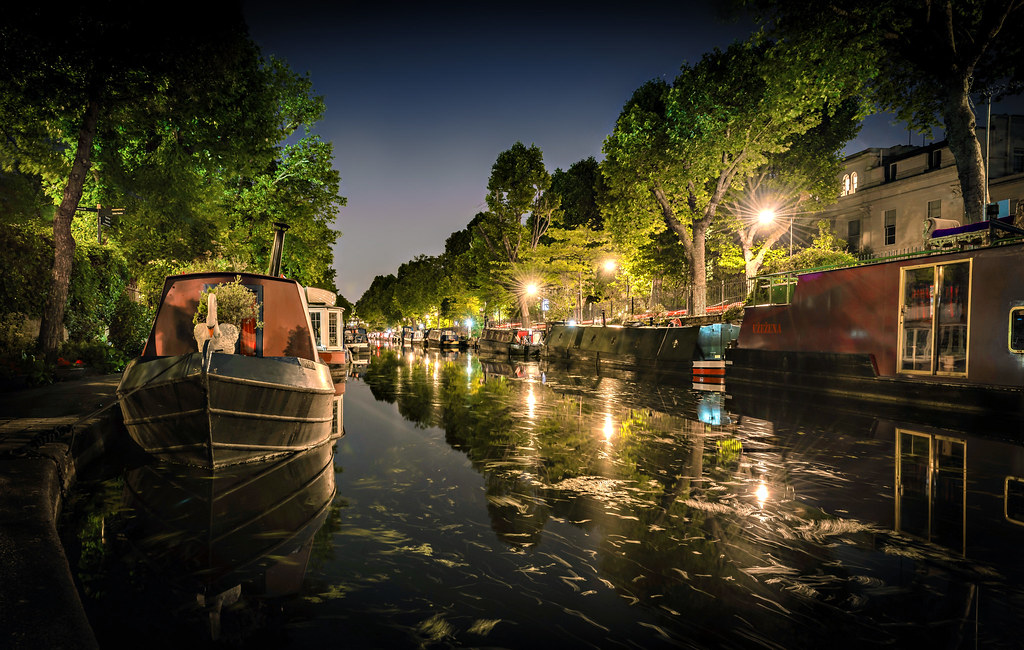
Little Venice. Where the canals whisper secrets under the London stars

We passed moored canal barges. Most were dark, but a few glowed from within: a man cooking over a tiny stove, a woman bent over her laptop, someone stretched out watching television. Their lives were visible through brightly lit portholes, as if privacy were optional.

“There are other similarities between Isherwood and me,” David went on. “When he was forty-eight he met his long-term partner, who was only eighteen. Does that sound familiar? Joshua was twenty-one when I met him. I was forty-four. Seventeen years later, we’re still together.”

“To be honest,” I said, “I’m surprised your relationship has lasted this long.”

I thought of the times he had propositioned me, and of the occasions I had refused him. I would have been eight when he met Joshua, who was now approaching forty. I had been in my early twenties when I first met David.

“The secret,” he said, “is not to make a relationship exclusive. Not my words—Isherwood’s. He and Don Bachardy both had sex with other people.”

It sounded close to a confession.

“Young men enjoy the benefits of being with an older man,” he continued. “Even if they get their sex elsewhere. Boys can take on the identity of their mentor. Bachardy picked up Isherwood’s accent within a year. Joshua is still his own person, but he always comes home. He values stability.”

Above us, traffic thundered along the Westway flyover. Sirens cut through the night. London had become a city of constant alarm. We were nearing Little Venice—named, supposedly, by Lord Byron, who compared its rubbish-filled waters to the Italian city he had once lived in. In the darkness we could just make out Browning’s Island.

“This is where Paddington Bear was once carried by a swan,” David joked. “Though I suppose that means nothing to you.”

My mind was elsewhere.

“I know times were different,” I said, “but Isherwood might today be accused of grooming a young boy.”

“I knew you’d say that,” David replied. “And yes—you’re right. An established literary figure and a college freshman. There were even unkind rumours in New York that he was with a twelve-year-old. His friends disliked Bachardy. But they turned a moral weakness into a long-term relationship. Rather like Joshua and me.”

He paused.

“Back then, people were blissfully unaware. Today everything is played out before a global audience. If the same thing happened now, Isherwood would be cancelled—even if nothing illegal had occurred. We used to call it boy-love. An appreciation of male beauty going back to the Greeks and Romans. Now it’s considered dirty. That’s something I struggle with.”

A person with limited education is at a disadvantage when arguing with David. He always has the clever words ready. My clumsiness betrayed me.

“Can’t you see that there’s something disgusting about the age difference?”

He frowned—not so much at my disapproval, but at my inelegance.

“When I was young,” he said, “homosexuality wasn’t acceptable. Many of us missed out on young love. Then the AIDS crisis came. Now we grow old resentful, because there’s a void. Is it so terrible that we try to recover something we lost? You’re the generation without constraint. You don’t understand our predicament.”

He stopped walking.

“No matter how old you are,” he said, “there will always be something exquisite about youth.”

“Why?” I asked. “Isherwood came from an even older generation. And what you’re saying sounds pederastic to people my age.”

“When Isherwood was young in the 1920s, he was driven out of Germany by the Nazis. Berlin became dangerous. By the time Bachardy appeared, Isherwood was already considered ancient. Some say the boy did the chasing. The relationship later became non-sexual. Bachardy had other lovers.”

A group of students approached—three boys, two girls—laughing loudly before falling into an awkward silence as they passed us. I recognised the look. Suspicion. Not for the first time, I’d been mistaken for a male hooker. I resisted the urge to run after them and explain myself.

David smirked.

“I think I know why you struggle with age disparity,” he said. “That look on your face—it wasn’t moral outrage. It was embarrassment. Shame. You’re ashamed to be seen with someone older.”

He shook his head.

“That’s not a virtue I admire. One day you’ll find yourself old without warning. And the object of your desire will be much younger. I hope that boy doesn’t think the way you do now.”
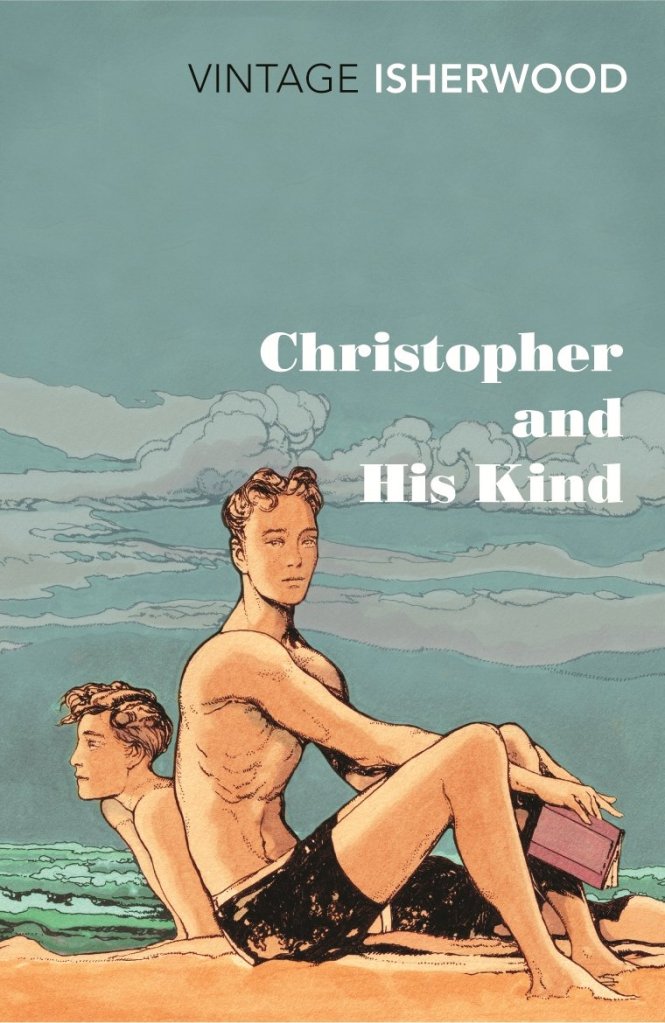
Christopher and His Kind is a 1976 memoir by Christopher Isherwood first printed in a 130-copy edition

Life Story: The Linger of What Was

New Romantic. Colin Cox. Photographed by David Suárez (December 2025)

The thrill of the forbidden, the surge of emotion and thought. That quiet, hollow space inviting reflection on the fleeting nature of our own lives and whatever traces we leave behind. A wavering line between appreciating beauty and surrendering to objectifying desire—an involuntary pull shaped by masculine sensitivity, itself carved by the bittersweet passage of time and the ephemerality of experience. The soft focus, the restrained emotion: a vivid instant once sharp and certain now blurring into a subtle, almost spectral echo of what once felt wholly present. The intensity drains away, leaving only a neutral, distant recollection, until all that survives are scattered fragments of sensation.

Hot Tap Hustle for the Horny

Image – Darkness Drops

Pablo thrusts his hands beneath the hot tap. He rubs them together in a frantic, almost self-destructive rhythm as the water climbs from warm to blistering. Anyone else would flinch, recoil — but he holds himself there, jaw locked, letting the scalding cascade engulf him in a cloud of bitter, furious steam.

The faces and bodies of the men he aches for seem to drift through that fog, circling him, pressing close. You can tell when the moment is nearing: the tightening of his calves, the subtle clench of his arse, the way he grinds himself against the cold lip of the sink. It is sharp, electric — his own strange ritual, the pink-hands-and-hot-water orgasm — that edge where pain dissolves into an ecstatic, trembling pleasure.

But the release he chases always slips from him. It teases, then vanishes.

When the heat becomes unbearable, he finally twists the tap off. His head drops. He turns, shoulders hunched, his shorts soaked and clinging to him. He won’t meet my eye; shame clouds the air between us. This little masochistic kitchen-sink drama — he believes it reveals too much.

The Shadowed Hand Behind the Letter


Being the transcript of a letter unearthed in the long-sealed vaults of the Royal Bank of Scotland, November 2025

George Walker Wood
66 Cavendish Street,
Marylebone
London

29 November, 1881

My dear Reader,

If by curious chance you hold this manuscript in your hands, I entreat you to read its contents with the utmost seriousness. Only by such attentive perusal shall you perceive that the pages which follow are both an explanation and a justification for their long concealment.

Should it prove that I still draw breath when these lines meet your eye, then I beg of you—burn them without delay, and disclaim all knowledge of ever having encountered them. The shame that would ensue from their divulgence is of so dreadful a nature that I scarcely dare commit the thought to paper.

I shall therefore begin at the point where first I made the acquaintance of one Johane—an Irish youth of some four-and-twenty years, of humble condition, and with every outward appearance of one who might easily draw misfortune to my door. He was, however, most commonly called Jack, and by that familiar name I shall refer to him henceforth. Dear Jack belonged to a loose fraternity of young loafers and street-bred rascals—variously known as the “London Boys”—a wild and merry set whose manners were as questionable as their morals, yet whose very recklessness possessed, for me, an unaccountable fascination.

In time I grew most attached to Jack, and he attended me frequently at my lodgings in Marylebone. There, behind doors safely bolted, we indulged in certain intimacies which, though common enough within that unseen sphere of which London pretends ignorance, would cause polite society to feign horror. Jack’s person was slight, his garments threadbare and ill-assorted, and he bore all the marks of those who are forced to wrest their sustenance from the streets; yet beneath that rough exterior there was a warmth and vigour not easily described. When fortune smiled and I had a few coins to spare, he would remain with me until morning, and those nights—cold, anxious, sweet as they were—remain fixed in my memory.

I suspect that my landlady, Mrs. Chivers, a stout matron of no small curiosity, had taken something of a liking to Jack as well; for once I discovered him seated at her kitchen table devouring a modest breakfast of bread and scrape. The glint of mischief in his eye, as he looked up at me over the crust, told me all I needed to know. She had chosen to see nothing of the nature of my rooms above.

My days were spent at the old desk overlooking Cavendish Street, where I composed articles for The London Figaro and The Dark Blue. Yet I had long nourished the ambition to attempt a novel—something that might echo, however faintly, the triumph of A Tale of Two Cities. My parents, never slow to remind me of my deficiencies, assured me that I lacked both imagination and creative faculty, that I was fit only to set down facts and order them neatly upon a page.

Still, I could not forget the tales Jack whispered to me during those winter nights—tales of gentlemen of rank who sought his company at a high price; of drawing-room adventures veiled beneath the richest draperies; of temptations and behaviours of which the world speaks only in scandalised murmurs. Spurred by these accounts, I sought the acquaintance of a certain printer known to an associate of Henry Ashbee—a man whose livelihood depended upon the discreet production of pamphlets of a decidedly provocative character.

Mr. William Lazenby, a sharp-eyed fellow, showed interest in my idea and agreed to an initial impression of two hundred and fifty copies. He offered me a share of the profits, subtracting his considerable costs, should I but write with candour. The sums he mentioned far exceeded any I had yet earned, and the promise of so easy a reward was exceedingly tempting. He informed me that the book should be sold exclusively by mail-order through an address in Paris, and insisted that I adopt a nom de plume, lest I bring inevitable ruin upon myself.

When I conveyed the scheme to Jack, he immediately demanded—nor without justice—a share of the proceeds, and further insisted that his own name be affixed to the work. I warned him that the police might take a dim view of such recklessness, but he merely laughed and declared that the “mutton-shunters”, knowing full well he could neither read nor write, would never suppose him connected to any printed matter. With that he tumbled himself upon the bed in his usual impudent fashion and suggested that we commence our “research” without delay.

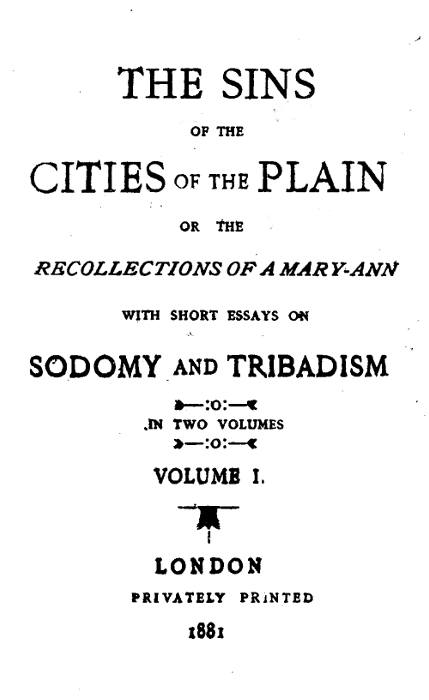
By June the manuscript was completed, and I had settled upon what I deemed a most fitting title—The Sins of the Cities of the Plain. Though Mr. Lazenby scoffed at it, he conceded that the biblical suggestion would doubtless catch the eye of those gentlemen who take an interest in such hidden matters. I confess I feared that certain passages, dealing as they did with the concealed customs of our clandestine fraternity, might prove too recognisable to those acquainted with that shadowed realm.

Lazenby nevertheless published the work in two parts, and it found immediate favour among readers eager to feast upon the covert indulgences of the great and respectable.

Though I tremble at the thought of its reception, I take comfort that my own name has thus far escaped suspicion. I offer here my apologies to Mr. Simeon Solomon and Mr. James Campbell Reddie—both of whom have been unjustly whispered about in connection with this deception. Jack, meanwhile, basks in the admiration of his companions and seems persuaded that a century hence his name will still be spoken among certain circles of “inverts”, as he jests.

This very day I have deposited my first earnings at the Lombard Street branch of Messrs. Glyn, Mills, Currie & Co., alongside this confession, sealed and hidden, to remain in the vault until such time as Providence ordains its discovery. Should that day come, I trust that The Sins of the Cities of the Plain shall be regarded as a truthful and unvarnished portrait of those whose society I have come to cherish.

Ever, dear Reader, your faithful servant,

𝒢. 𝒲𝒶𝓁𝓀𝑒𝓇 𝒲𝑜𝑜𝒹
⌣⌣⌣⌣⌣⌣⌣⌣⌣
George Walker Wood

*****

Now read on to separate fact from fiction.

This edition contains the unabridged text of the first edition housed at the British Library, together with a new introduction by Wolfram Setz and a facsimile reproduction of the original volumes’ title pages.

The Sins of the Cities of the Plain is an influential Victorian erotic novel, originally published anonymously in 1881 and widely considered one of the first works of exclusively gay pornography in English. It is a fictionalized memoir attributed to real-life Irish prostitute Jack Saul.

The book is a narrative, presented as the “recollections” or “memoirs” of Jack Saul, detailing his experiences as a young male prostitute (a “Mary-Ann” or “rentboy”) in the clandestine gay underworld of Victorian London. It traces his escapades from boarding school into young adulthood, describing his sexual encounters with various men, from schoolboys and guardsmen to wealthy aristocrats and members of high society.

While attributed to Jack Saul, the actual author is debated by scholars, with some suggesting a ghostwriter or figures like the painter Simeon Solomon or James Campbell Reddie were involved. The book was privately printed in two volumes in 1881 by William Lazenby to avoid obscenity laws and sold for a high price.

The original printings are unobtainable today, but modern editions are widely available from various publishers, such as Valancourt Books and Mint Editions.

Concerning the Boy from Ruislip


Mr and Mrs Jones of Ruislip,

I find it rather interesting that you spent thousands of pounds to send your son to this university city. Did he have a choice in the matter? Perhaps not — but in any case, thank you for your thoughtful consideration. He is, as you surely already knew, something of a handful. But did you also know that he grinds his teeth in his sleep?

Neither of us is brave enough to be honest

Luigi Mangione – Associated Press

We don’t choose who we live with — we go with whoever they say we must. Fourteen hours a night, every night, every week, locked in a cell with a stranger who becomes someone. You talk until you know each other’s secrets. Then talking becomes boring.

John asks who my perfect cellmate would be. “If there were any justice — haha — I’d share a cell with Luigi Mangione.”

John looks intrigued. “Why him?”

I realise that John’s a good-looking guy, and I know my answer matters; everything rests on what I say. But I bottle it. “I think he’d be an extremely interesting guy.”

John sighs. “I guess he would be.”

Dancing around the truth, neither of us is brave enough to be honest.

Fours Words in Sentences of Lust 

Everybody’s Fool – Charlie Marseilles

How did it happen?
I went for milk.
He served me milk.
Anything planned tonight mate?
I shook my head.
That’s a shame mate.
What are you doing?
Nothing at all mate.
I take a chance.
Come to mine then.
What are you saying?
Let’s watch a movie.
Not sure about that.
Please come, I say.
It sounds weird mate.
I tell him where.
He comes around later.
We chatted about things.
We watched a movie.
Gotta go now mate.
I don’t want that.
Please stay the night.
That looks bad mate.
It’s a good offer.
He agrees to stay.
We have good sex.
Next morning he’s dirty.
He takes a shower.
Gotta go to work.
I will miss you.
Miss you too mate.
Thanks for the milk.

Charlie: Between Silence and Skin

French Connection – Charlie Marseilles

The room where I try to write has slowly become the room where Charlie paints – always in nothing but his underwear, as though bare skin loosens his imagination. He fills his canvases with young men borrowed from Pinterest photographs, embellishing them with his own wild inventions. His pace is relentless; one wall is already crowded with finished works, while the others gleam with fresh white paint, waiting their turn.

I, by contrast, sit fully clothed at my desk opposite him, my screen a blank page that refuses to yield. His half-naked body distracts me more than the silence we share – a silence that can stretch for hours. My sentences falter, my fingers hover above the keys, while my gaze strays repeatedly to the slope of his shoulder, the subtle shifting of muscle beneath skin. When our eyes do meet, the faintest smile flickers between us, and in that moment, it feels as though the room itself has been written.

Our different pursuits seem to mirror our temperaments: Charlie paints with fearless exposure, while I write with restraint, dressed in caution. Yet the tension coils tighter. My prose begins to echo the shapes of his body, the rhythm of his movements, until the line between art and desire starts to blur.

At times I tell myself I am only imagining it – that Charlie is merely eccentric, his near-nudity no more than a quirk. But each page proves otherwise. It is littered with involuntary admissions: the shadows along his collarbone, the hush of his breath when he leans too close, the bare expanse of thigh against the studio chair. These confessions rise from me slowly, as though I am being coaxed – cornered – into acknowledging what I cannot claim.

Tonight, the silence shatters. My phone vibrates, abrupt as a stone cast into still water. Charlie turns at once, alert, the brush slipping from his hand. “I need a rest from painting,” he announces lightly. “Let me see what you’ve written.” He springs up, knowing I will resist, his request merely a pretext to draw near, to glimpse what has intruded into our silence.

It is from Bianchi in Verona. A thrill runs through me, but I dare not open it – Charlie would notice too much. “Who is Bianchi?” he asks, now beside me, his voice soft but insistent.

“A friend of Cola,” I murmur, unwilling to elaborate. The words hang in the air, evasive, unsatisfying, already unravelling.

Danny Fitzgerald: The Demi-Gods of Carroll Gardens

Johnny and Vinny (second and fourth from left) – Danny Fitzgerald (1963). According to, Loncar and Kempster, Fitzgerald never printed this image. It was found in a short, four-frame strip of images of the brothers smoking between two cars with friends, on a street in Carroll Gardens, Brooklyn.

The noisy summer of 1963. Shouts, laughter, transistor radios blasting crooners and rock ’n’ roll. Danny Fitzgerald walked the streets of Carroll Gardens—sixty square blocks of brownstone row houses stretching from DeGraw Street to Hamilton Avenue, and from Court Street to Hicks. The neighbourhood bore the name of Charles Carroll, the only Roman Catholic to sign the Declaration of Independence, and as if on cue, the bell towers of St. Mary Star of the Sea and Sacred Hearts & St. Stephens rang out, reminding Fitzgerald that faith was still the glue holding this community together.

Everybody knew everybody here. Reputations mattered, gossip travelled faster than the summer heat, and though Fitzgerald wasn’t an outsider, he knew that by the time he reached Carroll Park, word of his presence would already have spread. He checked that the roll of ten-dollar bills was still safe in his pocket.

On one corner stood a family deli; opposite it, the bakery, its doorway spilling the smells of fresh bread, sfogliatelle, and espresso, along with the little paper cups of ice that kids clutched in the sun. A neon sign buzzed over the grocery, where a framed portrait of John F. Kennedy hung proudly behind the counter.

Sicilian and Neapolitan voices floated from stoops where old women in black dresses swept steps, aired laundry, and fanned themselves as they traded gossip. Below them, men smoked cigars and talked dockside work while listening to baseball on portable radios. Children darted about—stickball, stoop ball, bicycles weaving down Union Street, dodging cars, or shrieking as they ran through the spray of a fire hydrant on President Street.

Fitzgerald found what he was looking for on Columbia Street: teenage boys in leather jackets and rolled-up jeans, striking poses, trying hard to look older as they flirted with girls.

Johnny leaned against an iron railing, a toothpick lodged in the corner of his mouth, hair slicked so smooth it gleamed in the afternoon sun.

“Johnny! Vai a prendere il pane!” his mother called from the window, tossing him a crumpled dollar bill. Go get the bread.

He caught it with ease, sighed, and stuffed it into his pocket. His buddies leaned against a parked Buick, passing around a cigarette. Johnny joined them, hesitated briefly—his mother waiting for bread—then shrugged. She could wait.

Fitzgerald stepped forward, cautious but deliberate. “Hi Johnny. I’ve got a proposition for you—and your brother.”


In 1963, Danny Fitzgerald was forty-two. A first-generation Irish-Italian, he had only taken up photography in his thirties. He trained at Abraham Goldberg’s gym on Clinton Street, where he gained the trust of the young men who boxed and lifted there. For a few dollars, he persuaded them to pose for what he called “standard beefcake”—half-naked in pouches or bikini trunks. These images sold covertly to private collectors and to Joe Weider, who used them for magazine covers: Young Physique, Muscles a Go-Go, Demi-Gods.

Health-and-fitness publications doubled as discreet erotica for America’s homosexuals, offering a socially acceptable way to admire the male form. For Fitzgerald, the work was both a business and a means of feeding his own desires. He was said to have fallen hopelessly in love with one of his muses, a blonde youth named Orest—“unrequited love is a ridiculous state, and it makes those in it behave ridiculously.”

In the early sixties, Fitzgerald met the striking bodybuilder Richard Bennett, who became his primary model and collaborator. Together they founded Les Demi Dieux—“the demigods”—a venture that presented “sublime, muscled beauties from the streets of Brooklyn, the beaches of New Jersey, and the woods of Pennsylvania.” Bennett often acted as bait, coaxing young men into Fitzgerald’s lens for tastefully erotic photographs.

By 1963, when Fitzgerald approached Johnny and his brother Vinny, his focus had shifted back to the gritty realism of South Brooklyn street life. A ten-dollar bill was enough to persuade a boy to pose; a little more, and one might strip to the waist.

It was a handsome life, but a quiet one. The photographs were rarely seen beyond private circles, and after 1968 Fitzgerald stopped shooting altogether.

He died in 1990, destined for obscurity, until Robert Loncar and James Kempster acquired his archive the following year. They catalogued his life’s work, publishing Brooklyn Boys: Danny Fitzgerald and Les Demi Dieux (1993) and mounting an exhibition. Though the book is now out of print, coveted by collectors, his photographs survive online at a dedicated website. https://lesdemidieux.com

The rediscovery sparked excitement. Critics praised the work for its intimacy, its blend of realism and myth, its ability to capture both the spirit of its era and something hauntingly timeless. For a while, Fitzgerald’s name flickered in the wider cultural conversation. Yet as the years passed, interest faded again. Today, the collection drifts in a liminal space—remembered vaguely, rarely exhibited, and maybe a danger vanishing once more. Its half-life raises a lingering question: how easily can art be lost, even when once found?

Muscle Boy. Photograph from the early 1960s by Danny Fitzgerald and his studio Les Demi Dieux

Straight Out of Verona – Part 7 – Finale

Ciao Bianchi – Charlie Marseilles

I had been summoned to Piazza Gilardoni, in the shadow of the Chiesa del Santissimo Nome di Maria—an imposing modernist church at Castel d’Azzano, some ten kilometres from Verona. The message had come from Cinzia, relayed with reluctance by Cola. During the drive he blasted Italian rap at full volume, perhaps to stop me asking questions.

We perched on a warm stone bench and waited. Cola, usually chatty, was subdued and chain-smoking.

The bells clanged on the hour. A man pruned branches into a heap outside the church, then stuffed them into a green bin. Another fussed with a watering can, an oddly futile gesture against the bulk of the trunk.

“My mother is angry with me,” Cola said suddenly. “She told me I should never have interfered—and if anything goes wrong, I’ll be the one to blame.”

I opened my mouth to ask what he meant, but at that moment I saw Cinzia and Bianchi crossing the road. For such a small suburb, the traffic was vicious. Cinzia waved, ushering us into a café called Al Quindese.

Inside, she kissed us both on the cheek, whispered something sharp to Cola, and ordered drinks. Bianchi scrolled through his phone, pointedly disengaged, not even looking up when she ordered him a shakerato and the rest of us espressos.

“It’s been a long time since we were last here,” Cinzia said. “Our grandmother grew up nearby. She still lives just around the corner.”

I tried again. “Why is Signora Bruschi angry with you, Cola?”

He faltered, glanced at Cinzia. She only smiled, unembarrassed.

“Perhaps I am the cause,” Cinzia said lightly. “I hoped you’d come today, though I wouldn’t have blamed you if you hadn’t. Cola knew the reason, but apparently he couldn’t tell you.” She shot him a disapproving look.

“I couldn’t,” Cola protested. “You already had a boyfriend—a Frenchman. And when I told my mother, she said we had no right to interfere.”

Cinzia leaned closer. “I’m sorry,” she whispered. “I only try to look after my little brother.” She spoke as though Bianchi could not hear, forgetting – or pretending to forget – that his English was weak.

Bianchi sensed the attention on him and glanced up, puzzled.

“I hope someone will eventually explain,” I muttered.

“Oh, it’s simple,” Cinzia said breezily. “Bianchi is shy. He’ll sit there looking innocent while I say anything I please about him. I could call him a murderer and he wouldn’t know.”

As she spoke, I noticed a man on a high balcony, leaning against a railing where laundry hung. Unshaven, in a crumpled shirt, he looked down on us from his faded yellow building.

“Tell me,” Cinzia asked suddenly, “do you like my brother?”

I hesitated. “I do. Provided he isn’t a killer.”

She laughed, then called something to Bianchi in Italian. He blushed, shrugged, answered. She translated with a mischievous smile. “He says he won’t kill you – unless you break his heart.”

“How could I possibly do that?”

“Bianchi is a baby,” she said, “curious, uncertain. But for now, he thinks he’s in love with you.”

Heat rose in my face. I looked at Cola for rescue.

“Sedici,” he groaned. “Cinzia, the boy is only sixteen.”

I stared. “But you told me he was eighteen.”

“I lied,” Cola admitted. “Otherwise you’d never have gone to the cinema with us.”

Bianchi smiled faintly and fixed his gaze on the Virgin Mary statue outside. Cola muttered something in Italian. Bianchi’s shoulders drooped.

“What did you tell him?” I demanded.

“That you’re only interested in girls,” Cola said smugly. “It’s safer that way. My mother will be relieved.”

Cinzia scolded him in Italian. Whatever she said, it lifted Bianchi’s expression again.

“I do like him,” I said carefully, “but I already have Charlie. And Bianchi… he’s far too young.”

“In Italy, age is not the same concern,” Cinzia replied. “The law is fourteen, regardless of gender. And Bianchi is capable of marvellous things.” Her eyes glinted wickedly. “He can squeeze the juice from an orange with the cheeks of his buttocks.”

Bianchi understood enough to flush crimson. Cola looked guilty, and I seized the chance to turn on him.