Tag Archives: gay fiction

When the Past Came Back as Tom

Harry Oldham is writing a novel based on his criminal and sordid past. To do so, he has returned to live at Park Hill, where he grew up, and the place that he once left behind. That was then and this is now, in which the old world collides with the new. (Parts 1 to 19 are available to read in the menu)

Perfectly Hard and Glamorous – Part 20

March 2025
Do you ever look at someone and feel certain they remind you of somebody else? The maddening part is not knowing who.

It happened to me last night.

Tom was sprawled on the sofa watching South Park — a show which, until then, I had probably been the only person on the planet never to see. He lay there like he owned the place, which in a way he now did. He hadn’t officially moved in, but he’d managed it in that quiet, stealthy way that gave me no real moment to object.

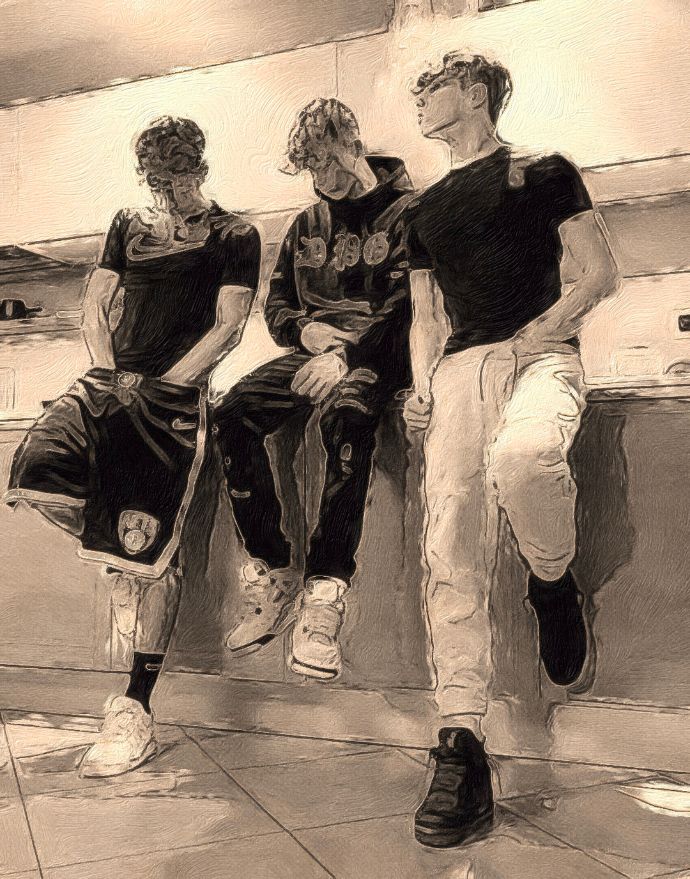
He wore nothing but a T-shirt and a pair of black football shorts. His head rested in the cushions while one smooth leg hooked lazily over the back of the sofa so that his bare foot dangled in the air.

I had seen that posture before.

Somewhere.
Somehow.

I tried to place it, but nothing came.

“Why are you staring at me, Harry?”

“I’m not,” I lied.

There’s something you should know about Tom, though it probably won’t surprise you.

Shortly after Christmas he’d been arrested for dealing drugs. He spent his weekends drifting around the city-centre clubs selling small bags of cocaine and making what he called “decent money.” One night a CCTV camera caught him in the act and within minutes he was surrounded by police.

Unluckily for him it had been a quiet night. When they searched him they found quite a stash hidden in his underwear. After they relieved him of it, he spent the night in a cell and was told to expect a court summons.

According to Tom, he was only the middleman — which, as it turned out, made matters worse. The man above him was furious about the lost merchandise and decided Tom owed him for it. Before long there was a price on his head.

Not for the first time, Tom had shown up on my doorstep covered in blood.

That was when I discovered how deep his troubles really ran. Two men with baseball bats had beaten him black and blue and informed him that his services were no longer required.

That night Tom told me almost everything.

He said he couldn’t go home to Hillsborough — too many questions, too many explanations. Instead he took a long shower, wrapped himself in a towel, and eventually curled up in his usual place on the sofa.

Since then he’d only ventured outside during the day. Evenings were spent stretched out in front of the television.

So far I hadn’t objected.

I never gave him a hard time about it either. My own past had been far murkier than Tom’s, and I hoped that maybe the experience had taught him something.

If it had, good.
If not, I wasn’t exactly the man to lecture him.

I knew how he must have felt.

The memory came back suddenly — a night nearly forty years earlier.

I hadn’t thought about Billy Mason from Gleadless Valley in decades, but he evidently hadn’t forgotten me.

A few years before that night, the Geisha Boys had robbed cigarettes from an off-licence where Billy’s girlfriend worked. She’d been hurt in the scuffle while Andy and Jack had been arrested. Word eventually got back to Billy about who’d been involved.

Frank Smith — an unruly police sergeant who occasionally did us favours — managed to have the charges dropped. He warned Billy Mason to leave it alone.

But I still remembered Frank’s words.

“The trouble is,” he’d said, “I can’t trust him.”

Billy Mason was the hardest case in the Valley. I normally stayed well clear of the place, but on that particular night I’d been sent there to entertain someone in a maisonette.

No Paolo this time.

It was a comedown after some of the houses I’d visited. No Jaguars or Mercedes outside. Just battered Vauxhall Cavaliers and old Ford Escorts.

But by then the Rufus Gang controlled the city’s rent boys, and when they told you where to go, you went. There was no negotiating.

Before heading up there I called into the John O’Gaunt for a pint.

A stupid mistake, as it turned out.

I hadn’t realised it was Billy Mason’s local.

He spotted me at the bar and followed when I left. I wasn’t exactly sure where I was going and took a shortcut behind some garages.

Another mistake.

Ironically, the only man never actually implicated in the robbery was the one Billy chose to punish.

He smashed a bottle over my head.

While I lay on the ground he kicked and stamped on me until I cried out.

“Don’t let anyone say Billy Mason holds a grudge,” he told me. “That’s wrong. I just hurt them instead.”

Then he left me grovelling in the mud and nicked my bag — several tubes of KY jelly and a spare change of clothes inside.

My head was split open and everything hurt.

I never made it to the maisonette. I staggered miles back home instead.

And if meeting Billy Mason had been an ordeal, the aftermath was nearly worse.

The Rufus Gang were not impressed that I’d failed to turn up. They made their feelings known with another beating and a warning not to cross them again.

“I guess we’ve lived parallel lives,” I said to Tom.

He lay there in the half-light, his body half hidden in shadow.

And then it hit me.

Hard.

Harder than I could have imagined.

“Tell me about yourself, Tom.”

“I’ve told you. There’s nothing to tell.”

“Tell me about your family.”

“What?” He sat up quickly. His face went pale.

Game over.

“What’s this really been about?”

“I don’t know what you mean,” he muttered.

Memories flashed in my head. Old anger. Old violence.

I grabbed him by the throat and shoved him back against the sofa.

He tried to push me away but I was stronger. I pinned him down, my knee digging into his groin.

I wanted to hurt him.

I tightened my grip as he gasped for breath.

“I’ve been so fucking stupid!”

His blue eyes filled with tears. That was confirmation enough.

Just before he lost consciousness I released him.

Instead of fighting back he collapsed into sobs, choking for air, snot running down his nose as he tried to breathe.

I stood over him.

“Tell me who your dad is.”

He couldn’t answer at first. He just curled away, crying. I doubted the tough little bastard had cried in front of anyone before.

Eventually I sat in the chair opposite and waited.

“I’m sorry, Harry,” he whimpered.

“Jack will eat no fat, and Harry no lean. Yet between them both Harry licks Jack’s ass clean.”

I watched him closely.

“Why didn’t you tell me your dad was Jack?”

Tom stared at his feet, fiddling with his toes — something he always did when he was nervous.

“Jack’s the same age as me,” I continued quietly. “Which means he had you late.”

Tom nodded.

“I’m the youngest,” he said. “Got a brother and two sisters.”

I shook my head.

“I’m struggling to understand this. Why all the cloak-and-dagger stuff?”

“My dad knew you were back in Sheffield. He wanted to know why.”

“Why didn’t he ask me himself?”

Tom shrugged helplessly.

“You’ll have to ask him that.”

“And it wasn’t an accident you ended up here?”

“No.”

“Was it planned?”

He nodded again.

“He wanted me to get to know you.”

I laughed bitterly.

“And I fell for it.”

“But why now?” I asked. “We haven’t seen each other in forty years.”

“A few years ago my dad showed me your books,” Tom said. “That’s how I knew who you were. He’d read them all. Said he used to know you, but whenever I asked how he’d change the subject.”

Jack reading books? I struggled to imagine it.

“Did he tell you why I left Sheffield?”

“No. Just that the Geisha Boys turned their backs on you.”

I sighed.

“When I needed my friends most, they fucked me off,” I said simply.

Tom studied the floor before speaking again.

“There’s something else you don’t know. My dad missed you more than you think. Maybe it was guilt. I don’t know.”

“Bollocks,” I said.

“I’m serious. He wanted me to find out if you were okay.”

I lit a cigarette and handed him one. His hands shook as he tried to light it.

“I told him you were doing well,” Tom continued. “That you were writing about the past.”

“And?”

“He looked… sad.”

That caught me off guard.

“I loved your dad,” I admitted quietly. “I loved Andy too. But Jack more.”

Tom listened without interrupting.

“He had everything going for him. Handsome. Charismatic. Brilliant footballer. I even dated his sister for a while just to stay close to him.”

Tom raised an eyebrow.

“So you fancied him?”

“Yes,” I said. “Though I didn’t understand it at the time. Things were different back then.”

We talked until the early hours.

For me it felt like a revelation. For Tom it was a relief not to lie anymore.

Eventually he settled back onto the sofa while I went to bed, though sleep refused to come.


Too many thoughts.

Too many memories.

Some time later the bedroom door creaked open and Tom slipped in beside me.

I turned away.

“Are you still mad at me?” he asked quietly.

“I don’t know,” I said. “But I’m glad the truth’s out.”

After a pause I added:

“Your job was done months ago. Yet you’re still here. Doesn’t Jack find it strange you’re never home?”

Tom hesitated.

“I told him I was staying with my girlfriend.”

“The mysterious girlfriend.”

“Yeah… about that.”

“You haven’t been staying with her, have you?”

“No.”

“Why keep coming here?”

He took a long breath.

“There never was a girlfriend, Harry. But you probably guessed that.”

I didn’t answer.

“I kept coming back because I felt safe here,” he said. “And… I liked being around you. After a while it just felt normal.”

I could hear the nervousness in his voice.

“I guess I hoped it could stay like this.”

I sighed.

“When I came back to Sheffield I wanted peace and quiet,” I said. “But I’ve enjoyed having you around.”

Tom shifted closer.

“I really need a hug right now,” he murmured.

I turned and wrapped an arm around him.

He pressed into my shoulder, warm and solid, his breath brushing my cheek.

For a moment he felt like Jack.

But he wasn’t Jack.

He was his son.

And the feeling was both wonderful and deeply wrong.

“There’s something else,” Tom said after a moment.

“Go on.”

He groaned softly.

“God, this is awkward.”

“Spit it out.”

He took another breath.

“I think… I sort of fell in love with you.”

I laughed quietly.

“So what you’re saying is you’re a faggot after all.”

Tom snorted.

“Oi. I’m supposed to be the one calling you that.”

“That’s how it works,” I replied. “Takes one to know one.”

That was all it took.

We fell asleep wrapped around each other, waking every now and then just to confirm it wasn’t a dream.

For me it felt like something I’d wanted for years without realising.

For Tom it was the beginning of his first real love affair.

When morning came I discovered I couldn’t move because his arm was wrapped firmly around me.

I tried to shift.

He held tighter.

“Tom,” I said.

“Mmm?”

“Let go.”

“Where are you going?”

“I need to get up.”

“Stay a bit longer,” he mumbled, kissing my cheek.

“I have to write.”

“Write what?”

“The rest of my book.”

He opened one eye.

“And when it’s finished?”

“I want you to read it,” I said.

“Why me?”

“Because the ending matters.”

I looked at him carefully.

“Only when you read the ending will you understand everything.”

The Shadowed Hand Behind the Letter


Being the transcript of a letter unearthed in the long-sealed vaults of the Royal Bank of Scotland, November 2025

George Walker Wood
66 Cavendish Street,
Marylebone
London

29 November, 1881

My dear Reader,

If by curious chance you hold this manuscript in your hands, I entreat you to read its contents with the utmost seriousness. Only by such attentive perusal shall you perceive that the pages which follow are both an explanation and a justification for their long concealment.

Should it prove that I still draw breath when these lines meet your eye, then I beg of you—burn them without delay, and disclaim all knowledge of ever having encountered them. The shame that would ensue from their divulgence is of so dreadful a nature that I scarcely dare commit the thought to paper.

I shall therefore begin at the point where first I made the acquaintance of one Johane—an Irish youth of some four-and-twenty years, of humble condition, and with every outward appearance of one who might easily draw misfortune to my door. He was, however, most commonly called Jack, and by that familiar name I shall refer to him henceforth. Dear Jack belonged to a loose fraternity of young loafers and street-bred rascals—variously known as the “London Boys”—a wild and merry set whose manners were as questionable as their morals, yet whose very recklessness possessed, for me, an unaccountable fascination.

In time I grew most attached to Jack, and he attended me frequently at my lodgings in Marylebone. There, behind doors safely bolted, we indulged in certain intimacies which, though common enough within that unseen sphere of which London pretends ignorance, would cause polite society to feign horror. Jack’s person was slight, his garments threadbare and ill-assorted, and he bore all the marks of those who are forced to wrest their sustenance from the streets; yet beneath that rough exterior there was a warmth and vigour not easily described. When fortune smiled and I had a few coins to spare, he would remain with me until morning, and those nights—cold, anxious, sweet as they were—remain fixed in my memory.

I suspect that my landlady, Mrs. Chivers, a stout matron of no small curiosity, had taken something of a liking to Jack as well; for once I discovered him seated at her kitchen table devouring a modest breakfast of bread and scrape. The glint of mischief in his eye, as he looked up at me over the crust, told me all I needed to know. She had chosen to see nothing of the nature of my rooms above.

My days were spent at the old desk overlooking Cavendish Street, where I composed articles for The London Figaro and The Dark Blue. Yet I had long nourished the ambition to attempt a novel—something that might echo, however faintly, the triumph of A Tale of Two Cities. My parents, never slow to remind me of my deficiencies, assured me that I lacked both imagination and creative faculty, that I was fit only to set down facts and order them neatly upon a page.

Still, I could not forget the tales Jack whispered to me during those winter nights—tales of gentlemen of rank who sought his company at a high price; of drawing-room adventures veiled beneath the richest draperies; of temptations and behaviours of which the world speaks only in scandalised murmurs. Spurred by these accounts, I sought the acquaintance of a certain printer known to an associate of Henry Ashbee—a man whose livelihood depended upon the discreet production of pamphlets of a decidedly provocative character.

Mr. William Lazenby, a sharp-eyed fellow, showed interest in my idea and agreed to an initial impression of two hundred and fifty copies. He offered me a share of the profits, subtracting his considerable costs, should I but write with candour. The sums he mentioned far exceeded any I had yet earned, and the promise of so easy a reward was exceedingly tempting. He informed me that the book should be sold exclusively by mail-order through an address in Paris, and insisted that I adopt a nom de plume, lest I bring inevitable ruin upon myself.

When I conveyed the scheme to Jack, he immediately demanded—nor without justice—a share of the proceeds, and further insisted that his own name be affixed to the work. I warned him that the police might take a dim view of such recklessness, but he merely laughed and declared that the “mutton-shunters”, knowing full well he could neither read nor write, would never suppose him connected to any printed matter. With that he tumbled himself upon the bed in his usual impudent fashion and suggested that we commence our “research” without delay.

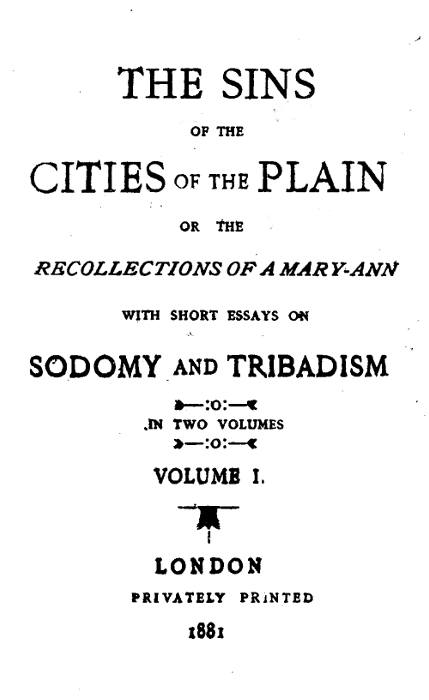
By June the manuscript was completed, and I had settled upon what I deemed a most fitting title—The Sins of the Cities of the Plain. Though Mr. Lazenby scoffed at it, he conceded that the biblical suggestion would doubtless catch the eye of those gentlemen who take an interest in such hidden matters. I confess I feared that certain passages, dealing as they did with the concealed customs of our clandestine fraternity, might prove too recognisable to those acquainted with that shadowed realm.

Lazenby nevertheless published the work in two parts, and it found immediate favour among readers eager to feast upon the covert indulgences of the great and respectable.

Though I tremble at the thought of its reception, I take comfort that my own name has thus far escaped suspicion. I offer here my apologies to Mr. Simeon Solomon and Mr. James Campbell Reddie—both of whom have been unjustly whispered about in connection with this deception. Jack, meanwhile, basks in the admiration of his companions and seems persuaded that a century hence his name will still be spoken among certain circles of “inverts”, as he jests.

This very day I have deposited my first earnings at the Lombard Street branch of Messrs. Glyn, Mills, Currie & Co., alongside this confession, sealed and hidden, to remain in the vault until such time as Providence ordains its discovery. Should that day come, I trust that The Sins of the Cities of the Plain shall be regarded as a truthful and unvarnished portrait of those whose society I have come to cherish.

Ever, dear Reader, your faithful servant,

𝒢. 𝒲𝒶𝓁𝓀𝑒𝓇 𝒲𝑜𝑜𝒹
⌣⌣⌣⌣⌣⌣⌣⌣⌣
George Walker Wood

*****

Now read on to separate fact from fiction.

This edition contains the unabridged text of the first edition housed at the British Library, together with a new introduction by Wolfram Setz and a facsimile reproduction of the original volumes’ title pages.

The Sins of the Cities of the Plain is an influential Victorian erotic novel, originally published anonymously in 1881 and widely considered one of the first works of exclusively gay pornography in English. It is a fictionalized memoir attributed to real-life Irish prostitute Jack Saul.

The book is a narrative, presented as the “recollections” or “memoirs” of Jack Saul, detailing his experiences as a young male prostitute (a “Mary-Ann” or “rentboy”) in the clandestine gay underworld of Victorian London. It traces his escapades from boarding school into young adulthood, describing his sexual encounters with various men, from schoolboys and guardsmen to wealthy aristocrats and members of high society.

While attributed to Jack Saul, the actual author is debated by scholars, with some suggesting a ghostwriter or figures like the painter Simeon Solomon or James Campbell Reddie were involved. The book was privately printed in two volumes in 1881 by William Lazenby to avoid obscenity laws and sold for a high price.

The original printings are unobtainable today, but modern editions are widely available from various publishers, such as Valancourt Books and Mint Editions.

Stolen Words / Now he feels like some ageing pin-up

Image: Amy Dury

“Now he feels like some ageing pin-up finding a pimply kid masturbating over photos of him as a boy, and peeping lecherously in on those carnal couplings of his youth.” – Separate Rooms – Pier Vittorio Tondelli – Italy – 1989