The grey gloom of a rainy afternoon and the empty alleyway is depressing. Only the yellowish headlamp of an ancient Vespa ridden by Salvo the old greengrocer suggests that colour exists in monochrome surroundings. He drives through puddles and looks at us suspiciously.
Marco stands on the step and stares at nothing, because there is nothing there, but his face suggests something different.
“What do you see?”
“What do YOU see?” he challenges. I shrug my shoulders.
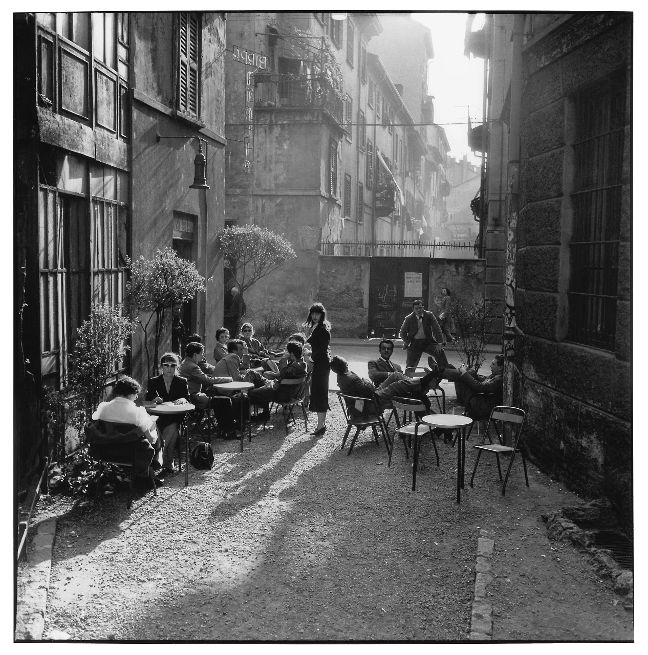
“I see sunshine and shadows,” he says. “The heat of a lazy afternoon. Tables and chairs. Miniature olive trees in pots. Young men and women sitting and talking.” He moves his gaze to the crumbling stucco wall. “There is a woman wearing sunglasses who holds a pen in her right hand with a notebook in front of her. There is something in the bag at her feet that holds a dark secret. But she doesn’t want to tell me anything. I want to tell her that from where I stand she is now dead.”
“What else can you see?” I ask.
“The woman opposite her, an old lady now, is reading the Memoirs of Jacques Casanova. The men wear sports jackets and baggy trousers and talk amongst themselves about football and fast cars – Alfa Romeos and Lancias – and the women they want to flirt with.
“Salvo the greengrocer is a young man, and he leans back on his chair, a Corriere della Sera sticking out of his pocket, and he is talking to a slender woman with long black hair and stiletto heels. She is ignoring him because she senses something but doesn’t know what it is.”
“Who is she?”
“This is your great grandmother and she is looking towards where you stand, but you are invisible to her because you haven’t been born. But she is troubled because something lies in wait that will cause distress to her family. She doesn’t know it yet, but your great grandfather, who sits before her, a philosopher amongst friends, with a violent temper, will kill the man he is talking to. Just like you did, Nido – her great grandson. It is the curse of your family. The curse of the Lombardos.”
Innocence came calling. What are you writing? I was writing about you, but didn’t say that, and it would have made no difference because it was never part of the plan.
Have you been sent by someone? Have you come with a message? Have you come to taunt me? Have you come to kill me?
In the dark, I think only of sweat, tattoos, and dirty underwear. How erotic is that? The excitement before you destroy me.
Have you come with love? Have you come with hate? Have you come with both? Have you come with nothing?
There is desire in the shadows. Hands everywhere, controlling, and satisfyingly rough. But there are unanswered questions. Do these hands belong to someone who wants me dead?
Have you got a disease? Have you got a condom? Have you got a knife? Have you got other ways of killing me?
They will get you in the least expected way. Beware of Gabriele of Stadium, they said. He will exploit your weakness. He is the Angel of Death and brings only a glass full of piss and blood.
Lust shattered my guard. Lust drowned my senses Lust clouded my judgement. Lust is the death of me.
The romantic Gypsy of Roma, who dances with a gun, and destroys hearts with the blade of Ardizzone, looks into my eyes. Is this the most addictive boy ever? Is this the saddest and perfect end? And after he slits my throat he will say to Alberto of Ostia that it was too easy.
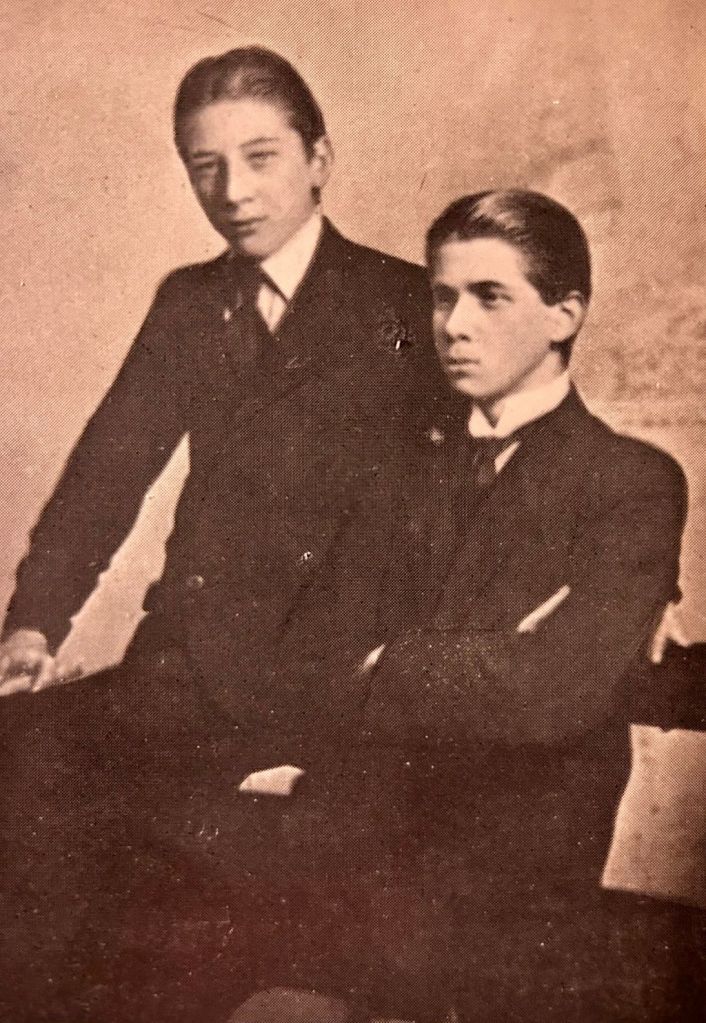
“People will look and see nothing. I will be an insignificant black and white photograph. But there will be a day when somebody sees me and is wonderstruck. They will want to know who that smirking boy with sleek black hair and Jewish nose was. I care not who that person might be, or what their motivation is, but I will know, my spirit will burst forth, and I will offer a skeletal hand in gratitude. That person will know that I cared nothing about wealth and good fortune, and that I only ever wanted to follow my dreams. They will find out if I succeeded, and be able to differentiate between the truth and the lies that might have been written.”
Roger Wolfe Kahn (1907-1962), American jazz and popular musician, composer, bandleader and aviator. Sometimes I am captivated by a photograph and must find out more. I would like to think that the skeletal hand of gratitude was being offered… but, alas, this is a work of fiction.
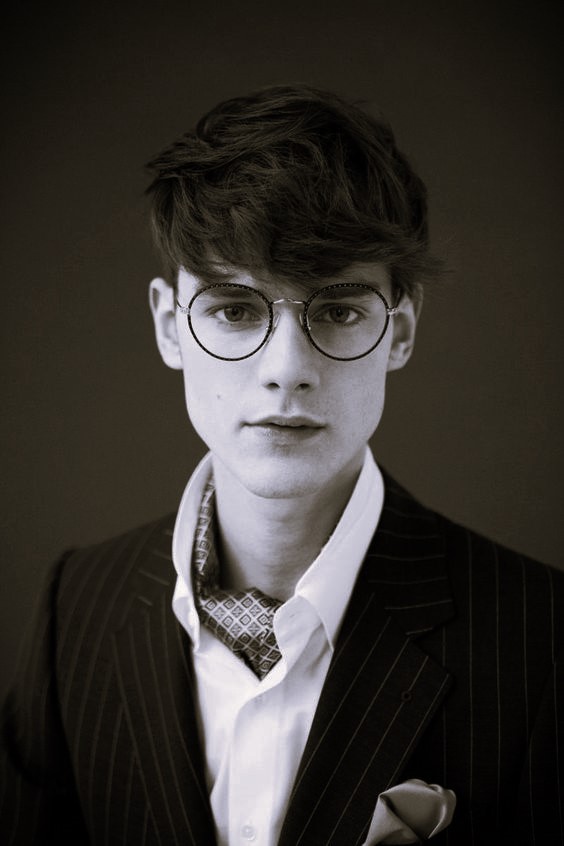
Felix came into the room at the same time as the music switched from Jacques Brel to an obscure eighties disco beat. He turned his nose up and the eyes showed disapproval behind round spectacles. His father cut the music, passed me a generous glass of brandy, and slumped down on the sofa. Our conversation would have to wait for another time. Felix sat in the leather armchair by the fireplace and opened the book that he’d been carrying. It was Hilaire Belloc’s The Path to Rome, published in 1902, and further deepened the mystery of this young man. There was an uncomfortable silence, and the crackle of flames intensified the moment. Felix had purposely interrupted. I studied his face in the half light and watched this strangely handsome boy frowning and mouthing words of the sentence that he was making a pretence of reading. Aware that we were staring, he sighed and closed the book. “Did you know that I am being groomed by algorithms? Spotify has created a playlist for me called 30s Vintage Hollywood Wednesday Late Night.”
A cobbled square with pigeons. A fountain casts shadows in the sunlight and there are shuttered buildings, silent in the heat of the afternoon. A boy in black trousers and a clean white shirt plays the violin in the shade of an archway. I think that these moments are incredibly beautiful. A car drives noisily into the piazza and stops. Mint green with a red stripe. I relax because a killer won’t be seen in a Fiat Cinquecento. The engine stops, and calm is restored. The boy plays something sorrowful as though he knows what comes next. The driver’s window slides down. A .22 revolver, black, shiny, and pointing at me. Bang! Bang! Bang! Blackness. But I can still hear the violinist – Corelli – Violin Sonata in D minor, Opus 5 – No. 12 La Folia.
I open an eye and see a light bulb on the ceiling. I open the other and see that the ceiling is dirty yellow. I can hear people talking. “He was supposed to die,” somebody says. “He probably will,” says another, “but we shall do our best.” I know that they are referring to me, and I’m frightened because I’m not dead, and that would have been the better option. My chest hurts, and so does my leg. I’m in excruciating pain but nobody seems to care. Perhaps they think I am a lost cause.
The door opens and a man with blue eyes stands over me. He shows concern but when he sees that I am conscious he relaxes. “He is still alive.” I try to tell him that I might be better off dead, but I can barely raise a whisper and the man doesn’t understand. I’m tired and must sleep, but I can hear someone singing. Raffaella Cara appears at my feet. “Rumore, Rumore.” She laughs and I try to give a thumbs up, but more blackness descends.
When I wake, there are three people in the room.
To the right of the bed is Mateo Pincerna, who wears a dark suit and sunglasses. “Rest,” he says, “I swear that I will get whoever did this to you.” I want to tell him that I’m exhausted, and that the killings have achieved nothing. We will always be at war, and I want to walk away from it. I also want to tell him that he is looking old and frail. My throat is bone dry and I say nothing.
I see mama sitting at the end of the bed, and I want to crawl into her lap like I did when I was a small boy. She would stroke my hair and tell me stories and I remember liking ‘The man who only came out at night’. Mama is dead, and she is weeping like the day that papa got killed in Scampia. She reaches out and says a prayer, and I want to confess that I’m lost to the church.
Pasolini is to my left. “I know what it is like to die a horrible death,” he says. “But you must not die because I need you to tell everyone that they got it wrong. They would not give me Salò back, and that was why I was killed.” He looks like he did in photographs, but in the fog, I realise he must be over one hundred years old. “He knows the truth!” he shouts, pointing accusingly at Mateo Pincerna who cannot see or hear him. “You must tell the truth!”
The door opens, and the child whose face I never wanted to see again, is holding the hand of his grandfather. The boy is four and has the face of an angel. His grandfather whispers something and the boy looks at me. I know what the old man has said. “This is the man who shot you. This is the man who murdered you.” I need to apologise and say that it was a mistake, but I cannot speak. The shot was intended for Federico but I aimed badly and killed the small boy instead. Mama clutches her rosary beads that I thought were in a small box at the bottom of my wardrobe. Pasolini shakes his head in disbelief.
“Who are you looking at?” Mateo Pincerna asks. His eyes search the room but there is nobody there. “You are delirious,” he says.
This should not have happened. I never wanted to be a bad person but needed to feel that I belonged. I’ve committed crimes that I wasn’t destined to commit. And now, in these last moments, I wish I’d stayed with my books and music and been like mama wanted me to be. But it is too late now.
It is getting dark, and my eyes heavier, but I try to keep them open because I know that when I close them, it will mean it is the end.
“I am here,” says a young man, who stands behind mama and gently puts his hand on her shoulder. “I have come for your son.” Mama looks up at him and her face softens. “What is your name?” “I am Michele,” he says. “God bless you,” mama gasps. “I am grateful that you are so understanding.” I try to tell Michele that he is handsome and that I’m sorry he died young, but he holds up a hand and stops me. “It is time to go.”
I shut my eyes and the pain subsides. I hear Mateo Pincerna splutter something. “An eye for an eye.” I submit, and sink deep into the mattress, but something happens… there is light, the brightest light I’ve ever seen, and Michele holds my hand, one that belongs to an assassin, and he speaks beautifully. “Come with me,” he says, “Your mama and papa are waiting.”
Jack Blanton. Image: Bob Hawkins/Remember Cliffside
I once went to a funeral and cried. It surprised everyone, not least Eleanor, because I wasn’t known for sentimentality. She gave me her handkerchief and I blubbered like a baby and everyone in church looked at me. On the way home, she said, “Joe, I didn’t realise that you knew Jack that well.”
There were a lot of things that my wife didn’t know about me. That’s the way things were. It was the last time we spoke about Jack Blanton.
***
It is now Christmas 1941, and that funeral was seven years ago. Eleanor and I are separated, and I only see the boys once a month. For the boys’ sake, she’s invited me to dinner, but a dark shadow threatens everybody’s celebrations because America is at war.
On Christmas Eve, I telephoned her and said that I wouldn’t be going.
At times like this, I needed a friend to turn to, somebody to share my fear of what lay ahead, because I knew that war would come for me. The only friend I ever had was Jack, and he’d left me in 1934.
I sat on the steps of Cliffside Elementary School, where both my boys attended, and thought how quiet and deserted it was at holiday time. It was a far cry from the schoolroom at the textile mill where Jack and I had met as young boys.
We came from respectable families and were inseparable. That surprised everyone because Jack had a God-abiding background whereas I hated religion.
I remembered the words of Pastor Hunnicut as we laid Jack to rest.
“Jack had a cheerful disposition and pleasant smile from which he greeted everyone, from childhood until his last breath, for he died with a smile of love and victory on his face.”
Kindness oozed out of him, and I never heard him say a bad word about anybody.
Jack was smart, cleverer than me, and he might have gone to college, but he was athletic and wanted to be a boxer instead. As kids, we filled an old cloth sack with horsehair and sand, then hung it from the beam of a ramshackle barn. I’d watch while Jack punched the heavy bag until his knuckles bled, prompting his father to buy him his first pair of boxing gloves.
An old pro at the gymnasium taught him how to fight properly, and by the time he turned eighteen he was in boxing tournaments.
I sat in his corner, rubbed his shoulders between bouts, and gave him words of encouragement. In victory, he smiled, and in defeat, he also smiled.
When there was nobody left to fight in Cliffside, we travelled to Charlotte for the big fights. He was twenty when he knocked down Buck Bridgers to win the decision, and the following year he floored Lloyd Parris after two rounds.
Jack was the squarest and cleanest shooter to climb through the ropes, and all the girls adored him, but he wasn’t interested, and too busy to notice that I had gone off the rails.
While he lived his clean-cut life, I had become addicted to illicit liquor that I obtained from a jailbird at Boiling Springs.
The night he mistakenly drank the ammonia used to purify water; I was getting drunk with Walt Parker in his backyard. I heard the next day that he’d only taken a sip, but the doctor said he had to pull out of his fight with Jim Swinson.
I went to see Jack, nursing a headache and racked with guilt, and told him that he needed to look after himself because he was my best friend. That was when he told me he’d met a girl and was going to marry her.
I said that it was a bad idea and promised to get straight if he’d reconsider, but he laughed and asked me to go to the wedding.
Jack married Juanita Crawford at the Baptist Parsonage in Avondale, and everyone was shocked because it had happened so quickly. They looked the perfect couple, Jack with his Italianate looks and slicked back hair, and Juanita with flowers in hers.
She was a sweet girl, but I resented the fact that she had stolen Jack from me.
A few weeks later I got hitched to Eleanor, who said I was worth a shot and thought she could help me mend my ways. It was a shotgun affair and nobody else was invited. Afterwards, I told Jack, and he said that I should take good care of her, but I knew that by not inviting him to the wedding, I had hurt him.
The following year, Jack fought ‘Kid’ Belk for the Championship of the Carolinas at the County Fairground. It was a close contest, but he was outpointed, and I remember the look of disappointment on his face, as if he had let everyone down.
I told him that I was proud of him and to focus on his next fight with ‘Kid’ Belk, but Jack was knocked out in the third round.
He changed after that, as if he knew that he was never going to be a great boxer, and when Juanita became pregnant, his priorities shifted to finding a good job. But these were bad times, with long unemployment lines, and work was even harder to find for a twenty-three-year-old.
This despondency might have sent Jack the same way as I had, but he never touched a drop of liquor. The Cliffside Baptist Church was his escape, getting involved with all sorts of activities, and attending prayers every Sunday and Wednesday.
He trained young boxers at the school gym and was excited when he discovered the next Carolina Carnera, a young boy called Walter ‘Bill’ Hamrick.
We went fishing like the old days, and talked about our childhood, the failures, and our hopes and dreams.
“Sometimes our disappointments turn out for the best. I see now that it was best that I did not continue boxing,” he said.
With no job, and the need to make ends meet, Jack joined Roosevelt’s Tree Army, and spent eighteen months planting trees and shrubs near Forest City.
Before he left, he grabbed me by the shoulders and looked me straight in the eyes. ”Joe, I love you like I do my brothers, Bill and Jim, and my sisters, Georgia, and Lillie-Bell. If ever you are in trouble, you must call me.”
Jack received a monthly salary of $30, of which $25 was sent to Juanita to help buy food, clothing, and fuel.
When he returned, his church connections landed him a job as supervisor at Cliffside Waterworks, as well as becoming the district milk inspector.
The last time I ever saw Jack, he showed me the Charlotte Observer and a photograph of his young daughter, Peggy Louise, who had been chosen as a Cliffside mascot. She smiled like her daddy did, and I knew that Jack had reason to be proud.
A few weeks later, I did something bad, and killed a man who stole a dollar off me. I punched him on the jaw, and followed it up, punch after punch, like Jack had shown me. I left him in an alleyway and got drunk with Walt who said he would give me an alibi.
That night, I went to see Jack because he would know what to do.
“He’s sleeping, Joe,” Juanita said, “He’s sick. He’s got real bad stomach pains.” I pleaded with her to let me see Jack, but she refused to wake him. “I’ll tell him you called as soon as he’s well again.”
Jack never did get better.
On Monday afternoon he was rushed to the Rutherford Hospital where doctors operated for appendicitis, but they said gangrene had already set in. He died a few hours later.
I went to offer my condolences to Juanita who was comforting Peggy Louise on the porch.
“He could never see the bad in you, Joe.”
She gave me Jack’s boxing gloves with their brown patina and cracked leather.
While I was leaving, she called after me.
“Why do good men have to die, Joe? Why isn’t it the bad ones?”
***
Back on the steps of the Elementary School, the light was fading, and snowflakes had started to fall.
I reached into the inside pocket of my jacket and pulled out a faded photograph. It was a photo of Jack, taken at a studio on Drug Store Street, a few days before his fight with Jerome Spangler. That would have been about 1930 when he was twenty three.
His fists are raised, eyes down, and I won’t forget that thick black hair that reminded people of a matinee idol.
He was wearing red boxing shorts that were tightened with string because he had been too skinny. On them, were the sewn-on letters ‘LB’ – Lawrence ‘Jack’ Blanton – that his mother had once cut from black cloth.
A sea-salt breeze. I think of Daryl Hannah in Splash inviting a young Tom Hanks to join her. I read an article that said that seventy-five per cent of mermen had an interest in mermaids as a child. In some stories they were very sexual, in others they sank ships, while others said they were royalty that ruled the sea. Are there really such things as mermen? And yet, I see one heading towards me now. He will invite me to take my last walk through the noise to the sea, not to die, but to be reborn.
Love Came For Me. Lyrics by Will Jennings & Lee Holdridge
It was long overdue and might have been a mistake, but I checked the email repeatedly, and it was certainly meant for me.
The photographer was from Brazil, and he’d chosen me after looking at my online portfolio. This wasn’t going to be a fashion shoot for a glossy magazine. Pablo had a reputation for taking raunchy images, and I hoped that he might make me look like the boys who made me feel inadequate.
The email didn’t give a lot away, but I knew there would be a lot of flesh, and the images might end up on the right side of Tumblr’s community guidelines.
I’d been to photoshoots before and hoped that it didn’t involve a room full of ego-driven males.
Don’t get me wrong. I know a lot of easy going guys, but there are many more self-centred boys involved. It’s an insecure business, one where you’ll be gone by the time you are thirty, and beneath the bravado is the fear that it can quickly be taken away.
The reality is that agencies no longer look at your body or looks. They are far more interested in how many Instagram followers you have, and that puts added pressure on. But that isn’t everything. I have an Insta-famous friend who does a lot of major campaigns and almost nobody knows who he is.
On the day, I turned up at an old factory located in the East End. It was split into separate business units, and Park Studio was on the second floor.
I walked up the staircase with its peeling walls and realised that money hadn’t been mentioned. The shoot would offer little financial reward and fell into the category of providing exposure only. I wouldn’t be leaving my job at Waitrose anytime soon.
I was relieved to find that there were only a handful of people present, those who made things happen. Photography assistant, stylist, make-up artist and the guy who handed out coffee.
After the obligatory hugs and kisses, I was directed behind a screen that served as the changing area. There was another guy who was half-undressed. He was called Luca and was from Italy. We blushed as we swapped our cheap underwear for snowy white Calvin Kleins.
We walked across to the big screen that would serve as the background to the shoot and made small talk. I discovered that Luca’s girlfriend was waiting outside.
At times like this, you mustn’t be self-conscious. Even when you’re practically naked next to a straight guy who you’d assumed was also gay. I was anxious not to make a fool of myself.
Pablo ignored us, played with his cameras, and barked orders about lighting and shading. When he realised that the main event was before him, he gave instructions as to what we should do, explaining the postures he wanted, and the way we had to interact.
The theme was ‘Boys Who Tease’ and that required Luka to be the dominant one, holding, touching, slinging me over his shoulder and placing his arms around me.
This went on for hours, Pablo firing shot after shot, and inventing new angles in which to enhance his standing in the photographic world.
We’d arrived well-groomed and smelling sweet, but by the time Pablo had burnt through his umpteenth roll of film, we were sweating under the hot spotlights, and he complained that our bodies were wet and glistening.
The assistant threw us towels and we wiped each other down. I told Luca that I was enjoying the experience, and he cocked an inquisitive eye.
For the final shots of the day, I had to crouch in front of Luca, who stood motionless with his arms by his side. Pablo told me to close my eyes and tilt my forehead until it touched the band of his Calvins. I was only a hairbreadth away from his crotch, and the slightest movement would have meant that my nose rubbed against his dick.
This was a tricky situation.
Pablo said to hold the position. I tried not to breathe, but I could sense Luca’s trembling body, and smelt baby oil and talcum powder on him. I was scared that I might embarrass myself, and started thinking about my checkout job at Waitrose, about what I might eat later, and about Luca’s girlfriend waiting in the street outside.
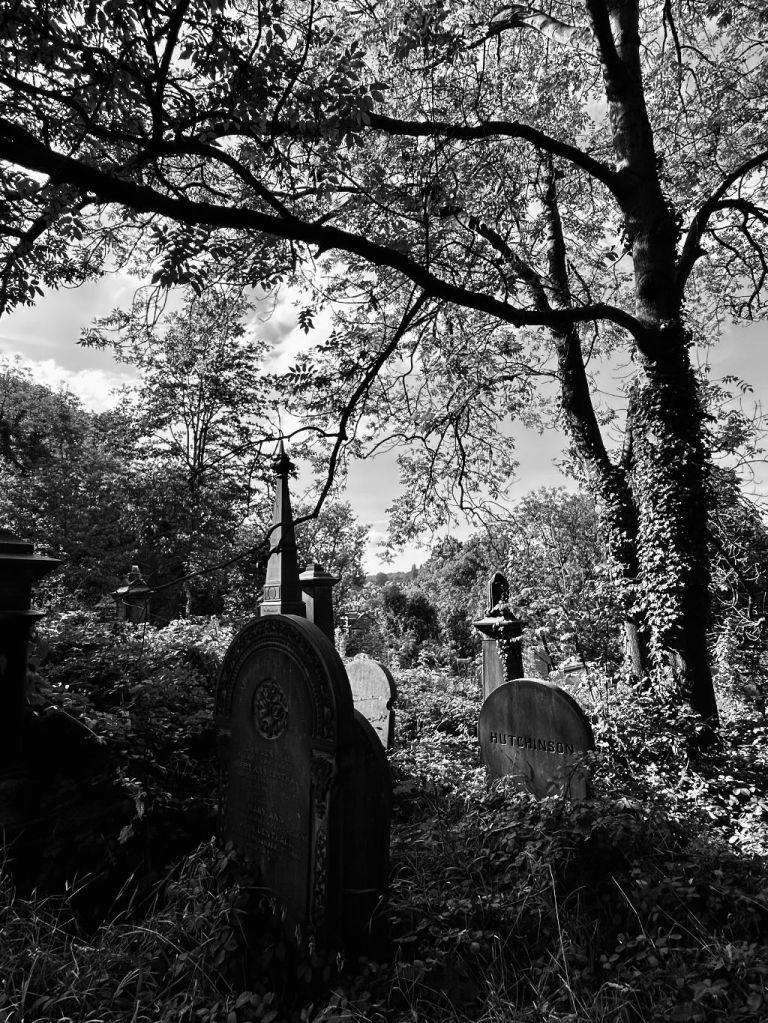
I’m on good terms with William and Julian Percy. We’ve had an intimate relationship these past four years. I was fourteen when I found them. It was a spring day, and I took a shortcut through the cemetery when I wasn’t supposed to. My mother had said it was out of bounds. Bad things happened to boys who wandered here, but she never said what these bad things were. As a child I imagined dead people crawling through the undergrowth, walking amongst graves, hiding behind crumbling monuments, ready to pounce on little boys. As I got older, I realised it wasn’t the dead that I needed to be afraid of, but the living.
I’ve come to believe that William and Julian called me that day. Voices from beyond urging me to leave the rough path and clamber over graves and through waist-deep brambles and nettles until I was lost. The sun shone and birds sang a ripe chorus. Amidst this secrecy was the long forgotten grave of William and Julian Percy who beckoned me to sit on the warmth of their heated stone.
I read the carved inscription: –
Here lies William Percy 1900 – 1918. Also, Julian Percy 1901 – 1918
“The sorrow we felt we cannot explain, The ache in our hearts Will always remain.”
I realised that they had been brothers, but only recently did I understand that they had been victims of that Great War.
I used to think that their bodies lay side by side, but the narrow tomb wouldn’t have allowed that. They were undoubtedly on top of each other, their brotherly bodies had rotted until they became one, their skeletal remains intwined.
These boys had been loved, mourned, and eventually forgotten. Nature had claimed their bodies as well as their final resting place.
The grave had sunk, and small holes had appeared where the stone had shifted. I peered into the blackness hoping to see something. I reached inside but they were merely hollows where I would later hide cans of Stella and packets of Marlboro Gold.
I came here daily and talked to William and Julian. I shared my secrets and thoughts, and told them about my small world. They always spoke back to me.
They didn’t mind me coming because they liked me and I they.
I don’t see them as skeletons anymore. They are handsome young boys who gave their lives for their country. They remain out of sight during the day, waiting for me to visit, and when darkness falls and owls call from the trees, they come out and roam amongst their friends.
They were musical. William played the cornet and Julian was expert at the violin, and their instruments were buried with them. Was this true? I like to think so. I’ve played them the music I listen to – Bring Me the Horizon, YUNGBLUD and The Reytons – and they smile at the Yorkshire accents because it reminds them of people they once knew.
They didn’t mind that long hot summer when I sunbathed naked on top of them and drank a full bottle of wine I’d stolen from the corner shop and fell asleep until I burned red.
They liked it when I read the opening paragraph of a cool book I found in Oxfam.
“Last night, I fell out with Amy when she caught me sucking her boyfriend under the table of some stinking Euro-pop club in not so gay Paris. She’d been going out with him for five days and claimed he was straight. But as soon as I clocked how much eyeliner he had on, I told her the only place he was going was straight to a gay bar.”
They’d both laughed and made me recite the whole book over the next few days.
Today, they want to have a serious conversation.
“We’ve really enjoyed your visits,” said William.
“It’s been lovely to talk to someone after a hundred years,” interrupted Julian.
“Yes,” said William, “But the time has come when you will no longer be able to come and talk to us.”
“What do you mean?”
“What we’re saying,” said Julian, “is that today is the anniversary of our deaths, and we realise that we might have misled you into thinking that we were soldiers who died at war.”
“But that wasn’t the case,” said William. “Yes, we both served our country and were scarred but came home unharmed.”
“I don’t understand.”
“Remember when you came to us a few years ago and spoke about a pandemic and you were forced to stay at home for months?”
“Lockdown,” I agreed.
“But you still came to see us every day,” Julian commented, “And we didn’t feel it was the right time to tell you the truth about how we died.”
“How did you die?”
“Well,” continued William, “we both died of influenza, a dreadful disease that one of us picked up in France.”
“The Spanish flu?”
“That’s what they called it,” said Julian, “and it was an unpleasant experience that turned into pneumonia, and ultimately our deaths.”
“Julian got it first and I sat beside his bed while he slipped away, and then I became ill and by the end of the day had surrendered to it as well. We had each other, but our parents were heartbroken.”
“You see why we didn’t want to frighten you before?” asked Julian.
“That’s so sad,” I told them, “But I’ll keep visiting.”
“Yes, you can visit, and I hope that you shall, but I’m afraid that we won’t be able to speak with you.”
“Whyever not?”
“As the oldest, I was eighteen years old when I died. How old are you now?”
“I’m eighteen, almost nineteen.”
“And come tomorrow you will have lived a longer life than I did, and that means that our ability to talk must come to an end.”
“But what about Julian? He was only seventeen.”
“Alas,” said Julian, “Brothers must stick together in life and in death and where my brother goes, I shall follow.”
“You’re both leaving?”
“We move on, somewhere else, but we shall occasionally return to see our final home. And you shall get on with your own life and in time will forget we ever existed.”
I left the cemetery. Angry, dejected, and sad. I never even said goodbe. And, as I crawled through the familiar undergrowth, the day darkened and spots of rain started to fall, and I swear that I could hear a tune somewhere behind me. It was played by a mournful trumpet and a sorrowful violin.
A smoked bacon sandwich and sunbathing on the Aisle of Aldi And Dixon Dallas and his explicit gay country songs And a winding canal of no-added sugar apple and blackcurrant juice And a trip to the inconvenience store And the dead writer Eric Jourdan who sits with a wet and dripping Jeff Buckley who has climbed out of the Mississippi River And a stick man who jumps off the shelf above my desk And Chrissie Hynde who steals my unopened pack of twelve sharp HB pencils And jazz-funk played out of a wind-up gramophone And a beach hut with a blue flag on top And Grandmaster Flash who plays dominoes with a white-suited Johnny Cash and hum White Lines together And a cucumber sandwich filled with juniper berries, crab sticks and piccalilly And the boy’s a slag, the best you ever had And the handsome guy whose hair is cut by Jar Jar Binks And come see, come see, remember me And Heartbeat on perpetual loop And Timothée Chalamet dancing to Rush with Troye Sivan’s underwear between his teeth And Taylor Swift biting the head off a street drinker on Tottenham Court Road and spitting it into the Thames And train drivers who believe they’re poor And dirty teenage boys who are shirtless and ride Vespas up and down the seafront at Cannes And rusting Italian scooters dumped at the bottom of a Venice lagoon And Pier Paolo Pasolini reading Enid Blyton stories to Cornish piskies on Bodmin Moor And Arthur Rimbaud, who promises to be nice, quoting poetry, bumbling and buzzing over stinking cruelties, And Noel Coward dueting with Nicki Minaj on a bandstand in Barbie World USA And the Eifell Tower in French France weeping tears of diluted Gautier And the photo of Derek Jarman that blows over when a house from Kansas drops through the roof of TK Maxx And the sweaty rent boy that drinks Jack Daniels and bleach on the rocks And the woman who has her clitoris pierced by Brigitte Bardot wearing jam jar glasses in Taco Bell And the lanky lad with tarantula bites on his legs And the boyfriend who says he doesn’t love me anymore And Come On, Harry, We Want to Say Goodnight to You.