
Category Archives: Charlie

Charlie: The Promise of Paris – Partie 2

Thomas – Charlie Marseille (2026)

I had assumed that French people’s reputation for being sexually daring and uninhibited was overstated. My relationship with Charlie confirmed it. An observer could have thought that I was more typical of the French than he was. Charlie avoided sexual gratification: my desire for sex could be insatiable.

My reason for going to Paris was not, as I had told Charlie, to review an exhibition at an art gallery, but simply to find Thomas, his older brother, who had urged me to go. Charlie had every reason to suspect that this had been my intention all along. He had watched my contrived journey around the city with scepticism. Every message, each question, was an effort to catch me out.

Charlie knew much more about his unlikely brother than he cared to mention. “Make sure you do not go to see Thomas.” It was a warning that implied something unthinkable might happen if I did. That was the allure. I hoped that something might happen.

My arrival had stirred a buzz of excitement. Thomas had greeted me like a returning lover. But there was still ambivalence. He had rooms above Bar Dieudonné and I had noticed the only bed which suggested that I was going to share it with him.

The arrival of Ambre was the first time I realised that he had a girlfriend, and I confess that I initially regarded her as unwelcome competition. His friend, Léo, added to the uncertainty. After that, I resigned myself to sleeping on the brown leather sofa.

While Thomas worked at the bar, Ambre and Léo took me into Le Marais and we ended up at Joe Le Sexy, a gay sex boutique, where I had discovered naked photos of Charlie in the glossy magazine Le Pénis.

Ambre consulted Thomas and took it upon herself to make me drunk. After drinking too many Vodka-Apples I began telling them everything that was wrong with Charlie. They comforted me in a way I had never known. Ambre kept kissing me and brushing her cheek against mine. Léo insisted on nibbling my ear and letting his lips trail down my neck. I found that I was enjoying the attention.

We encountered Thomas as he was shutting down Bar Dieudonné for the night. He slipped his arm around me. “My brother is an idiot,” he whispered. “But we shall make your stay memorable, and then you might not wish to go back.” He insisted that we go to a late-night café on Rue de Seine where bar staff gathered after work.

It was a small place; tables with candles squeezed into every available space; the walls covered in black and white prints of Paris in the 1960s; chart music turned low. “Brigitte Bardot, Françoise Hardy and Serge Gainsbourg used to come here,” said Ambre.

There was a vacant table in a dark corner.

“Come,” Thomas gestured. “Sit beside me and we can lust over Ambre and Léo together.” His hand rested lightly on my knee.

A young man brought bottles of red wine and fussed attentively over us.

“The waiter who was in charge of that part of the room was a young, handsome fellow, about 23 years of age,” said Ambre, smiling. Her eyes followed the blushing boy and then settled upon Léo.

“Civil, good-natured, and obliging,” Léo interjected. “He was a favourite with both master and son, the latter of whom, black-eyed beauty as he was, seemed to regard him with even affection.”

He signalled for Ambre to continue.

“But he was only a waiter: he was an heir,” she sighed and shook her head in quiet sadness. “Mutual affection is, in civilised parts of the world, a mere folly.”

Everyone laughed.

“The French are crazy people,” the waiter said to me with a shrug.

When he had gone, Thomas restored a sense of order around the table.

“I must see the incriminating photographs that have caused such remue-ménage.”

Ambre pulled out Le Pénis and handed it to him.

Thomas slowly flicked through the magazine, carefully studying each page, raising his eyebrows once or twice. We, the jury, waited until he finally reached the images of Charlie. Léo kicked me under the table while Thomas spent a long time examining the photographs.

“Thomas!” Ambre shrieked. “If you spend any more time looking at them, I shall think that you are becoming aroused by your own brother. What do you think?”

“I think it is a tragedy and a regeneration,” he replied. “Good pictures. Unusual themes—beautiful, dramatic, romantic—exquisitely thrilling and appealing. What more can I say.” 

So far, I had been allowed to wallow in my misery; the quiet spectator who was content to let the others remain the focus of attention. But Ambre and Léo were waiting for me to say something.

“Your critique is interesting, it is almost an art form,” I managed to say, “but, sadly, that is not the way I see it.”

Thomas gave a great sigh and stroked my hand.

“I understand that you are hurting. I understand that you are embarrassed and angry. But we are not talking about war, suffering, or death. We are talking about photographs.”

“Only photographs,” I agreed, “but naked photographs of Charlie with an erection. It was a shock because I had no idea that he had agreed to be photographed in this way. Charlie usually tells me everything. In this case, he didn’t because he knew that I would disapprove.”

“And why would you have done so?” asked Ambre.

“Because,” I stammered, “I fail to see why the world should see him like this when I have not. Why has he allowed this to happen? I feel like a fool.”

My phone pinged again as it had done dozens of times. I looked at my messages, some accusatory, and some, I might add, showing concern. But I had no desire to reply. Among them, I saw that Bianchi had also messaged, and, for once, I did not feel guilty.

“Give me your phone,” Thomas demanded.

I resisted. It was said that a boy and his dog were inseparable, and the same might have applied to a boy and his phone. Especially when you knew that Thomas was about to do something that I might regret.

Thomas held his hand out and waited until I reluctantly handed it to him.

He laid the copy of Le Pénis on the table and took a photograph of it. Then he opened WhatsApp and sent it to Charlie.

It was as simple as that. No need to make excuses for not replying to messages. Make him see that I was angry without saying anything.

Almost immediately, the phone pinged.

“No, monsieur,” Thomas warned. “You are not permitted to look at it and certainly not allowed to answer it… at least not for three years.”

Charlie maintained that Thomas was stupid but, from what I saw and heard, I began to understand that the opposite was true. Thomas was like Charlie in some ways, and, as the older of the two brothers, had been able to refine his instincts in a way that made Charlie seem less complete.

Thomas turned and kissed me. His lips were warm and soft, and I felt the brush of stubble against my chin. When he pressed his tongue into my mouth I yielded, accepting that this had been the moment I had waited for. There was a soft, melodic hum—Ambre’s way of showing that she found this display of affection ‘cute’ and ‘heartwarming’. Léo gripped my inner thigh. “Nous prendrons soin de toi, ami,” he said soothingly.

We were interrupted by the waiter who, satisfied that the occupants of this corner table were unlikely to cause any trouble, had brought more red wine.

We talked for ages: nothing of any consequence.

“Thomas tells us that you are an established travel writer. That must be very exciting.”

“Well,” I volunteered, “Thomas is only partly correct. I am a travel writer who does not go anywhere.”

“And that you are also living in Italy.”

“Again, Thomas is being creative with the truth. I can stay in a room that Signora Bruschi keeps for me. It is not mine, and when I go, which is not often, I am allowed to stay rent free.”

“But you are able to make a living?”

I decided that the truth could wait for another day and nodded. My head spun slightly as I did so.

“Miles must earn money to keep Charlie,” Thomas interjected. “My brother is known for not paying his own way. But I think that they are in love most of the time.”

I pulled a face.

“I am a student at Paris Diderot University,” Léo said. “I study history and one day I shall win a Nobel Prize for my genius.”

Ambre howled with laughter.

“And that means you are always spending your time with friends, visiting cafés, and enjoying the nightlife. Studying is only a small part.”

“And do not underestimate the importance of sleep,” he said “Ambre does nothing worthwhile. She works in a fashion store at Canal Saint-Martin and spends her days complaining about loathsome Parisians with too much money and no manners.”

We talked for ages: nothing of any consequence.

“Where did you all meet?” I asked.

“We do not know when or how we met,” said Thomas. “A French thing. It is usually through a friend, or a friend of a friend, and after we have been introduced, they disappear and we are left with each other. It is a union of those people who are not wanted.”

“Non,” Ambre decided, “it was about sex.”

“What?”

“The French prioritise the art of seduction, and our appetites are natural and normal rather than shameful. We were certainly attracted to each other sexually.”

If that were true, then I had been unfortunate enough to have become involved with the only French person who did not follow such principles. But Charlie had allowed strangers to see him in a way that I, his lover, had never been permitted to. I thought back to the times when I had tried to be affectionate and the refusals that followed. And now there was the realisation that, if this relationship was to survive, it might have to be shared through the pages of magazines like Le Pénis.

I slipped away to the toilet, and, with Thomas not there to admonish me, I could not resist the urge to look at my phone. The last message from Charlie had been an hour ago and read: I love you. Really, I do. I had always understood the meaning of a Queen’s silence, or what might now be a King’s silence, and I was not drunk enough to forget it. I did not reply.

When I returned, Ambre was lip-synching to Melodrama. Léo was nowhere to be seen. Thomas had that ecstatic look on his face which suggested that he had taken something. But then I noticed that Léo had slipped beneath the table and was giving him a blow job. When somebody came over to say hello, Thomas shook their hand as he came in Léo’s mouth.
Charlie: The Promise of Paris – Partie 1


Paris in the spring. The city had emerged from winter into blooming flowers, mild air, and sudden rain showers. Not like England, where winter still clung stubbornly to everything.

If I returned to Paris, Charlie had insisted that he should be the one to take me. It was the city where he had grown up, where his family still lived. But to Charlie’s frustration, he had not been able to come. He had recently landed a job as a nightclub DJ—something he had wanted desperately and had then come to hate.

“No, Charlie, you’ve only been here a few weeks. You can’t take a holiday.”

His anger and frustration were matched only by my hidden delight.

“You cannot go to Paris without me,” Charlie had pleaded.

“It is work, not pleasure,” I told him, adopting a serious tone. “I’m being paid to write about an art gallery.” It was an elaborate lie.

“But you’re not an art expert. I would have been able to tell you what is good and what is bad.”

I shrugged this off, quietly pleased at my good fortune.

“There’s no choice in the matter. I must go, and that’s that.”

Before I left, Charlie looked me straight in the eye.

“You must promise that you won’t see Thomas.”

“Charlie, I’m going to be busy. I won’t have time to see anyone—least of all Thomas.” 

He was not placated.

“Promise me. Cross your heart that you’ll have no contact with him.”

“I promise I won’t see Thomas,” I lied. “Cross my heart and hope to die.”

Thomas was Charlie’s older brother, of dubious parentage, and I had met him only once, years earlier, when he stayed at our apartment for a few days. Charlie was convinced that Thomas had tried to seduce me.

That part was true.

Nothing had happened, but Thomas had left an impression.

We messaged each other regularly. More accurately, we flirted—quite shamelessly—and Charlie had no idea.

It was the same with Bianchi in Verona. Charlie had no idea that he existed either.

I climbed the steps from the Métro at Rue du Bac and found the bar on Boulevard Saint-Germain. Bar Dieudonné stood on a corner, occupying the first two floors of a traditional Haussmann building. A striped, blue awning ran along the façade, beneath which stainless-steel tables and matching chairs spilled onto the pavement. A handful of people sat outside, lingering over drinks.

This was the bar that Thomas managed, though I couldn’t see him. A young waiter took my order and raised his eyebrows slightly when I asked for a café crème—it was well into the afternoon.

I have always thought the best parts of this neighbourhood were the little streets that slipped away from Boulevard Saint-Germain: narrow cobbled lanes with outdoor cafés and dusty curio shops. But there was no work to do, and there would be plenty of time for wandering. For now, I sat back and watched the passing crowds—bohemians and tourists alike—talking loudly, smiling, drifting past in loose, cheerful hordes.

A small Algerian boy approached and held out his hand.

My French is about as good as my Italian, and I struggled for something to say. In the end I muttered “fuck off,” which only earned me a puzzled look. I waved him away instead, and he slunk back into the crowd, looking dejected.

I assumed I must be close to the house where Jean‑Paul Marat, one of the more notorious figures of the French Revolution, had been stabbed to death while writing in his bath. Yet this elegant corner of the 6th arrondissement had attracted many other ghosts over the years—Oscar Wilde, Charles Baudelaire, Ernest Hemingway, Jean‑Paul Sartre, and Simone de Beauvoir, among countless others. Shadows from earlier lives, but still somehow present.

A pair of hands suddenly covered my eyes from behind.

“Ah,” a voice said. “I see my intended lover has finally arrived.”

It was Thomas—tall, slender, delicate, with skin as pale as snow. A baseball cap hid most of his blond hair, which seemed to have been cut short. He kissed me lightly on both cheeks and then pulled me into a hug that felt surprisingly strong for someone with such an elegant frame.

“I hope my brother isn’t hiding somewhere, ready to appear and ruin everything.”

“I’m alone,” I said, “though Charlie has an uncanny ability to know everything that goes on—even when he isn’t there.”

Thomas sat opposite me and smiled, revealing perfect white teeth.

A small pang of guilt drifted through me.

“Where does Charlie think you’re staying?”

“An Airbnb,” I replied. “That way he won’t be able to track me down quite so easily.”

For a moment I wondered what I was doing here. Why was I willing to jeopardise everything with Charlie?

There was only one honest answer: sex.

My friend Levi says I have an addiction to it, and he may be right. On the Eurostar to Paris I had looked up the symptoms, and the similarities with my own life had been unsettling: continuing despite knowing the consequences; using it as a coping mechanism for something missing; an inability to control the urges; risky behaviour; escaping shame through sex; living a secret life to hide things from partners; compulsive pornography; confusing sexual attraction with intimacy.

The list had felt uncomfortably familiar.

I loved Charlie, and I had good reason to believe that he loved me. He was the perfect pin-up boy—French, handsome, with a body people envied. Everyone said they were jealous of us. The perfect couple.

Yet I also knew that Charlie would happily sleep with anyone who offered, while somehow maintaining an aversion to sleeping with me. That hurt more than I cared to admit. It was an awkward conversation we had both avoided.

Which meant I was always looking elsewhere.

Charlie, I suspected, probably was too.

Thomas, I decided, was the next closest thing to sleeping with Charlie. The same genes, the same beauty—though expressed differently. He possessed an allure that was quieter, more evocative.

And impossible to ignore.

“I must work until late,” he said, “but you can stay in my rooms upstairs.”

I slung my bag over my shoulder and followed him through a large doorway beside the bar. We climbed several flights of marble stairs, the walls decorated with faded mosaic patterns, until we reached his door.

“I should apologise,” Thomas said as he unlocked it. “My rooms are untidy. I’m not as particular as Charlie.”

He wasn’t exaggerating.

The place reminded me of the many student apartments I had visited over the years—not dirty exactly, but nothing seemed to belong anywhere.

The main room was dominated by an enormous television fixed to the wall. Beneath it sat what could only be described as a gaming command centre, surrounded by controllers, headsets, and cables. A huge brown leather sofa occupied the middle of the room.

Unopened boxes were stacked in three corners, while the fourth had become a kind of tech graveyard—a tangled nest of charging cables, old headphones, and abandoned power banks. The window ledges were crowded with pot plants, some thriving, others clearly beyond saving.

The small kitchen counters were cluttered with dishes and coffee mugs—clean, but apparently without a cupboard willing to receive them. In one corner sat the remains of several breakfasts: croissants, chocolatines, pain aux raisins, brioche, alongside fresh bread, ground coffee, and hot chocolate.

It seemed Thomas lived almost entirely on whatever the pâtisserie across the street happened to produce.

The bedroom was no better.

A floordrobe of clean and discarded clothes spread across the wooden floor. He had adopted the “bare mattress” aesthetic: no sheets, the bed unmade, pillows scattered in all directions except where they were meant to be.

“Throw your bag in here,” he said casually. “Like I warned you—it’s a bit of a mess.”

The bathroom was clean, though untidy. Half-empty bottles of shower gel and shampoo lined the edge of the shower, alongside an assortment of deodorants and colognes. Toothpaste tubes lay scattered near the sink. Two toothbrush holders stood side by side, each containing a single toothbrush.

The toilet and bidet had been recently cleaned with pine disinfectant, and a full roll of ‘papier toilette’ had been folded into an elegant point, as if in a luxury hotel.

The illusion was spoiled, however, by the pile of discarded cardboard tubes that had accumulated beside the waste bin.

I had the impression that Thomas wanted to impress in certain places, though for the most part the effort had fallen short.

The contrast between the way Thomas and Charlie lived could hardly have been greater. Still, I wasn’t too concerned. I had stayed in places far worse than this.

Charlie had insisted that Thomas had a girlfriend, although the tone of Thomas’s messages to me had suggested otherwise. Flirty, flirty French boy.

But one small detail gave me pause: the two separate toothbrushes.

Almost as if he had read my thoughts, Thomas chose that moment to complicate matters.

“My girlfriend, Ambre, will be along later,” he said nonchalantly. “She’s bringing my friend Léo with her. They’ve promised to take you out this afternoon.”

I was left alone and cleared a small space for my neatly folded clothes. There would be no confusion about what belonged to whom. I also placed my own toothbrush beside the others.

That meant there were now three toothbrushes in the bathroom.

I made myself a strong coffee and waited for the arrival of Ambre and Léo.

They arrived in a burst of energy. Like Thomas and Charlie, their English was excellent, and although they often slipped into French when speaking to each other, they were careful to translate whatever they had said.

Ambre was a slim brunette who seemed to radiate personality. Bright and bubbly, she swept through the rooms with an effortless charm that felt distinctly French.

Léo, by comparison, was quieter.

He looked about twenty: dark-haired, reasonably handsome, with the faint beginnings of a moustache that might have taken months to achieve.

“Thomas was right,” Ambre said with a wink. “You are a very handsome homo boy. So, we must take you to Le Marais and let our boys decide for themselves.”

I couldn’t quite tell whether Léo was gay or not, but he appeared perfectly happy to be included in the plan.

They were easy to get along with, and before long it felt as though we had known each other for years. We wandered through several crowded bars, drinking pastis and mimosas, before eventually stopping at Joe le Sexy—a shop that might best be described as a kinky gay boutique, selling everything from books to toys and explicit magazines.

Ambre bought several bottles of Rush poppers and dropped them into a brown paper bag that did little to disguise where they had come from.

Léo grew visibly embarrassed when I began leafing through several issues of Le Pénis, a magazine that contained exactly what its title suggested. He peered over my shoulder, offering approving or disapproving noises depending on the size and shape of the appendage on display.

Up to this point I had become so caught up in the carefree afternoon that I hadn’t checked my phone. When I finally glanced at it in the shop, several messages from Charlie were waiting.

They followed a familiar pattern: polite curiosity slowly hardening into anxiety once I hadn’t replied.

“Where are you?”

“Did you find the art gallery?”

“What are you doing this afternoon?”

“Answer me.”

“Make sure you do not go to find Thomas.”

I carefully composed a reply.

“All good, Charlie. Found the gallery. Busy talking. Call you later x”

Almost immediately a thumb-up appeared

I felt strangely comfortable with the small fiction I had created. The sunshine had put me in a carefree mood, and the alcohol had washed away any lingering doubts that I might be behaving like a bit of a skank.

When I put my phone away, Léo was still browsing through Le Pénis. I rested my chin lightly on his shoulder, and he seemed perfectly content for me to share the explicit photographs with him. He smelled faintly of Bleu de Chanel and something musky beneath it.

I decided that I really did like French boys.

He turned the pages idly, but suddenly something caught my eye, and I stopped him at once.

“What is it?” Léo asked.

“Turn back a few pages.”

He flipped slowly through the magazine until I told him to stop.

I froze.

Léo stared at the page, trying to understand what had unsettled me.

Unsettled wasn’t quite the word. It felt more like a bomb going off.

“I can’t believe it,” I said quietly. “These are photographs of Charlie.”

Léo looked puzzled. I later forgave him for not recognising him—he had apparently never met him—but there was no doubt in my mind.

Several glossy colour images showed Charlie completely naked, proudly demonstrating that this magazine truly deserved its title. In Charlie’s case, it might more accurately have been called Grandiose Le Pénis.

The penis was magnificent.

A rush of conflicting sensations flooded through me. Mortification. Confusion. Disbelief.

And anger—enough to make me want to tear someone’s head off.

“Fuck me, Léo,” I muttered. “That’s my boyfriend.”

“What are you saying?”

“I’m saying that this enormous dick shouldn’t be in here.”

Léo didn’t seem to know how to respond and called Ambre over for support. He spoke rapidly in French while she gave short replies that sounded increasingly disapproving.

“Let me see,” she said.

Léo held up the magazine while she studied the photographs of Charlie, although what this was meant to accomplish remained unclear to me.

“And you did not know?” she asked.

“No!” I snapped.

“Maybe it is AI,” she suggested thoughtfully. “Maybe this zizi does not belong to him. Maybe it has been… enhanced.”

“The point isn’t the size of his dick,” I said. “The point is that he’s showing it in a magazine—especially when…”

I stopped myself.

“Especially when what?” Léo asked.

“Especially when I have absolutely no idea what size his dick is,” I said. “Because I’ve never seen it.”

Ambre and Léo exchanged a quick glance. Neither seemed to know what they were supposed to say.

“Ça va aller,” Ambre said gently. “We must speak with Thomas. Perhaps he knows something about this. I will call him now.”

She stepped outside the shop and spoke quickly into her phone.

“Poor thing,” said Léo softly.

Ambre returned a few minutes later, slightly out of breath.

“I spoke with Thomas. He knows nothing about it.”

By that point I had slipped into a strange kind of numb shock.

Ambre bought the offending issue of Le Pénis and dropped it into the same brown bag that already contained the bottles of poppers.

“And now,” she announced firmly, “we are going to find another bar and get you extremely drunk.”

Charlie – On Films, Subtitles, and Temper

Fury – Charlie Marseilles (2026)

There is a new film director in our apartment. Not literally, of course. But after seeing Kleber Mendonça Filho’s The Secret Agent at the cinema, we discovered that MUBI was showing a small collection of his earlier films. Trust Charlie to want to watch Aquarius, which—naturally—wasn’t among them.

The thing about Charlie is that he never gives up. He eventually found it on the Internet Archive, only to be dismayed that it was in Portuguese. He tried to locate English or French subtitles, but to no avail. The other thing about Charlie is that he is impatient.

I wrestled the TV remote from him and began investigating for myself. This was not what he wanted. “Give it back,” he ordered. “You’re wasting my time now.”

Call me childish, sulky—perhaps simply bad-tempered—but I had what can only be described as an adult tantrum. I threw the remote into his lap and stormed off to bed.

The next morning, Charlie went for the César Award. “I was frightened,” he claimed. “You threw the remote at my head. I believe I may even have been unconscious for a while.”

Charlie – The Comfort of Anonymity

Image: Charlie Besso

February ended with an odd remark from Charlie.

“I searched online,” he said, “and found no evidence that you have ever written anything.”

In one sense this was reassuring. I write under an assumed name, after all. Yet it was also unsettling, because the remark revealed that Charlie had been looking. If he were ever to find my work, he might not appreciate how frequently he appears in it.

He forgets that I am blocked from viewing his Instagram page, though that obstacle proved easily solved with a hastily created fake profile.

“Some people prefer to remain anonymous,” I told him.

Charlie cannot understand this. The French boy dreams of fame and dabbles in anything that might propel him towards it. I, on the other hand, prefer the safety of obscurity.

My friend David, a successful author, has written under a nom de plume for decades. As he once explained, “If I knew a book would succeed, I’d happily publish it under my real name. But writers are haunted by failure. Imagine the shame of having that failure attached to the real you.”

I have never had the heart to tell him that his real identity can be discovered by anyone, anywhere in the world.

Charlie might have uncovered my secret already, had he possessed a little more information. A few weeks ago I typed the titles of several of my stories into Google. To my alarm, an AI assistant suggested that they might have been written by me. It had linked three titles to Spotify playlists of the same name on my profile. I quickly changed the account name, but the episode left me with an uneasy realisation: artificial intelligence will always be a few steps ahead of us.

Anonymity, it turns out, is fertile ground for paranoia.

Charlie later recommended that I watch a short film on YouTube.

“It is about a writer with a mental block,” he said, “who rents a summer house and becomes obsessed with a young boy on the beach.” Then he gave me a mischievous wink. “Watch it. It is very you.”

The film was Belgian. It followed Louis, an ageing writer who becomes fixated on Tommy, a young man who visits the beach each day with his girlfriend. The obsession rekindles Louis’s imagination, and in the novel he begins to write he conveniently drowns the girlfriend, leaving Tommy entirely to himself. At least, I think that is what happens. The ending leaves you uncertain whether the events belong to fiction or reality.

Charlie was right. It was “very me”, in the sense that I often begin with a person and build a story around them. What Charlie did not know was how close that description came to the truth. I found myself wondering whether he had somehow hacked into my laptop.

“Why did you search for my work?” I asked.

He hesitated.

“Well,” he said eventually, “I am curious about what you are writing—and whether it is good.”

That was the dilemma. Long ago I realised that I depend on acceptance for survival, and that my writing might reveal far more of my inner life than I would ever willingly confess.

“I’m not sure I could face the shame of criticism,” I said. “Or the possibility of being exposed as incompetent.”

It was meant as an offhand remark, yet it revealed more than I intended.

I half expected reassurance, perhaps even encouragement. None came.

“I suppose we are all afraid that people might see our flaws,” Charlie said thoughtfully. Then he smiled.

“Except, of course, when you do not have any. Like me.” 

Charlie: Almost. Almost. The Scent That Remained

Un amante italiano – Charlie Marseilles

Charlie didn’t go to Paris for Christmas. A family dispute—best addressed through absence—kept him away. Instead, he stayed with a cousin in Woodstock, near Blenheim Palace: an improbable place for pleasure. I was content with the opposite arrangement. Christmas alone. Eating, drinking, letting Netflix decide what mattered.

On Christmas Eve, I dreamed he climbed into bed and lay on top of me. His naked body was warm, yielding, unmistakably real. He kissed me. A faint musk rose from his skin—intimate, animal—stirring every sense at once. At last, I thought, this is the closeness.

I woke up with the sensation intact. The dream clung to me through Christmas morning, vivid enough to unsettle. I searched for an explanation and learned that smell can infiltrate dreams, especially when memory and desire are involved. Olfactory dreaming, they called it. Cologne was the usual example.

In the nineteenth century, a French physician, Alfred Maury, described inducing such dreams by getting his assistant to place eau de Cologne beneath his nose while he slept. On waking, Maury claimed to have dreamt of Cairo, of the perfumer Farina’s workshop, of adventures set loose by scent alone.

I hadn’t smelt Cologne. What lingered with me was the smell of a boy. And with it, a quieter truth: Charlie and I had never moved beyond kissing.

Someone, inevitably, had to puncture the theory. A psychiatrist dismissed the idea entirely. You don’t smell the coffee and wake up, she insisted. You wake up, then you smell the coffee.

I abandoned science and let Spotify take over. It suggested an album by Wolfgang Tillmans, which surprised me. I’d known him only as a photographer. The music turned out to be a sound work made for an exhibition—joy and heartbreak threading through collapse and repair.

I first encountered Tillmans years earlier through a Pet Shop Boys video composed almost entirely of mice living on the London Underground. Ever since, I’d found myself scanning platforms, tunnels, tracks—without success. A memory surfaced: my friend Stephen once worked on a four-hour Tillmans sound installation of It’s a Sin. He now despises the song completely.

Christmas dinner was an indulgence of sorts: cold baked beans eaten straight from the tin. I spent an hour scrolling through films before accepting, once again, that choosing outlasts watching. I downloaded the Christopher Isherwood biography David had recommended—the one that never seems to end—and fell asleep within pages.

When I woke, the room had darkened. Charlie had messaged: Will be home tonight at about eight x.

Transport on Christmas Day was nonexistent, yet somehow he’d convinced his cousin to drive him 130 miles. When Charlie arrived, I asked where his cousin was.

“Gone back,” he said.

“You didn’t invite him in?”

“It’s Christmas. He’ll want to be home.”

“And petrol money?”

He hesitated. “I didn’t think of that.”

Our former lodger once called Charlie a “me, me, me person.” Another friend was less generous and called him an asshole. Perhaps it was cultural. Perhaps it was simply him. Charlie struggled to imagine himself from the outside. I told myself it wasn’t malice. Just a narrow field of vision.

Despite the journey, he looked fresh, handsome. He smiled; I mirrored it. I considered mentioning the dream, then decided against it.

“Why come back early?”

“I shouldn’t have left you alone,” he said, without pause. “It’s Christmas.”

While he dropped his bag in the bedroom, I switched on the tree lights. We exchanged gifts a day early.

His were faultlessly chosen: Salò on Blu-ray, Sargent, Ramón Novarro, Edmund White, a glossy Igor Mattio photography book. Then he disappeared into the studio and returned with a canvas. He turned it around.

It was me.

He’d painted me sitting, relaxed, looking beyond the frame—as if caught somewhere warmer, lighter. My eyes were generous. My mouth was kind. Around my neck he’d included a thin silver chain, a birthday gift I wore only on rare occasions. The detail felt deliberate, almost intimate.

“I painted while you were writing,” he said. “I hope you like it.”

I had never been seen like that before. Not by anyone. I felt exposed, and cherished.

“I don’t know what to say,” I told him.

“One day,” he said lightly, “when you’re old—célèbre—people will say, painted by his French lover.’”

Charlie went to shower. Alone, I recognised a flicker of shame. I’d suspected his absence was a ruse. I’d rehearsed disappointment, punished him silently for not being who I wanted. The dream—so tender, so convincing—had fed that instinct. Sex can exist without love; love can exist without sex. The phrase circled uselessly.

Still, it would be nice.

There it was again. That reflex. The mind’s preference for negativity over positivity. 

Charlie returned wearing only grey jogging bottoms and a Santa hat. He stretched out beside me on the sofa, smelling faintly of crushed mandarins, and rested his head in my lap.

“A Christmas film,” he murmured. “Something cosy.”

I stroked his stomach as we watched The Holdovers: a misaligned teacher, a sharp-tongued cook, a boy full of grievance. By the end credits, Charlie was asleep.

I didn’t move. I was afraid that motion would undo everything. His weight, his warmth, the faint citrus on his skin—it felt provisional, like something borrowed. The room held its breath.

I loved him then with a sudden, almost painful tenderness. Not the urge to claim, but to preserve. To keep the moment intact, untouched by language or expectation.

I stayed exactly where I was.

And waited to see whether stillness could last.

Charlie: The Rumour of Possibility

He is completely unaware and does not expect to be photographed at all – Charlie Marseiiles

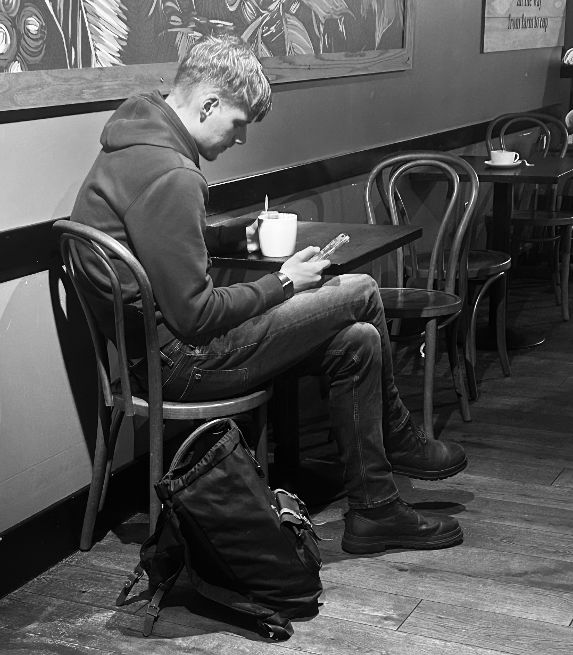
There is a game that Charlie likes to play. I blame the streak of melodramatic French in him — he can’t help speculating about everyone. We ducked into a bright little coffee shop to escape the damp, heavy air outside. Amid the hiss of the coffee machine, steamy windows, damp clothes and the sweet smell of pastries, Charlie zeroed in on a guy sitting alone, scrolling on his phone, blissfully unaware he’d become the latest target of Charlie’s imagination.

“What is he looking at? Who is he messaging?” Charlie whispered while we waited for our takeaway. I’d heard these questions a hundred times, and I hardly had the energy to answer anymore. His curiosity could tip into something nosy, even a bit rude, and I’d told him more than once that it bordered on prying. Still… I had to admit, despite my protests, it was often weirdly entertaining.

And he was already off. “It’s all very mysterious, but I’ve got a theory,” he said, eyes locked on the boy with the coffee. “He is telling someone he woke up without a care in the world… until a man in the street annoyed him. So he punched him — once — and killed him. And now that boy over there is a murderer.”

Sometimes I wondered whether he was just trying to make me laugh, or if there was something darker in the way he saw people. I glanced at the poor guy and found myself, just for a moment, considering whether Charlie’s wild theory wasn’t entirely impossible.

Charlie: Between Silence and Skin

French Connection – Charlie Marseilles

The room where I try to write has slowly become the room where Charlie paints – always in nothing but his underwear, as though bare skin loosens his imagination. He fills his canvases with young men borrowed from Pinterest photographs, embellishing them with his own wild inventions. His pace is relentless; one wall is already crowded with finished works, while the others gleam with fresh white paint, waiting their turn.

I, by contrast, sit fully clothed at my desk opposite him, my screen a blank page that refuses to yield. His half-naked body distracts me more than the silence we share – a silence that can stretch for hours. My sentences falter, my fingers hover above the keys, while my gaze strays repeatedly to the slope of his shoulder, the subtle shifting of muscle beneath skin. When our eyes do meet, the faintest smile flickers between us, and in that moment, it feels as though the room itself has been written.

Our different pursuits seem to mirror our temperaments: Charlie paints with fearless exposure, while I write with restraint, dressed in caution. Yet the tension coils tighter. My prose begins to echo the shapes of his body, the rhythm of his movements, until the line between art and desire starts to blur.

At times I tell myself I am only imagining it – that Charlie is merely eccentric, his near-nudity no more than a quirk. But each page proves otherwise. It is littered with involuntary admissions: the shadows along his collarbone, the hush of his breath when he leans too close, the bare expanse of thigh against the studio chair. These confessions rise from me slowly, as though I am being coaxed – cornered – into acknowledging what I cannot claim.

Tonight, the silence shatters. My phone vibrates, abrupt as a stone cast into still water. Charlie turns at once, alert, the brush slipping from his hand. “I need a rest from painting,” he announces lightly. “Let me see what you’ve written.” He springs up, knowing I will resist, his request merely a pretext to draw near, to glimpse what has intruded into our silence.

It is from Bianchi in Verona. A thrill runs through me, but I dare not open it – Charlie would notice too much. “Who is Bianchi?” he asks, now beside me, his voice soft but insistent.

“A friend of Cola,” I murmur, unwilling to elaborate. The words hang in the air, evasive, unsatisfying, already unravelling.

Charlie / I will make him appear extremely homoerotic

Levi in the Bath – Charlie Marseilles

“Shameless. He floats naked in the water, the light rippling over chest and stomach. His lips, as if caught between a breath and a moan, his hand loose at his side like he’s waiting to be grabbed. There’s nothing soft about it – just flesh, need, and the unspoken dare in his stillness. Every line built for touch, for heat, waiting to be claimed. The invitation to take what you want. The sight is blunt, undeniable: he wants to be used.”

Charlie had taken his art in a new direction. He was bored, disillusioned with paintings of landscapes, objects and street scenes. A flirtation with what he called ‘art contemporain’ had ended in frustration. “Circles, squares, solid colours, lines, zig-zags … they mean nothing to me!”

The first that I knew about this new path was when I returned home to find Levi, our former lodger, sprawled on the sofa in just his underwear. “It isn’t what it looks like,” he flushed. ”I’m only doing it as a favour.”

Charlie shouted from the bathroom. “I am ready now. The bathtub is full and my camera is ready.” I was bemused to say the least.

Charlie wandered into the room. “Ah, you are home, mon ami. I need the bathroom for thirty minutes while I photograph Levi.”

The Polish boy with the Yorkshire accent followed him along the corridor and into the brightly lit bathroom. With a certain amount of embarrassment he stepped into the bath. “Lay down, Levi, and put your head underwater. I am going to stand on both sides of the bath and take photos from above.”

I watched from the doorway and listened while Levi was told to take deep breaths and submerge himself. Then he had to raise his right arm, then his left, and then both of them together. All the time, Charlie was precariously balancing, taking shot after shot. 

When they had finished, Levi stood up, looking satisfyingly toned, and dripping from head to toe. Charlie looked him up and down. “As I suspected, you have a little dick, but we cannot all be lucky. You can get dry now.” 

“I feel stupid,” Levi told him, “and I haven’t brought any dry boxer shorts.” Charlie flicked through the images and appeared not to have heard him, so I went to a bedroom drawer and gave him a pair of mine to change into.

That night Charlie spent hours searching for the right photo. The next morning he visited a local print shop and had it blown up to the size of a small poster. He placed it on an artist’s easel and studied it. “I am going to use this photo to create my next painting,” he announced. “If it is successful then I am going to start painting beautiful men from now onwards.”

I reminded him that there had been a time when he would have considered Levi anything but beautiful. “That was the case,” he replied, “but I needed somebody that I knew who was willing to model for me, and when I have finished, I will make him appear extremely homoerotic which is something he is definitely not.”

Charlie / I’m gonna be the man who goes along with you

Image: Charlie Marseilles

Charlie was enthusiastic about going hiking in the countryside. I hadn’t realised the motive behind this sudden urge to get into the wild.

Our progress was slow. Every few minutes Charlie would stop, hand me his mobile phone, and ask me to take a video. Charlie walking up a hill towards the camera, Charlie opening a gate and closing it behind him. Charlie pretending to climb a rock face (he was only a few feet from the ground). Charlie walking into the distance. Charlie eating a sandwich. Charlie admiring the valley below.

Each time he said, “Just one more video, and that will be it.” But it never was. He tutted if he wasn’t happy with the results. “You will never make a great director,” he told me, and I was inclined to agree.

We walked ten miles and it took us six hours. Later, as we drank coffee in the late afternoon sun, he informed me that his ‘reel’ had been edited and posted, and that he was getting hundreds of likes.  But there was no mention of the unfortunate guy who shot the videos.

Charlie / When boys parted and the broken handshake


“We were brought up as good Catholic boys,” Charlie confided. “But there is no such thing as a good Catholic boy. I am living proof of that.” 

Charlie and his brother went to a Catholic school on the outskirts of Paris. He loved it, whereas Thomas hated it, and was expelled for accidentally setting fire to the priest’s Renault Clio. 

“But Catholic school turned me into a homosexual, and that makes me sad.” He rolled with laughter. “I fooled you! I have such happy memories. I was a prince amongst pigs.” Was this a French expression that was lost in translation?

The conversation happened before we watched Au revoir les enfants (on DVD, no less). The film is set in a French Catholic school in 1944. A boy – Julien – becomes friendly with a new boy – Jean – who turns out to be a Jew in hiding. Throw in the Germans, and you can guess the rest.

Charlie’s school hadn’t been a boarding school, but he probably wished it had been. Living and sleeping amongst dozens of hormonal schoolboys would have suited him wonderfully.

The film’s end scenes were traumatic. Julien, a precocious boy, nervously glances at his friend, tipping off the Gestapo official and, seemingly, causing Jean’s arrest. Later, as he is being led away, he walks over to shake Julien’s hand, but just as their fingers touch, Jean is snatched away. And when the headmaster, Père Jean, also arrested for harbouring Jews, and utters the line – “Au revoir, les enfants!” – the tears rolled down Charlie’s cheeks.  

Louis Malle directed the film and provided the closing voiceover:

“More than forty years have passed, but I will remember every second of that January morning until I die.” (He would depart this world eight years later).

It was based on Malle’s experiences of World War Two when he attended Petit-Collège d’Avon at Fontainebleau. Three Jewish students and a teacher were rounded up and sent to Auschwitz while the school’s headmaster, Père Jacques, would die in the concentration camp at Mauthausen. The memory of his lost friend, and that broken handshake, kept bobbing to the surface, but it took Malle 43 years to make the film.

As the credits rolled, Charlie was in a sombre mood and scanned the back of the empty DVD case. “It was made in 1987, and I cannot believe that I have never seen or heard of this movie before… and it was French too.” He used the fingers of both hands to help him with a calculation. “Do you realise that it has been 38 years since this movie was made? Think about it. Those boy actors will now be old men.”