A second-hand record store. Old French chansons played over the speakers. “Très bien,” Charlie beamed, because it made him feel at home. But this wasn’t France, it was an English suburb on a quiet Saturday afternoon. I Shazamed a song on my phone. It was Jeanne Moreau singing Les Voyages.
Charlie rummaged through a cardboard box of old cassette tapes and I pointed out that had he found something interesting, then he wouldn’t be able to listen to it, because we didn’t have anything to play it on.
And besides, I told him, I was surprised that he even knew what they were because they were obsolete before he’d been born. “That is not the point,” said the Millennium Child. “I have a good reason for looking.”
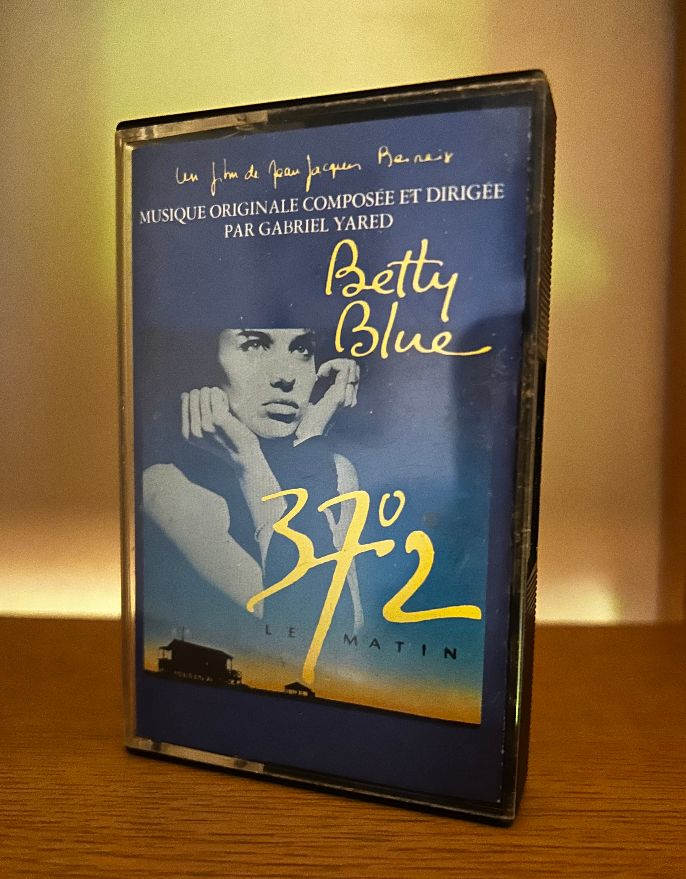
At last, he found something that pleased him. “This is what I want,” and he held up the soundtrack album to Betty Blue, or 37°2 le matin, if we want to give it the proper title. (I later discovered that it was released in 1986).
“But how are you going to play it?”
“I am not going to listen to it. If I wanted to do that I would listen to the music on Spotify. I have something else in mind.” With that, he borrowed a pound coin with which to buy it.
The apartment. The office (which used to be Levi’s bedroom). The cassette tape is stood upright on a shelf alongside vintage postcards, pebbles and shells collected from beaches, and a wooden model of the Arc de Triomphe. “It is simply for show,” said Charlie.
A few weeks ago, Charlie introduced me to the works of Jacques Tati. We started with Jour de fête (1949) and over a week watched his Monsieur Hulot, featured in Les Vacances de Monsieur Hulot (1953), Mon Oncle (1958), Playtime (1967) and Trafic (1971). I’m late to Tati’s work, but it wasn’t hard to catch up, because he made so few films, and the ones that he did were genius.
Charlie knew I would like Tati’s humour but confessed to knowing little about him. Intrigued to find out more, I bought one of the many biographies and spent warm evenings on the terrace absorbed in the life of this French legend.
Tati had a gentle spirit, and a quiet dignity, but behind the camera he could be elusive, stubborn and emotionally distant. This was easily confused with arrogance and I was left with the impression that he wasn’t a nice person. It troubled me because I discovered too many similarities with the person I lived with. I thought, ‘Fuck me! Is Charlie a reincarnation of Jacques Tati?’
Charlie, who tries hard to be good at everything, but doesn’t really know what it is he is best at. Painting? Photography? Modelling? He’s a complex person, committed to artistic vision – sometimes to the point of obsession – and to an outsider he can seem a bit of a shit.
He’s quite the opposite really, but his devotion to art can seem almost monastic. He pushes for the purity of his vision, as though wanting to leave behind something beautiful, and that pursuit can sometimes be baffling.
I explained this to Charlie, and as the English like to say, he got ‘the face on’. “You do not understand my ache of misunderstood devotion,” he replied. “But I appreciate your concern, because it is mine also, and I need to decide what it is that I am going to be brilliant at.”
A hillside in the remote countryside. Serge Gainsbourg sang Black Trombone on the iPhone. Charlie danced in his underwear. His hair formed a question mark on his head. He looked cute. I grabbed him from behind and he reached over and patted me on the head like a dog. Then he pissed into the wind and I got covered from behind.
The day started with a mystery that caused a problem. Charlie had done the laundry and I had been angry. It doesn’t matter how many times that you tell him to separate whites and colours, he refuses to do so. The result was that my white t-shirts came out pink yet again. When I challenged him about it, he sulked, and put the rest of the clothes away in silence.
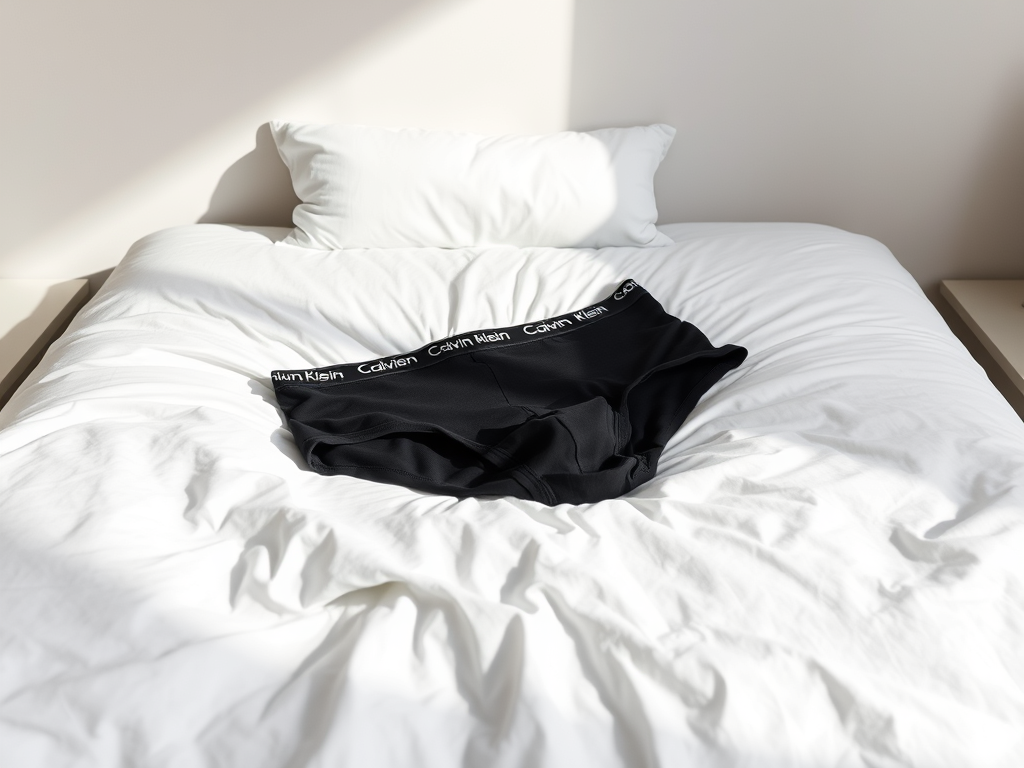
And then we came to the black Calvin Klein briefs.
Charlie was putting them in my drawer and I pointed out that they didn’t belong to me. He held them between his fingers and examined them. “They are not mine either,” he decided. “They must be yours,” I replied. “They are definitely not mine.”
We stared at the underwear and waited for the other person to admit to owning them. But neither of us coughed up.
Charlie tossed them onto the bed.
“This poses a significant problem,” I decided. “If they don’t belong to either one of us, then whom do they belong to?”
“That is a very good question. Do they belong to someone who you have been sleeping with?”
“In your dreams,” I responded, but there was hesitancy in my voice. Charlie had the ability of making you feel guilty even when you were innocent, and this was one of those occasions. He pounced upon my uncertainty and decided that I had been sleeping with someone who had forgotten to take their underwear home with them.
“I can assure you that I haven’t slept with anyone. The only person that I’ve slept with is you, but even that’s debatable.”
“What do you mean?”
“Nothing. I’m just a bit upset because I know that they are not mine, nor are they anybody else’s that I know of, so the finger of suspicion points squarely at you. Have you been sleeping with somebody behind my back?”
Charlie rubbed his hands through his hair in desperation. “Do not be disgusting. I have not been sleeping with anybody.”
“Was it one of those American Mormon boys who came knocking at the door? Did one of them come back when I was out?” It was a cheap shot. But a few days before, they had come bright-eyed and eager to save our souls. I’d politely turned them down and said to Charlie that it was inconceivable that every Mormon boy appeared to be cute.
When Charlie was hurt, his French accent became more pronounced. “I believe it when you say that you know nothing about them, but you must also understand that I have nothing to do with them either.”
“But whose are they?”
“I have no idea. But maybe they belonged to Levi who left them behind when he moved out.”
“But that was weeks ago,” I said.
“I guess that there is no other explanation.”
And that was where we left it. Black Calvin Klein underwear unclaimed.
Charlie stands in the glow that surrounds him. He is a dark silhouette bathed in the yellowish hue of an afternoon sun. He is unrecognisable and might be anybody. I hear strange voices that are drowned by the cries of seagulls. I help him down from the harbour wall and he smells of wood sage and sea salt.
“Enough about angels,” Charlie admonished. “I am tired of hearing about angels.”
I admit that I’ve been going on too much about angels but indulge me once more.
“We are waiting for an angel that never shows up. We don’t know if he’s there, because he could just be hiding behind the doorway.” I once saw that line accompanying an artwork in a gallery but I’m certain that I played around with the words. I suppose it means that we are on the lookout for a love that never comes, but is elusive and out of sight. But in the case of Charlie, he is elusive but right in front of my eyes.
I saw the angel looking fashionably casual in shorts and tee-shirt in the late night shop. His real name is Reese with an ‘S’ and he wasn’t hiding behind the doorway but appeared from behind shelves of soup, pasta and cans of beans. I know this angel, but he’s also out of reach.
The angel hadn’t expected to see anybody he knew, and froze like a rabbit in a car’s headlights. His smile faded when he saw that I was with someone. “Hi guys, are you going out?” I felt awkward. “No, we’re just going home,” I replied. Judging by the look on his face, that was a pretty dumb thing to say because it was a lie. “What about you? What are you up to?” He looked miserable. “I’m staying in for the next week or so.”
I wanted to say more but Charlie pulled me by the arm and signalled that it was time to leave. I nodded to the angel and left him on his own.
Outside the shop Charlie scowled. “Who’s the guy with the golden penis?” He has the ability to make me feel guilty, as though I’ve been doing something seedy and underhand, even when I’m completely innocent.
Later that night, I looked at the angel’s facebook page and could see that it was full of quotes like “can y’all please start dating men that actually like you so you can shut the fuck up,” and “come fw me, you won’t get cheated on.” Nobody posted any likes and I didn’t look anymore because it was too painful.
I felt sorry for him and contemplated sending a nice message, but I thought that might seem a bit creepy, and I wasn’t convinced that he wouldn’t show it to anyone.
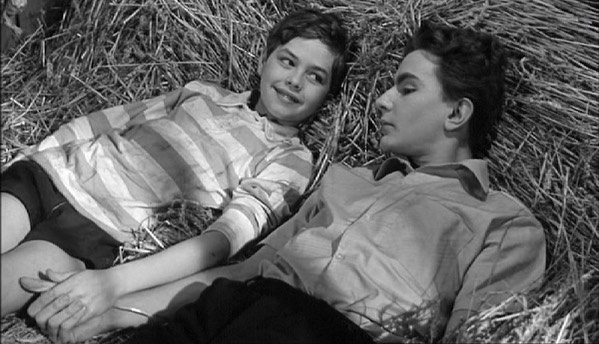
Image: Les amitiés particulières (1964). Directed by Jean Delannoy
It was the last night of our short seaside holiday and Charlie decided that it would be a good idea to stream a movie. He spent well over an hour flicking through Netflix and Prime Video until my patience finally ran out.
“Charlie, we will soon have spent as long looking for a movie than it would to watch one.” He stopped flicking. “Then I shall choose this one, and if you do not like it, I shall not be held responsible,” he said petulantly.
The movie he chose was in black and white and called This Special Friendship. It soon became apparent that it was old (1964), and in French, which delighted Charlie, but the English subtitles would soon annoy him, while I would be annoyed with Charlie for moaning about them.
“It is called Les amitiés particulières, which means ‘special friendships’, but the English cannot translate it correctly,” he told me. “The synopsis is simple. It is set in the rigid atmosphere of a Jesuit boarding school and is a tender relationship between a 14-year-old upperclassman and a 12-year-old boy, who is the object of his desire.” Charlie’s expertise had come after consulting his iPhone.
The movie seemed harmless enough, and because it was made in the 1960s was tame when compared to boy-love movies of today, but after only a few minutes Charlie tutted with disdain. “The character of Georges is supposed to be 14 years old,” he said, “but he looks like he is older than me.” I later found out that the actor, Francis Lacombrade, according to one source, had been 21, but others stated that he had been 17.
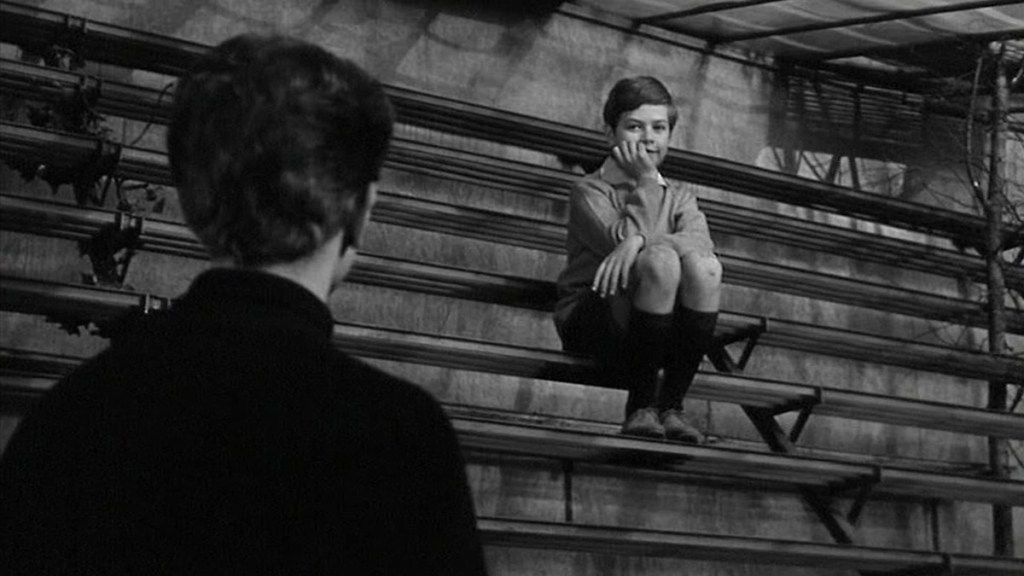
Charlie’s derision intensified when the object of his desire appeared for the first time. He was a small cupid-faced boy carrying a lamb which we presumed was meant to be the symbolism of Jesus Christ as the Lamb of God. “Bordel de merde! Please tell me that this boy isn’t going to be his lover.” His fears proved to be correct, and I agreed that the age difference was disturbing.
He was called Alexandre, who turned out to be a bit of a cock-tease for Georges, but the romance mainly involved love letters passed between the two of them. The relationship is destroyed by a priest’s will to protect them from homosexuality. “We know why he did that,” said Charlie knowingly. “That priest wanted his wicked way with the little boy.” That wasn’t the case, but there were no happy endings, because heartbroken Alexandre jumped to his death from a moving train.
“The movie was good,” Charlie said afterwards, “but I found it troubling.” I agreed and began my own internet search to see what people thought about it. I was surprised to find that modern-day audiences seem unperturbed by the subject matter but could see that the Catholic Church had tried unsuccessfully to get it banned on its release.
Charlie disappeared into the kitchen while I fell down a rabbit hole as I dug deeper into the movie’s background. When he returned with two mugs of tea I told him my findings.
“I’ve found things that might upset you even more.”
“What do you mean?”
“The movie is based on a book written by a French author called Roger Peyrefitte and is said to be autobiographical because he had a similar romance, and the younger boy committed suicide.” My pronunciation was poor, and it came out as Pay-ri-fit.
Charlie corrected me. “Pey-ri-fee.” He stretched on the leather sofa and mulled over my new-found knowledge.
“But there is more,” I said, scrolling down the page of a French literary site. “Peyrefitte visited the movie set and fell in love with a 12-year-old boy who played a small part as a choir boy. They had a relationship, and the boy became his personal secretary and was eventually adopted by him.”
“It is Greek love,” Charlie frowned. “Erastes and Eromenos. What happened to them?”
“The boy was called Alain-Philippe Malagnac d’Argens de Villèle.” My English pronunciation left a lot to be desired, but Charlie looked at me as though I had said something significant.
“Alain-Philippe Malagnac?”
“I suppose so.”
“It cannot be the same person,” he cried, “but my father once knew somebody with that name.”
I continued reading.
“Malagnac became proprietor of Le Club Colony in Paris and briefly managed French singer Sylvie Vertan but it almost bankrupted Peyrefitte and forced him to sell artworks and erotic antiques.”
“The Alaine-Philippe Malagnac that my father knew was married to Amanda Leah, who he believes to really be a man, but a gay icon. He died in a fire near the Alpilles Mountains.”
I saved my pièce de résistance until last.
“Malagnac married Amanda Lear in 1979. She was close friends with Salvador Dali, who disapproved of the marriage.”
Charlie smiled triumphantly. “That is incredible. I cannot wait to tell my father, but what shall I say?” He began fiddling inside his shorts, something he tended to do when he mulled things over. At last, he came to a decision. “I will not say anything because he will become worried that I might also be seduced by an older man.”
I smiled. “I think it is most likely to be the other way around.”
Image: Les amitiés particulières (1964). Directed by Jean Delannoy
Charlie had been watching movies on TV and hadn’t gone to bed until three o’clock in the morning. This was normal, but he wasn’t used to me waking him up six hours later. I reminded him that he was due to meet Leon at ten for his photo shoot. Only the top of his head could be seen from under the covers and his hair stuck up at all angles. He was barely communicative and answered with strange little noises that sounded kind of cute.
Ten minutes later I had to tell him again that he had to get up. “It’s like trying to sleep in the Gare du Nord,” he moaned. There was then a frantic rush to shower and make himself look beautiful, not helped by the fact that in this rented holiday cottage the bathroom was downstairs while his clothes were upstairs.
I stayed out of the way and flicked through an old antiques magazine that was at least ten years old. Things appeared to be going well because when Charlie was in a good mood he would start singing Jacques Brel songs in French and I could hear the words to La Chanson de Jacky through the floorboards that had wide gaps between them.
“Même si on m’appelle Antonio Que je brûle mes derniers feux En échange de quelques cadeaux Madame, oh madame, je fais ce que je peux.”
Leon had arranged to meet Charlie outside Dolly’s Vintage Tea Room, but I’d been warned to stay away. He reasoned that my presence would cause him embarrassment. My day was going to be spent wandering around this small fishing village while trying not to spend money that I didn’t have.
“This is going to be interesting,” Charlie said as he drank the remains of his tea (white with two sweeteners). “Leon takes photographs of different subjects, but his speciality is taking pictures of dead birds and the occasional dead rat.
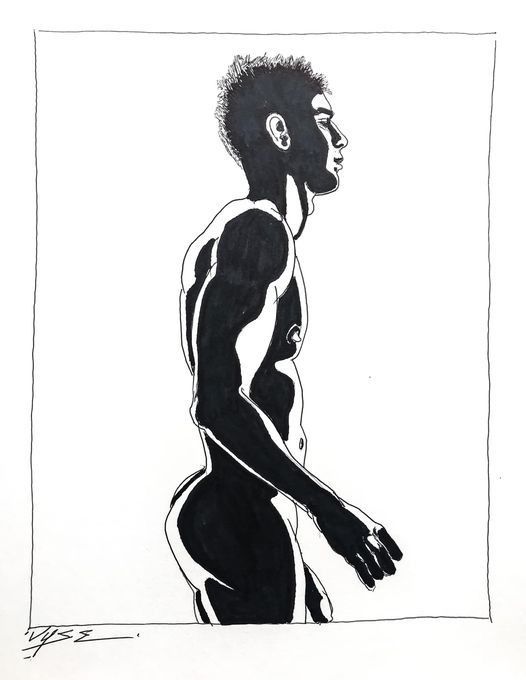
Charlie looked admiringly at the sketch.. “When I was a small child I got into trouble at school for drawing a picture of a naked man with a 20 inch dick. Not by desire, but by terrible proportion.”
Image: Staithes Harbour / North Yorkshire / delicto (2025)
We walked around Staithes Harbour while the tide was out and the sun went down and the boats ended up in the mud.
Charlie was in a reflective mood.
“We once visited Le Tréport and when the tide went out there was a dead body left behind. It was a man who had gone missing a few days before. The sad thing is that he had lost a boot, and I have always wondered where the other boot ended up because one boot was no use to anyone.”
It was a depressing story but a beautiful end to the day.







 Perfectly Hard and Glamorous