Author Archives: Delicto

Whitechapel Boy and the Threadbare Years

I confess—I didn’t notice the rabbits at first. But there was something in the photograph that drew me in. It was taken by Izis Bidermanas, the Jewish-Lithuanian photographer, in Whitechapel, London, in 1951.

It’s quite possible that the boy in the image is still alive, but the rabbits, of course, are not.

Bidermanas worked primarily in France and is best remembered for his photographs of French circuses, Parisian streets, and commissions for the iconic Paris Match magazine. He befriended Jacques Prévert, the French poet and screenwriter; both were described as “urban wanderers.” A year after this photograph was taken, they published Charmes de Londres, a book of black-and-white photographs of post-war London by Bidermanas, accompanied by Prévert’s poetic texts—a vivid portrait of the “shabby old capital in its threadbare post-war years.”

There is something both tender and prematurely adult about this image. A loosely tied scarf, a jacket slightly too big. His style seems effortless—almost cool—as if he had stepped out of his own decade and into ours.

He is someone out of sync with his time. The kind of boy you might spot today on the Underground platform, earbuds in, oversized coat slung over his shoulders. Certain types of youth are universal—postures, anxieties, and dreams that repeat across generations. It makes you want to know his story.

There is an angularity to his posture, an aloof tilt of the head. He strokes the rabbit but does not quite look at it. Tenderness in his hands, hardness in his shoulders. Quiet care, resilience, an emotional inheritance that compels him to protect something gentle, even if he has rarely known gentleness himself.

He seems too sharp, too perceptive for the smallness around him—working here because life left him no choice, waiting for the real story to begin. The rabbits were merely a way to earn a few coins.

What if he was drawn to things outside society’s expectations? Art, books, music—worlds not meant for boys like him. Perhaps he dreamed of Soho jazz clubs, photography, fashion—things his home would never have approved of.

He was a boy caught between worlds: childhood and adulthood, duty and desire, the past and the future. A timeless boy, carrying secret longings.

That Moment: A good rave, on a good night

Surrender – Charlie Marseilles

The music starts, and it feels like heat rising under my skin. I move without thinking — a slow, trembling rhythm that begins in my ribs and spills outward. My shirt clings, half open, heavy with sweat. Each breath feels like it’s carving light through me, and I let it. There’s no audience, just the sound of air, the pulse of my own heartbeat echoing through the floor.

The world shrinks to the movement of my spine, the slip of fabric, the catch of breath. My body feels thin, electric, fragile — like something lit from within. I close my eyes and lean into the rhythm until it blurs the edges of everything. There’s a strange kind of pleasure in it: the way exhaustion burns into something tender, almost holy. I don’t know if I’m dancing or dissolving.

When the music fades, I’m still trembling. The air is warm against my skin, every breath thick and slow. I can taste salt on my lips. For a moment, I stay there — suspended in the quiet — before the world comes back into focus. My body is mine again, but it feels changed, like it’s remembered something it shouldn’t have.

Charlie: The Rumour of Possibility

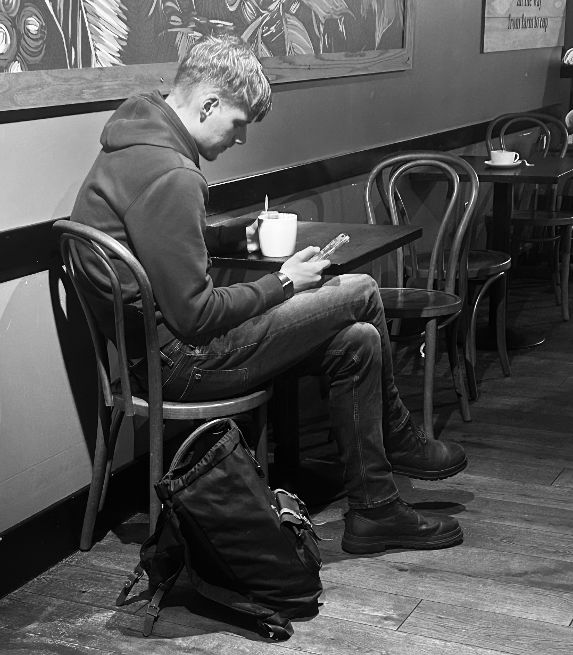
He is completely unaware and does not expect to be photographed at all – Charlie Marseiiles

There is a game that Charlie likes to play. I blame the streak of melodramatic French in him — he can’t help speculating about everyone. We ducked into a bright little coffee shop to escape the damp, heavy air outside. Amid the hiss of the coffee machine, steamy windows, damp clothes and the sweet smell of pastries, Charlie zeroed in on a guy sitting alone, scrolling on his phone, blissfully unaware he’d become the latest target of Charlie’s imagination.

“What is he looking at? Who is he messaging?” Charlie whispered while we waited for our takeaway. I’d heard these questions a hundred times, and I hardly had the energy to answer anymore. His curiosity could tip into something nosy, even a bit rude, and I’d told him more than once that it bordered on prying. Still… I had to admit, despite my protests, it was often weirdly entertaining.

And he was already off. “It’s all very mysterious, but I’ve got a theory,” he said, eyes locked on the boy with the coffee. “He is telling someone he woke up without a care in the world… until a man in the street annoyed him. So he punched him — once — and killed him. And now that boy over there is a murderer.”

Sometimes I wondered whether he was just trying to make me laugh, or if there was something darker in the way he saw people. I glanced at the poor guy and found myself, just for a moment, considering whether Charlie’s wild theory wasn’t entirely impossible.

Concerning the Boy from Ruislip


Mr and Mrs Jones of Ruislip,

I find it rather interesting that you spent thousands of pounds to send your son to this university city. Did he have a choice in the matter? Perhaps not — but in any case, thank you for your thoughtful consideration. He is, as you surely already knew, something of a handful. But did you also know that he grinds his teeth in his sleep?

Twink on Trial

Twink – Charlie Marseilles (2025)

Johnny had Sabrina Carpenter in his ears again, looping ‘Feather’ from Russell Square all the way to Wood Green. She didn’t know she was basically the narrator of his life, but one day he’d tell her. That’s what twinks do: dream big, unrealistic, sparkly dreams and somehow convince themselves it’ll all work out. Johnny didn’t care. He usually jumped head-first into the unknown anyway.

The day had been a slog. Instead of listening to his tutor, he’d spent two hours doodling in his notebook — the one with the Eric Ravilious cover he pretended made him look cultured. The tutor finally snapped and kept him back. “How would you describe your life?” he’d asked, like Johnny had personally offended academia.

Johnny had smiled. “Fed, pampered, and impatient. Honestly? My life is one long, sexy, pouty battle.”

The tutor hadn’t expected honesty. Or attitude. “In my day,” he’d muttered, “you would have been called a prostitute.”

Harsh, sure. But Sabrina would’ve had his back. She’d remind him he was eighteen, hot, and fully allowed to be desired — and if someone wanted to bankroll his glitter-coated lifestyle, that was on them. She’d conveniently skip the part about him being high twink maintenance: fine dining, special diets, beach holidays, designer clothes, and accommodation that didn’t smell like student desperation.

Alexander funded the whole thing, because Johnny lived for an Instagram-ready existence and the universe had not, so far, given him the bank account to match.

Twinks are vulnerable, Johnny decided, and love could never be found in a discount store.

When he got home, Alexander was already there, drinking wine and listening to Vivaldi — the soundtrack of men who’d survived ‘twink death’ and were now coasting through their late thirties in cashmere.

“We need to talk,” Alexander said. Serious voice. Terrible sign. Johnny tossed his Reiss puffer on the floor anyway. He was a trophy boy, and trophies didn’t hang themselves up.

Alexander cleared his throat. “The thing is… sugar babies aren’t really financially viable anymore. I need to do a quarterly business evaluation.”

Johnny froze. Thank God he’d kept all the receipts — he’d at least prove he’d been properly maintained. And he was not going down quietly.

“Look,” Johnny said, already shifting into survival mode, “you’re old enough to be fluent in PowerPoint and so I’m going to prepare a presentation of all my key deliverables. I think you’ll find them very compelling. Being adorable. Emotional availability. Pretending to like oysters. And really? That’s just the intro slide.”

Fashion Brothers and the Absurd


“I’m in love with a Lego brick,” Josef said, grinning like it was the most normal thing in the world.

Tomas raised an eyebrow. “What do you know, Joe? Are you an AI prostitute now?”

“No,” Josef said seriously, as if clarifying a crucial fact. “I’m Gigolo Joe.” He slammed the cases into the trunk with mock solemnity.

“Are we ready?” Tomas asked.

“Ready when you are, brother. But make it fashion,” Josef said, voice smooth as a sales pitch.

Tomas laughed, a little bitter towards his little brother.“I used to be somebody. I used to take people places.”

Their parents groaned, caught between shame and exasperation. “Put some clothes on, Tomas!”

The Beauty of Destruction

Destruction – Charlie Marseilles (2025)

Destruction has its own pleasure: a compulsion—call it weakness or strength—to obliterate the good and start anew. I’ve done this all my life and won’t stop now.

How beautiful maleness is, if it finds its right expression


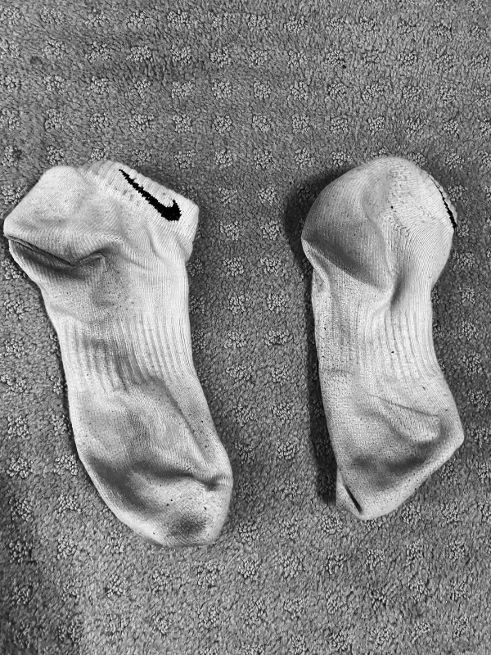
There’s something sneaky going on in the subconscious — innocence, purity, chaos, sweat. Dirty white socks hit all of it at once. They spark that weird little thrill: the musk, the heat, the trace of someone’s body still clinging to the cotton. It’s a micro-kink, sure, but the power comes from whatever story you attach to them — private, charged, and way more psychological than you’d ever admit out loud.

Something Worth Remembering

Dominik Datko and Maciej Poplonyk. Photographed by Arthur Iskandarov

Dominic chose fourteen stone steps to sit on. They hadn’t been cleaned in a century; weathered and frost-damaged, they had taken on a patina — the greyness broken by lichens and mosses, ivy-leaved toadflax, and ryegrass. He rested his head against the iron railings and sighed.

Arthur sat thinking below him, his legs sprawled across the pavement. 

 “Once upon a time, a horse and carriage pulled up, and a well-dressed man — wearing a top hat and fine coat — disembarked and climbed these steps. He rang the bell and waited while an old butler answered the door, then handed over the hat and coat before being shown into a reception room.”

“How do you know that?” said Dominic, who lit a cigarette and looked towards the front door. There was no grandeur anymore. A glass door stood behind a padlocked gate; dirty net curtains protected the inside from prying eyes. The house was empty and unloved.

 “You only say it because you are describing something that you have seen or read. You don’t know what happened, because you weren’t here.”

Arthur picked up a piece of stone that had crumbled from one of the two pillars at the foot of the steps. He examined it before putting it inside a trouser pocket. This was something else to add to his ‘shelf of memories’. One day, when they were old men, he would pick up the piece of stone and show it to Dominic and say, “Do you remember the day we sat on those stone steps?” But he doubted that Dominic would grow old.

“My dear boy, despite your charm and privilege, you sadly lack imagination and prefer to live that shallow existence on TikTok and Instagram. Such a waste of an upbringing.”

Dominic laughed.

“And besides,” Arthur continued, “you will never become famous if you don’t contribute anything worthwhile that you can be remembered for.”

“That, my love, sounds too much like hard work,” Dominic replied. “But I envy you, Arthur, because you believe that writing those shitty little posts will turn you into a brilliant writer.”

There was a note of sarcasm in his voice, and Arthur knew that Dominic didn’t mean to be unkind.

“It is true. There are millions of tadpoles swimming in this huge pond. Why should anybody take notice of this one ordinary tadpole? But, Dominic, it’s not about being a brilliant writer. It’s about learning from mistakes — because I look back at some of the things I’ve written and cringe. But I remind myself that writing is about me, and I write for my own enjoyment.”

We Were Kind to Each Other and Everyone Was Afraid


Jeffrey and his mafia. And me—only me—still unaware that I was God. A mutual understanding never consummated in public. We conspired like poets at war: Jeffrey with his loyal men, and I, followed only by those who believed in my every word. Yet I remember one moon-warmed night, when the sea breathed softly beneath us, and at the stern of a drifting ship, we clasped hands and swore our respect. The water glowed like milk around us. It was the start of a beautiful romance that put fear into the hearts of everyone except ourselves.