Every man has his secret sorrows which the world knows not; and often times we call a man cold when he is only sad
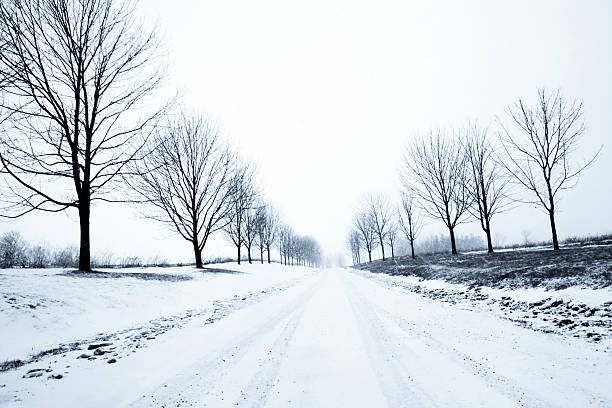
The days are getting shorter and, honestly, more depressing. The final stretch of this yearly slog is only weeks away, yet I’m already wondering whether I’ll make it to the finish line in one piece. Autumn seemed to appear out of nowhere this year. Now the winter solstice looms on 21 December — an already dismal day made even bleaker by falling on a Sunday.
“Solstice” means “sun stands still”: the Sun’s path appears to pause for a few days before inching north again, marking the peak of winter. It sounds poetic, almost serene, but for someone like me it can feel anything but. This year has been one of the bad wobbles.
I belong to that unlucky club of people living with Seasonal Affective Disorder (SAD), a form of depression that follows a seasonal rhythm — often called “winter blues” because the symptoms intensify as the light dwindles. At least I’m in decent company: Adele, Ryan Reynolds, Jim Carrey, and Emma Thompson have all spoken openly about dealing with it.
The symptoms? A greatest-hits list of misery: persistent low mood, loss of interest, low energy, oversleeping, carb cravings, weight gain, fuzzy concentration, irritability, social withdrawal, and those heavy feelings of guilt or worthlessness. Over the past few weeks, I’ve ticked every single box.
Worst of all are the irrational thoughts that hitch a ride. These fixations burrow in and make themselves at home. In previous years, I’ve spiralled over a long-ago one-night stand, convinced I needed to confess it to my partner to find peace — thankfully a friend talked me down. Another winter I became obsessed with the idea that I had too much money and would have to explain myself to the taxman, despite everything being perfectly legitimate. This year, despite feeling physically fine, I can’t shake the fear that I’m harbouring a terminal illness. Seeing it written out looks absurd, but that’s the reality of it.
SAD likely stems from disruptions to the body’s internal clock and imbalances in serotonin and melatonin triggered by the lack of sunlight. It was formally named in 1984 by Dr. Norman Rosenthal and his team at the National Institute of Mental Health.
There’s no magic cure. You grit your teeth and get through it. It’s less “mind over matter” and more “matter over mind” — odd phrasing, but surprisingly accurate. What helps me most is staying occupied: researching, writing, watching TV, cleaning… anything that absorbs me. Eventually, after a few hours, I’ll notice I feel almost normal again. I recently read that building Lego can help too — its structure and focus promote mindfulness, which can ease anxiety and depressive symptoms.
The fear that you’re “cracking up” can be overwhelming the first time, especially if you don’t yet know what’s happening. But when it returns, you at least recognise the shape of it. You learn its rhythm. You remember it passes. And that alone is sometimes enough to help you hold on until the light returns.
I noticed him but he chose not to notice me. After he had dropped his mobile phone on the floor for the third time, he realised that he had to say something.
Pablo thrusts his hands beneath the hot tap. He rubs them together in a frantic, almost self-destructive rhythm as the water climbs from warm to blistering. Anyone else would flinch, recoil — but he holds himself there, jaw locked, letting the scalding cascade engulf him in a cloud of bitter, furious steam.
The faces and bodies of the men he aches for seem to drift through that fog, circling him, pressing close. You can tell when the moment is nearing: the tightening of his calves, the subtle clench of his arse, the way he grinds himself against the cold lip of the sink. It is sharp, electric — his own strange ritual, the pink-hands-and-hot-water orgasm — that edge where pain dissolves into an ecstatic, trembling pleasure.
But the release he chases always slips from him. It teases, then vanishes.
When the heat becomes unbearable, he finally twists the tap off. His head drops. He turns, shoulders hunched, his shorts soaked and clinging to him. He won’t meet my eye; shame clouds the air between us. This little masochistic kitchen-sink drama — he believes it reveals too much.
– Being the transcript of a letter unearthed in the long-sealed vaults of the Royal Bank of Scotland, November 2025
George Walker Wood 66 Cavendish Street, Marylebone London
29 November, 1881
My dear Reader,
If by curious chance you hold this manuscript in your hands, I entreat you to read its contents with the utmost seriousness. Only by such attentive perusal shall you perceive that the pages which follow are both an explanation and a justification for their long concealment.
Should it prove that I still draw breath when these lines meet your eye, then I beg of you—burn them without delay, and disclaim all knowledge of ever having encountered them. The shame that would ensue from their divulgence is of so dreadful a nature that I scarcely dare commit the thought to paper.
I shall therefore begin at the point where first I made the acquaintance of one Johane—an Irish youth of some four-and-twenty years, of humble condition, and with every outward appearance of one who might easily draw misfortune to my door. He was, however, most commonly called Jack, and by that familiar name I shall refer to him henceforth. Dear Jack belonged to a loose fraternity of young loafers and street-bred rascals—variously known as the “London Boys”—a wild and merry set whose manners were as questionable as their morals, yet whose very recklessness possessed, for me, an unaccountable fascination.
In time I grew most attached to Jack, and he attended me frequently at my lodgings in Marylebone. There, behind doors safely bolted, we indulged in certain intimacies which, though common enough within that unseen sphere of which London pretends ignorance, would cause polite society to feign horror. Jack’s person was slight, his garments threadbare and ill-assorted, and he bore all the marks of those who are forced to wrest their sustenance from the streets; yet beneath that rough exterior there was a warmth and vigour not easily described. When fortune smiled and I had a few coins to spare, he would remain with me until morning, and those nights—cold, anxious, sweet as they were—remain fixed in my memory.
I suspect that my landlady, Mrs. Chivers, a stout matron of no small curiosity, had taken something of a liking to Jack as well; for once I discovered him seated at her kitchen table devouring a modest breakfast of bread and scrape. The glint of mischief in his eye, as he looked up at me over the crust, told me all I needed to know. She had chosen to see nothing of the nature of my rooms above.
My days were spent at the old desk overlooking Cavendish Street, where I composed articles for The London Figaro and The Dark Blue. Yet I had long nourished the ambition to attempt a novel—something that might echo, however faintly, the triumph of A Tale of Two Cities. My parents, never slow to remind me of my deficiencies, assured me that I lacked both imagination and creative faculty, that I was fit only to set down facts and order them neatly upon a page.
Still, I could not forget the tales Jack whispered to me during those winter nights—tales of gentlemen of rank who sought his company at a high price; of drawing-room adventures veiled beneath the richest draperies; of temptations and behaviours of which the world speaks only in scandalised murmurs. Spurred by these accounts, I sought the acquaintance of a certain printer known to an associate of Henry Ashbee—a man whose livelihood depended upon the discreet production of pamphlets of a decidedly provocative character.
Mr. William Lazenby, a sharp-eyed fellow, showed interest in my idea and agreed to an initial impression of two hundred and fifty copies. He offered me a share of the profits, subtracting his considerable costs, should I but write with candour. The sums he mentioned far exceeded any I had yet earned, and the promise of so easy a reward was exceedingly tempting. He informed me that the book should be sold exclusively by mail-order through an address in Paris, and insisted that I adopt a nom de plume, lest I bring inevitable ruin upon myself.
When I conveyed the scheme to Jack, he immediately demanded—nor without justice—a share of the proceeds, and further insisted that his own name be affixed to the work. I warned him that the police might take a dim view of such recklessness, but he merely laughed and declared that the “mutton-shunters”, knowing full well he could neither read nor write, would never suppose him connected to any printed matter. With that he tumbled himself upon the bed in his usual impudent fashion and suggested that we commence our “research” without delay.
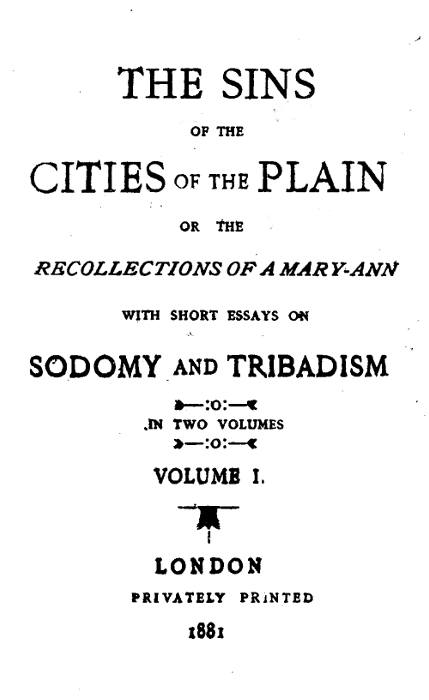
By June the manuscript was completed, and I had settled upon what I deemed a most fitting title—The Sins of the Cities of the Plain. Though Mr. Lazenby scoffed at it, he conceded that the biblical suggestion would doubtless catch the eye of those gentlemen who take an interest in such hidden matters. I confess I feared that certain passages, dealing as they did with the concealed customs of our clandestine fraternity, might prove too recognisable to those acquainted with that shadowed realm.
Lazenby nevertheless published the work in two parts, and it found immediate favour among readers eager to feast upon the covert indulgences of the great and respectable.
Though I tremble at the thought of its reception, I take comfort that my own name has thus far escaped suspicion. I offer here my apologies to Mr. Simeon Solomon and Mr. James Campbell Reddie—both of whom have been unjustly whispered about in connection with this deception. Jack, meanwhile, basks in the admiration of his companions and seems persuaded that a century hence his name will still be spoken among certain circles of “inverts”, as he jests.
This very day I have deposited my first earnings at the Lombard Street branch of Messrs. Glyn, Mills, Currie & Co., alongside this confession, sealed and hidden, to remain in the vault until such time as Providence ordains its discovery. Should that day come, I trust that The Sins of the Cities of the Plain shall be regarded as a truthful and unvarnished portrait of those whose society I have come to cherish.
Ever, dear Reader, your faithful servant,
𝒢. 𝒲𝒶𝓁𝓀𝑒𝓇 𝒲𝑜𝑜𝒹 ⌣⌣⌣⌣⌣⌣⌣⌣⌣ George Walker Wood
*****
Now read on to separate fact from fiction.
This edition contains the unabridged text of the first edition housed at the British Library, together with a new introduction by Wolfram Setz and a facsimile reproduction of the original volumes’ title pages.
The Sins of the Cities of the Plain is an influential Victorian erotic novel, originally published anonymously in 1881 and widely considered one of the first works of exclusively gay pornography in English. It is a fictionalized memoir attributed to real-life Irish prostitute Jack Saul.
The book is a narrative, presented as the “recollections” or “memoirs” of Jack Saul, detailing his experiences as a young male prostitute (a “Mary-Ann” or “rentboy”) in the clandestine gay underworld of Victorian London. It traces his escapades from boarding school into young adulthood, describing his sexual encounters with various men, from schoolboys and guardsmen to wealthy aristocrats and members of high society.
While attributed to Jack Saul, the actual author is debated by scholars, with some suggesting a ghostwriter or figures like the painter Simeon Solomon or James Campbell Reddie were involved. The book was privately printed in two volumes in 1881 by William Lazenby to avoid obscenity laws and sold for a high price.
The original printings are unobtainable today, but modern editions are widely available from various publishers, such as Valancourt Books and Mint Editions.
I confess—I didn’t notice the rabbits at first. But there was something in the photograph that drew me in. It was taken by Izis Bidermanas, the Jewish-Lithuanian photographer, in Whitechapel, London, in 1951.
It’s quite possible that the boy in the image is still alive, but the rabbits, of course, are not.
Bidermanas worked primarily in France and is best remembered for his photographs of French circuses, Parisian streets, and commissions for the iconic Paris Match magazine. He befriended Jacques Prévert, the French poet and screenwriter; both were described as “urban wanderers.” A year after this photograph was taken, they published Charmes de Londres, a book of black-and-white photographs of post-war London by Bidermanas, accompanied by Prévert’s poetic texts—a vivid portrait of the “shabby old capital in its threadbare post-war years.”
There is something both tender and prematurely adult about this image. A loosely tied scarf, a jacket slightly too big. His style seems effortless—almost cool—as if he had stepped out of his own decade and into ours.
He is someone out of sync with his time. The kind of boy you might spot today on the Underground platform, earbuds in, oversized coat slung over his shoulders. Certain types of youth are universal—postures, anxieties, and dreams that repeat across generations. It makes you want to know his story.
There is an angularity to his posture, an aloof tilt of the head. He strokes the rabbit but does not quite look at it. Tenderness in his hands, hardness in his shoulders. Quiet care, resilience, an emotional inheritance that compels him to protect something gentle, even if he has rarely known gentleness himself.
He seems too sharp, too perceptive for the smallness around him—working here because life left him no choice, waiting for the real story to begin. The rabbits were merely a way to earn a few coins.
What if he was drawn to things outside society’s expectations? Art, books, music—worlds not meant for boys like him. Perhaps he dreamed of Soho jazz clubs, photography, fashion—things his home would never have approved of.
He was a boy caught between worlds: childhood and adulthood, duty and desire, the past and the future. A timeless boy, carrying secret longings.
The music starts, and it feels like heat rising under my skin. I move without thinking — a slow, trembling rhythm that begins in my ribs and spills outward. My shirt clings, half open, heavy with sweat. Each breath feels like it’s carving light through me, and I let it. There’s no audience, just the sound of air, the pulse of my own heartbeat echoing through the floor.
The world shrinks to the movement of my spine, the slip of fabric, the catch of breath. My body feels thin, electric, fragile — like something lit from within. I close my eyes and lean into the rhythm until it blurs the edges of everything. There’s a strange kind of pleasure in it: the way exhaustion burns into something tender, almost holy. I don’t know if I’m dancing or dissolving.
When the music fades, I’m still trembling. The air is warm against my skin, every breath thick and slow. I can taste salt on my lips. For a moment, I stay there — suspended in the quiet — before the world comes back into focus. My body is mine again, but it feels changed, like it’s remembered something it shouldn’t have.
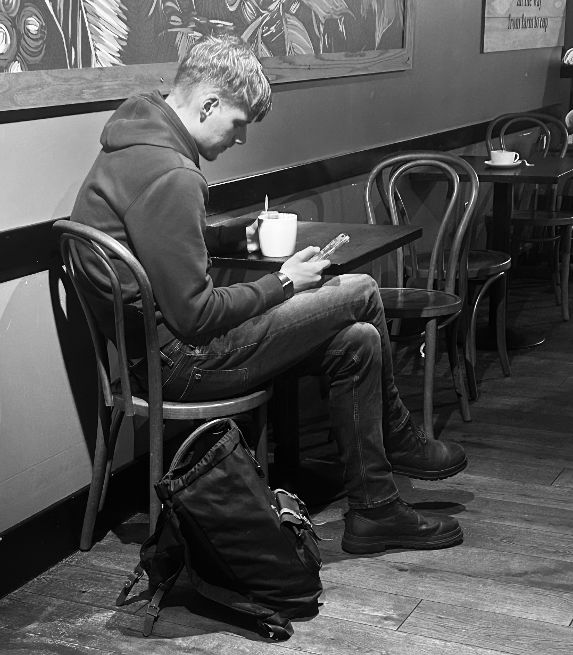
He is completely unaware and does not expect to be photographed at all – Charlie Marseiiles
There is a game that Charlie likes to play. I blame the streak of melodramatic French in him — he can’t help speculating about everyone. We ducked into a bright little coffee shop to escape the damp, heavy air outside. Amid the hiss of the coffee machine, steamy windows, damp clothes and the sweet smell of pastries, Charlie zeroed in on a guy sitting alone, scrolling on his phone, blissfully unaware he’d become the latest target of Charlie’s imagination.
“What is he looking at? Who is he messaging?” Charlie whispered while we waited for our takeaway. I’d heard these questions a hundred times, and I hardly had the energy to answer anymore. His curiosity could tip into something nosy, even a bit rude, and I’d told him more than once that it bordered on prying. Still… I had to admit, despite my protests, it was often weirdly entertaining.
And he was already off. “It’s all very mysterious, but I’ve got a theory,” he said, eyes locked on the boy with the coffee. “He is telling someone he woke up without a care in the world… until a man in the street annoyed him. So he punched him — once — and killed him. And now that boy over there is a murderer.”
Sometimes I wondered whether he was just trying to make me laugh, or if there was something darker in the way he saw people. I glanced at the poor guy and found myself, just for a moment, considering whether Charlie’s wild theory wasn’t entirely impossible.
I find it rather interesting that you spent thousands of pounds to send your son to this university city. Did he have a choice in the matter? Perhaps not — but in any case, thank you for your thoughtful consideration. He is, as you surely already knew, something of a handful. But did you also know that he grinds his teeth in his sleep?
Johnny had Sabrina Carpenter in his ears again, looping ‘Feather’ from Russell Square all the way to Wood Green. She didn’t know she was basically the narrator of his life, but one day he’d tell her. That’s what twinks do: dream big, unrealistic, sparkly dreams and somehow convince themselves it’ll all work out. Johnny didn’t care. He usually jumped head-first into the unknown anyway.
The day had been a slog. Instead of listening to his tutor, he’d spent two hours doodling in his notebook — the one with the Eric Ravilious cover he pretended made him look cultured. The tutor finally snapped and kept him back. “How would you describe your life?” he’d asked, like Johnny had personally offended academia.
Johnny had smiled. “Fed, pampered, and impatient. Honestly? My life is one long, sexy, pouty battle.”
The tutor hadn’t expected honesty. Or attitude. “In my day,” he’d muttered, “you would have been called a prostitute.”
Harsh, sure. But Sabrina would’ve had his back. She’d remind him he was eighteen, hot, and fully allowed to be desired — and if someone wanted to bankroll his glitter-coated lifestyle, that was on them. She’d conveniently skip the part about him being high twink maintenance: fine dining, special diets, beach holidays, designer clothes, and accommodation that didn’t smell like student desperation.
Alexander funded the whole thing, because Johnny lived for an Instagram-ready existence and the universe had not, so far, given him the bank account to match.
Twinks are vulnerable, Johnny decided, and love could never be found in a discount store.
When he got home, Alexander was already there, drinking wine and listening to Vivaldi — the soundtrack of men who’d survived ‘twink death’ and were now coasting through their late thirties in cashmere.
“We need to talk,” Alexander said. Serious voice. Terrible sign. Johnny tossed his Reiss puffer on the floor anyway. He was a trophy boy, and trophies didn’t hang themselves up.
Alexander cleared his throat. “The thing is… sugar babies aren’t really financially viable anymore. I need to do a quarterly business evaluation.”
Johnny froze. Thank God he’d kept all the receipts — he’d at least prove he’d been properly maintained. And he was not going down quietly.
“Look,” Johnny said, already shifting into survival mode, “you’re old enough to be fluent in PowerPoint and so I’m going to prepare a presentation of all my key deliverables. I think you’ll find them very compelling. Being adorable. Emotional availability. Pretending to like oysters. And really? That’s just the intro slide.”








 Perfectly Hard and Glamorous