Part 1 – The Venetian Arrangement
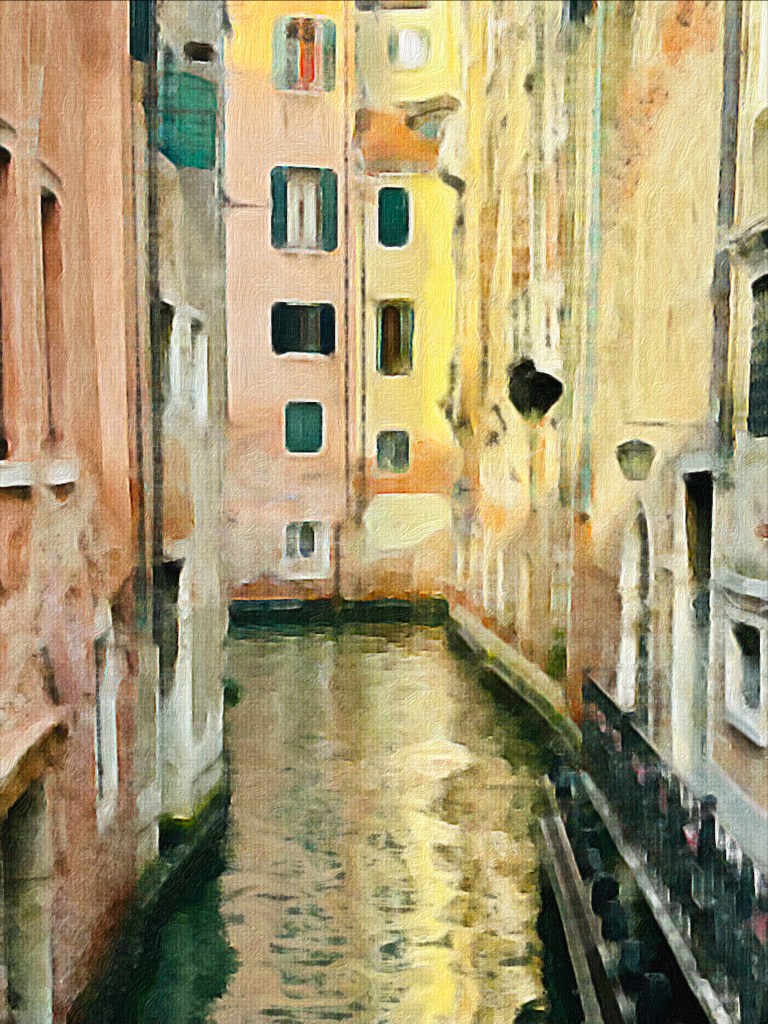
I have only been to Venice twice before.
The first time I was thirteen years old, and it was a cold, damp, misty day. I seem to remember wandering around alone for most of the day, although it was extremely unlikely that I actually did.
The second time was a couple of years ago, when I caught the train from Verona with Cola and stayed for only a few hours before returning. That day it was bright and sunny and completely different from the Venice I remembered. A thunderstorm rolled across the lagoon just as we were about to leave.
And now, for the third time, I have returned to Venice.
This time I will be staying considerably longer.
It was not by choice. There are too many things to do in the UK, and a trip back to Italy seemed more of a distraction than it would be to most people.
I think it was Truman Capote who said: “Venice is like eating an entire box of chocolate liqueurs in one go.” I’m not entirely sure what he meant by that, but I imagined that a stay here was more than most people could stomach.
For a start, there are the tourists.
On a typical day there may be as many as 60,000 of them. I hate tourists. Particularly those who wander around not so much looking at the sights as looking at the sights through a mobile phone. Hundreds of photographs they will never look at again. And if they do, it will probably be to bore the pants off an uninterested friend.
It’s not so much of a problem in Verona, but I imagined that you couldn’t escape them in Venice, which is, after all, a series of small islands.
If tourists get in my way, I will unashamedly kick them into the nearest canal.
But my visit is not for the purpose of being a tourist either.
I am above that.
Venice is neutral territory for a reunion with my long-lost lover, Charlie.
I’ll not bore you with the details, but we went our separate ways after my ill-fated trip to Paris in April. I took the advice of his father, who suggested that I play hard to get and Charlie would follow.
He never did.
Neither did he answer my messages.
He simply disappeared for the summer.
I moved on to Verona and my adventures with Signora Bruschi et al.
There comes a point when you think you have finally got someone out of your system. It is usually at precisely that moment that the least expected thing happens.
I received a message.
You okay?
I made the mistake of replying out of curiosity and allowed the floodgates to open.
Charlie had mistakenly believed that I had spent most of my time not in Verona but in Venice, and expressed a wish to meet up with me there.
For my sins, Verona had always been a secret I kept from Charlie. I wanted it to remain that way for as long as possible. Charlie’s older brother, Thomas, had subscribed to my wishes and, when pressed, had lied that I had settled in the floating city.
And so, we were to meet in Venice.
Signora Bruschi got in touch with an old school friend who lived in Venice, and I was allowed to stay in rooms close to the Ponte di Rialto.
“For as long as you wish,” Signora Bruschi told me.
But she had concerns about me staying on my own.
Alas, Cola had to remain in Verona for treatment on his broken arm. Instead, she insisted that Bianchi jump on a Trenitalia train and arrive at Venezia Santa Lucia in time for my own arrival by Alilaguna Linea Arancio from Marco Polo.
My heart leapt at the thought of Bianchi joining me.
But it would also cause complications for any reconciliation with Charlie, if reconciliation was actually on the agenda.
After all, Charlie had probably been the love of my life.
But I suspected that I had not been the love of his.
And there were too many secrets between us.
Before I set off, an English friend told me to watch The Comfort of Strangers because it would put me in the mood for Venice.
I did as I was told.
He was right.
It put me in exactly the right frame of mind if I wanted to get my throat cut by a psychotic stranger.
I met Bianchi near Rialto.
We had only been apart for a few weeks, but it seemed much longer.
Bianchi threw his arms around me and kissed me on both cheeks.
“I have missed you, Miles,” he cooed excitedly. “But we are together again, and we are going to have a good time.”
Signora Bruschi had told me that it hadn’t taken much to persuade Bianchi to come.
None at all.
He had jumped at the opportunity without hesitation.
But she had also warned him that I was unavailable and that we must sleep in separate beds.
“Signora Bruschi says that I am too young for you,” Bianchi moaned.
Perhaps so, I thought.
But I also knew that teenage boys have a habit of ignoring good advice.
We manoeuvred through the hordes of ignorant tourists I had already taken a dislike to. Like Piazza San Marco, they descend on Rialto as though these are the only two places worth visiting in Venice.
At last we found the quieter calli and crossed small bridges until we reached the place where we would be staying.
Palazzo Pesaro Labia dalle Rose had been described to me as a small but elegant two-room apartment overlooking the canals and located in a fifteenth-century palace.
From the outside, it looked as though it hadn’t been touched since the fifteenth century, with its weathered appearance and crumbling brickwork.
We accessed it through a private courtyard and climbed a set of steps leading to a locked door, beyond which another staircase led upwards to a pair of old double doors.
But as soon as we saw inside, we both loved it.
It was so far removed from Signora Bruschi’s house in Verona, which, up to this point, I had always considered grand. It was even further removed from Bianchi’s modest family home in San Giorgio in Salici.
For a start, it wasn’t small.
Its two rooms dwarfed my own apartment back home.
I would describe it as grand Italian.
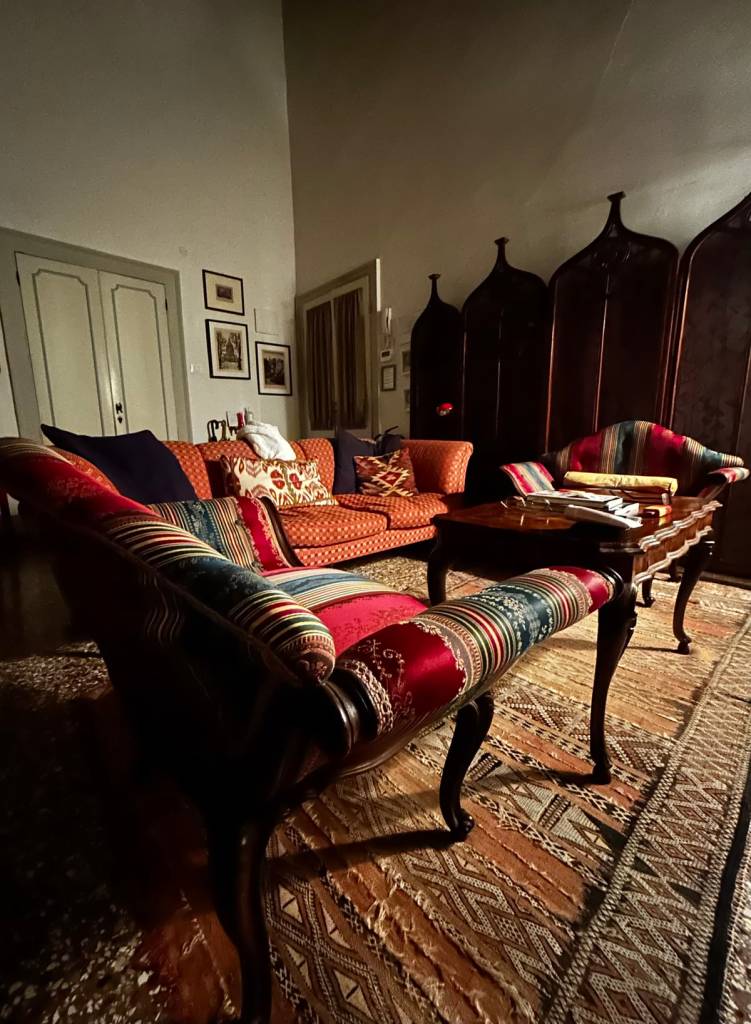
The living room was stylishly furnished with antiques, and the walls were covered with tasteful prints. The second room consisted of a kitchen space, a huge dining area, and a small bathroom attached.
The roof space was so vast that a half-mezzanine floor had been built, with a circular staircase leading to the sleeping area.
And there, occupying most of it, was a huge double bed.
Bianchi looked at it.
I looked at Bianchi.
It was plain to see.
We would both have to sleep together.
“I hope that this doesn’t disappoint you,” Bianchi said rather sheepishly.
“It doesn’t,” I told him. “But we must be careful not to tell Signora Bruschi.”
“I do not think that either of us has the courage to do so,” he innocently replied.