On going out and getting drunk in Verona …
Francesco called me noioso, which I had no trouble interpreting as “boring”. And he wasn’t wrong. There comes a point in everyone’s life when drinking simply becomes too much. If I’m honest, that moment arrived for me in my early twenties. Others, like Francesco, were still going strong well into their thirties.
I was on my sixth Birra Moretti, and the combination of oppressive heat and alcohol was beginning to take its toll. Italians don’t generally binge drink, preferring a few leisurely glasses of wine instead. But Francesco had once lived in London and had wholeheartedly embraced the British tradition of getting shitfaced in the shortest possible time.
I was sinking fast.
Francesco—whose name I’m delighted to say translates rather wonderfully as “Frank Horse” in English—suggested that later we should head to Paradiso, an underground club that played 1980s Italo-disco for people who had missed it the first time around. There was a rumour that Disco Bambino would be DJing, but when I checked, he wasn’t even in the country.
With three hours still to kill before Paradiso opened, I knew I wasn’t going to make it. “Noioso,” he repeated when I told him I was heading back to the apartment to sleep it off. “But first we must go to the river. It will be cooler.”
By Italian standards, Frank Horse was no longer especially handsome. He had put on weight, dressed as though he had wandered straight out of the 1980s, and would have blended seamlessly into Paradiso. His nose had also been permanently bent after a fight in Piazza Bra.
But he hadn’t always looked that way.
Once upon a time, Frank Horse had been slim, handsome and one of Pietro’s boys. Eventually Pietro grew tired of his heavy drinking and cast him aside. It seemed that I had become his long-term replacement until Pietro dropped dead from a heart attack. Frank Horse now earned his living as a distinctly unhurried car mechanic in a rather dubious garage off Via XX Settembre. Yet, despite everything, he had never shown me the slightest resentment. He had always remained perfectly cordial.
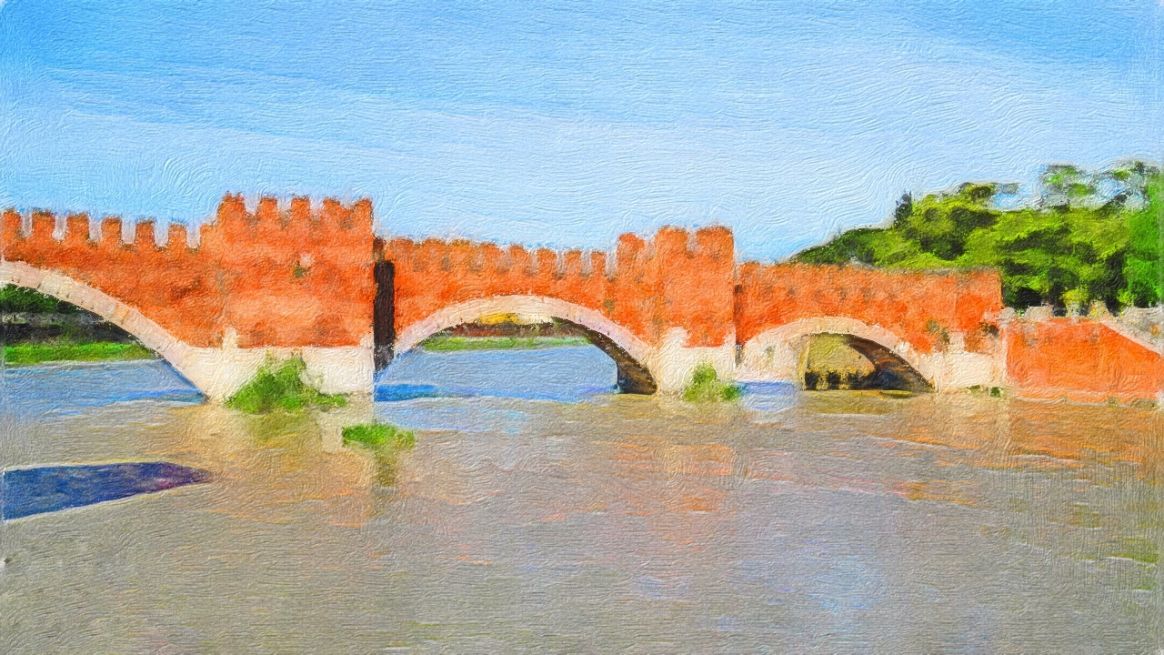
He dragged me to Ponte di Castelvecchio, the fortified medieval bridge spanning the Adige, where tourists crowded together, phones and cameras raised. I squeezed past them to peer through one of the crenellations and marvelled at the broad sweep of water gliding silently beneath us, the afternoon sun dazzling on its surface.
Behind me, an American voice was enthusiastically explaining the bridge’s history.
“Of course, it’s not really the original bridge because it was blown up by the German army in 1945 and rebuilt using the stones recovered from the river.”
After a fair amount to drink, I have a habit of retreating into my own little world.
Had I been fully aware of my surroundings, I might have noticed the commotion further along the bridge, followed by a loud cheer. Seconds later there was an enormous splash as somebody landed feet first in the Adige. The young man waved happily as the current carried him towards Ponte della Vittoria.
Frank Horse eventually climbed out further downstream, where he was promptly arrested by the decidedly humourless Polizia Locale.
Alas, he never made it to Paradiso.
On finding that leather’s just for the look…
There is a room at the top of Signora Bruschi’s house that is filled with clutter. It is where unwanted things are taken to be forgotten. The good lady mentioned that there were boxes up there that had belonged to Pietro—and that they probably belonged to me now. It was a less-than-subtle hint that I ought to sort through them. I pretended not to hear.
Three boxes appeared in my room the following day.
Box Number One …
Inside was an old Italian-language paperback, Fratelli by John Preston. The price sticker on the back still read L. 4.500. Time had turned the edges of the pages a brittle amber, carrying the faint scent of vanilla, dust and old glue. The book fell open naturally at page 142, where a paragraph had been permanently marked by the back of an old glossy Polaroid.
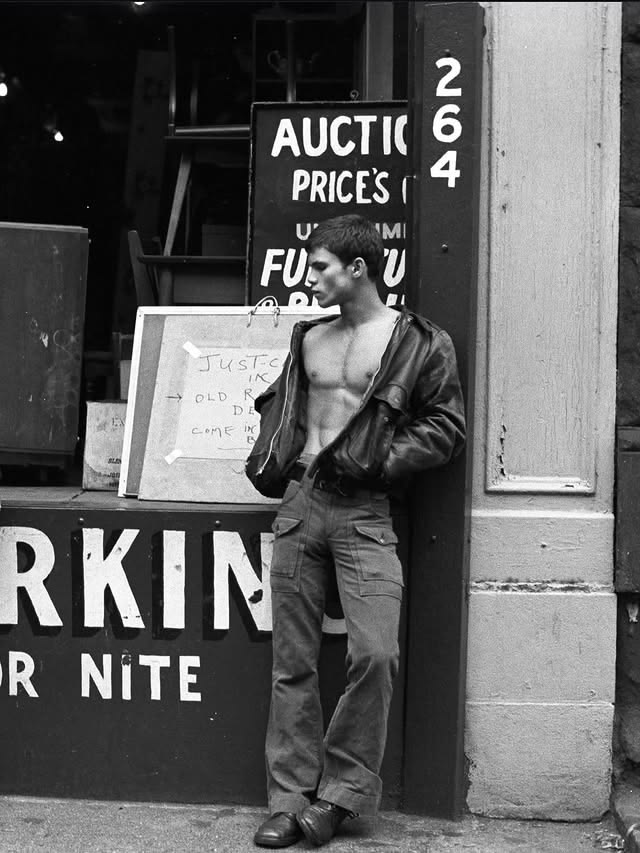
I recognised the photograph immediately. I’d seen it before. It was Hustler by Christopher Makos and taken in 1977: a handsome young man wearing nothing but a pair of jeans and a leather jacket, provocatively unzipped to reveal a well-toned chest.
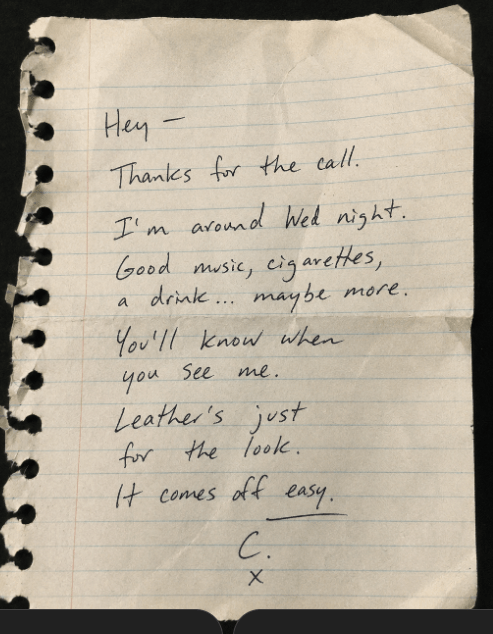
Tucked inside the pages was a note, apparently torn from an old notebook.
One line leapt out at me.
“Leather’s just for the look. It comes off easy.”
On looking at young Peter again …
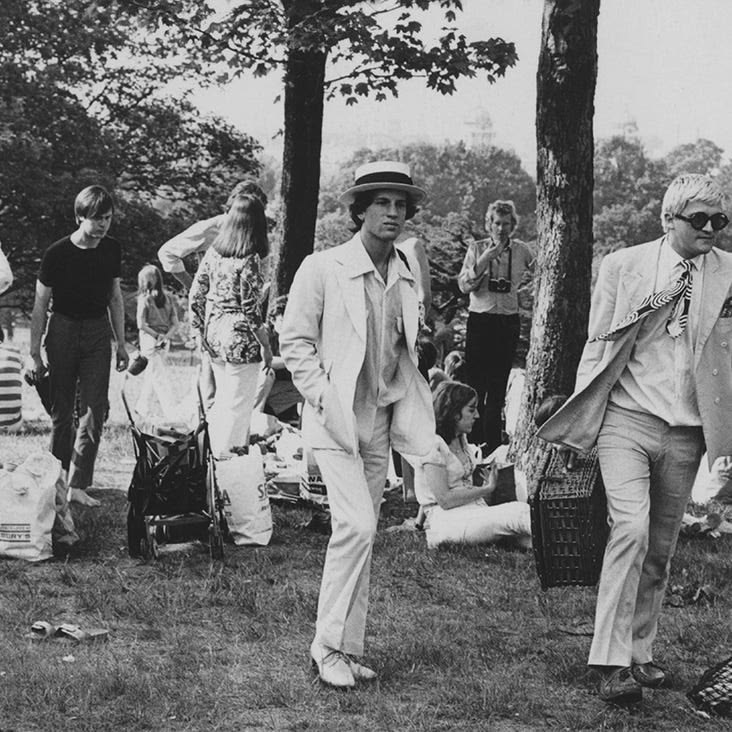
Well, I’m apparently being accused of hating David Hockney.
According to my inbox, my post about Peter Schlesinger, his lover and muse for three years, was unfairly biased in favour of the American (who, incidentally, is alive and well). Fair enough. But while I’ve always admired Hockney’s work—indeed, I seem to be surrounded by Hockney art at the moment—I never found the man himself in the least bit attractive.
The same could not be said of Peter Schlesinger fifty years ago. He was, surely, every man’s erotic dream.
I’ve now managed to get hold of Schlesinger’s A Chequered Past (2003), a collection of photographs taken during the 1960s and 1970s, accompanied by brief autobiographical reflections. (Note to self: why are old photography books always so darned expensive?)
The point I had tried to make—and evidently failed to make very well—was that Hockney was extraordinarily fortunate to have shared part of his life with someone like Schlesinger. Today, of course, such a teacher-student relationship would rightly raise serious ethical questions.
And perhaps Hockney was a little naïve not to realise that young free spirits have always had a habit—as they still do—of looking around the next corner.
How I would have loved to have been a fly on the wall during that “dramatic and public break-up” in Cadaqués in 1971.
On being fooled by Dorian Grai …
Spotify chucked a recommendation my way.
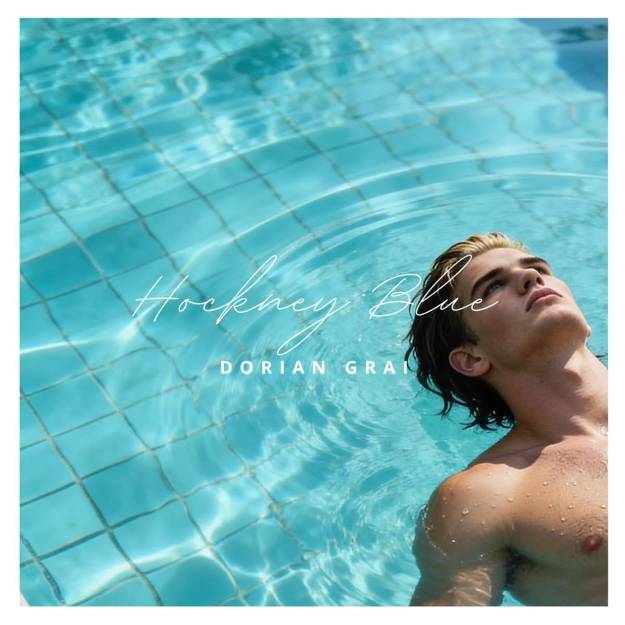
It was a singer called Dorian Grai and a song entitled Hockney Blue, which I found surprisingly seductive. It is a tribute to David Hockney’s swimming pool paintings, particularly those populated by cute, half-naked young men.
A snapshot of the lyrics gives you the general drift.
I’ve had one night on my youth slipping away ever since I saw the boy who knew nothing of decay.
He slipped into the water cool, how it possessed him. So that every drop glistened as a diamond on his skin.
I can see him now as he swims across, how his body’s framed in that azure box.
And I had to be an admirer of the boy I knew I could never love.
So I wish him well, how I make my peace, and I take his portrait as a memory. And I see the stars and I smell the flowers, how the day is gone forever.
He was the boy in the turquoise swimming shorts, tanned skin, black hair, his body lean and honed and young.
He slipped into the swimming pool of Hockney blue.
So that all I could do was sit still, held beneath my eyes.
According to Blakeman Records, Dorian Grai is a twenty-year-old British-American digital artist. Hockney Blue is described as a smooth tropical house track with delicate harmonies and jazzy motifs—a paean both to the paintings of David Hockney and to the yearning regret of a love that never had the chance to blossom.
There is also an interview with the handsome young man.
“I’ll never forget how it felt to write my first song and to listen back to it. I was electrified by the act of creativity—that I had made this thing that had never existed before in the world—and I was hooked.”
Well, I like the song and I like the sentiment, but—and it is a very big but—it is entirely AI-generated, as is Dorian Grai himself.
To be fair, there is no attempt at deception. Everything is out in the open, right down to the lustfully created video of him swimming half-naked in a pool.
On the cute and willing…