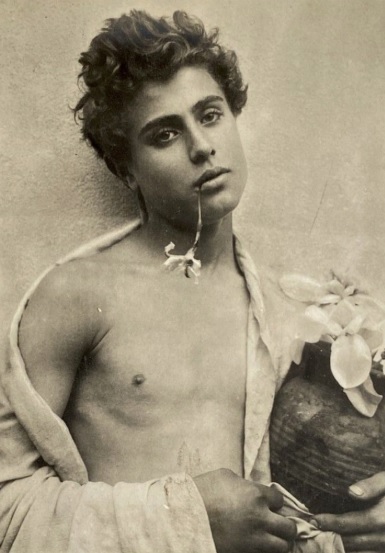
Sicilian Youth with Flowers – Wilhelm von Gloeden (1900)
He came in the glow of the noon-tide sun, He came in the dusk when the day was done, He came with the stars; but I saw him not, I saw him not.
But ah, when the sun with his earliest ray Was kissing the tears of the night away, I dreamed of the moisture of warm wet lips Upon my lips.
Then sudden the shades of the night took wing, And I saw that love was a beauteous thing, For I clasped to my breast my curl-crowned king, My sweet boy-king.
John Francis Bloxam writing under his pseudonym of Bertram Lawrence . It appeared in The Chameleon, a one-off literary magazine edited by Bloxam, in December 1894.
Mainly I strive to show by deed and word How great my love for you, how deep and strong; Daily you hear my heart’s one passionate song, And still pass on as though you had not heard; Your slightest smile, your gentlest glance can gird My suppliant life with joy that lingers long, – You touch my hand, and straight a gladsome throng Of hopes are born, and all my soul is stirred.
But ah, you do not understand nor see, And when my looks of my devotion tell You deem it but some pitiful wayward spell; Love comes not my interpreter to be, And in your eyes, because you love not me, My greatest fault is loving you too well!
From Love in Earnest – Sonnets, Ballades and Lyrics by J.G.F. Nicholson (1892)
Ignacio Martínez Moreno, in Uranian Poetry: The Homosocial and Homoerotic Paradox (2020), describes John Gambril (Francis) Nicholson as “a prisoner of his feelings, only able to express them through poetry.” Hopeless Love reveals a form of homoeroticism in which the lightest touch can unleash a flood of feeling—emotions that need not be reciprocated to ignite passion within the poetic voice.
Oh yes, I know this all too well.
I perceive beauty where others see none. I feel a desire that no one else seems able to recognise. He is the pearl concealed within a hard exterior. Through close proximity, a sense of deep familiarity takes hold, awakening attraction and affection that override his less generous qualities.
It is an obsessive infatuation, one in which reciprocation will never arrive—because he refuses, or is simply unable, to see the effect he has on me.
And no matter how hard I try… it is not recognised.
“I give my white-skinned boy a pearl Fair as his body and as strange As still pools veiled in mists that change Their mysteries as they wreathe and curl: — So that his visions ever be Wondrous and subtle as the sea, I give my white-skinned boy a pearl.”
This verse comes from The Seven Gifts by Edmund John, published in the May 1916 edition of The English Review. It was introduced with the following note: “Suggested by the fragment of a letter from an Athenian father to his son, in the time of Pericles, now in the possession of Sydney Oswald, Esqre.”
The note was almost certainly fiction—an artful screen to disguise the real impulse behind the poem. Edmund John liked writing about boys.
One of Britain’s most obscure poets, Edmund John (1883–1917) was never afforded the opportunity to establish a reputation. His premature death at thirty-three ensured that his name would slip quietly into obscurity. Only three volumes of poetry were published: The Flute of Sardonyx (1913), The Wind in the Temple (1915), and the posthumous Symphonie Symbolique (1919). Today, he is largely forgotten, his small but striking body of work almost entirely overlooked.
John was born in Woolwich on 27 November 1883 to a Welsh father and a Scottish mother. He studied science—particularly biology and chemistry—before turning to philosophy. With his brother, he ran a boys’ school in Crouch End, supplementing his income by coaching undergraduates.
Travel appears to have played an important role in his development as a poet. The introduction to Symphonie Symbolique suggests that Cuba left a lasting impression:
“Where the glowing colours of the South, the luxuriance of the tropics, provided his palette with a richness that it did not possess before, and gave to his verse an almost exotic warmth and splendour.”
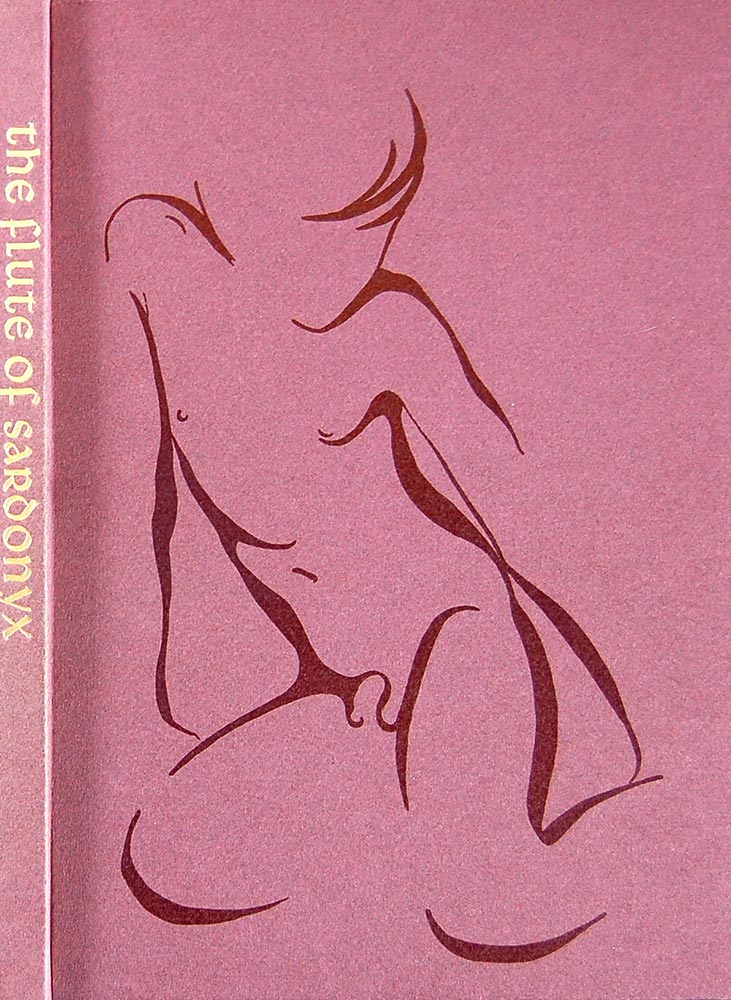
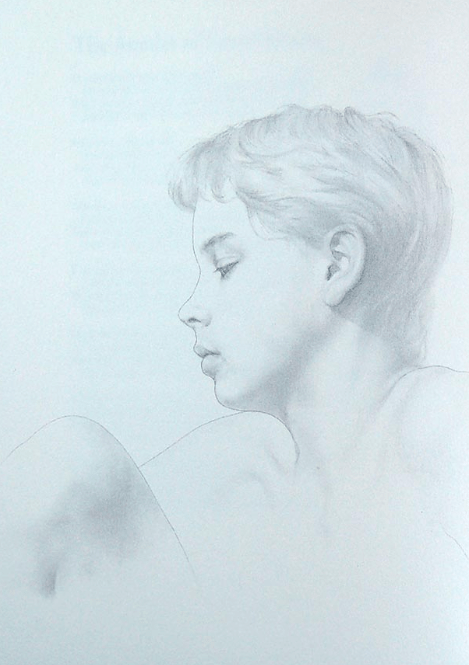
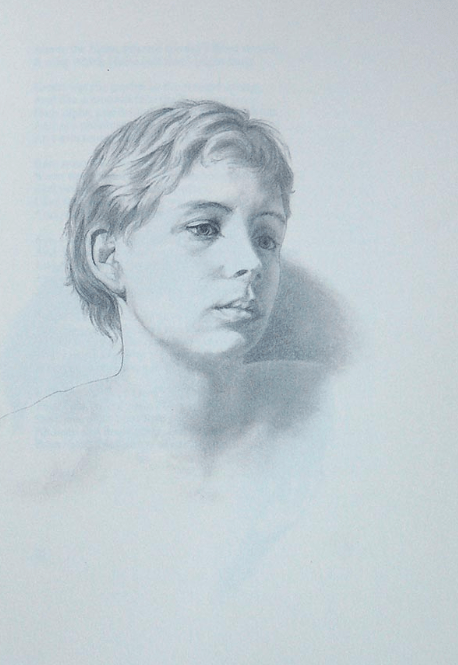
The Flute of Sardonyx (1913). Reprinted in 1991 (The Old Stile Press) with pencil drawing by Nicholas Wilde
His first book of poetry, The Flute of Sardonyx, gained immediate notoriety upon publication. Critics were, for the most part, receptive—perhaps because many failed to grasp its implications. One who did not was James Douglas, a prominent literary critic, who launched a fierce attack on both Edmund John and Stephen Williams, author of the book’s introduction.
“Williams in the introduction of The Flute of Sardonyx seeks to justify or excuse these poems by citing Milton’s definition of poetry, and he implies that Milton meant by the word ‘sensuous’ not merely the normal, healthy, and wholesome senses of the normal, healthy, and wholesome human being, but also the debased, depraved and degraded sensations of a perverted and abnormal erotomania. I have not the slightest doubt that in a court of law an English jury and an English judge would not hesitate to condemn Mr John as being guilty of a gross offence against elementary propriety. I demand without delay the volume should be withdrawn in deference to what I believe to the inevitable and inexorable verdict of public opinion.”
One poem in particular, Salome, provoked Douglas’s outrage.
“These stanzas, I venture to affirm, are of a vileness hitherto unparalleled in English poetry. Nothing approximating to or of approaching depravity has, as far as I am aware, ever been tolerated in English literature.”
Others were scarcely more forgiving. A. E. Manning Foster, writing in The Bookmarker, observed:
“Salome is an Aubrey Beardsley picture in words, and yet it is not entirely pleasing. Mr John brings into his poem what Oscar Wilde in his play on Salome and Flaubert in his short story never did—an unhealthy, perverted strain.”
Herbert Jenkins, John’s publisher, abruptly withdrew The Flute of the Sardonyx, later reissuing it in a revised edition that was, as one commentator noted, “meeker than the Shakespeare we use at school.”
One of the few surviving biographical sketches of Edmund John appears in George Norman Douglas’s memoir Looking Back: An Autobiographical Excursion (1933).
“We met through his sending verses to The English Review after the publication of The Flute of Sardonyx, and it often struck me how greatly his person resembled his writings—sensuous and ornate, elaborate in manner, a little over-dressed, too many rings and tiepins, too much thought expended upon the colour of socks. He would have grown out of these incongruities had he lived. Meanwhile he was young and handsome.
“He could drink like a fish and remain perfectly sober. In those days I bought my whisky in kegs, and it was alarming to see how he could put it away. Good company! At such moments he cast off that veil of precocity, though a certain refinement always clung to him; it was part of his nature.”
John’s second volume, The Wind in the Temple, published in 1915, was widely praised.
“The superb loveliness of these stanzas are beyond praise,” wrote the Westminster Gazette. “Seldom has the enhancing beauty of Greek thought so captivated the soul of a poet; seldom has this enchantment been rendered so felicitously in modern verse.” The Evening Standard noted: “Although owing much to Arthur Symons, these poems have a magic all their own, for Mr John knows the value of the leash, the most difficult of all lessons to be learnt.”
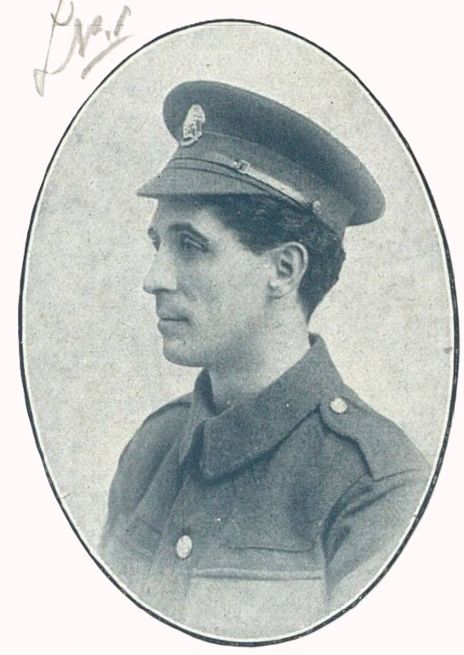
Edmund John in military uniform
Around this time, John enlisted in the 28th (London) Battalion, the Artist’s Rifles, to fight in the First World War. Founded in 1859 amid fears of a French invasion, the regiment attracted volunteers from public schools, universities, and the creative professions—painters, musicians, actors, architects.
John’s death in 1917 might easily be assumed to have been a casualty of war. Douglas, however, suggests otherwise.
“In his correspondence he told me that he had been invalided out of the army (in 1916) on account of his heart. He had also married for money, as he frankly confessed. His tastes were luxurious; coaching, and an occasional volume of verse would never make him feel at ease. It looked as if all were going well, yet I did not like the nervous tones of his letters….”
Seeking to recover his health, John travelled to Italy and settled in Taormina.
“It is a site of great distances—its soft colouring—its streets hushed at noonday as by some weird enchantment—its leaning walls in flower—its secluded gardens—its terraces—its lemon and almond groves; its crystal air, crystal and flare at noon, opal and pearl at either edge of the day; its castled crests and crumbling ruins.”
An obituary followed:
“On the 28th February (1917), at Taormina, Sicily, Edmund John, of heart failure, beloved husband of Kate Dalliba John, of Florence, and dearly loved eldest son of Thomas and Margaret John of 20 Cranley Gardens, London, aged thirty-three.”
Douglas corrected the record bluntly:
“I replied to John’s letter on the 19th of February 1917. On the 28th of the same month he killed himself. A miserable ending of which he seemed to have had a presentiment.”
From this point onward, certainty dissolves. The dead do not speak, and what remains is conjecture.
Certainly, John suffered from a debilitating heart condition and bouts of depression. But other forces may have contributed.
“Ah God, it was the Hope gave to me, Within the womb, of things unknown and fair, The Bud that blossomed into this Despair. Art Thou content, O God, with thus Thy work? Art Thou content that Thou hast planned so well? That Thy cold hands have thrust me into Hell?”
The Flute of Sardonyx. Pencil drawing by Nicholas Wilde (1991)
John’s poetry is suffused with Uranian themes—a term coined in the nineteenth century by Karl Heinrich Ulrichs, before the invention of the word homosexual.
“His eyes are brothers to the sun and sky, His body’s fragrance haunts the murmuring wood, And all the flowers are singing where he stood, And all the leaves are chanting their reply.”
In The Wind in the Temple, love is repeatedly figured as adolescent beauty.
“His body is like milk edged with rose-colour rare, With vine and lure of hemlock in his red-gold hair, Night-kissed, that burns and gleams; His grave sweet scarlet lips are parted voicelessly, His eyes like stars reflected in a violet sea Of dawn and dreams.”
And elsewhere:
“Harder, press harder with your scarlet mouth; Lie close, limbs woven of the passionate South; Twine nearer, subtle satin limbs of June, Burn your gold scented body into mine, Cling to my lips with yours of Graecian wine, Cling closer till the blood come and life swoon…”
Yes, Edmund John was a Uranian poet, and he harboured pederastic desires. Men and Boys (1924) reproduced part of a letter he wrote to a “young friend”:
“I have received your adorable, illustrated letter this morning and loved it so much I immediately made an altar before it, lit by amber candles in copper candlesticks, burnt incense before it and kissed its extreme beautifulness.”
Did his homosexuality weigh heavily upon him?
That John died in Taormina is suggestive. Long regarded as a “Queer Eden” for artists and intellectuals, the town was famed for its beauty, Greek mystique, and relative tolerance—an atmosphere reinforced by Wilhelm von Gloeden’s homoerotic photographs of local youths. Oscar Wilde and André Gide had passed through; later visitors would include Truman Capote, Tennessee Williams, Gore Vidal, Jean Cocteau, Thomas Mann, Somerset Maugham, and Roger Peyrefitte.
There is also the unresolved mystery of John’s marriage to Kate Dalliba, reportedly solemnised in Florence.
“Kate Dalliba, of St. John’s Wood. Famous for her Sunday night salon, referred to as The House of Music. Wealthy musicians in evening dress rub shoulders with poor and budding young geniuses in wrinkled light clothes and soiled linen. All here is democracy, art, Bohemianism.”
Born into a wealthy family in Cleveland, Ohio, Dalliba used her fortune to support artists such as Ezra Pound, Ida Rubinstein, Olga Rudge, and Ildebrando Pizzetti. She lived in Florence and maintained her London house as a free lodging and performance space for travelling musicians and artists.
It is entirely possible that John, described by George Norman Douglas as being poor, was drawn to her wealth. He had openly admitted that he married her for money. The rich older woman and the handsome young poet might have passed, outwardly, as a conventional May–December match.
Whether Dalliba later recognised the truth of the arrangement—and whether this recognition had consequences for John—remains unknown. She herself lost most of her fortune in the Wall Street Crash of 1929.
What remains is a handful of poems, a scandal, a life cut short, and the faint outline of a gifted, troubled poet whose voice—sensuous, excessive, and dangerous—proved too much for his time.
The Flute of Sardonyx. Pencil drawing by Nicholas Wilde (1991)
Boys will be boys. Different sorts. Different morals. Not fussed really.
I can do nice boys I can do bad boys I can do polite boys I can do charming boys I can do clever boys I can do rough boys I can do tough boys I can do council boys I can do rich boys I can do student boys I can do clean boys I can do dirty boys I can do skinny boys I can do clean-cut boys I can do athletic boys I can do energetic boys I can do adventurous boys I can do sensitive boys I can do confident boys I can do caring boys I can do unconventional boys But I can’t do golden boys
“Bambino carissimo: – Will you come and stay with me in Florence? A revederci carino.”
Players I send thee cigarettes for thy delight. Smoke my belov’d and think awhile of one Who thinks and dreams of thee from sun to sun Longing to have thee, lov’d one, in his sight; To hold to his thy lissom body tight; To press thy lips and, pressing, to surprise Thy soul and his together in thine eyes … If this be wrong, no love on earth is right!
Once, a handsome Sicilian boy, the son of Eros and a nymph, fell deeply in love with the sun, and couldn’t bear to stay another minute where he couldn’t see it. He worshipped it wherever he went, and when it wandered out of sight, especially at night, he couldn’t rest, because that object he loved wasn’t warm upon his tanned breast. For this reason, he never walked, stood, or lay in the shade, the love, in full sway, was boundless, and made his life its prey.
At one time, the sun remained under a cloud for eight days; during this period, the boy, Cylmenon, was very unhappy, and because he could not find his beloved, pined away and died. It was a tragic end for a fine young boy. When the sun shone again it found Cylmenon’s body near a fountain where he had tried to see the sun’s reflection, and so grieved was the sun, that it changed the lad’s body into a golden flower, of the first Marigold.
Study of a Sicilian boy with Passionflowers in his hair, Sicily, c.1899 – Baron Wilhelm von Gloeden
An explanation: Marigolds are known as “herbs of the sun” and represent the sun’s power, warmth, energy, and light. They are often associated with joy, optimism, passion, and creativity. This story is based on an obscure and forgotten poem from 1868 by Peter Spenser. Little is known about him other than that he was the eldest son of the Rev. Peter Spenser, Rector of Temple Ewell, near Dover. He wrote poetry for local newspapers across England and also published the magnificently titled ‘Parvula, or, a Few Little Rhymes: About a Few Little Flowers, a Few Little Birds, and a Few Little Girls, to Which Are Added, a Few Little Songs, and a Few Other Little Things.’(1863)
Youth in tree with arm raised – Wilhelm von Gloeden (1856-1931)
Love, I adore the contours of thy shape, Thine exquisite breasts and arms adorable; The wonders of thine heavenly throat compel Such fire of love as even my dreams escape: I love thee as the sea-foam loves the cape, Or as the shore the sea’s enchanting spell: In sweets the blossoms of thy mouth excel The tenderest bloom of peach or purple grape.
I love thee, sweet! Kiss me again, again! Thy kisses soothe me, as tired earth the rain; Between thine arms I find mine only bliss; Ah let me in thy bosom still enjoy Oblivion of the past, divinest boy, And the dull ennui of a woman’s kiss!
From ‘Caprices: Poems by Theodore Wratislaw’ (London: Gay and Bird, 1893)
No mystery about what’s going on here.
When someone at the Pall Mall Gazette got an early look at Caprices, they immediately picked up on the vibe — To a Sicilian Boy and L’Eternal Feminin were clearly written with a Uranian (homoerotic) theme. The staffer freaked out and threatened bad reviews unless those poems were cut. The publisher caved and swapped them for two safer options, Paradox and At Midnight.
But nobody seemed to notice the poems quietly dedicated to Oscar Wilde and Lord Alfred Douglas. That particular scandal was still waiting in the wings.
To a Sicilian Boy eventually found its way into Charles Kains Jackson’s The Artist and the Journal of Home Culture, a more open-minded publication of the time.
Theodore William Graf Wratislaw (1871–1933) — yes, he claimed to be a Count thanks to his grandfather, who basically declared himself one — was born in Rugby. These days, almost no one remembers him, but he wrote about 160 poems, most during the so-called “naughty nineties.” His work popped up in Love’s Memorial, Some Verses, The Yellow Book, and The Strand Magazine. He’s even rumoured to have inspired Max Beerbohm’s character Enoch Soames.
At some point, Wratislaw swapped the pen for a government desk job — which he famously called “penal servitude.” He married three times, but people still speculated about his sexuality, and To a Sicilian Boy didn’t exactly hide the clues. The timing’s telling: Wilde’s trial happened in 1895, and that same August, Wratislaw quietly joined the Civil Service. Draw your own conclusions.
How did it happen? I went for milk. He served me milk. Anything planned tonight mate? I shook my head. That’s a shame mate. What are you doing? Nothing at all mate. I take a chance. Come to mine then. What are you saying? Let’s watch a movie. Not sure about that. Please come, I say. It sounds weird mate. I tell him where. He comes around later. We chatted about things. We watched a movie. Gotta go now mate. I don’t want that. Please stay the night. That looks bad mate. It’s a good offer. He agrees to stay. We have good sex. Next morning he’s dirty. He takes a shower. Gotta go to work. I will miss you. Miss you too mate. Thanks for the milk.
Innocence came calling. What are you writing? I was writing about you, but didn’t say that, and it would have made no difference because it was never part of the plan.
Have you been sent by someone? Have you come with a message? Have you come to taunt me? Have you come to kill me?
In the dark, I think only of sweat, tattoos, and dirty underwear. How erotic is that? The excitement before you destroy me.
Have you come with love? Have you come with hate? Have you come with both? Have you come with nothing?
There is desire in the shadows. Hands everywhere, controlling, and satisfyingly rough. But there are unanswered questions. Do these hands belong to someone who wants me dead?
Have you got a disease? Have you got a condom? Have you got a knife? Have you got other ways of killing me?
They will get you in the least expected way. Beware of Gabriele of Stadium, they said. He will exploit your weakness. He is the Angel of Death and brings only a glass full of piss and blood.
Lust shattered my guard. Lust drowned my senses Lust clouded my judgement. Lust is the death of me.
The romantic Gypsy of Roma, who dances with a gun, and destroys hearts with the blade of Ardizzone, looks into my eyes. Is this the most addictive boy ever? Is this the saddest and perfect end? And after he slits my throat he will say to Alberto of Ostia that it was too easy.








 Perfectly Hard and Glamorous