
Part 1 – The Art of Resentment
There was a time in the 1990s when David compiled a mental list of young men he would have liked to have slept with. He had seen them dancing in Heaven and The Soundshaft. Handsome young men who were not afraid to show off their naked bodies. They were much the same, really: young, skinny and with an element of danger.
There were only five worth mentioning, but the challenge had been to shag each of them and be damned with the consequences. David had managed just one. Jonathan, a thirty-five-year-old banker, had taken him back to Chiswick and feasted him on vodka and LSD. David had been so out of it that he couldn’t remember whether the sex had been any good. Or whether it had even happened.
He still remembered the faces of the other four. He had never got the chance to sleep with them, but they had lived on in his memory, preserved exactly as they had been thirty years ago. He daren’t imagine what they might look like now. Time and age could be most unflattering.
He wasn’t sure why he had thought about them today of all days. There was no sensible connection, but the memory had stirred something in him. His own behaviour still bothered him.
The morning after that one-night stand, all those years ago, David had caught the Tube feeling flat and emotionally drained. There had also been an overwhelming sense of disappointment. An opportunity missed, perhaps.
Thirty years later, David was feeling much the same.
There was that familiar heaviness, that disorientating feeling that made little sense. He couldn’t understand why he was disappointed. Hurt, even. But he had caught the Tube and was now wandering through Kennington Park, feeling rather sorry for himself.
The blame should have been his, of course, but it was always easier to blame someone else.
That someone could only be Louie, a man he had hated for twenty years. Except that the hatred was really a rather misguided admission of love and desire. He hated Louie because Louie had never once expressed the slightest interest in him.
Louie had been eighteen when David first met him. He worked as an assistant at Radnedge Varello, the publishing house where David secured his book deal. David had fallen for him immediately and, inevitably, paid him rather a lot of attention.
Everything about Louie consumed him.
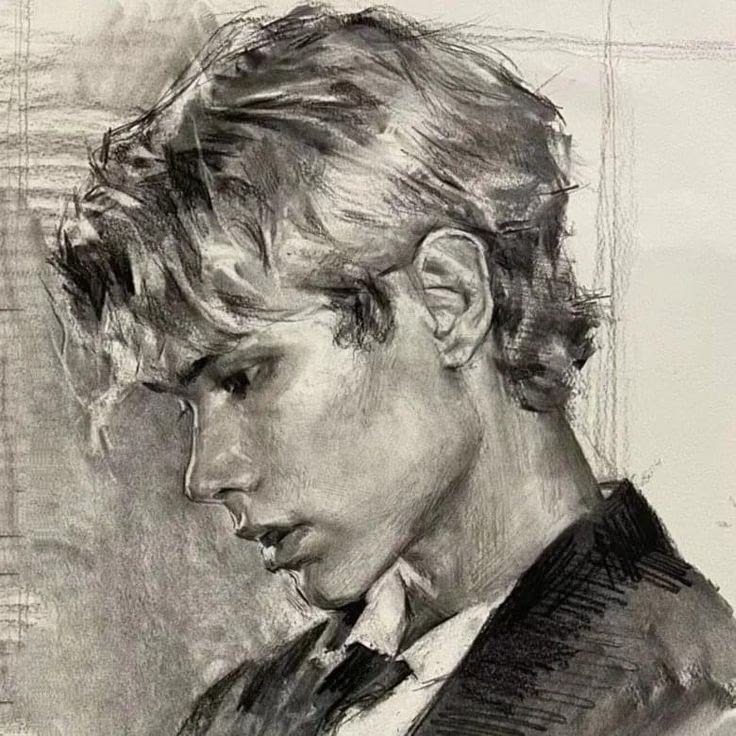
The soft tumble of dark hazel-brown hair that fell across his brow in artful disarray. The intensity of his grey-green eyes, which seemed to hold a quiet, almost intimate invitation. Every line of his face suggested a delicate symmetry, from the high, cleanly sculpted cheekbones to the faintly teasing mole beside his full, soft lips. There was a youthful strength about him, beautifully offset by an expression that was gentle and relaxed.
But whenever David spoke to him, Louie could never quite manage to look him in the eye. His answers were contrite and mumbled. David took this as evidence that he had some sort of hold over him and decided to exploit the situation.
He invited Louie to dinner and arranged to meet him at a restaurant in Covent Garden. Louie never showed. Afterwards, Louie explained that he had fallen asleep, although he never actually apologised for his absence.
That should have been warning enough, but David refused to see it.
He bought Louie a £1,000 gold chain for Christmas and was somewhat disconcerted when the boy failed to thank him. He never saw him wearing it either. Perhaps it had been tossed into a drawer and forgotten.
David discovered that Louie came from a middle-class Hampshire family who had spoiled him. That he had struggled with his sexuality as a young boy and had been frequently bullied at school. That he had grown up with a preference for working-class boys, although he seemed incapable of maintaining a relationship with any of them for more than five minutes.
David learned all this from John, his editor and Louie’s boss. But when he tried to find out more directly, Louie refused to divulge anything else. He kept his important cards close to his chest.
David, meanwhile, had decided to play the long game.
He never gave up his pursuit of the boy, even when Joshua came into his life two years later. The new relationship had not been intended to last, and even when it did, it never deterred David from the chase.
But he had underestimated Louie, whose star was shining rather brightly at the publishers.
One evening, John made a rather frivolous remark during a moment of unconventional drunkenness.
“I worship the ground that Louie walks on.”
That was when David began to suspect that something might be going on between the editor and his assistant. He never forgot the burning resentment that followed. Suspicion fuelled his dislike of John and gave his animosity towards Louie an altogether more personal dimension.
It almost brought about a split between the author and his publisher. Of course, David couldn’t publicly reveal the real reason for his discontent. In the end, it never happened because he couldn’t bear the thought of never seeing Louie again.
It took him a while to accept that jealousy could be destructive when it became an overwhelming and chronic force. It was not the last time he would decide to keep contact to a minimum. This was an ineffectual attempt to see whether Louie might eventually come crawling back. The truth was that he never did.
While David might have underestimated Louie, the same could also be said of John.
In his own misguided pursuit, John had failed to recognise that Louie had an agenda of his own. He was quite prepared to betray and bypass his superior if it meant securing a more senior position. The words used to describe Louie’s behaviour were ruthless, mercenary and predatory, but those in high places seemed remarkably blinkered.
Then David received a call to say that John had been fired and that Louie would be taking his place. At last, there would be a close working relationship between them, and with it came the prospect of renewed attentions.
It never quite worked out that way.
David became a successful writer, thanks in no small part to his publisher, but certainly not to Louie. The new editor continued to keep him at arm’s length, delegating most of his work to a young woman who, to be fair, did an excellent job.
For the past ten years, David had treated Louie with disdain, questioned his abilities and repeatedly threatened to move to another publishing house.
But all along, he had been fighting a phoney war.
There was no love lost on Louie’s part. He had once told David to move if he so wished, but David was always running scared. He knew perfectly well that he would never leave.
Instead, he watched as Louie secured a handsome salary, acquired a brand-new Land Rover Defender and bought a multi-million-pound apartment near Canary Wharf.
Writers belong to a fairly close-knit community, and David often spoke to his stablemates at Radnedge Varello. Inevitably, snippets of gossip about Louie found their way into conversation, providing ample fuel for old grudges and renewed acrimony.
Louie was now involved with a younger man called Oliver, another writer who would no doubt become the next literary sensation. Louie liked to play around, they whispered, and there was never any shortage of willing young men.
But Louie was now in his late thirties and apparently looking to settle down with someone nearer his own age. David was advised to be careful. Louie had already expressed an interest in Joshua and might well make a move if the opportunity presented itself.
Ruthless. Mercenary. Predatory.
The news landed like a punch. David was determined to keep the two of them well apart.
And then came the London Book Fair at Olympia.

