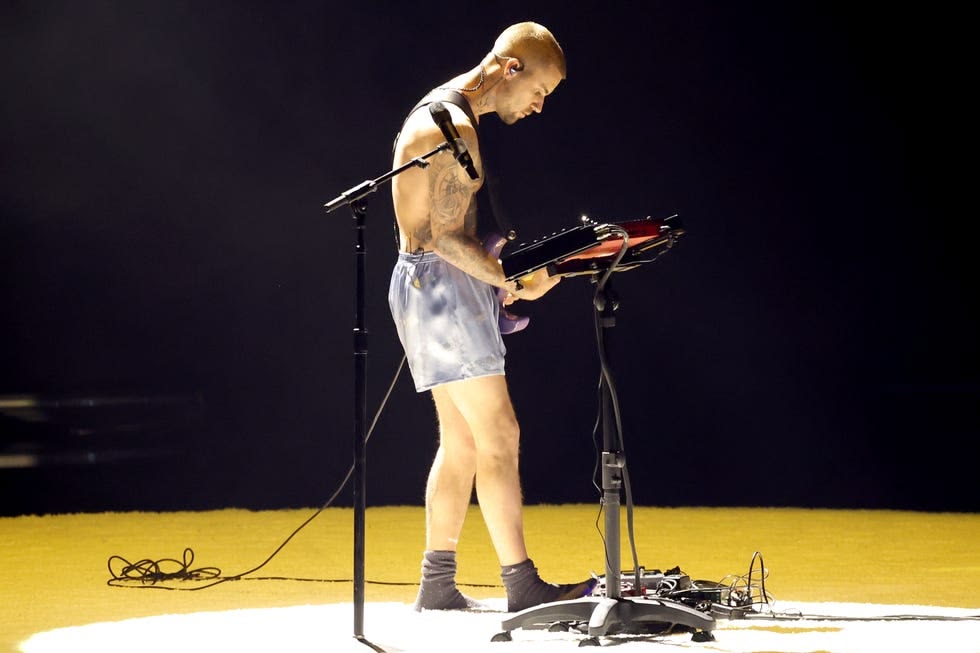
The body grows older; the mind, one hopes, grows softer. Justin Bieber steps onto the Grammys stage wearing little more than boxer shorts and black socks, and suddenly we declare him grown. A raw act, we’re told—an offering of honesty, of soul laid bare. Others call it baffling, even disturbing, unsettled by a performance that flirts so closely with undress. But who are we to protest?
Once, the disdain came loudest from older men who sneered at his pre-pubescent voice, his softness, his prettiness—at the very things that made him desirable. He was easy on the eye, a doll to be admired and dismantled in the same breath. It was fashionable to hate him.
Then came the litany of recklessness: urinating in a restaurant mop bucket, the abandoned monkey in Germany, the tabloid parade of bratty excess. Legal troubles piled up, stories of disrespect followed close behind, and obscene wealth insulated him from consequence, from the slow education of ordinary life. Entitlement clung to him like cologne.
And yet here we are. A sharp crew cut, a half-naked body under the glare of millions, and absolution arrives. Forgiveness, it seems, does not always come through music. Sometimes it comes through the body.
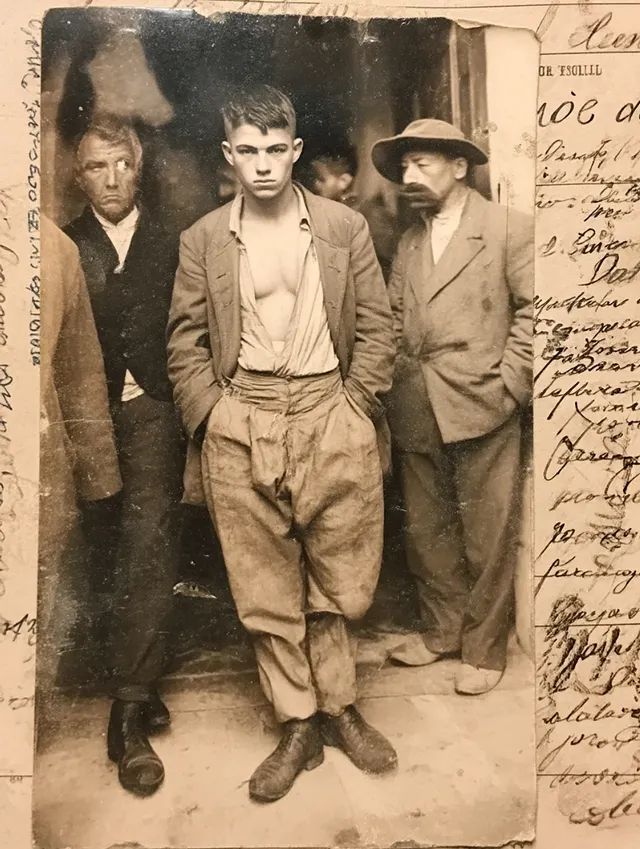
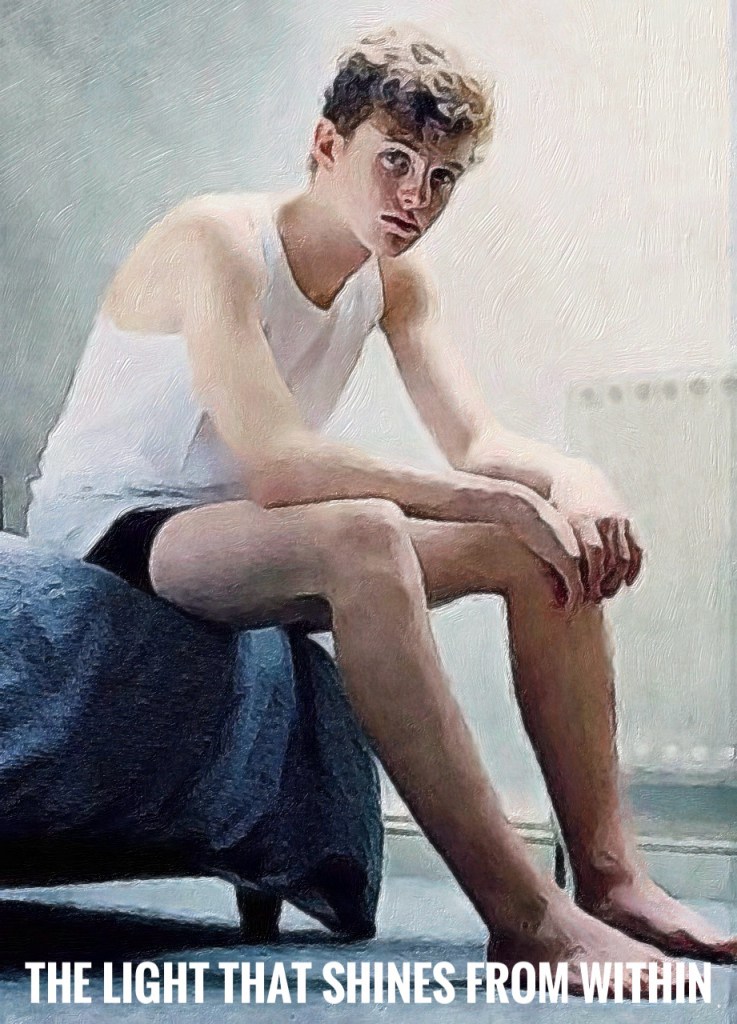
“When I see this image, the first thing that comes to mind is my theory that in our youth we are all beautiful! Is it because in our twenties very few things scare us, or because life has barely run us over yet? It is not my intention to make you think that this is the best period of our lives, I absolutely don’t think that! But there is something there, perhaps the little life one still has behind them, that gives this stage a bright patina. Later, that shine doesn’t disappear, it just changes its nature. It becomes deeper, more complex, sometimes harder to see at first glance, but no less real.” – Nuria Velasco
New Romantic. Colin Cox. Photographed by David Suárez (December 2025)
The thrill of the forbidden, the surge of emotion and thought. That quiet, hollow space inviting reflection on the fleeting nature of our own lives and whatever traces we leave behind. A wavering line between appreciating beauty and surrendering to objectifying desire—an involuntary pull shaped by masculine sensitivity, itself carved by the bittersweet passage of time and the ephemerality of experience. The soft focus, the restrained emotion: a vivid instant once sharp and certain now blurring into a subtle, almost spectral echo of what once felt wholly present. The intensity drains away, leaving only a neutral, distant recollection, until all that survives are scattered fragments of sensation.
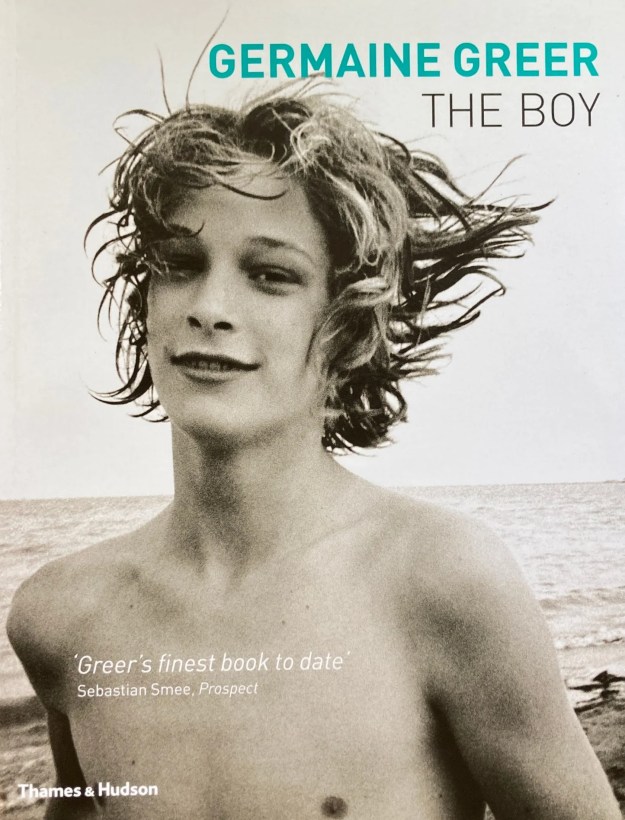
Germaine Greer – The Boy. Published by Thames & Hudson (2007)
Baron Corvo once told me in a dream that I should write something controversial. Terrible advice, obviously. But here we are.
I found a book in a charity shop that Charlie told me not to buy. He said it was distasteful. Which, of course, made me want it more.
The book was Germaine Greer’s The Boy — a 2003 art history study about how young males have been represented in Western art. Greer argued that, for centuries, it was the male body — not the female — that dominated the gaze. Art, she said, used to worship men. Then we decided that kind of looking was shameful.
When it came out, The Boy caused an uproar. Greer said she wanted to help women reclaim their “capacity for visual pleasure,” to look at men the way art has long looked at women. Then she dropped her most infamous line: “A woman of taste is a pederast — boys rather than men.” Predictably, everyone lost their minds.
The book is filled with over 200 images — statues, paintings, portraits — each exploring what Greer called the “evanescent loveliness of boys.” The soldier. The martyr. The angel. The narcissist. The seducer. It’s the sort of book that doesn’t end up on display in Oxfam, which is precisely why I found it there.
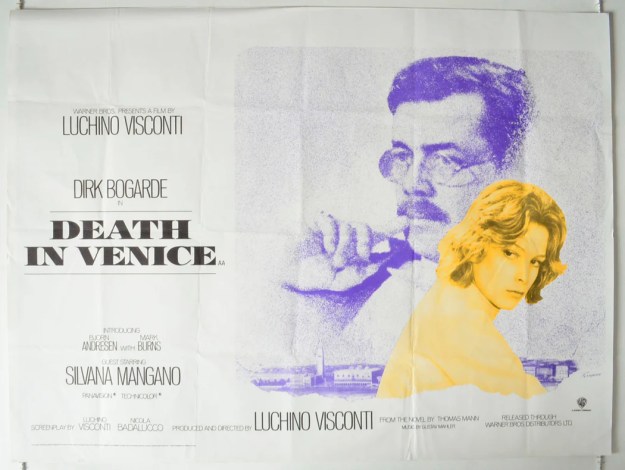
The cover shows Björn Andrésen, the Swedish actor who played Tadzio in Death in Venice (1971). The photograph was by David Bailey, but Andrésen said no one asked permission to use it. He was furious — disgusted, even. “I have a feeling of being utilised that is close to distasteful,” he said. And the irony? The week I bought the book, he died, aged seventy.
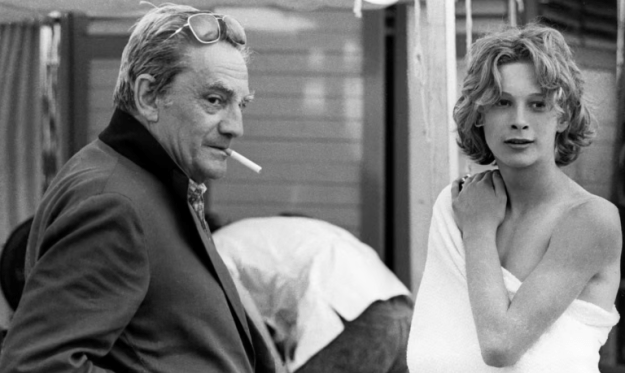
Björn Andrésen with Luchino Visconti on the set of Death in Venice. Photograph: Mario Tursi
Every obituary revisited the same scene: the audition tape from Death in Venice that was included in The Most Beautiful Boy in the World — a documentary about his life. Visconti tells him to smile. Then to undress. He laughs nervously. Strips to his trunks. Shifts under the gaze of men deciding whether he’s beautiful enough.
It’s hard to watch now. Visconti — Count of Lonate Pozzolo, titan of Italian cinema, and apparently, chaos in a cravat — ends up looking less like a mentor and more like a predator. But dead men can’t explain themselves.
When I was fifteen, I’d probably have thought that kind of attention was glamorous. Maybe I’d have handled it. Maybe it would’ve destroyed me. Hard to know. My own encounters with predatory men later on made Visconti look almost saintly by comparison. At least he left art behind. Maybe Andrésen’s story isn’t just one of exploitation, but what happens when fame and beauty collide with someone who’s too young to bear it.
Charlie, meanwhile, can’t stand The Boy. But he loves Death in Venice. He called Tadzio a “beau.” When I asked what that meant, he said: “The boy is beautiful. It’s sensuous, not pederastic. I’m surprised no one’s remade it.”
Which — yes — feels like a double standard. Both the book and the film are about the same thing: beauty. The kind we no longer know how to look at without flinching.
Could Death in Venice ever be remade?
I doubt it. The original is a masterpiece, and also completely unmakeable now. Mann’s 1912 novella was already controversial — a composer obsessed with a boy — and Visconti turned that tension into pure cinema. But in 2025, the moral landscape is different. Post-Me Too, post-Epstein, even looking can feel like a crime. No studio would touch it.
Unless you flipped it.
Make Tadzio older. Make the story less about sex and more about time — the hunger for youth, stillness, lost purity. Desire becomes existential, not erotic. If Visconti made the tragedy of seeing, a modern director — Luca Guadagnino, Todd Haynes, François Ozon, Joanna Hogg, Andrew Haigh — could make the tragedy of knowing you’re looking.
Visconti’s gaze was romantic. Ours would have to be self-conscious.
In their own way, both The Boy and Death in Venice celebrate the same thing — male beauty, youth, the brief perfection of being looked at before it fades. Once upon a time, that was sacred. Now it’s scandalous. Somewhere along the line, admiration turned into suspicion.
So yes, Baron Corvo told me to write something controversial. Bad idea from a worse man. But maybe he was right about one thing: sometimes, it’s worth writing about what we’re not supposed to look at.
Dirk Bogarde in Death in Venice (Morte a Venezia). Photograph: Ronald Grant Archive
Death In Venice (a.k.a. Morte a Venezia). Original British quad movie poster
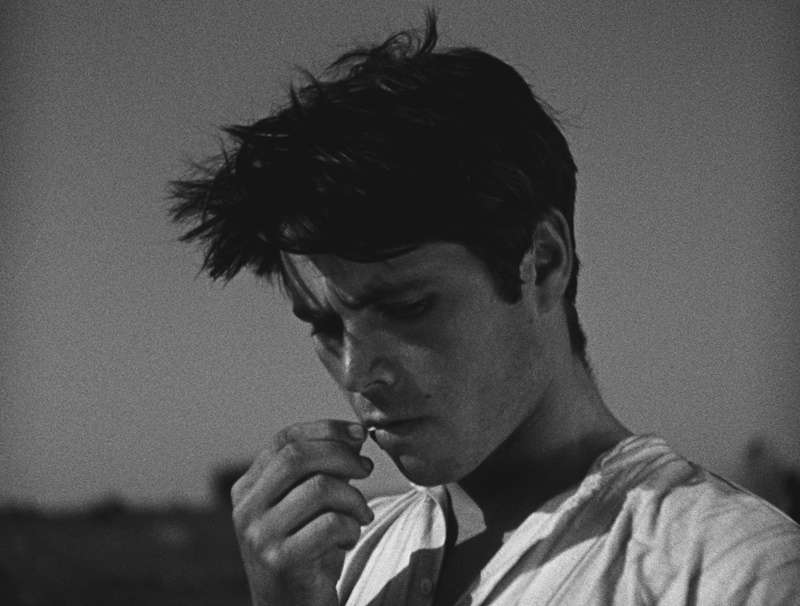
Handsome French boy. The light falls on him like a thought half-formed, catching the edges of his face before retreating into shadow. A quiet defiance in the way he chews on a matchstick. The air feels slow around him, salt and sand mingling with the scent of his skin. His shirt, open at the collar, softens the hardness of his jaw, and the wind seems to pause there – unsure whether to touch him or not. In that hesitation, the moment turns fragile, suspended – beauty caught between innocence and knowing. The image might have been taken yesterday, but this Brittany fisherman is from Finis Terrae, a 1929 French silent film written and directed by Jean Epstein.
Adonis was said to be the son of Theias, king of Syria, and his daughter Myrrha. There was nothing, it seemed, like a touch of incest to produce a child of exquisite beauty. When her father discovered her pregnancy, Myrrha fled and was transformed into a myrrh tree. Yet even in that form, she gave birth to a boy so lovely that Aphrodite herself took pity on him.
The goddess carried the infant to the underworld, entrusting him to Persephone’s care. But when Adonis grew into a youth of rare grace, both women fell hopelessly in love with him. It was inevitable, perhaps, that beauty would bring both adoration and ruin.
One day, while hunting, Adonis was fatally gored by a wild boar—sent, some say, by Artemis to punish his vanity. His blood mingled with Aphrodite’s tears and gave birth to the first anemone. Thus, his beauty became eternal, immortalised in a flower.
And so the story of Adonis was handed down through the ages, until it reached a boy called Banjo.
There is something wonderfully absurd about a boy named Banjo. The name had been chosen simply because his grandfather played the instrument—nothing more mystical than that. Had Banjo been plain, the name might have invited merciless teasing. But as fate would have it, he was beautiful—achingly so—and thus the name became a kind of charm.
He was the sort of young man who made strangers feel vaguely inadequate. They would take in his fine-boned features, his golden skin, his effortless grace, and feel the familiar pang of envy or desire. His beauty unsettled people, as though they were confronted by something not entirely human.
Banjo, however, found his looks exhausting. So he delighted in the single imperfection that spoiled the illusion: a missing front tooth. When people stared too long, he would flash a grin—a broad, dazzling smile—and there it was: the flaw that disrupted the marble perfection.
No one knew how he’d lost it. The rumours ranged from drugs to fights to some impoverished past before fame. The truth, however, was known only to Banjo, and he guarded it carefully. The missing tooth became his private rebellion against the myth others had built around him.
He liked the way it disarmed people, how it made him seem approachable, almost ordinary. It was a reminder that even gods have their fractures. Beauty, he thought, was not found in perfection, but in the quirks and vulnerabilities that betrayed our humanity.
If the ancient sculptors had carved him, they had stopped just short of finishing the smile—leaving him, deliberately, incomplete.
Banjo never replaced the tooth. He kept it as a secret charm, a flaw that told the truth: that myths do not survive in the real world, and perfection is the loneliest lie of all.
A time of potential, energy, and opportunity, and joy and personal maturation. It’s about vitality and growth. A reward and a source of joy. It is strength and vigour, seen as a time of great potential and opportunity.
A time for learning, maturing, and developing one’s sense of self before the responsibilities of adulthood.
Make the most of it.
It is a foundational period for developing wisdom and forming good habits. Appreciate and make positive choices during this fleeting time because personal fulfillment can still be achieved.
The café hums softly — a low murmur of spoons, voices, milk steaming behind the counter. I go there more often than I should, pretending it’s for the coffee, though I know that’s not true. He’s always there — Joseph — the boy with the rolled sleeves, the nice ass, the quiet smile. He moves with a kind of unthinking grace that makes the simplest gestures unbearable to watch. The tilt of his head, the tiny crease that appears between his brows when he concentrates. He hums under his breath when the machine hisses, wipes the same patch of counter top as if he’s polishing a secret into it. The light hits his hair just so, and I find myself timing my arrival to catch that moment when he leans over the counter and looks up.
Sometimes he catches my eye, and it feels like an accident — a spark that wasn’t meant to happen. He doesn’t know what he does to me: the curve of his wrist, the steam curling around his face, the way his voice seems to linger in the air a heartbeat too long. When his hand brushes mine as he gives me change, there’s the faint scent of roasted beans and skin, a small, electric pause before he turns away.
I tell myself I could stop if I wanted to. That it’s just a crush, just admiration. But I don’t want to. I want the ache. It isn’t love — not really — it’s too fleeting, too impossible. He doesn’t see me, not the way I see him. Yet there’s a strange tenderness in wanting without having, in sitting there each morning, pretending to read, tracing the rim of my cup as the warmth fades — while the boy behind the counter unknowingly becomes the centre of my day.
I collect fragments of him and carry them home like offerings. Sometimes I imagine saying his name aloud, but I never do. It feels too intimate, too final — as if it might break the spell.
The room where I try to write has slowly become the room where Charlie paints – always in nothing but his underwear, as though bare skin loosens his imagination. He fills his canvases with young men borrowed from Pinterest photographs, embellishing them with his own wild inventions. His pace is relentless; one wall is already crowded with finished works, while the others gleam with fresh white paint, waiting their turn.
I, by contrast, sit fully clothed at my desk opposite him, my screen a blank page that refuses to yield. His half-naked body distracts me more than the silence we share – a silence that can stretch for hours. My sentences falter, my fingers hover above the keys, while my gaze strays repeatedly to the slope of his shoulder, the subtle shifting of muscle beneath skin. When our eyes do meet, the faintest smile flickers between us, and in that moment, it feels as though the room itself has been written.
Our different pursuits seem to mirror our temperaments: Charlie paints with fearless exposure, while I write with restraint, dressed in caution. Yet the tension coils tighter. My prose begins to echo the shapes of his body, the rhythm of his movements, until the line between art and desire starts to blur.
At times I tell myself I am only imagining it – that Charlie is merely eccentric, his near-nudity no more than a quirk. But each page proves otherwise. It is littered with involuntary admissions: the shadows along his collarbone, the hush of his breath when he leans too close, the bare expanse of thigh against the studio chair. These confessions rise from me slowly, as though I am being coaxed – cornered – into acknowledging what I cannot claim.
Tonight, the silence shatters. My phone vibrates, abrupt as a stone cast into still water. Charlie turns at once, alert, the brush slipping from his hand. “I need a rest from painting,” he announces lightly. “Let me see what you’ve written.” He springs up, knowing I will resist, his request merely a pretext to draw near, to glimpse what has intruded into our silence.
It is from Bianchi in Verona. A thrill runs through me, but I dare not open it – Charlie would notice too much. “Who is Bianchi?” he asks, now beside me, his voice soft but insistent.
“A friend of Cola,” I murmur, unwilling to elaborate. The words hang in the air, evasive, unsatisfying, already unravelling.
“It was pretty, and the simpering, self-conscious style which shop girls adore and mammas dote upon. He had regular features, a placid and supercilious smile, drooping eyes which he would occasionally cast toward the crowd outside the window, and a daintiness of gesture which would have made him a success on the stage in the delineation of a certain type of metropolitan character. His hair was sleek, well oiled and beautifully banged, his colour pink and white and his narrow-chested body was encased in a beautiful blazer of pink and white silk, drawn together by a heavy and interlaced crimson cord down the front. On his head he wore a silk jockey cap, also of pink and white stripes, and his hands were rendered prominent by what might be called outside cuffs of snowy linen, which came up to the elbow and completely covered the blazer sleeves. The languid manner with which he tossed the taffy over the big silver hook was in thorough consonance with the languorous glance which he occasionally directed toward the women outside the window.”
Blakely Hall writes about a handsome young man working in a New York candy store. The Philadelphia Times – 23 December 1888
Blakely Hall was a New York-based journalist who became editor of Truth Magazine in 1891 and spiced up the publication by adding more pictures of women to its pages, more social satire, and colour. Circulation grew to 50,000 subscribers at that point.